
Wireless Electric Vehicle Charging Systems Market Size, Share and Trends 2026 to 2035
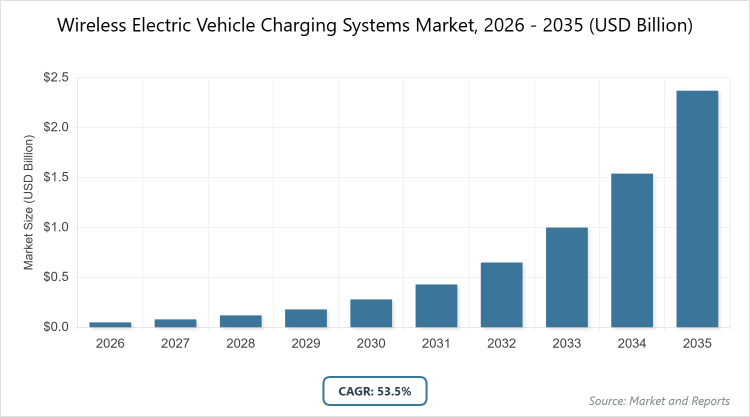
According to MarketnReports, the global Wireless Electric Vehicle Charging Systems market size was estimated at USD 0.05 billion in 2025 and is expected to reach USD 3.38 billion by 2035, growing at a CAGR of 53.5% from 2026 to 2035. Wireless Electric Vehicle Charging Systems Market is driven by the rapid adoption of electric vehicles and advancements in inductive charging technology.
What is Wireless Electric Vehicle Charging Systems? An Industry Overview
Wireless electric vehicle charging systems are innovative technologies that enable the transfer of electrical energy to EVs without physical cables, utilizing electromagnetic fields or resonant inductive coupling to charge batteries through ground-based pads and vehicle-mounted receivers. The market definition includes static, dynamic, and quasi-dynamic systems that support convenient, efficient charging for passenger cars, commercial fleets, and public transport, emphasizing safety, interoperability, and integration with smart grids to reduce range anxiety, enhance user experience, and promote sustainable mobility in urban and highway environments.
What are the Key Insights of Wireless Electric Vehicle Charging Systems Market?
- The global Wireless Electric Vehicle Charging Systems market was valued at USD 0.05 billion in 2025 and is projected to reach USD 3.38 billion by 2035.
- The global Wireless Electric Vehicle Charging Systems market is expected to grow at a CAGR of 53.5% during the forecast period 2026-2035.
- The Wireless Electric Vehicle Charging Systems market is driven by government incentives for EV infrastructure and technological innovations in dynamic charging.
- The inductive charging subsegment dominates the technology segment with a 70% share due to its maturity, efficiency, and widespread adoption in pilot projects.
- The stationary wireless charging subsegment dominates the charging type segment with a 77% share owing to its simplicity and lower cost for home and public stations.
- The passenger cars subsegment dominates the vehicle type segment with a 60% share because of rising consumer EV ownership and convenience focus.
- Asia Pacific dominates the global Wireless Electric Vehicle Charging Systems market with a 40% share attributed to massive EV production and infrastructure investments in China.
What are the Market Dynamics of Wireless Electric Vehicle Charging Systems?
Growth Drivers
The wireless electric vehicle charging systems market is propelled by the global surge in electric vehicle adoption, supported by government subsidies and mandates for zero-emission transport, such as the EU’s Green Deal aiming for millions of charging points by 2030. Advancements in resonant inductive technology improve efficiency to over 90%, reducing charging times and enabling seamless integration with autonomous vehicles, while collaborations between automakers and tech firms accelerate standardization. Increasing urban congestion and the need for convenient charging solutions without plugs drive demand, as dynamic systems embedded in roads promise continuous power for fleets, enhancing range and operational viability.
Restraints
High initial infrastructure costs for installing ground pads and retrofitting vehicles limit widespread deployment, particularly in developing regions where budget constraints prioritize basic EV charging over advanced wireless options. Technical challenges like alignment sensitivity and power loss over air gaps reduce efficiency compared to wired systems, deterring adoption in cold climates or uneven terrains. Regulatory inconsistencies across countries regarding electromagnetic field safety and interoperability standards further slow market progress, as varying certification processes increase compliance burdens for manufacturers.
Opportunities
The expansion of smart cities and 5G networks offers opportunities for dynamic wireless charging in highways and public transit, enabling real-time energy transfer that extends EV range without stops, attracting investments from governments like China’s NEV initiatives. Integration with renewable energy sources, such as solar-powered pads, aligns with sustainability goals, creating niches in off-grid areas. Partnerships with fleet operators for commercial applications, like electric buses, can scale pilots into commercial rollouts, unlocking revenue through subscription-based charging models.
Challenges
Achieving high power transfer rates while maintaining safety from electromagnetic exposure poses engineering challenges, requiring ongoing R&D to minimize health risks and meet international standards. Supply chain dependencies on rare earth materials for coils and semiconductors create vulnerabilities to price fluctuations and geopolitical tensions. Moreover, consumer skepticism regarding reliability and higher upfront vehicle costs compared to traditional EVs hinders mass adoption, necessitating education and incentives to build trust.
Wireless Electric Vehicle Charging Systems Market: Report Scope
| Report Attributes | Report Details |
| Report Name | Wireless Electric Vehicle Charging Systems Market |
| Market Size 2025 | USD 0.05 Billion |
| Market Forecast 2035 | USD 3.38 Billion |
| Growth Rate | CAGR of 53.5% |
| Report Pages | 220 |
| Key Companies Covered |
Witricity, Qualcomm, Electreon Wireless, HEVO Inc., Momentum Dynamics, Plugless Power, and Others |
| Segments Covered | By Technology, By Charging Type, By Vehicle Type, and By Region |
| Regions Covered | North America, Europe, Asia Pacific (APAC), Latin America, and The Middle East and Africa (MEA) |
| Base Year | 2025 |
| Historical Year | 2020 – 2024 |
| Forecast Year | 2026 – 2035 |
| Customization Scope | Avail customized purchase options to meet your exact research needs. |
The Wireless Electric Vehicle Charging Systems market is segmented by technology, charging type, vehicle type, and region.
Based on Technology Segment: The inductive charging segment is the most dominant, holding a 70% market share, as it provides reliable, contactless power transfer with established standards like SAE J2954, driven by its compatibility with existing EV models. This dominance drives market growth by facilitating widespread pilots and commercial deployments. The resonant inductive charging segment is the second most dominant with a 20% share, offering better misalignment tolerance, which propels the market through improved user convenience in parking scenarios.
Based on Charging Type Segment: The stationary wireless charging segment is the most dominant, capturing a 77% share, due to its cost-effectiveness and ease of installation for home and public stations. Its dominance accelerates market growth by addressing immediate consumer needs for convenient overnight charging. The dynamic wireless charging segment ranks second with a 15% share, enabling on-the-move power for highways, driving the market with potential for fleet efficiency.
Based on Vehicle Type Segment: The passenger cars segment is the most dominant, with a 60% share, attributed to rising personal EV ownership and demand for hassle-free charging. This leads market growth by spurring residential and parking infrastructure investments. The commercial vehicles segment is second with a 25% share, where fleets benefit from reduced downtime, propelling growth through logistics applications.
What are the Recent Developments in Wireless Electric Vehicle Charging Systems Market?
- In 2025, Witricity partnered with a major automaker to deploy wireless charging for luxury EVs, achieving 11kW transfer rates in pilot programs.
- Qualcomm expanded its Halo technology with dynamic charging trials on European highways, demonstrating 20kW continuous power.
- Electreon Wireless completed a 1km electrified road project in Israel, enabling buses to charge while driving.
- HEVO Inc. secured funding for urban wireless pads, integrating with smart city grids in the U.S.
- Momentum Dynamics launched high-power systems for heavy trucks, focusing on fleet electrification.
What is the Regional Analysis of Wireless Electric Vehicle Charging Systems Market?
- Asia Pacific to dominate the global market
Asia Pacific holds a 40% share in the Wireless Electric Vehicle Charging Systems market, driven by massive EV incentives and infrastructure rollouts. China dominates, with national programs installing thousands of wireless pads in cities like Shanghai, supported by BYD and SAIC integrations.
Europe maintains a strong position in the Wireless Electric Vehicle Charging Systems market, fueled by green mobility policies. Germany leads, with BMW and Volkswagen piloting dynamic systems on autobahns, aligned with EU carbon targets.
North America exhibits robust growth in the Wireless Electric Vehicle Charging Systems market, propelled by tech innovation. The United States dominates, with Tesla and GM exploring wireless options in California, backed by federal grants.
Latin America is emerging in the Wireless Electric Vehicle Charging Systems market, focusing on urban transport. Brazil leads, adopting systems for electric buses in Sao Paulo, supported by energy reforms.
The Middle East and Africa show potential in the Wireless Electric Vehicle Charging Systems market, emphasizing sustainability. The UAE is a key player, integrating wireless charging in Dubai’s EV taxis, attracting investments.
Who are the Key Market Players and Strategies in Wireless Electric Vehicle Charging Systems?
Witricity focuses on standardization, licensing Halo tech to OEMs for passenger EVs.
Qualcomm emphasizes dynamic systems, partnering for highway pilots in Europe.
Electreon Wireless pursues road-embedded charging, expanding trials in Israel and Sweden.
HEVO Inc. targets urban infrastructure, securing U.S. funding for public pads.
Momentum Dynamics specializes in high-power fleets, collaborating with truck manufacturers.
Plugless Power develops residential solutions, integrating with home energy systems.
What are the Market Trends in Wireless Electric Vehicle Charging Systems?
- Shift toward dynamic charging for highways and fleets.
- Integration with V2G for grid stability.
- Advancements in high-efficiency resonant technologies.
- Focus on interoperability standards like SAE J2954.
- Adoption in public transport for buses and taxis.
- Emphasis on safety from electromagnetic fields.
What are the Market Segments and their Subsegment Covered in the Wireless Electric Vehicle Charging Systems Report?
By Technology
-
- Inductive Charging
- Resonant Inductive Charging
- Capacitive Charging
- Magnetic Resonance Charging
- Laser Charging
- Microwave Charging
- Radio Wave Charging
- Static Wireless Charging
- Dynamic Wireless Charging
- Conductive Charging
- Others
By Charging Type
-
- Stationary Wireless Charging
- Dynamic Wireless Charging
- Quasi-Dynamic Wireless Charging
- Home Charging
- Public Charging
- Commercial Charging
- Fleet Charging
- V2G Charging
- Bidirectional Charging
- Unidirectional Charging
- Others
By Vehicle Type
-
- Passenger Cars
- Commercial Vehicles
- Electric Buses
- Electric Trucks
- Two-Wheelers
- Autonomous Vehicles
- Light Commercial Vehicles
- Heavy Commercial Vehicles
- Plug-in Hybrid Vehicles
- Battery Electric Vehicles
- Others
By Region
-
- North America
- U.S.
- Canada
- Europe
- UK
- Germany
- France
- Rest of Europe
- Asia Pacific
- China
- India
- Japan
- Rest of Asia Pacific
- Latin America
- Brazil
- Mexico
- Rest of Latin America
- Middle East & Africa
- UAE
- South Africa
- Rest of Middle East & Africa
- North America
Chapter 1. Preface
Chapter 2. Executive Summary
Chapter 3. Global Wireless Electric Vehicle Charging Systems Market - Industry Analysis
Chapter 4. Global Wireless Electric Vehicle Charging Systems Market- Competitive Landscape
Chapter 5. Global Wireless Electric Vehicle Charging Systems Market - Technology Analysis
Chapter 6. Global Wireless Electric Vehicle Charging Systems Market - Charging Type Analysis
Chapter 7. Global Wireless Electric Vehicle Charging Systems Market - Vehicle Type Analysis
Chapter 8. Wireless Electric Vehicle Charging Systems Market - Regional Analysis
Chapter 9. Company Profiles
Frequently Asked Questions
Wireless Electric Vehicle Charging Systems are contactless technologies that transfer energy to EVs via electromagnetic fields, enabling convenient charging without plugs.
Key factors include EV adoption, infrastructure investments, and tech advancements in dynamic charging.
The market is projected to grow from USD 0.07 billion in 2026 to USD 3.38 billion by 2035.
The market is expected to grow at a CAGR of 53.5% during 2026-2035.
Asia Pacific will contribute notably, holding a 40% share due to EV production hubs.
Major players include Witricity, Qualcomm, Electreon Wireless, HEVO Inc., Momentum Dynamics, and Plugless Power.
The report provides market size, trends, segmentation, regional insights, key players, and forecasts.
Stages include component manufacturing, system integration, infrastructure deployment, vehicle adaptation, and maintenance services.
Trends favor dynamic and V2G systems, with consumers preferring convenient, cable-free charging.
Emission regulations and green incentives drive adoption, while safety standards for fields influence development.