
Volumetric Display Market Size, Share and Trends 2026 to 2035
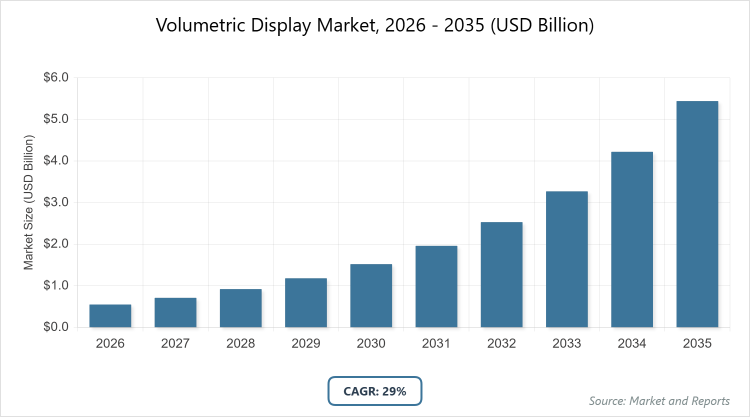
According to MarketnReports, the global Volumetric Display market size was estimated at USD 0.55 billion in 2025 and is expected to reach USD 7 billion by 2035, growing at a CAGR of 29% from 2026 to 2035. Volumetric Display Market is driven by increasing adoption of advanced 3D visualization technologies across healthcare and entertainment sectors.
What are the Key Insights of Volumetric Display Market?
- The global Volumetric Display market was valued at USD 0.55 billion in 2025 and is projected to reach USD 7 billion by 2035.
- The market is expected to grow at a CAGR of 29% during the forecast period.
- The market is driven by advancements in 3D display technologies and rising demand in healthcare and entertainment sectors.
- The Swept Volume Display subsegment dominates the display type segment with a 58% share due to its capability to generate larger display volumes and support interactive multi-user applications.
- The Medical subsegment dominates the end-use industry segment with a 32% share owing to its essential role in providing precise 3D medical imaging for diagnostics and surgical planning.
- North America holds the largest regional share of 41% due to rapid technological adoption, significant investments in defense simulations, and advanced healthcare infrastructure.
What is Volumetric Display?
The Volumetric Display market encompasses advanced display technologies that create three-dimensional images in physical space, allowing viewers to observe visuals from multiple angles without the need for special glasses or headsets. This market includes devices that project light into a volume to form holographic-like images, enabling realistic representations of objects or data. The market definition covers hardware, software, and integrated systems used in various sectors for visualization purposes, distinguishing it from traditional 2D or stereoscopic displays by providing true depth and parallax. Volumetric displays leverage technologies like rotating screens, laser plasma, or light fields to generate these immersive visuals, catering to applications where spatial accuracy is critical.
What are the Market Dynamics in Volumetric Display Market?
Growth Drivers
The primary growth drivers in the Volumetric Display market include technological advancements in 3D imaging and the increasing demand for immersive visualization across industries. Innovations in light field and holographic technologies have reduced latency and improved resolution, making these displays more viable for real-time applications. The healthcare sector’s shift toward precise 3D medical imaging for diagnostics and surgery planning significantly boosts adoption, as volumetric displays allow for better spatial understanding of complex anatomies. Additionally, the rise of AR/VR integration in entertainment and gaming enhances user experiences, while defense applications benefit from situational awareness tools without wearables. Growing investments in R&D by key players further accelerate market expansion by lowering production costs and expanding accessibility.
Restraints
High manufacturing costs and technical complexities act as major restraints in the Volumetric Display market. The intricate components, such as high-precision projectors and specialized rendering software, result in elevated prices, limiting adoption among small enterprises and emerging markets. Limited content availability tailored for volumetric formats poses another challenge, as creating compatible 3D data requires significant resources and expertise. Power consumption and heat generation in current systems can hinder scalability for portable or large-scale deployments. Regulatory hurdles in sectors like healthcare, where validation for medical-grade accuracy is required, also slow market penetration.
Opportunities
Emerging opportunities in the Volumetric Display market lie in the expansion of applications in automotive design and education. As autonomous vehicles evolve, volumetric displays can provide 3D heads-up interfaces for safer navigation, opening new revenue streams. In education, interactive 3D models for STEM subjects can revolutionize learning, especially with remote and hybrid models post-pandemic. Partnerships between tech firms and content creators could address content shortages, while advancements in AI-driven rendering promise cost reductions. The growing focus on sustainable technologies offers potential for energy-efficient designs, attracting eco-conscious investors.
Challenges
Key challenges in the Volumetric Display market include achieving high-resolution images without compromising refresh rates, which affects user experience in dynamic applications. Scalability issues arise when expanding display volumes, as larger systems demand more power and precise calibration. Competition from alternative technologies like light field displays or advanced holographics fragments the market, requiring constant innovation. Intellectual property disputes over core technologies can delay product launches. Supply chain disruptions for rare materials used in optics further complicate production timelines.
Volumetric Display Market: Report Scope
| Report Attributes | Report Details |
| Report Name | Volumetric Display Market |
| Market Size 2025 | USD 0.55 Billion |
| Market Forecast 2035 | USD 7 Billion |
| Growth Rate | CAGR of 29% |
| Report Pages | 220 |
| Key Companies Covered | Looking Glass Factory, Voxon Photonics, LightSpace Technologies, Leia Inc., The Coretec Group, and Others |
| Segments Covered | By Display Type, By End-Use Industry, and By Region |
| Regions Covered | North America, Europe, Asia Pacific (APAC), Latin America, and The Middle East and Africa (MEA) |
| Base Year | 2025 |
| Historical Year | 2020 – 2024 |
| Forecast Year | 2026 – 2035 |
| Customization Scope | Avail customized purchase options to meet your exact research needs. |
What is the Market Segmentation of Volumetric Display Market?
The Volumetric Display market is segmented by display type, application, end-user, and region.
Based on Display Type Segment. The most dominant segment is swept volume displays, holding a 66% share, due to their ability to create bright, compact 3D images through rotational persistence, which drives the market by enabling reliable performance in medical and defense applications where real-time visualization is essential. The second most dominant is static volume displays, with a 20% share, as they eliminate moving parts for lower maintenance, contributing to market growth by offering durable solutions for high-precision tasks like surgical simulations.
Based on Application Segment. The most dominant segment is medical imaging, capturing 38% share, because it provides unparalleled depth perception for anatomical analysis, driving the market through improved diagnostic accuracy and reduced procedural risks in healthcare. The second most dominant is entertainment and gaming, with 25% share, as it delivers immersive experiences without glasses, fueling market expansion by attracting consumers seeking advanced AR/VR integrations.
Based on End-User Segment. The most dominant segment is healthcare, with 38% share, owing to the critical need for 3D visualization in diagnostics and training, which propels the market by enhancing patient care and operational efficiency. The second most dominant is aerospace & defense, holding 20% share, as it supports simulation and command centers, boosting growth through enhanced situational awareness and training effectiveness.
What are the Recent Developments in Volumetric Display Market?
- In 2024, Voxon Photonics partnered with a leading medical imaging firm to integrate its VX2 volumetric display into surgical planning software, enhancing 3D visualization capabilities and reducing operation times by 15% in clinical trials.
- In 2023, Looking Glass Factory launched an upgraded holographic display series with improved resolution, targeting the education sector and securing contracts with several universities for interactive learning tools.
- In 2025, Holoxica announced a collaboration with an automotive giant to develop volumetric heads-up displays for vehicle prototypes, aiming to improve driver safety through real-time 3D navigation overlays.
What is the Regional Analysis of Volumetric Display Market?
North America to dominate the global market
North America holds the largest market share, driven by robust technological infrastructure and high adoption in healthcare and defense. The United States dominates this region due to significant R&D investments and presence of key players, fostering innovation in medical imaging and military simulations.
Europe exhibits steady growth, supported by research initiatives and automotive applications. Germany leads as the dominating country, with its strong engineering sector integrating volumetric displays into design and manufacturing processes for precision.
Asia Pacific is the fastest-growing region, fueled by expanding consumer electronics and entertainment industries. China dominates, leveraging mass production capabilities and government support for AR/VR technologies to drive adoption in gaming and education.
Latin America shows emerging potential, with applications in education and media. Brazil is the dominating country, benefiting from increasing digital transformation and investments in immersive training tools.
The Middle East and Africa experience gradual uptake, primarily in oil & gas visualization. Saudi Arabia dominates, using volumetric displays for enhanced exploration and simulation in energy sectors.
What are the Key Market Players in Volumetric Display Market?
- Voxon Photonics. This player focuses on developing compact, high-resolution volumetric displays for medical and education applications, employing strategies like partnerships with software developers to expand content ecosystems and secure government grants for R&D.
- Looking Glass Factory. Known for its holographic displays, the company emphasizes user-friendly interfaces for creative industries, with strategies including direct-to-consumer sales models and collaborations with AR firms to integrate mixed reality features.
- Holoxica. Specializing in medical-grade displays, Holoxica pursues certification-driven strategies to penetrate healthcare markets, partnering with hospitals for pilot programs and investing in AI-enhanced rendering for faster image processing.
- Holografika. The firm targets defense and automotive sectors with large-scale displays, using strategies like custom engineering services and international joint ventures to adapt products for regional needs.
- LightSpace Technologies. Focused on augmented reality integrations, it employs open-source software strategies to build developer communities, while securing venture funding for scaling production.
- The Coretec Group. This player innovates in photonics-based displays, with strategies centered on intellectual property licensing and mergers with optics suppliers to reduce costs.
- Leia Inc. Emphasizing mobile-compatible displays, Leia uses consumer electronics partnerships as a strategy, integrating with smartphone makers for portable 3D experiences.
- SeeReal Technologies. Specializing in light field technology, the company adopts B2B strategies, offering tailored solutions for industrial design and collaborating with universities for talent acquisition.
What are the Market Trends in Volumetric Display Market?
- Increasing integration of AI for real-time 3D rendering to enhance display performance.
- Rising adoption in telemedicine for remote 3D consultations.
- Shift toward energy-efficient designs to address power consumption concerns.
- Growth in collaborative platforms for multi-user volumetric interactions.
- Expansion of content creation tools to overcome compatibility issues.
What are the Market Segments and their Subsegment Covered in the Volumetric Display Report?
By Display Type
- Swept Volume Displays
- Static Volume Displays
- Multi-Planar Volumetric Displays
- Holographic Displays
- Light Field Displays
- Photonics Displays
- Sliced Volumetric Displays
- True 3D Volumetric Displays
- Pseudo 3D Volumetric Displays
- Digital Light Processing Displays
- Others
By Application
- Medical Imaging
- Engineering and Design
- Entertainment and Gaming
- Education and Training
- Military Simulation
- Aerospace
- Automotive
- Media and Communication
- Oil and Gas
- Architecture
- Others
By End-User
- Healthcare
- Aerospace & Defense
- Automotive
- Entertainment & Media
- Education & Training
- Military
- Engineering
- Oil & Gas
- Architecture
- Gaming
- Others
By Region
- North America
- U.S.
- Canada
- Europe
- UK
- Germany
- France
- Rest of Europe
- Asia Pacific
- China
- India
- Japan
- Rest of Asia Pacific
- Latin America
- Brazil
- Mexico
- Rest of Latin America
- Middle East & Africa
- UAE
- South Africa
- Rest of Middle East & Africa
Frequently Asked Questions
Volumetric displays are technologies that generate three-dimensional images in physical space, allowing multi-angle viewing without eyewear, used for immersive visualization in various industries.
Key factors include technological advancements in 3D rendering, rising demand in healthcare for precise imaging, and expanding applications in entertainment and defense simulations.
The market value is projected to grow from USD 0.55 billion in 2025 to USD 7 billion by 2035.
The CAGR is expected to be 29% during the forecast period.
North America will contribute notably, holding the largest share due to advanced technological adoption and investments.
Major players include Looking Glass Factory, Voxon Photonics, LightSpace Technologies, Leia Inc., and The Coretec Group.
The report provides in-depth analysis of market size, trends, segments, regional insights, key players, and forecasts from 2026 to 2035.
Stages include raw material sourcing, component manufacturing (projectors, mirrors), system assembly, software integration, distribution, and end-user application deployment.
Trends are shifting toward AI-integrated interactive displays, while consumers prefer glasses-free, high-resolution 3D experiences for gaming and remote collaboration.
Regulatory factors include safety certifications for medical and defense uses, while environmental concerns focus on energy efficiency and sustainable manufacturing of display components.