
Vanilla Market Size, Share and Trends 2026 to 2035
According to MarketnReports, the global Vanilla market size was estimated at USD 3.83 billion in 2025 and is expected to reach USD 7.0 billion by 2035, growing at a CAGR of 6.2% from 2026 to 2035. Vanilla Market is driven by rising consumer preference for natural and organic ingredients across food, beverage, and personal care sectors.
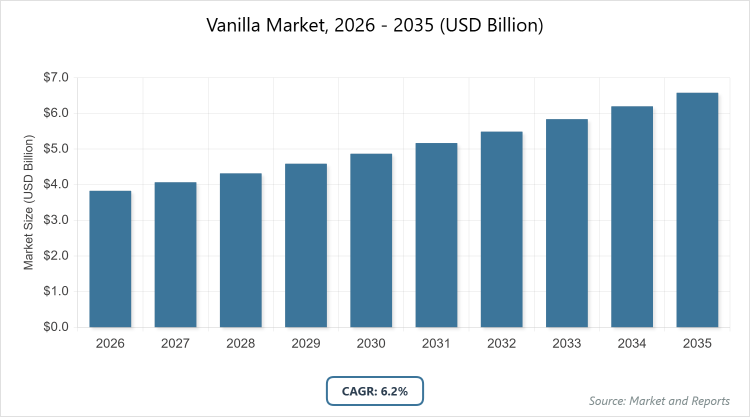
What are the key insights from the Vanilla market analysis?
- The global Vanilla market was valued at USD 3.83 billion in 2025 and is projected to reach USD 7.0 billion by 2035.
- The market is anticipated to grow at a CAGR of 6.2% during the forecast period from 2026 to 2035.
- The Vanilla market is driven by increasing demand for natural flavoring agents in food and beverages, coupled with expanding applications in personal care and pharmaceuticals.
- In the origin segment, Madagascar Vanilla dominated with a 80% share due to its superior quality, rich aroma, and status as the world’s largest producer, ensuring consistent supply and preferred use in premium products.
- In the form segment, Liquid dominated with a 75.9% share owing to its versatility in blending, ease of incorporation into recipes, and widespread use in dairy, baking, and beverages for enhanced flavor delivery.
- In the application segment, Food & Beverages dominated with a 45.3% share because of its essential role in enhancing taste in bakery items, desserts, and drinks, aligning with consumer shifts toward natural ingredients.
- In the end-user segment, Food & Beverage Manufacturers dominated with a 50% share as they heavily rely on vanilla for product innovation in mass-produced goods, driving volume demand through large-scale processing.
- Europe held the largest regional share of 33.6%, attributed to strong demand for premium natural ingredients in confectionery, dairy, and cosmetics industries, supported by clean-label trends and established supply chains.
What is the industry overview of the Vanilla market?
The Vanilla market encompasses the production, distribution, and consumption of vanilla-derived products, which are prized for their unique flavor and aroma extracted from orchids of the Vanilla genus. This market serves as a critical component in various industries, providing natural flavoring solutions that enhance sensory experiences in food items, personal care formulations, and medicinal applications. Market definition refers to vanilla as a natural ingredient sourced primarily from vanilla beans, including extracts, powders, and other forms, distinguished from synthetic alternatives like vanillin, with a focus on organic and ethically sourced varieties that cater to health-conscious and premium product demands.
What are the market dynamics in the Vanilla industry?
Growth Drivers
The growth drivers in the Vanilla market are multifaceted, primarily fueled by a global shift toward natural and organic ingredients as consumers increasingly avoid synthetic additives in favor of healthier options. This trend is amplified by rising disposable incomes in emerging economies, enabling greater expenditure on premium food and beverage products where vanilla plays a pivotal role in flavor enhancement. Additionally, the expansion of the food and beverage sector, particularly in bakery and dairy applications, drives demand due to vanilla’s ability to impart authentic taste profiles that resonate with gourmet and artisanal trends. Innovations in personal care and pharmaceuticals further propel growth, leveraging vanilla’s antioxidant and antimicrobial properties for natural formulations. Sustainable farming advancements also contribute by improving yield reliability and appealing to environmentally aware buyers, creating a robust ecosystem for market expansion.
Restraints
Restraints in the Vanilla market stem largely from supply chain vulnerabilities, including climate-dependent cultivation limited to tropical regions, which exposes production to natural disasters like cyclones and droughts, leading to yield fluctuations and price volatility. The labor-intensive nature of vanilla farming, requiring manual pollination and extended maturation periods, increases costs and limits scalability, making it challenging to meet surging demand. Competition from cheaper synthetic vanillin alternatives poses a significant barrier, as manufacturers in cost-sensitive industries opt for these substitutes to maintain profit margins. Geopolitical issues in key producing countries, such as Madagascar, add to instability, while stringent quality standards and certification requirements for organic vanilla further complicate market entry and expansion for smaller players.
Opportunities
Opportunities in the Vanilla market arise from technological advancements in cultivation, such as controlled-environment agriculture and improved pollination techniques, which can enhance yield consistency and reduce dependency on traditional growing regions. The burgeoning demand for clean-label and plant-based products opens avenues for vanilla in innovative applications like dairy alternatives and functional foods, where its natural appeal aligns with health trends. Expansion into emerging markets in Asia Pacific presents growth potential through rising urbanization and westernized diets increasing consumption of flavored beverages and desserts. Partnerships focused on sustainable and ethical sourcing can differentiate brands, attracting premium pricing, while exploration of vanilla derivatives in pharmaceuticals for wellness products offers untapped revenue streams amid growing interest in natural remedies.
Challenges
Challenges in the Vanilla market include unpredictable price swings driven by supply-demand imbalances, which disrupt planning for manufacturers and lead to inconsistent product availability. Limited geographic suitability for cultivation restricts diversification, heightening risks from regional disruptions and over-reliance on a few producing nations. Meeting the escalating demand for organic and certified vanilla strains resources, as transitioning farms to sustainable practices requires significant investment and time. Counterfeiting and adulteration issues erode consumer trust, necessitating robust traceability systems that add operational complexity. Environmental factors, such as climate change impacting bean quality, combined with labor shortages in rural areas, pose ongoing hurdles to maintaining high standards and scaling production effectively.
Vanilla Market: Report Scope
| Report Attributes | Report Details |
| Report Name | Vanilla Market |
| Market Size 2025 | USD 3.83 Billion |
| Market Forecast 2035 | USD 7.0 Billion |
| Growth Rate | CAGR of 6.2% |
| Report Pages | 230 |
| Key Companies Covered | Nielsen-Massey Vanillas, Inc., McCormick & Company, Inc., Symrise AG, Givaudan SA, Sensient Technologies Corporation, Firmenich SA, Synthite Industries Ltd., Prova SAS, Lafaza Foods, Ever Organic, and Others |
| Segments Covered | By Origin, By Form, By Application, By End-User, and By Region |
| Regions Covered | North America, Europe, Asia Pacific (APAC), Latin America, and The Middle East and Africa (MEA) |
| Base Year | 2025 |
| Historical Year | 2020 – 2024 |
| Forecast Year | 2026 – 2035 |
| Customization Scope | Avail customized purchase options to meet your exact research needs. |
How is the Vanilla market segmented?
The Vanilla market is segmented by origin, form, application, end-user, and region.
Based on Origin Segment, Madagascar Vanilla emerged as the most dominant subsegment, holding approximately 80% market share, primarily because it offers a deep, rich flavor profile preferred in high-end food and beverage applications, supported by Madagascar’s position as the global leader in vanilla production with optimal climatic conditions and established farming expertise that ensure superior quality and volume supply, driving overall market growth through reliable sourcing for international brands; the second most dominant, Mexican Vanilla, accounts for about 10% share, valued for its bold, spicy notes that complement chocolate and dessert recipes, contributing to market expansion by catering to niche gourmet demands and fostering innovation in regional cuisines.
Based on Form Segment, Liquid dominated with a 75.9% share, owing to its high versatility in mixing with liquids for seamless integration into beverages, dairy products, and sauces, which accelerates market growth by enabling efficient flavor distribution in large-scale manufacturing processes and appealing to convenience-oriented consumers; Powder, the second dominant at around 24%, excels in dry applications like baking mixes and protein supplements due to its long shelf life and ease of storage, propelling the market forward through its role in health-focused and clean-label products that attract a growing demographic of wellness enthusiasts.
Based on Application Segment, Food & Beverages led with 45.3% share, driven by its indispensable use in enhancing taste in bakery, desserts, and drinks amid rising preferences for natural flavors, which boosts market dynamics by stimulating demand in fast-growing food industries and encouraging product diversification; Personal Care & Cosmetics, the second dominant at approximately 30%, benefits from vanilla’s soothing scent and properties in lotions and perfumes, advancing the market through alignment with natural beauty trends that promote sustainable and multifunctional formulations.
Based on End-User Segment, Food & Beverage Manufacturers dominated with over 50% share, as they utilize vanilla extensively for mass production of flavored goods, fueling market growth by leveraging economies of scale and innovating with natural ingredients to meet consumer health demands; Cosmetics Companies, second at about 20%, incorporate vanilla for its aromatic and skin-benefiting attributes, driving the market by capitalizing on the clean beauty movement and expanding into premium, eco-friendly product lines.
What are the recent developments in the Vanilla market?
- In December 2024, Nykaa introduced the Swiss Vanilla Collection, featuring hair & body mist, eau de parfum, and body lotion, emphasizing natural vanilla scents to tap into the growing demand for premium personal care items with comforting, sustainable fragrances.
- In July 2024, Sun-Maid Growers unveiled Vanilla and Blueberry Yogurt Covered Raisins, developed with input from children, highlighting vanilla’s role in innovative snack products that blend health benefits with appealing flavors for family-oriented markets.
- In January 2024, Givaudan launched Scentaurus Vanilla, a non-coloring fragrance precursor that delivers long-lasting vanilla notes activated by oxygen, revolutionizing perfumery by offering cleaner, more sustainable options for cosmetic and personal care formulations.
- In April 2025, Laird Superfood released Vanilla Instant Latte using real vanilla bean powder in a vegan format, targeting the functional beverage sector with natural, plant-based alternatives that support wellness trends and convenient consumption.
What is the regional analysis of the Vanilla market?
- Europe to dominate the global market
Europe leads the Vanilla market with a 33.6% share, driven by robust demand in countries like Germany, which dominates regionally due to its established confectionery and dairy industries favoring natural flavors in processed foods and premium baked goods; the region’s emphasis on clean-label products, sustainable sourcing, and strong fragrance sector further solidifies its position, with France and the UK contributing through high consumption in artisanal chocolates and cosmetics, fostering innovation and ethical trade practices that enhance overall market stability.
North America represents a lucrative market, with the U.S. as the dominating country owing to health-conscious consumers prioritizing natural and organic vanilla in dairy, bakery, and plant-based alternatives; the region’s specialty coffee culture and clean-label trends drive growth, supported by stable supply chains and increasing awareness of vanilla’s antioxidant benefits, enabling expansion in functional foods and personal care products amid rising disposable incomes.
Asia Pacific is the fastest-growing region at a CAGR of 6.8%, led by China as the dominating country with strong demand in bakery, confectionery, and dairy sectors fueled by urbanization and westernized diets; emerging economies like India and Japan contribute through plant-based product adoption and sustainable farming advancements, creating opportunities for natural flavor integration in beverages and cosmetics, thus accelerating market penetration and innovation.
Latin America shows steady potential, with Brazil dominating due to its growing food industry incorporating vanilla in tropical beverages and desserts; the region’s proximity to alternative cultivation areas supports supply diversification, while increasing exports and consumer preferences for natural ingredients in personal care drive moderate growth, though challenged by economic fluctuations.
Middle East & Africa experiences emerging demand, with South Africa as a key player leveraging vanilla in fragrances and food applications amid tourism-driven hospitality sectors; the region’s focus on ethical sourcing from African producers like Madagascar enhances sustainability efforts, promoting market growth through partnerships and rising awareness of natural products in urban centers.
Who are the key market players in the Vanilla industry?
Nielsen-Massey Vanillas, Inc. specializes in high-quality vanilla extracts, pastes, powders, and beans, employing sustainable sourcing and cold extraction methods to preserve flavor compounds, while partnering with farmers for ethical practices that strengthen supply chains and appeal to premium markets.
McCormick & Company, Inc. leads as a global spice and flavor provider, supporting over 16,000 farmers in Madagascar and Indonesia through sustainable farming initiatives to boost yields and livelihoods, enabling consistent quality and innovation in food and beverage applications.
Symrise AG focuses on flavors and fragrances, investing in research for natural vanilla solutions that align with clean-label demands, enhancing product portfolios through acquisitions and sustainability commitments.
Givaudan SA innovates in scent technologies, such as the Scentaurus Vanilla launch, emphasizing oxygen-activated, non-coloring formulations for long-lasting effects in cosmetics and personal care, backed by global R&D networks.
Sensient Technologies Corporation delivers flavor solutions with a emphasis on natural ingredients, utilizing advanced extraction techniques to meet regulatory standards and consumer preferences for organic vanilla in diverse applications.
Firmenich SA prioritizes sustainable ingredients, collaborating on ethical sourcing projects to ensure traceability and quality, driving growth in fragrances and food sectors through innovation.
Synthite Industries Ltd. produces spices and flavors, expanding vanilla offerings via integrated farming and processing, targeting export markets with cost-effective, high-purity products.
Prova SAS supplies premium vanilla, focusing on origin-specific varieties and custom blends for food manufacturers, supported by expertise in extraction and quality control.
Lafaza Foods offers organic vanilla, emphasizing fair trade and regenerative agriculture to build resilient supply chains, catering to health-focused consumers in North America and Europe.
Ever Organic concentrates on certified organic vanilla, implementing eco-friendly practices and direct farmer partnerships to deliver pure products for clean-label brands.
What are the market trends in the Vanilla sector?
- Increasing preference for organic and clean-label vanilla products over synthetic alternatives, driven by health awareness and natural associations.
- Rising incorporation of vanilla in plant-based and dairy-free alternatives, aligning with vegan and wellness trends.
- Growth in multifunctional personal care items using vanilla for its soothing, antioxidant, and aromatic properties.
- Advancements in sustainable cultivation techniques to mitigate supply risks and appeal to environmentally conscious consumers.
- Expansion of vanilla applications in functional foods and nutraceuticals for their antimicrobial and health-boosting benefits.
- Innovation in fragrance precursors and long-lasting scents for cosmetics and perfumery sectors.
- Shift toward ethical sourcing and fair trade certifications to enhance brand reputation and consumer trust.
- Increasing demand in emerging markets for premium flavored beverages and desserts amid urbanization.
- Exploration of vanilla derivatives in pharmaceuticals for natural flavoring and therapeutic uses.
- Adoption of traceability technologies to combat adulteration and ensure product authenticity.
What market segments and their subsegments are covered in the Vanilla report?
By Origin
- Madagascar Vanilla
- Mexican Vanilla
- Tahitian Vanilla
- Indonesian Vanilla
- Indian Vanilla
- Papua New Guinea Vanilla
- Ugandan Vanilla
- Tongan Vanilla
- Comorian Vanilla
- Reunion Vanilla
- Others
By Form
- Liquid
- Powder
- Beans
- Paste
- Extract
- Sugar
- Salt
- Oil
- Seeds
- Oleoresin
- Others
By Application
- Bakery & Confectionery
- Dairy & Frozen Desserts
- Beverages
- Fragrances
- Personal Care Products
- Pharmaceuticals
- Nutraceuticals
- Cosmetics
- Food Flavoring
- Gourmet Foods
- Others
By End-User
- Food & Beverage Manufacturers
- Cosmetics Companies
- Pharmaceutical Companies
- Retail Consumers
- Hotels & Restaurants
- Bakeries
- Ice Cream Producers
- Perfume Manufacturers
- Nutraceutical Companies
- Confectionery Producers
- Others
By Region
- North America
- U.S.
- Canada
- Europe
- UK
- Germany
- France
- Rest of Europe
- Asia Pacific
- China
- India
- Japan
- Rest of Asia Pacific
- Latin America
- Brazil
- Mexico
- Rest of Latin America
- Middle East & Africa
- UAE
- South Africa
- Rest of Middle East & Africa
Chapter 1. Preface
1.1 Report Description and Scope1.2 Research Scope1.3 Research Methodology1.3.1 Market Research Type1.3.2 Market Research MethodologyChapter 2. Executive Summary
2.1 Global Vanilla Market, (2026 - 2035) (USD Billion)2.2 Global Vanilla Market: SnapshotChapter 3. Global Vanilla Market - Industry Analysis
3.1 Vanilla Market: Market Dynamics3.2 Market Drivers3.2.1 The vanilla market is driven by rising consumer preference for natural and organic ingredients, growing disposable incomes in emerging economies, expanding food and beverage applications in bakery and dairy, increasing use in personal care and pharmaceuticals, and advancements in sustainable vanilla farming practices.3.3 Market Restraints3.3.1 The vanilla market is restrained by climate-sensitive and geographically concentrated production, labor-intensive cultivation leading to high costs and price volatility, strong competition from synthetic vanillin substitutes, geopolitical instability in key producing regions, and stringent quality and certification requirements.3.4 Market Opportunities3.4.1 The vanilla market presents strong opportunities through advanced cultivation technologies for yield stability, rising demand for clean-label and plant-based foods, expanding consumption in Asia-Pacific, premium differentiation via sustainable and ethical sourcing, and growing use of vanilla derivatives in pharmaceuticals and wellness products.3.5 Market Challenges3.5.1 The vanilla market faces challenges from volatile pricing and supply-demand imbalances, geographic concentration of production, resource-intensive transition to organic certification, counterfeiting and traceability concerns, climate change impacts on quality, and persistent labor shortages in cultivation regions.3.6 Porter’s Five Forces Analysis3.7 Market Attractiveness Analysis3.7.1 Market Attractiveness Analysis By Origin3.7.2 Market Attractiveness Analysis By Form3.7.3 Market Attractiveness Analysis By Application3.7.4 Market Attractiveness Analysis By End-UserChapter 4. Global Vanilla Market- Competitive Landscape
4.1 Company Market Share Analysis4.1.1 Global Vanilla Market: Company Market Share, 20254.2 Strategic Development4.2.1 Acquisitions & mergers4.2.2 New Product launches4.2.3 Agreements, partnerships, collaborations, and joint ventures4.2.4 Research and development and regional expansion4.3 Price Trend AnalysisChapter 5. Global Vanilla Market - Origin Analysis
5.1 Global Vanilla Market Overview: Origin5.1.1 Global Vanilla Market share, By Origin, 2025 and 20355.2 Madagascar Vanilla5.2.1 Global Vanilla Market by Madagascar Vanilla, 2026 - 2035 (USD Billion)5.3 Mexican Vanilla5.3.1 Global Vanilla Market by Mexican Vanilla, 2026 - 2035 (USD Billion)5.4 Tahitian Vanilla5.4.1 Global Vanilla Market by Tahitian Vanilla, 2026 - 2035 (USD Billion)5.5 Indonesian Vanilla5.5.1 Global Vanilla Market by Indonesian Vanilla, 2026 - 2035 (USD Billion)5.6 Indian Vanilla5.6.1 Global Vanilla Market by Indian Vanilla, 2026 - 2035 (USD Billion)5.7 Papua New Guinea Vanilla5.7.1 Global Vanilla Market by Papua New Guinea Vanilla, 2026 - 2035 (USD Billion)5.8 Ugandan Vanilla5.8.1 Global Vanilla Market by Ugandan Vanilla, 2026 - 2035 (USD Billion)5.9 Tongan Vanilla5.9.1 Global Vanilla Market by Tongan Vanilla, 2026 - 2035 (USD Billion)5.10 Comorian Vanilla5.10.1 Global Vanilla Market by Comorian Vanilla, 2026 - 2035 (USD Billion)5.11 Reunion Vanilla5.11.1 Global Vanilla Market by Reunion Vanilla, 2026 - 2035 (USD Billion)Chapter 6. Global Vanilla Market - Form Analysis
6.1 Global Vanilla Market Overview: Form6.1.1 Global Vanilla Market Share, By Form, 2025 and 20356.2 Liquid6.2.1 Global Vanilla Market by Liquid, 2026 - 2035 (USD Billion)6.3 Powder6.3.1 Global Vanilla Market by Powder, 2026 - 2035 (USD Billion)6.4 Beans6.4.1 Global Vanilla Market by Beans, 2026 - 2035 (USD Billion)6.5 Paste6.5.1 Global Vanilla Market by Paste, 2026 - 2035 (USD Billion)6.6 Extract6.6.1 Global Vanilla Market by Extract, 2026 - 2035 (USD Billion)6.7 Sugar6.7.1 Global Vanilla Market by Sugar, 2026 - 2035 (USD Billion)6.8 Salt6.8.1 Global Vanilla Market by Salt, 2026 - 2035 (USD Billion)6.9 Oil6.9.1 Global Vanilla Market by Oil, 2026 - 2035 (USD Billion)6.10 Seeds6.10.1 Global Vanilla Market by Seeds, 2026 - 2035 (USD Billion)6.11 Oleoresin6.11.1 Global Vanilla Market by Oleoresin, 2026 - 2035 (USD Billion)Chapter 7. Global Vanilla Market - Application Analysis
7.1 Global Vanilla Market Overview: Application7.1.1 Global Vanilla Market Share, By Application, 2025 and 20357.2 Bakery & Confectionery7.2.1 Global Vanilla Market by Bakery & Confectionery, 2026 - 2035 (USD Billion)7.3 Dairy & Frozen Desserts7.3.1 Global Vanilla Market by Dairy & Frozen Desserts, 2026 - 2035 (USD Billion)7.4 Beverages7.4.1 Global Vanilla Market by Beverages, 2026 - 2035 (USD Billion)7.5 Fragrances7.5.1 Global Vanilla Market by Fragrances, 2026 - 2035 (USD Billion)7.6 Personal Care Products7.6.1 Global Vanilla Market by Personal Care Products, 2026 - 2035 (USD Billion)7.7 Pharmaceuticals7.7.1 Global Vanilla Market by Pharmaceuticals, 2026 - 2035 (USD Billion)7.8 Nutraceuticals7.8.1 Global Vanilla Market by Nutraceuticals, 2026 - 2035 (USD Billion)7.9 Cosmetics7.9.1 Global Vanilla Market by Cosmetics, 2026 - 2035 (USD Billion)7.10 Food Flavoring7.10.1 Global Vanilla Market by Food Flavoring, 2026 - 2035 (USD Billion)7.11 Gourmet Foods7.11.1 Global Vanilla Market by Gourmet Foods, 2026 - 2035 (USD Billion)Chapter 8. Global Vanilla Market - End-User Analysis
8.1 Global Vanilla Market Overview: End-User8.1.1 Global Vanilla Market Share, By End-User, 2025 and 20358.2 Food & Beverage Manufacturers8.2.1 Global Vanilla Market by Food & Beverage Manufacturers, 2026 - 2035 (USD Billion)8.3 Cosmetics Companies8.3.1 Global Vanilla Market by Cosmetics Companies, 2026 - 2035 (USD Billion)8.4 Pharmaceutical Companies8.4.1 Global Vanilla Market by Pharmaceutical Companies, 2026 - 2035 (USD Billion)8.5 Retail Consumers8.5.1 Global Vanilla Market by Retail Consumers, 2026 - 2035 (USD Billion)8.6 Hotels & Restaurants8.6.1 Global Vanilla Market by Hotels & Restaurants, 2026 - 2035 (USD Billion)8.7 Bakeries8.7.1 Global Vanilla Market by Bakeries, 2026 - 2035 (USD Billion)8.8 Ice Cream Producers8.8.1 Global Vanilla Market by Ice Cream Producers, 2026 - 2035 (USD Billion)8.9 Perfume Manufacturers8.9.1 Global Vanilla Market by Perfume Manufacturers, 2026 - 2035 (USD Billion)8.10 Nutraceutical Companies8.10.1 Global Vanilla Market by Nutraceutical Companies, 2026 - 2035 (USD Billion)8.11 Confectionery Producers8.11.1 Global Vanilla Market by Confectionery Producers, 2026 - 2035 (USD Billion)Chapter 9. Vanilla Market - Regional Analysis
9.1 Global Vanilla Market Regional Overview9.2 Global Vanilla Market Share, by Region, 2025 & 2035 (USD Billion)9.3 North America9.3.1 North America Vanilla Market, 2026 - 2035 (USD Billion)9.3.1.1 North America Vanilla Market, by Country, 2026 - 2035 (USD Billion)9.3.2 North America Vanilla Market, by Origin, 2026 - 20359.3.2.1 North America Vanilla Market, by Origin, 2026 - 2035 (USD Billion)9.3.3 North America Vanilla Market, by Form, 2026 - 20359.3.3.1 North America Vanilla Market, by Form, 2026 - 2035 (USD Billion)9.3.4 North America Vanilla Market, by Application, 2026 - 20359.3.4.1 North America Vanilla Market, by Application, 2026 - 2035 (USD Billion)9.3.5 North America Vanilla Market, by End-User, 2026 - 20359.3.5.1 North America Vanilla Market, by End-User, 2026 - 2035 (USD Billion)9.4 Europe9.4.1 Europe Vanilla Market, 2026 - 2035 (USD Billion)9.4.1.1 Europe Vanilla Market, by Country, 2026 - 2035 (USD Billion)9.4.2 Europe Vanilla Market, by Origin, 2026 - 20359.4.2.1 Europe Vanilla Market, by Origin, 2026 - 2035 (USD Billion)9.4.3 Europe Vanilla Market, by Form, 2026 - 20359.4.3.1 Europe Vanilla Market, by Form, 2026 - 2035 (USD Billion)9.4.4 Europe Vanilla Market, by Application, 2026 - 20359.4.4.1 Europe Vanilla Market, by Application, 2026 - 2035 (USD Billion)9.4.5 Europe Vanilla Market, by End-User, 2026 - 20359.4.5.1 Europe Vanilla Market, by End-User, 2026 - 2035 (USD Billion)9.5 Asia Pacific9.5.1 Asia Pacific Vanilla Market, 2026 - 2035 (USD Billion)9.5.1.1 Asia Pacific Vanilla Market, by Country, 2026 - 2035 (USD Billion)9.5.2 Asia Pacific Vanilla Market, by Origin, 2026 - 20359.5.2.1 Asia Pacific Vanilla Market, by Origin, 2026 - 2035 (USD Billion)9.5.3 Asia Pacific Vanilla Market, by Form, 2026 - 20359.5.3.1 Asia Pacific Vanilla Market, by Form, 2026 - 2035 (USD Billion)9.5.4 Asia Pacific Vanilla Market, by Application, 2026 - 20359.5.4.1 Asia Pacific Vanilla Market, by Application, 2026 - 2035 (USD Billion)9.5.5 Asia Pacific Vanilla Market, by End-User, 2026 - 20359.5.5.1 Asia Pacific Vanilla Market, by End-User, 2026 - 2035 (USD Billion)9.6 Latin America9.6.1 Latin America Vanilla Market, 2026 - 2035 (USD Billion)9.6.1.1 Latin America Vanilla Market, by Country, 2026 - 2035 (USD Billion)9.6.2 Latin America Vanilla Market, by Origin, 2026 - 20359.6.2.1 Latin America Vanilla Market, by Origin, 2026 - 2035 (USD Billion)9.6.3 Latin America Vanilla Market, by Form, 2026 - 20359.6.3.1 Latin America Vanilla Market, by Form, 2026 - 2035 (USD Billion)9.6.4 Latin America Vanilla Market, by Application, 2026 - 20359.6.4.1 Latin America Vanilla Market, by Application, 2026 - 2035 (USD Billion)9.6.5 Latin America Vanilla Market, by End-User, 2026 - 20359.6.5.1 Latin America Vanilla Market, by End-User, 2026 - 2035 (USD Billion)9.7 The Middle-East and Africa9.7.1 The Middle-East and Africa Vanilla Market, 2026 - 2035 (USD Billion)9.7.1.1 The Middle-East and Africa Vanilla Market, by Country, 2026 - 2035 (USD Billion)9.7.2 The Middle-East and Africa Vanilla Market, by Origin, 2026 - 20359.7.2.1 The Middle-East and Africa Vanilla Market, by Origin, 2026 - 2035 (USD Billion)9.7.3 The Middle-East and Africa Vanilla Market, by Form, 2026 - 20359.7.3.1 The Middle-East and Africa Vanilla Market, by Form, 2026 - 2035 (USD Billion)9.7.4 The Middle-East and Africa Vanilla Market, by Application, 2026 - 20359.7.4.1 The Middle-East and Africa Vanilla Market, by Application, 2026 - 2035 (USD Billion)9.7.5 The Middle-East and Africa Vanilla Market, by End-User, 2026 - 20359.7.5.1 The Middle-East and Africa Vanilla Market, by End-User, 2026 - 2035 (USD Billion)Chapter 10. Company Profiles
10.1 Nielsen-Massey Vanillas Inc.10.1.1 Overview10.1.2 Financials10.1.3 Product Portfolio10.1.4 Business Strategy10.1.5 Recent Developments10.2 McCormick & Company Inc.10.2.1 Overview10.2.2 Financials10.2.3 Product Portfolio10.2.4 Business Strategy10.2.5 Recent Developments10.3 Symrise AG10.3.1 Overview10.3.2 Financials10.3.3 Product Portfolio10.3.4 Business Strategy10.3.5 Recent Developments10.4 Givaudan SA10.4.1 Overview10.4.2 Financials10.4.3 Product Portfolio10.4.4 Business Strategy10.4.5 Recent Developments10.5 Sensient Technologies Corporation10.5.1 Overview10.5.2 Financials10.5.3 Product Portfolio10.5.4 Business Strategy10.5.5 Recent Developments10.6 Firmenich SA10.6.1 Overview10.6.2 Financials10.6.3 Product Portfolio10.6.4 Business Strategy10.6.5 Recent Developments10.7 Synthite Industries Ltd.10.7.1 Overview10.7.2 Financials10.7.3 Product Portfolio10.7.4 Business Strategy10.7.5 Recent Developments10.8 Prova SAS10.8.1 Overview10.8.2 Financials10.8.3 Product Portfolio10.8.4 Business Strategy10.8.5 Recent Developments10.9 Lafaza Foods10.9.1 Overview10.9.2 Financials10.9.3 Product Portfolio10.9.4 Business Strategy10.9.5 Recent Developments10.10 Ever Organic10.10.1 Overview10.10.2 Financials10.10.3 Product Portfolio10.10.4 Business Strategy10.10.5 Recent Developments
Frequently Asked Questions
Vanilla refers to the flavoring derived from orchids of the Vanilla genus, primarily used as a natural ingredient in forms like beans, extracts, and powders for enhancing taste and aroma in food, beverages, personal care, and pharmaceuticals.
Key factors include rising demand for natural ingredients, expansion in food and beverage industries, advancements in sustainable farming, increasing applications in personal care and pharmaceuticals, and consumer shifts toward organic and clean-label products.
The Vanilla market is projected to grow from an estimated value post-2025 to USD 7.0 billion by 2035, reflecting steady expansion driven by diverse applications.
The CAGR value is expected to be 6.2%, supported by consistent demand across key sectors and regions.
Europe will contribute notably, holding the largest share due to strong preferences for premium natural flavors in confectionery, dairy, and cosmetics.
Major players include Nielsen-Massey Vanillas, Inc., McCormick & Company, Inc., Symrise AG, Givaudan SA, Sensient Technologies Corporation, Firmenich SA, Synthite Industries Ltd., Prova SAS, Lafaza Foods, and Ever Organic.
The report provides comprehensive analysis, including market size, trends, segmentation, drivers, restraints, opportunities, regional insights, key players, and forecasts to guide strategic decisions.
The value chain involves cultivation and harvesting in tropical regions, processing and extraction, supply and distribution through intermediaries, manufacturing integration in end products, and retail or consumer delivery.
Trends are shifting toward organic, sustainable, and multifunctional uses, with consumers preferring natural over synthetic options for health and environmental reasons, boosting innovation in plant-based and premium applications.
Regulatory factors include organic certifications, fair trade standards, and clean-label requirements, while environmental factors like climate change and sustainable sourcing initiatives impact production and supply chain resilience.