
Thiophene Market Size, Share and Trends 2026 to 2035
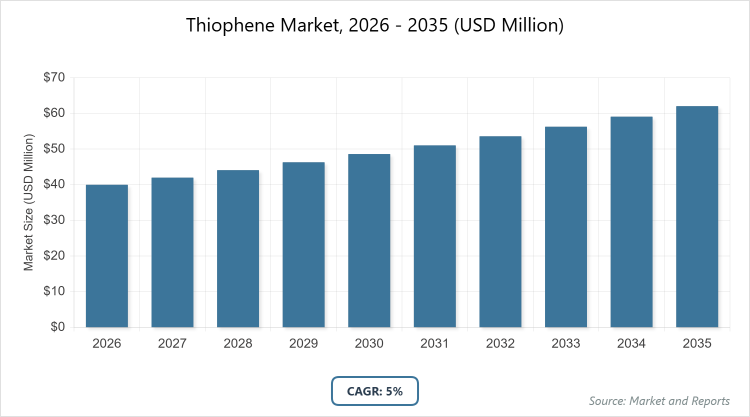
According to MarketnReports, the global Thiophene market size was estimated at USD 40 million in 2025 and is expected to reach USD 65 million by 2035, growing at a CAGR of 5% from 2026 to 2035. Increasing demand in pharmaceuticals and agrochemicals.
What are the Key Insights into the Thiophene Market?
- The global thiophene market size was USD 40 million in 2025 and is projected to reach USD 65 million by 2035.
- The market is anticipated to grow at a CAGR of 5% from 2026 to 2035.
- The market is driven by rising applications in pharmaceuticals, agrochemicals, and electronic materials.
- The pharmaceutical grade segment dominates the product type with around 45% share, owing to its high purity standards essential for drug synthesis and compliance with regulatory requirements in healthcare manufacturing.
- The pharmaceuticals segment leads the application with approximately 50% market share, due to thiophene’s critical role in producing active ingredients for antibiotics, anti-inflammatories, and other therapeutics that fuel medical advancements.
- The pharmaceutical segment is dominant in the end-use industry with about 50% share, as it leverages thiophene derivatives extensively for innovative drug development and large-scale production.
- Asia Pacific dominates the regional market with around 40% share, driven by expansive manufacturing capabilities, cost-effective production in China and India, and surging exports to global pharmaceutical markets.
What is Thiophene?
Industry Overview
The thiophene market involves the production, supply, and utilization of thiophene, a sulfur-containing heterocyclic organic compound widely used as a key intermediate in chemical synthesis for various industrial applications, including the creation of pharmaceuticals, agrochemicals, dyes, polymers, and electronic materials. This market caters to sectors requiring precise chemical building blocks for developing advanced products, with thiophene valued for its aromatic properties and reactivity that enable the formation of complex molecules through substitution and polymerization processes. Market definition encompasses all activities related to the commercial extraction, purification, derivatization, and distribution of thiophene, excluding non-commercial research or incidental uses, and it reflects the growing integration of thiophene in sustainable and high-performance materials amid evolving industrial needs for efficient and versatile chemical precursors.
What are the Market Dynamics Affecting Thiophene?
Growth Drivers
The growth drivers in the thiophene market are primarily propelled by the expanding pharmaceutical industry, where thiophene serves as a vital building block for synthesizing a wide array of drugs, including cephalosporins and other antibiotics, amid rising global healthcare demands and the need for novel therapeutic solutions to combat resistant pathogens. This is complemented by advancements in agrochemicals, where thiophene derivatives enhance the efficacy of pesticides and herbicides, supporting agricultural productivity in response to population growth and food security challenges. Furthermore, the integration of thiophene in conducting polymers for electronics, such as OLEDs and solar cells, drives market expansion through technological innovations that promote energy efficiency and sustainable materials, bolstered by increasing R&D investments in organic electronics.
Restraints
Restraints in the thiophene market stem from volatile raw material prices, particularly for sulfur and butadiene used in production, which can disrupt supply chains and elevate costs for manufacturers reliant on petrochemical feedstocks amid geopolitical tensions and fluctuating oil markets. Stringent environmental regulations on emissions and waste from chemical synthesis processes also hinder growth, requiring costly compliance measures and cleaner production technologies that may not be feasible for smaller players. Additionally, health and safety concerns related to thiophene’s toxicity and handling risks impose operational limitations, potentially slowing adoption in sensitive applications like food-related flavors.
Opportunities
Opportunities in the thiophene market arise from emerging applications in advanced materials, such as bio-based polymers and nanomaterials, where thiophene’s conductive properties can be harnessed for next-generation batteries and sensors, appealing to the growing demand for green technologies in renewable energy sectors. The shift toward sustainable chemistry opens avenues for bio-derived thiophene alternatives, reducing dependency on fossil fuels and attracting eco-conscious investments. Moreover, expanding markets in developing regions offer potential through increased industrialization and partnerships for localized production, enabling customized solutions for regional needs in pharmaceuticals and agriculture.
Challenges
Challenges in the thiophene market include environmental sustainability issues, as traditional production methods generate hazardous byproducts, prompting the need for greener synthesis routes that may increase R&D costs and time-to-market. Intense competition from substitute compounds like furan or pyrrole in certain applications poses risks to market share, requiring continuous innovation to maintain thiophene’s advantages in reactivity and stability. Supply chain vulnerabilities, exacerbated by reliance on specific geographic sources for raw materials, create instability, while intellectual property disputes over derivative patents can limit access to key technologies.
Thiophene Market: Report Scope
| Report Attributes | Report Details |
| Report Name | Thiophene Market |
| Market Size 2025 | USD 40 million |
| Market Forecast 2035 | USD 65 Million |
| Growth Rate | CAGR of 5% |
| Report Pages | 220 |
| Key Companies Covered |
PCAS, SKC, Fisher-Scientific, Hongyuan Pharmaceutical, Dongsheng Chemical, Sincere Chemicals, BASF SE, and Others |
| Segments Covered | By Product Type, By Application, By End-Use Industry, and By Region |
| Regions Covered | North America, Europe, Asia Pacific (APAC), Latin America, and The Middle East and Africa (MEA) |
| Base Year | 2025 |
| Historical Year | 2020 – 2024 |
| Forecast Year | 2026 – 2035 |
| Customization Scope | Avail customized purchase options to meet your exact research needs. |
How is the Thiophene Market Segmented?
The Thiophene market is segmented by product type, application, end-use industry, and region.
Based on product type segment, the pharmaceutical grade subsegment is the most dominant, holding around 45% share, due to its requirement for ultra-high purity in sensitive drug manufacturing processes that ensure safety and efficacy, which drives the market by enabling the development of complex pharmaceuticals and supporting global health initiatives through reliable supply chains. The industrial grade subsegment is the second most dominant, with approximately 30% share, as it offers cost-effective solutions for bulk chemical synthesis in dyes and polymers, contributing to market growth by facilitating large-scale industrial applications and cost reductions in end products.
Based on the application segment, the pharmaceuticals subsegment is the most dominant, capturing about 50% share, attributed to thiophene’s essential use in synthesizing active pharmaceutical ingredients for treatments like anti-cancer and anti-viral drugs, which propels the market by addressing rising disease burdens and fostering innovation in personalized medicine. The agrochemicals subsegment is the second most dominant, with around 25% share, owing to its role in enhancing pesticide formulations for crop protection, helping to drive the market through improved agricultural yields and sustainability in food production amid climate challenges.
Based on end-use industry segment, the pharmaceutical subsegment is the most dominant, with roughly 50% share, facilitated by heavy reliance on thiophene for drug intermediates that meet stringent quality standards, driving the market by accelerating therapeutic advancements and expanding access to healthcare solutions worldwide. The agriculture subsegment is the second most dominant, holding about 20% share, propelled by demand for efficient agrochemicals that incorporate thiophene derivatives, which contribute to market expansion by boosting farm productivity and supporting global food security efforts.
What are the Recent Developments in Thiophene Market?
- In 2024, Merck KGaA expanded its thiophene portfolio with a new catalytic nitration facility in Germany, reducing energy consumption by 30% and aligning with sustainability goals while increasing production capacity for pharmaceutical intermediates.
- In January 2023, BASF SE announced the expansion of its production capacity for specialty chemicals, including 2-(4-Fluorophenyl)thiophene, to meet growing demand in the pharmaceutical and electronics sectors.
- In March 2025, Merck KGaA introduced a new thiophene-based catalyst system for efficient nitration processes, enhancing yield and reducing environmental impact in chemical manufacturing.
How Does Regional Analysis Impact the Thiophene Market?
- Asia Pacific to dominate the global market.
Asia Pacific leads the thiophene market with a substantial share, fueled by rapid industrialization, low-cost manufacturing, and a booming pharmaceutical sector; China stands out as the dominating country, where extensive chemical production facilities and government support for exports drive growth through innovations in drug synthesis and agrochemicals, contributing to the region’s dominance by supplying global demands at competitive prices.
North America follows with steady growth, supported by advanced R&D in electronics and pharmaceuticals, along with stringent quality standards; the United States is the dominating country, leveraging major companies like Fisher-Scientific for high-purity thiophene applications in drug development, which bolsters market expansion via technological patents and collaborations with biotech firms.
Europe maintains a strong position, driven by environmental regulations promoting sustainable chemistry and investments in green technologies; Germany dominates here, with firms like BASF SE and Merck KGaA leading in specialty chemical production, supporting growth through eco-friendly thiophene derivatives for polymers and biocides that align with EU sustainability directives.
Latin America exhibits emerging potential, influenced by agricultural expansion and increasing chemical imports; Brazil is the dominating country, where rising agrochemical demands utilize thiophene for pesticide enhancements, aiding market development by addressing local farming needs and fostering partnerships with international suppliers.
The Middle East and Africa represent nascent opportunities, constrained by infrastructure but gaining from oil-derived feedstocks; South Africa dominates in this region, with its developing chemical industry incorporating thiophene for dyes and intermediates, driving gradual growth through industrial diversification and regional trade agreements.
Who are the Key Market Players in Thiophene?
- PCAS specializes in custom synthesis of thiophene derivatives for pharmaceuticals, employing strategies such as R&D collaborations with biotech firms, capacity expansions in high-purity production, and a focus on sustainable processes to capture demand in drug intermediates.
- SKC targets electronics and polymer applications, with strategies including investments in conducting polymer technologies, partnerships for OLED materials, and supply chain optimizations to enhance market penetration in Asia.
- Fisher-Scientific provides laboratory-grade thiophene, utilizing strategies like broad distribution networks, e-commerce platforms for quick delivery, and emphasis on quality certifications to serve research and development sectors.
- Hongyuan Pharmaceutical focuses on pharmaceutical intermediates, adopting strategies such as vertical integration for cost control, regulatory compliance for exports, and innovation in anti-viral drug components to drive growth in healthcare.
- Dongsheng Chemical emphasizes agrochemical uses, with strategies involving localized production in China, R&D for efficient pesticides, and expansions into bio-based alternatives to meet sustainability trends.
- Sincere Chemicals offers industrial-grade thiophene, employing strategies like competitive pricing, supply agreements with dye manufacturers, and the adoption of green chemistry to address environmental regulations.
- BASF SE leverages a diverse portfolio for specialty chemicals, with strategies including acquisitions for thiophene tech, heavy R&D in polymers, and global sustainability initiatives to maintain leadership.
What are the Market Trends Shaping Thiophene?
- Increasing adoption of thiophene in conducting polymers for flexible electronics and solar cells.
- Shift toward sustainable and bio-based thiophene derivatives to reduce environmental impact.
- Growing use in pharmaceutical synthesis for novel drug candidates targeting chronic diseases.
- Expansion of applications in agrochemicals for enhanced crop protection formulations.
- Rise in R&D for thiophene-based nanomaterials in energy storage devices.
- Focus on high-purity grades to meet regulatory standards in healthcare and food sectors.
- Integration in dyes and pigments for eco-friendly textile coloring processes.
What Market Segments and Subsegments are Covered in the Thiophene Report?
By Product Type
- Pharmaceutical Grade
- Industrial Grade
- High Purity Grade
- 2-Thiophene
- 3-Thiophene
- Alkyl Thiophenes
- Halogenated Thiophenes
- Nitro Thiophenes
- Amino Thiophenes
- Acyl Thiophenes
- Others
By Application
- Pharmaceuticals
- Agrochemicals
- Dyes & Pigments
- Plastics & Polymers
- Electronics
- Chemical Intermediates
- Biocides
- Flavors & Fragrances
- Research & Development
- Others
By End-Use Industry
- Pharmaceutical
- Agriculture
- Chemical
- Electronics
- Textile
- Food & Beverage
- Automotive
- Aerospace
- Consumer Goods
- Industrial
- Others
By Region
- North America
- U.S.
- Canada
- Europe
- UK
- Germany
- France
- Rest of Europe
- Asia Pacific
- China
- India
- Japan
- Rest of Asia Pacific
- Latin America
- Brazil
- Mexico
- Rest of Latin America
- Middle East & Africa
- UAE
- South Africa
- Rest of Middle East & Africa
Chapter 1. Preface
Chapter 2. Executive Summary
Chapter 3. Global Thiophene Market - Industry Analysis
Chapter 4. Global Thiophene Market- Competitive Landscape
Chapter 5. Global Thiophene Market - Product Type Analysis
Chapter 6. Global Thiophene Market - Application Analysis
Chapter 7. Global Thiophene Market - End-Use Industry Analysis
Chapter 8. Thiophene Market - Regional Analysis
Chapter 9. Company Profiles
Frequently Asked Questions
Thiophene is a heterocyclic organic compound consisting of a five-membered ring with four carbon atoms and one sulfur atom, used as a key intermediate in chemical synthesis for pharmaceuticals, agrochemicals, and materials.
Key factors include expanding pharmaceutical applications, demand for sustainable materials, advancements in electronics, and growth in agrochemical sectors amid population increases.
The thiophene market is projected to grow from approximately USD 40 million in 2026 to USD 65 million by 2035.
The CAGR value is expected to be 5% during 2026-2035.
Asia Pacific will contribute notably, driven by manufacturing growth and pharmaceutical exports.
Major players include PCAS, SKC, Fisher-Scientific, Hongyuan Pharmaceutical, and Dongsheng Chemical.
The report provides in-depth analysis on market size, trends, segments, regional insights, key players, and forecasts from 2026 to 2035.
Stages include raw material procurement, synthesis and purification, derivatization, distribution, and end-use application in industries like pharmaceuticals.
Trends are moving toward eco-friendly derivatives and high-purity products, with preferences for sustainable sourcing in pharmaceuticals and electronics.
Regulatory factors include strict emission controls and safety standards, while environmental factors involve pressures for greener production to minimize hazardous waste.