
Recycled Carbon Fiber Market Size, Share and Trends 2026 to 2035
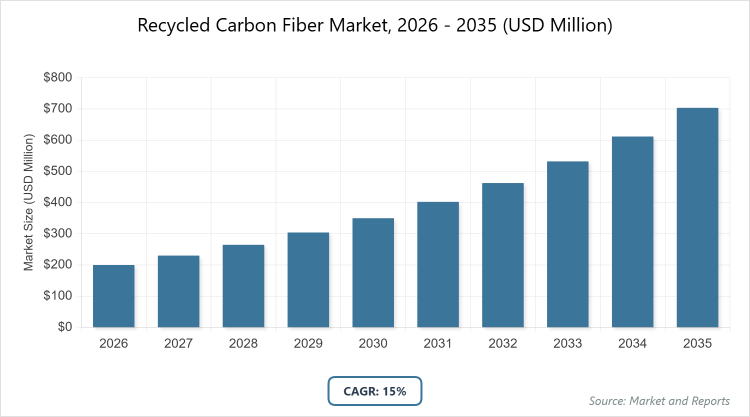
According to MarketnReports, the global Recycled Carbon Fiber market size was estimated at USD 200 million in 2025 and is expected to reach USD 800 million by 2035, growing at a CAGR of 15% from 2026 to 2035. Increasing demand for sustainable and lightweight materials in the automotive and aerospace industries.
What are the Key Insights of the Recycled Carbon Fiber Market?
- The global Recycled Carbon Fiber market is expected to be valued at USD 200 million in 2025 and reach USD 800 million by 2035.
- The market is projected to grow at a CAGR of 15% from 2026 to 2035.
- The market is driven by stringent environmental regulations and the push for sustainable materials in high-performance industries.
- The chopped segment dominates the type segment with approximately 62% share because of its versatility in composites manufacturing, ease of integration into molding compounds, and broad applications across automotive and industrial sectors.
- The automotive & transportation segment dominates the end-use segment with 40% share due to the critical need for lightweight components to enhance fuel efficiency, reduce emissions, and support electric vehicle production.
- Europe dominates the global market with 35% share due to strict environmental regulations, advanced recycling infrastructure, and the strong presence of key industry players.
What is the Recycled Carbon Fiber Market?
Industry Overview
The recycled carbon fiber market encompasses the collection, processing, and commercialization of carbon fiber recovered from waste composites, including end-of-life aerospace components, automotive parts, and industrial scrap. Through processes like pyrolysis, solvolysis, and mechanical recycling, the material retains key properties such as high tensile strength, low density, and stiffness while significantly reducing environmental impact compared to virgin carbon fiber production. This market supports circular economy initiatives by diverting waste from landfills, lowering energy consumption, and addressing sustainability demands across industries seeking high-performance, eco-friendly alternatives.
What are the Market Dynamics of the Recycled Carbon Fiber Market?
Growth Drivers
Growth drivers include rising environmental regulations promoting waste reduction and circular economy practices, which encourage industries to adopt recycled materials. Cost advantages over virgin carbon fiber, combined with comparable mechanical properties, make it appealing for manufacturers aiming to lower production costs without compromising performance. Demand for lightweight materials in the automotive and aerospace sectors to meet fuel efficiency and emission standards further accelerates adoption.
Restraints
Restraints involve high capital costs for establishing advanced recycling facilities and variability in recycled fiber quality depending on source and process, limiting use in critical applications. Limited supply of consistent high-quality waste feedstock and competition from established virgin materials pose additional barriers to widespread adoption.
Opportunities
Opportunities arise from technological innovations in recycling methods, such as enhanced solvolysis and pyrolysis, which improve fiber recovery rates and quality. Expanding applications in electric vehicles, renewable energy, and consumer goods, along with government incentives for sustainable materials, create new growth avenues.
Challenges
Challenges include scaling recycling operations to meet rising demand while maintaining consistent quality standards. Logistical issues in waste collection and sorting, plus the need for industry education on recycled material benefits, remain key hurdles.
Recycled Carbon Fiber Market: Report Scope
| Report Attributes | Report Details |
| Report Name | Recycled Carbon Fiber Market |
| Market Size 2025 | USD 200 million |
| Market Forecast 2035 | USD 800 million |
| Growth Rate | CAGR of 15% |
| Report Pages | 220 |
| Key Companies Covered |
Toray Industries Inc., Procotex, Vartega Inc., Gen 2 Carbon Limited, Sigmatex, and Others |
| Segments Covered | By Type (Chopped, Milled), By End-Use (Automotive & Transportation, Aerospace & Defense, Wind Energy, Sporting Goods, Others), and By Region |
| Regions Covered | North America, Europe, Asia Pacific (APAC), Latin America, and The Middle East and Africa (MEA) |
| Base Year | 2025 |
| Historical Year | 2020 – 2024 |
| Forecast Year | 2026 – 2035 |
| Customization Scope | Avail customized purchase options to meet your exact research needs. |
How is the Recycled Carbon Fiber Market Segmented?
The Recycled Carbon Fiber market is segmented by type, end-use, and region.
Based on Type Segment, the chopped recycled carbon fiber segment is the most dominant with 62% share, driven by its suitability for injection molding, thermoplastic compounds, and diverse industrial uses where short fibers provide excellent reinforcement and processability. The milled segment is the second most dominant, valued for applications in non-woven fabrics and coatings, supporting market growth by enabling specialized uses in electronics and construction.
Based on End-Use Segment, the automotive & transportation segment is the most dominant with 40% share, propelled by the need for lightweight, high-strength components that reduce vehicle weight, improve fuel efficiency, and comply with emission regulations, especially in electric vehicles. The aerospace & defense segment is the second most dominant, benefiting from stringent performance requirements for durable, lightweight parts, driving market expansion through high-value, regulated applications.
What are the Recent Developments in the Recycled Carbon Fiber Market?
- In October 2023, Apply Carbon commissioned the world’s first fully automated mass production plant for recycled carbon fiber, significantly boosting capacity and process efficiency.
- In January 2023, Asahi Kasei developed a new recycling technology for carbon fiber-reinforced plastics in partnership with research institutions, advancing sustainable material recovery.
- In August 2023, Carbon Conversions partnered with Joby Aviation to recycle scrap carbon fiber for aviation use, supporting eco-friendly practices in the aerospace sector.
Which Region Dominates the Recycled Carbon Fiber Market?
- Europe is to dominate the global market.
Europe leads the market due to stringent EU regulations on waste and emissions, advanced recycling infrastructure, and strong adoption in the automotive and aerospace industries. Countries like Germany and the UK drive growth through innovation and sustainability mandates.
North America holds a substantial share, with the US leading via investments in recycling technologies and demand from aerospace and defense sectors focused on performance and environmental compliance.
Asia Pacific is the fastest-growing region, driven by rapid industrialization in China and Japan, increasing automotive production, and wind energy expansion, emphasizing sustainable materials.
Latin America and the Middle East & Africa show emerging potential, supported by growing environmental awareness and investments in renewable energy and automotive sectors.
Who are the Key Players in the Recycled Carbon Fiber Market?
- Toray Industries Inc. is a major player, focusing on advanced recycling technologies, strategic partnerships, and expanding production to meet demand in automotive and aerospace applications.
- Procotex specializes in high-quality recycled carbon fiber from industrial waste, emphasizing sustainable processes and supply to various end-use industries.
- Vartega Inc. innovates in recycling methods, providing reliable recycled fiber for automotive and consumer goods, with a focus on cost-effective solutions.
- Gen 2 Carbon Limited develops proprietary recycling processes to deliver high-performance recycled carbon fiber, targeting industrial and transportation sectors.
- Sigmatex offers recycled carbon fiber products with a commitment to quality and sustainability, serving aerospace and automotive markets through advanced weaving technologies.
What are the Market Trends in the Recycled Carbon Fiber Market?
- Rising adoption of electric vehicles for lightweighting and emission reduction.
- Advancements in recycling technologies are enhancing fiber quality and recovery rates.
- Growing emphasis on circular economy and zero-waste manufacturing practices.
- Expansion into wind energy and sporting goods sectors for sustainable performance.
- Increased collaborations across the supply chain to secure feedstock and improve efficiency.
What Market Segments and their Subsegments are Covered in the Report?
By Type
- Chopped
- Milled
By End-Use
- Automotive & Transportation
- Aerospace & Defense
- Wind Energy
- Sporting Goods
- Others
By Region
- North America
- U.S.
- Canada
- Europe
- UK
- Germany
- France
- Rest of Europe
- Asia Pacific
- China
- India
- Japan
- Rest of Asia Pacific
- Latin America
- Brazil
- Mexico
- Rest of Latin America
- Middle East & Africa
- UAE
- South Africa
- Rest of Middle East & Africa
Chapter 1. Preface
Chapter 2. Executive Summary
Chapter 3. Global Recycled Carbon Fiber Market - Industry Analysis
Chapter 4. Global Recycled Carbon Fiber Market- Competitive Landscape
Chapter 5. Global Recycled Carbon Fiber Market - Type Analysis
Chapter 6. Global Recycled Carbon Fiber Market - End-Use Analysis
Chapter 7. Recycled Carbon Fiber Market - Regional Analysis
Chapter 8. Company Profiles
Frequently Asked Questions
Recycled carbon fiber is carbon fiber recovered from waste composites through processes like pyrolysis and mechanical recycling, offering high strength and sustainability benefits.
Key factors include environmental regulations, technological advancements in recycling, demand for lightweight materials in automotive and aerospace, and cost advantages over virgin fiber.
The market is expected to reach USD 800 million by 2035.
The CAGR is 15%.
Europe will contribute notably due to regulatory support and industry adoption.
Major players include Toray Industries Inc., Procotex, Vartega Inc., Gen 2 Carbon Limited, and Sigmatex.
The report offers detailed analysis of market size, segments, trends, key players, regional insights, and forecasts.
Stages include waste collection and sorting, recycling processing, fiber treatment, compounding, and integration into end-use products.
Preferences are shifting toward eco-friendly, high-performance materials with greater acceptance of recycled options in automotive, aerospace, and renewable energy.
Regulations on emissions, waste management, and circular economy policies drive growth by incentivizing sustainable material use.