
Quantum Dot Solar Cell Market Size, Share and Trends 2026 to 2035
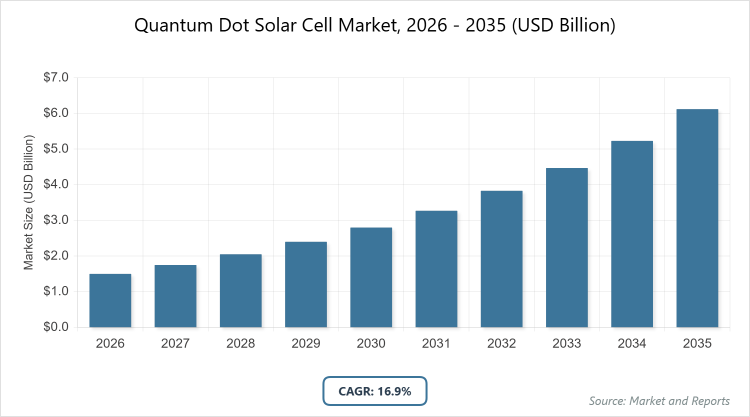
According to MarketnReports, the global Quantum Dot Solar Cell Market size was estimated at USD 1.5 billion in 2025 and is expected to reach USD 7 billion by 2035, growing at a CAGR of 16.9% from 2026 to 2035. Quantum Dot Solar Cell Market is driven by increasing demand for high-efficiency, flexible, and cost-effective solar energy solutions.What are the Key Insights of the Quantum Dot Solar Cell Market?
- The quantum dot solar cell market was valued at USD 1.5 billion in 2025 and is projected to reach USD 7 billion by 2035.
- The market is expected to grow at a CAGR of 16.9% during the forecast period from 2026 to 2035.
- The market is driven by advancements in nanotechnology and rising demand for renewable energy sources with higher efficiency.
- Quantum Dot Photovoltaic Cells dominates the type segment with a 53% share because it offers superior light absorption and efficiency in converting sunlight to electricity; Cadmium-Based Quantum Dots dominates the material segment with a 45% share due to its established performance and cost-effectiveness in enhancing cell stability; Building Integrated Photovoltaics dominates the application segment with a 40% share owing to its seamless integration into architecture for sustainable building designs.
- North America dominates the market with a 37% share due to strong R&D investments, supportive government policies, and advanced technological infrastructure.
What is the Industry Overview of the Quantum Dot Solar Cell Market?
The quantum dot solar cell market involves the use of nanoscale semiconductor particles, known as quantum dots, to enhance the efficiency and performance of photovoltaic cells by enabling better light absorption across a broader spectrum of wavelengths. Market definition refers to solar cells that incorporate quantum dots to achieve higher conversion efficiencies, tunable bandgaps, and potential for multiple exciton generation, addressing limitations in traditional silicon-based solar technologies. This market supports the transition to renewable energy by offering lightweight, flexible, and cost-effective alternatives suitable for applications in building-integrated photovoltaics, portable devices, and utility-scale installations, ultimately contributing to reduced carbon emissions and greater energy independence through innovative materials and manufacturing processes.
What are the Market Dynamics of the Quantum Dot Solar Cell Market?
Growth Drivers
The quantum dot solar cell market is driven by the urgent need for higher-efficiency photovoltaic technologies amid global efforts to combat climate change and transition to sustainable energy sources. Quantum dots enable cells to capture a wider range of the solar spectrum, potentially exceeding the Shockley-Queisser limit through multiple exciton generation, which boosts overall energy conversion rates. Supportive government incentives, such as tax credits and subsidies for renewable energy projects, further accelerate adoption, particularly in regions prioritizing green infrastructure. Additionally, declining manufacturing costs due to advancements in synthesis methods and scalable production techniques make these cells more accessible for commercial and residential applications, fostering widespread integration into diverse energy systems.
Restraints
High production costs associated with quantum dot synthesis and integration into solar cells remain a major restraint, limiting scalability for widespread commercial deployment. Concerns over the toxicity of cadmium-based quantum dots pose environmental and health risks, leading to regulatory hurdles and increased scrutiny in eco-conscious markets. Moreover, the relative immaturity of the technology results in challenges related to long-term stability and degradation under real-world conditions, which erodes investor confidence. Supply chain vulnerabilities for rare materials and the need for specialized manufacturing equipment further complicate market entry for new players, slowing overall growth despite promising efficiency gains.
Opportunities
Opportunities in the quantum dot solar cell market arise from the development of cadmium-free alternatives, such as perovskite and carbon-based dots, which address environmental concerns and open doors to regulated markets. The rise of building-integrated photovoltaics creates demand for flexible, aesthetically pleasing solar solutions that quantum dots can provide through tunable colors and transparency. Emerging applications in portable electronics and wearable devices offer niche growth avenues, leveraging the lightweight and efficient nature of these cells. Furthermore, collaborations between research institutions and industry players can accelerate commercialization, while government funding for clean energy R&D presents avenues for innovation in hybrid systems combining quantum dots with existing solar technologies.
Challenges
Challenges include achieving consistent quantum dot uniformity and stability during large-scale manufacturing, which impacts cell performance and reliability over time. Intellectual property disputes and the need for extensive patent navigation can hinder innovation and market entry for smaller firms. Varying global regulations on nanomaterial use add compliance complexities, particularly in regions with stringent environmental standards. Additionally, competition from established silicon-based solar technologies, which benefit from mature supply chains and lower costs, poses a barrier to market penetration, requiring quantum dot solutions to demonstrate clear superiority in efficiency and durability to gain traction.
Quantum Dot Solar Cell Market: Report Scope
| Report Attributes | Report Details |
| Report Name | Quantum Dot Solar Cell Market |
| Market Size 2025 | USD 1.5 Billion |
| Market Forecast 2035 | USD 7 Billion |
| Growth Rate | CAGR of 16.9% |
| Report Pages | 220 |
| Key Companies Covered |
First Solar, UbiQD Inc., Nanoco Group plc, Oxford Photovoltaics Ltd., QD Solar Inc., Quantum Material Corporation, and Others. |
| Segments Covered | By Type, By Material, By Application, and By Region. |
| Regions Covered | North America, Europe, Asia Pacific (APAC), Latin America, and The Middle East and Africa (MEA) |
| Base Year | 2025 |
| Historical Year | 2020 - 2024 |
| Forecast Year | 2026 - 2035 |
| Customization Scope | Avail customized purchase options to meet your exact research needs. |
What is the Market Segmentation of the Quantum Dot Solar Cell Market?
The Quantum Dot Solar Cell Market is segmented by type, material, application, and region.By Type Segment: The Quantum Dot Photovoltaic Cells segment dominates with a 53% share, as it leverages quantum dots for enhanced light harvesting and higher efficiency, driving the market by enabling cost-effective scalability in solar energy production. The Quantum Dot Hybrid Solar Cells segment is the second most dominant at 25%, combining quantum dots with other materials like perovskites to improve stability and performance, contributing to market growth through versatile applications in hybrid systems.
By Material Segment: The Cadmium-Based Quantum Dots segment dominates with a 45% share, offering proven efficiency and tunability in bandgap engineering, which drives the market by facilitating higher conversion rates in photovoltaic cells. The Cadmium-Free Quantum Dots segment is the second most dominant at 30%, providing eco-friendly alternatives with reduced toxicity, propelling market expansion by meeting regulatory demands and enabling sustainable solar solutions.
By Application Segment: The Building Integrated Photovoltaics segment dominates with a 40% share, integrating quantum dots into architectural elements for seamless energy generation, driving the market through urban sustainability initiatives and aesthetic appeal. The Multi-Junction Solar Cell segment is the second most dominant at 20%, utilizing layered quantum dots for broader spectrum absorption, contributing to market growth by achieving record efficiencies in advanced solar technologies.
What are the Recent Developments in the Quantum Dot Solar Cell Market?
- In July 2025, First Solar partnered with UbiQD to integrate quantum dots into thin-film bifacial solar panels, aiming to enhance efficiency with a commercial rollout planned for late 2026.
- In June 2025, Michigan Technological University researchers achieved 11% efficiency in quantum dot solar cells using UV laser techniques to improve thin-film quality.
- In 2025, QD Solar reported breakthroughs in hybrid perovskite-quantum dot solar cells, achieving record conversion efficiencies in laboratory conditions.
- In 2024, Ulsan National Institute of Science & Technology achieved 18.1% efficiency for quantum dot solar cells, highlighting advancements in cadmium-free materials.
- In December 2024, a review on plasmonic nanostructures for quantum dot solar cells discussed enhancement mechanisms like optical field enhancement and hot-electron injection.
- In 2024, LONGi Solar announced a perovskite-silicon tandem solar cell with 26.81% efficiency, influencing quantum dot hybrid developments.
What is the Regional Analysis of the Quantum Dot Solar Cell Market?
North America to dominate the global market.North America leads the quantum dot solar cell market, supported by robust R&D investments, favorable policies like tax incentives, and a focus on renewable energy innovation. The United States dominates the region, with companies like First Solar and UbiQD driving advancements through partnerships and commercialization efforts, bolstered by initiatives such as the CHIPS Act to enhance domestic manufacturing and reduce reliance on imports.
Asia Pacific is the fastest-growing region, fueled by rapid industrialization, government subsidies for solar projects, and increasing energy demands. China leads as the dominating country, leveraging its massive production capabilities and national strategies for carbon neutrality, with firms like Hanwha Q CELLS advancing quantum dot integration in large-scale photovoltaic deployments.
Europe shows strong growth through emphasis on sustainability and EU Green Deal objectives, promoting clean energy transitions. Germany dominates the region, with its engineering expertise and companies like Oxford PV focusing on hybrid quantum dot-perovskite cells to meet stringent emission targets and expand export markets.
Latin America is emerging with investments in renewable infrastructure amid energy diversification efforts. Brazil leads as the dominating country, adopting quantum dot technologies for remote and agricultural applications, supported by government programs to enhance grid stability and attract international solar investments.
The Middle East and Africa exhibit potential in solar-rich environments for off-grid and utility-scale projects. The United Arab Emirates dominates, integrating quantum dot solar cells into smart city initiatives like those in Dubai, backed by Vision 2031 for diversified energy sources beyond oil.
What are the Key Market Players and Strategies in the Quantum Dot Solar Cell Market?
First Solar: First Solar focuses on partnerships for quantum dot integration into thin-film panels, emphasizing efficiency enhancements and scalable manufacturing to expand market presence in utility-scale solar projects.
UbiQD Inc.: UbiQD Inc. pursues innovation in cadmium-free quantum dots, investing in production facilities and collaborations to develop applications in greenhouses and bifacial panels for improved light spectrum utilization.
Nanoco Group plc: Nanoco Group plc employs a strategy of developing eco-friendly quantum dots, forming alliances with electronics firms to diversify into displays and solar, while prioritizing patent protection for competitive advantage.
Oxford Photovoltaics Ltd.: Oxford Photovoltaics Ltd. leverages R&D in perovskite-quantum dot hybrids, securing funding for commercialization to achieve higher efficiencies and target building-integrated solar solutions.
QD Solar Inc.: QD Solar Inc. concentrates on hybrid cell breakthroughs, collaborating with research institutions to push laboratory efficiencies toward market-ready products for residential and commercial use.
Quantum Material Corporation: Quantum Material Corporation adopts mass-production techniques for quantum dots, partnering with solar manufacturers to reduce costs and enhance cell performance in emerging markets.
What are the Market Trends in the Quantum Dot Solar Cell Market?
- Advancements in cadmium-free quantum dots to address environmental concerns and comply with regulations.
- Integration with perovskite materials for hybrid cells achieving efficiencies over 25%.
- Focus on building-integrated photovoltaics for urban sustainability and aesthetic applications.
- Development of flexible and lightweight cells for portable and wearable electronics.
- Use of plasmonic nanostructures to enhance light absorption and efficiency.
- Partnerships between startups and established solar firms for commercialization.
- Emphasis on scalable manufacturing to reduce production costs.
- Growth in multi-junction cells for broader spectrum utilization.
- Adoption in emerging markets driven by renewable energy incentives.
- Research on stability improvements for long-term performance in real-world conditions.
What are the Market Segments and their Subsegments Covered in the Quantum Dot Solar Cell Market Report?
By Type
- Quantum Dot Photovoltaic Cells
- Quantum Dot Hybrid Solar Cells
- Quantum Dot with Nanowire in Solar Cells
- Colloidal Quantum Dot Solar Cells
- Thin-Film Quantum Dot Solar Cells
- Quantum Dot Sensitized Solar Cells
- Perovskite-Quantum Dot Hybrid Solar Cells
- Organic-Inorganic Hybrid Quantum Dot Solar Cells
- Metal-Semiconductor Junction Solar Cells
- P-I-N Structure Solar Cells
- Others
By Material
- Cadmium-Based Quantum Dots
- Cadmium-Free Quantum Dots
- Lead-Based Quantum Dots
- Carbon-Based Quantum Dots
- Indium Arsenide Quantum Dots
- Lead Selenide Quantum Dots
- Lead Sulfide Quantum Dots
- Perovskite Quantum Dots
- Silicon Quantum Dots
- Graphene Quantum Dots
- Others
By Application
- Building Integrated Photovoltaics
- Multi-Junction Solar Cell
- Portable & Wearable Electronics
- Single Junction Solar Cell
- Transparent Smart Glass & Displays
- Commercial
- Industrial
- Residential
- Utility
- Consumer Electronics
- Others
By Region
- North America
- U.S.
- Canada
- Europe
- UK
- Germany
- France
- Rest of Europe
- Asia Pacific
- China
- India
- Japan
- Rest of Asia Pacific
- Latin America
- Brazil
- Mexico
- Rest of Latin America
- Middle East & Africa
- UAE
- South Africa
- Rest of Middle East & Africa
Frequently Asked Questions
The quantum dot solar cell market comprises photovoltaic technologies using nanoscale quantum dots to improve efficiency and light absorption in solar energy conversion.
Key factors include technological advancements in nanomaterials, government incentives for renewables, and demand for high-efficiency solar solutions.
The market is projected to grow from USD 1.5 billion in 2025 to USD 7 billion by 2035.
The CAGR is expected to be 16.9% from 2026 to 2035.
North America will contribute notably, holding a 37% share due to innovation and policy support.
Major players include First Solar, UbiQD Inc., Nanoco Group plc, Oxford Photovoltaics Ltd., QD Solar Inc., and Quantum Material Corporation.
The report provides detailed analysis of market size, trends, segments, regional insights, key players, and forecasts from 2026 to 2035.
Stages include raw material sourcing, quantum dot synthesis, cell assembly, integration, distribution, and end-user installation with maintenance.
Trends shift toward eco-friendly, high-efficiency cells, with consumers favoring flexible and integrated solutions for sustainable energy.
Regulations on toxic materials and incentives for renewables promote cadmium-free dots and green manufacturing practices.