
Psychedelic Drugs Market Size, Share and Trends 2026 to 2035
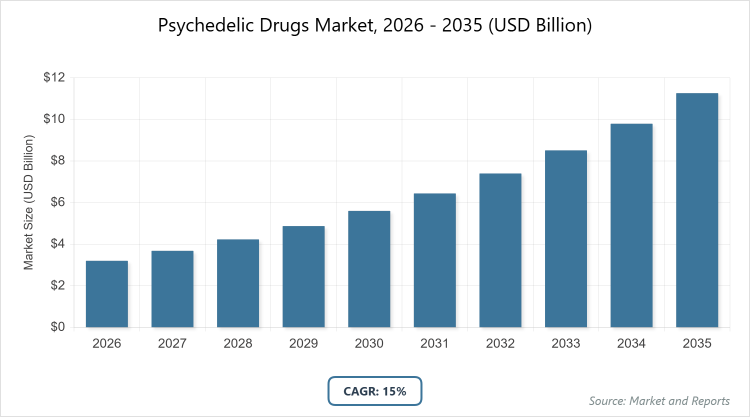
According to MarketnReports, the global Psychedelic Drugs Market size was estimated at USD 3.2 billion in 2025 and is expected to reach USD 13 billion by 2035, growing at a CAGR of 15% from 2026 to 2035. Psychedelic Drugs Market is driven by increasing clinical research and regulatory approvals for mental health treatments.What are the key insights into the Psychedelic Drugs Market?
- The global Psychedelic Drugs Market was valued at USD 3.2 billion in 2025 and is projected to reach USD 13 billion by 2035.
- The market is expected to grow at a CAGR of 15% during the forecast period from 2026 to 2035.
- The market is driven by rising prevalence of mental health disorders, advancements in clinical trials, and shifting regulatory environments favoring therapeutic use.
- In the drug type segment, psilocybin dominates with approximately 40% market share due to its promising results in depression trials and FDA breakthrough designations.
- In the application segment, depression holds about 50% share because of high global incidence rates and successful psychedelic-assisted therapies.
- In the distribution channel segment, hospital pharmacies command roughly 60% share owing to the need for supervised administration in clinical settings.
- North America dominates the regional market with approximately 45% share, attributed to progressive legalization in the US and Canada, coupled with robust R&D investments.
What is the industry overview of the Psychedelic Drugs Market?
The Psychedelic Drugs Market encompasses pharmaceuticals derived from hallucinogenic substances used primarily for therapeutic purposes in treating mental health disorders, with ongoing research expanding their applications beyond traditional recreational use. Market definition refers to psychedelic drugs as controlled substances like psilocybin, LSD, and MDMA that induce altered states of consciousness, administered under medical supervision to address conditions such as depression, PTSD, and anxiety, through mechanisms that promote neuroplasticity and emotional processing. This market integrates biotechnology, psychiatry, and regulatory frameworks, focusing on clinical trials, drug development, and distribution channels to ensure safe, evidence-based therapies while navigating evolving legal landscapes and public perceptions toward mental health innovation.
What are the market dynamics of the Psychedelic Drugs Market?
Growth Drivers
The growth drivers of the Psychedelic Drugs Market are propelled by the escalating global mental health crisis, with over 970 million people affected by disorders like depression and anxiety, prompting demand for innovative treatments where traditional antidepressants fail in up to 30% of cases. Breakthrough therapy designations by the FDA for compounds like psilocybin and MDMA have accelerated clinical trials, demonstrating efficacy in reducing symptoms through single-dose sessions combined with psychotherapy. Increasing venture capital investments, exceeding $3 billion since 2020, support biotech firms in scaling production and navigating approvals, while decriminalization efforts in regions like Oregon and Colorado expand access, fostering a shift toward evidence-based psychedelic medicine and driving market expansion.
Restraints
Restraints in the Psychedelic Drugs Market include stringent regulatory hurdles and historical stigma, as many psychedelics remain Schedule I substances under international conventions, limiting research funding and commercial viability despite growing evidence. High costs associated with clinical trials, often surpassing $100 million per drug, coupled with the need for specialized therapy protocols, deter smaller players and slow adoption. Potential adverse effects like hallucinations and psychological distress require controlled environments, raising liability concerns, while inconsistent global legal frameworks create market fragmentation, hindering widespread distribution and investor confidence.
Opportunities
Opportunities in the Psychedelic Drugs Market arise from expanding therapeutic indications beyond mental health, such as chronic pain and neurodegenerative diseases, with ongoing studies on MDMA for eating disorders and LSD for Alzheimer's. Partnerships between pharma giants and startups, like Johnson's collaboration with Compass Pathways, enable resource sharing for faster market entry. Emerging markets in Europe and Asia Pacific offer growth through regulatory reforms, while digital therapeutics integrating VR with psychedelics enhance treatment outcomes, supported by telemedicine advancements post-pandemic, opening avenues for scalable, personalized care models.
Challenges
Challenges in the Psychedelic Drugs Market revolve around ensuring drug purity and dosing consistency, as natural sources like psilocybin mushrooms vary in potency, necessitating synthetic manufacturing standards that increase production complexities. Intellectual property disputes over naturally occurring compounds limit exclusivity, while training healthcare professionals in psychedelic-assisted therapy demands new educational frameworks, straining resources. Public misconceptions and media sensationalism risk backlash, and varying reimbursement policies for experimental treatments pose financial barriers, collectively impeding broad acceptance and market maturation.
Psychedelic Drugs Market: Report Scope
| Report Attributes | Report Details |
| Report Name | Psychedelic Drugs Market |
| Market Size 2025 | USD 3.2 Billion |
| Market Forecast 2035 | USD 13 Billion |
| Growth Rate | CAGR of 15% |
| Report Pages | 220 |
| Key Companies Covered |
Compass Pathways, Atai Life Sciences, MindMed, Cybin Inc., Field Trip Health, and Others. |
| Segments Covered | By Drug Type, By Application, By Distribution Channel, and By Region. |
| Regions Covered | North America, Europe, Asia Pacific (APAC), Latin America, and The Middle East and Africa (MEA) |
| Base Year | 2025 |
| Historical Year | 2020 - 2024 |
| Forecast Year | 2026 - 2035 |
| Customization Scope | Avail customized purchase options to meet your exact research needs. |
How is the Psychedelic Drugs Market segmented?
The Psychedelic Drugs Market is segmented by drug type, application, distribution channel, and region.By Drug Type Segment, psilocybin is the most dominant, holding about 40% market share, followed by MDMA as the second most dominant with around 25%. Psilocybin's dominance stems from its robust clinical evidence in treating treatment-resistant depression and FDA breakthrough status, driving the market by attracting investments and accelerating approvals for psychedelic therapies; MDMA contributes by showing efficacy in PTSD trials, expanding applications and fostering regulatory progress.
By Application Segment, depression is the most dominant with approximately 50% share, while PTSD is the second most dominant at about 20%. Depression's leadership is driven by its high prevalence and psychedelics' ability to provide rapid, long-lasting relief, boosting market growth through increased clinical adoption; PTSD supports expansion via targeted therapies like MDMA-assisted sessions, addressing veteran and trauma care needs.
By Distribution Channel Segment, hospital pharmacies are the most dominant with around 60% share, followed by clinics as the second most dominant at roughly 20%. Hospital pharmacies lead due to the requirement for supervised dosing and integration with inpatient care, driving the market by ensuring safety and compliance; clinics aid growth by offering outpatient psychedelic sessions, enhancing accessibility in specialized mental health facilities.
What are the recent developments in the Psychedelic Drugs Market?
- In January 2026, the FDA granted breakthrough therapy designation to Cybin's CYB003 for major depressive disorder, accelerating Phase 3 trials and highlighting psilocybin's potential in rapid symptom relief.
- In October 2025, Atai Life Sciences launched a new MDMA formulation for PTSD, partnering with academic institutions for expanded access programs in Europe.
- In July 2025, MindMed reported positive Phase 2 results for LSD in anxiety disorders, securing additional funding for global commercialization efforts.
- In April 2025, Compass Pathways initiated a collaborative study with Johnson & Johnson on psilocybin for treatment-resistant depression, combining expertise in drug delivery.
What is the regional analysis of the Psychedelic Drugs Market?
North America to dominate the global market.North America leads the Psychedelic Drugs Market, driven by favorable regulatory changes and high mental health burden, with the United States as the dominating country due to state-level decriminalization in Oregon and Colorado, coupled with federal research grants exceeding $500 million, fostering innovation in clinical trials and biotech hubs.
Europe exhibits significant growth through progressive policies in countries like the Netherlands and Portugal, led by the United Kingdom with its focus on psilocybin research at institutions like Imperial College, supported by EU funding for mental health initiatives.
Asia Pacific shows promising expansion amid rising awareness, with Australia dominating through recent rescheduling of psychedelics for therapeutic use, enabling clinical access and investments in regional trials.
Latin America presents opportunities from traditional use in shamanic practices, dominated by Brazil with growing research on ayahuasca for addiction, backed by university partnerships.
The Middle East and Africa offer niche growth via exploratory studies, led by Israel through its advanced biotech sector and trials on MDMA for PTSD in conflict zones.
Who are the key market players in the Psychedelic Drugs Market?
Compass Pathways focuses on psilocybin therapy development, leveraging Phase 3 trials and partnerships to expand access for depression treatments globally.
Atai Life Sciences employs a diversified pipeline strategy, investing in multiple compounds like MDMA and ibogaine to address various mental health disorders.
MindMed prioritizes LSD and novel derivatives, utilizing clinical data to secure FDA approvals and enter new markets through collaborations.
Cybin Inc. adopts a focus on synthetic psilocybin formulations, emphasizing rapid-onset therapies to differentiate in competitive landscapes.
Field Trip Health concentrates on clinic-based delivery models, integrating psychedelics with psychotherapy to build scalable treatment networks.
What are the market trends in the Psychedelic Drugs Market?
- Increasing focus on microdosing for daily mental health management.
- Rise in psychedelic-assisted psychotherapy integration with digital tools.
- Growing investments in synthetic production for consistent dosing.
- Expansion of decriminalization efforts influencing market accessibility.
- Emphasis on combination therapies with traditional antidepressants.
- Surge in academic and private sector collaborations for R&D.
What market segments and their subsegments are covered in the Psychedelic Drugs Market report?
By Drug Type
- Psilocybin
- LSD
- MDMA
- Ketamine
- Ayahuasca
- DMT
- Ibogaine
- Salvinorin A
- Mescaline
- 2C-B
By Application
- Depression
- PTSD
- Anxiety Disorders
- Addiction Treatment
- Pain Management
- Cluster Headaches
- OCD
- Eating Disorders
- Bipolar Disorder
- Schizophrenia
By Distribution Channel
- Hospitals Pharmacies
- Retail Pharmacies
- Online Pharmacies
- Clinics
- Research Centers
- Specialty Stores
- Compounding Pharmacies
- Mail Order Pharmacies
- Institutional Sales
- Direct Sales
By Region
- North America
- U.S.
- Canada
- Europe
- UK
- Germany
- France
- Rest of Europe
- Asia Pacific
- China
- India
- Japan
- Rest of Asia Pacific
- Latin America
- Brazil
- Mexico
- Rest of Latin America
- Middle East & Africa
- UAE
- South Africa
- Rest of Middle East & Africa
Frequently Asked Questions
The Psychedelic Drugs Market involves therapeutic substances like psilocybin and MDMA used for mental health treatments under medical supervision.
Key factors include regulatory approvals, clinical trial advancements, mental health awareness, and investment in biotech.
The market is projected to grow from USD 3.2 billion in 2026 to USD 13 billion by 2035.
The CAGR is expected to be 15%.
North America will contribute notably, driven by US regulatory progress.
Major players include Compass Pathways, Atai Life Sciences, MindMed, Cybin Inc., and Field Trip Health.
The report provides analysis of size, trends, segments, regions, players, and forecasts.
Stages include raw material sourcing, drug synthesis, clinical trials, regulatory approval, distribution, and therapy administration.
Trends shift toward personalized therapies, with consumers favoring evidence-based treatments for mental health.
Factors include decriminalization laws and ethical sourcing of natural psychedelics promoting sustainable growth.