
Progressive Web Application Market Size, Share and Trends 2026 to 2035
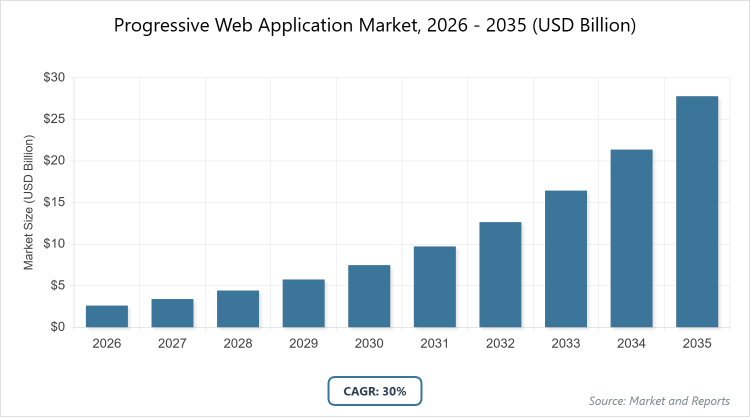
According to MarketnReports, the global Progressive Web Application Market size was estimated at USD 2.62 Billion in 2025 and is expected to reach USD 35 Billion by 2035, growing at a CAGR of 30% from 2026 to 2035. Progressive Web Application Market is driven by increasing demand for enhanced user experiences and cost-effective app development.
What is the Industry Overview of Progressive Web Application Market?
The Progressive Web Application (PWA) market encompasses the development and deployment of web applications that combine the best features of web and mobile apps, providing users with fast, reliable, and engaging experiences. Market definition: Progressive Web Applications are web-based applications built using standard web technologies like HTML, CSS, and JavaScript, enhanced with service workers and manifest files to enable offline functionality, push notifications, and installation on home screens, mimicking native app behavior while being accessible via browsers without requiring app store downloads. This market includes platforms, services, and tools that facilitate the creation, maintenance, and optimization of PWAs, catering to businesses seeking to improve user engagement across devices with lower development costs compared to traditional native apps.
What are the Key Insights into the Progressive Web Application Market?
- The global Progressive Web Application market size was valued at USD 2.62 billion in 2025 and is projected to reach USD 35 billion by 2035.
- The market is anticipated to grow at a CAGR of 30% during the forecast period from 2026 to 2035.
- The market is driven by rising mobile device usage, demand for offline-capable applications, and cost savings in app development.
- The services subsegment dominates the offering segment with a 55% share due to the need for specialized consulting and integration to customize PWAs for business needs; the platforms subsegment follows with 45% as it provides foundational tools for rapid deployment.
- North America holds the largest regional share at 35% owing to advanced technological infrastructure and presence of key innovators like Google and Microsoft.
What are the Market Dynamics in the Progressive Web Application Market?
Growth Drivers
The growth drivers for the Progressive Web Application market are primarily fueled by the surging adoption of mobile devices globally, which necessitates fast-loading and responsive applications that PWAs excel at providing. Businesses are increasingly shifting towards PWAs to reduce development and maintenance costs, as they eliminate the need for separate native apps for iOS and Android platforms. Additionally, features like offline access and push notifications enhance user retention, particularly in e-commerce and media sectors where seamless experiences drive revenue. Technological advancements in web standards, supported by browsers like Chrome and Safari, further accelerate PWA adoption by enabling native-like functionalities without app store dependencies.
Restraints
Restraints in the Progressive Web Application market include limited access to certain device hardware features, such as advanced camera controls or Bluetooth, which can hinder adoption in specialized applications requiring deep integration. Browser compatibility issues persist, as not all browsers fully support PWA features uniformly, leading to inconsistent user experiences. Security concerns, including potential vulnerabilities in service workers, also pose challenges, especially for industries handling sensitive data like finance and healthcare. Moreover, the lack of awareness among small businesses about PWA benefits and the need for skilled developers can slow market penetration in emerging regions.
Opportunities
Opportunities in the Progressive Web Application market arise from the expanding digital transformation in emerging economies, where high mobile penetration but limited app store access makes PWAs an ideal solution for reaching users. Integration with emerging technologies like AI, machine learning, and AR/VR opens new avenues for enhanced PWAs in sectors such as retail and education. The rise of low-code/no-code platforms democratizes PWA development, enabling non-technical users to create applications and broadening market reach. Additionally, post-pandemic shifts towards remote work and online services create demand for reliable, offline-capable tools, positioning PWAs as a key enabler for hybrid work environments.
Challenges
Challenges facing the Progressive Web Application market involve the evolving regulatory landscape around data privacy and web security, which requires continuous updates to PWAs to comply with standards like GDPR and CCPA. Competition from native apps remains strong in performance-critical areas, where PWAs may lag in speed or feature depth. Skill gaps in the workforce for advanced PWA development, including service worker management, can lead to implementation delays. Furthermore, in regions with unstable internet connectivity, while PWAs offer offline modes, initial loading and syncing issues can frustrate users, necessitating ongoing optimizations to maintain market growth.
Progressive Web Application Market Report Scope
| Report Attributes | Report Details |
| Report Name | Progressive Web Application Market |
| Market Size 2025 | USD 2.62 Billion |
| Market Forecast 2035 | USD 35 Billion |
| Growth Rate | CAGR of 30% |
| Report Pages | 220 |
| Key Companies Covered | Google, Microsoft, IBM Corp, Alibaba, Amazon, Salesforce, Adobe, Samsung, Mozilla, Ionic, and Others |
| Segments Covered | By Offering, By Application, By End-User, and By Region |
| Regions Covered | North America, Europe, Asia Pacific (APAC), Latin America, and The Middle East and Africa (MEA) |
| Base Year | 2025 |
| Historical Year | 2020 - 2024 |
| Forecast Year | 2026 - 2035 |
| Customization Scope | Avail customized purchase options to meet your exact research needs. |
What is the Market Segmentation of Progressive Web Application Market?
The Progressive Web Application Market is segmented by offering, application, end-user, and region. All the segments have been analyzed based on present and future trends and the market is estimated from 2026 to 2035.
Based on Offering Segment, The services subsegment is the most dominant with a 55% share, as it encompasses consulting, integration, and maintenance that allow businesses to tailor PWAs to specific needs, driving market growth through customized solutions that enhance user engagement and operational efficiency. The platforms subsegment is the second most dominant at 45%, providing ready-to-use frameworks that accelerate development and reduce costs, helping to propel the overall market by enabling faster time-to-market for applications across industries.
Based on Application Segment, E-commerce & Retail is the most dominant subsegment with a 25% share, as PWAs enable seamless shopping experiences with offline browsing and quick loading, boosting conversions and customer loyalty which significantly drives market expansion. Media & Entertainment follows as the second most dominant at 20%, leveraging PWAs for content delivery with push notifications and caching, enhancing user retention and content consumption that contributes to broader market adoption.
Based on End-User Segment, Large Enterprises dominate with a 60% share, utilizing PWAs for scalable, cross-platform solutions that integrate with existing systems, reducing costs and improving global reach which fuels market growth. Small & Medium Enterprises are the second most dominant at 40%, adopting PWAs for affordable, easy-to-maintain alternatives to native apps, enabling digital presence and competitiveness that supports overall market progression.
What are the Recent Developments in Progressive Web Application Market?
- In 2024, Google announced enhancements to its Chrome browser, including improved service worker APIs that allow PWAs to handle more complex offline scenarios, boosting adoption in e-commerce by enabling seamless shopping experiences even in low-connectivity areas.
- Microsoft launched a new PWA builder tool in 2025, integrating AI-driven design suggestions to simplify development for enterprises, which has accelerated PWA deployment in the healthcare sector for patient engagement apps.
- IBM Corporation partnered with a leading retail chain in 2024 to deploy PWAs with advanced analytics, resulting in a 30% increase in user retention through personalized push notifications and offline access features.
What is the Regional Analysis of Progressive Web Application Market?
North America to dominate the global market.
North America leads the Progressive Web Application market with a 35% share, driven by robust technological infrastructure and innovation hubs in the United States, where companies like Google and Microsoft pioneer PWA advancements, fostering widespread adoption in e-commerce and media; Canada contributes through its growing tech ecosystem focused on digital transformation.
Asia Pacific is the fastest-growing region, propelled by high smartphone penetration in China and India, where PWAs address connectivity challenges in rural areas, enabling e-commerce giants like Alibaba to enhance user experiences; Japan and South Korea add momentum with their advanced mobile networks supporting PWA integration in gaming and entertainment.
Europe holds a significant share, with Germany and the UK dominating through strict data privacy regulations that PWAs comply with efficiently, aiding sectors like banking; France and the Netherlands follow, leveraging PWAs for sustainable digital solutions in travel and education.
Latin America shows emerging potential, led by Brazil and Mexico, where PWAs help bridge digital divides in e-commerce and education amid improving internet access; Argentina contributes through its burgeoning startup scene adopting cost-effective PWA technologies.
The Middle East and Africa are gradually expanding, with the UAE and South Africa at the forefront, using PWAs to support mobile-first economies in finance and healthcare; Saudi Arabia invests in digital initiatives, while Nigeria leverages PWAs for offline-capable services in media.
Who are the Key Market Players in Progressive Web Application Market?
Google: Google focuses on advancing PWA technologies through its Chrome ecosystem, offering tools like Lighthouse for optimization and emphasizing features like offline support to drive enterprise adoption and user engagement strategies.
Microsoft: Microsoft integrates PWAs into its Edge browser and Azure cloud services, providing developer resources and AI-enhanced builders to streamline deployment, targeting large enterprises with scalable solutions for improved cross-platform experiences.
IBM Corp: IBM employs PWA strategies in its Watson AI integrations, offering consulting services for customized applications in healthcare and finance, focusing on security and analytics to enhance data-driven decision-making.
Alibaba: Alibaba leverages PWAs in its e-commerce platforms like Taobao, emphasizing mobile-first designs with push notifications to boost user retention in emerging markets, supported by cloud-based development tools.
Amazon: Amazon utilizes PWAs for its web services, integrating with AWS to provide seamless shopping experiences, focusing on performance optimization and offline capabilities to expand global retail reach.
Salesforce: Salesforce incorporates PWAs into its CRM solutions, enabling offline access for sales teams, with strategies centered on integration with enterprise systems to improve productivity and customer interactions.
Adobe: Adobe offers PWA tools through its Experience Cloud, focusing on UI/UX design enhancements with analytics, targeting media and entertainment sectors for immersive, responsive applications.
Samsung: Samsung promotes PWAs via its Galaxy ecosystem, providing browser support and developer kits for IoT integrations, aiming to enhance user experiences in mobile and smart devices.
Mozilla: Mozilla advances open-source PWA standards through Firefox, offering resources for developers to build secure, performant applications, with a focus on privacy and accessibility.
Ionic: Ionic specializes in hybrid PWA frameworks, providing UI components and tools for rapid development, targeting SMEs with cost-effective strategies for cross-platform app creation.
What are the Market Trends in Progressive Web Application Market?
- Integration of AI and machine learning for personalized user experiences in PWAs.
- Rise of low-code/no-code platforms simplifying PWA development for non-technical users.
- Increased focus on offline functionality and progressive enhancement for emerging markets.
- Adoption of PWAs in e-commerce for faster loading and reduced bounce rates.
- Enhanced security features to address data privacy concerns in regulated industries.
- Convergence with AR/VR technologies for immersive applications in retail and education.
- Growing use in social media for seamless content sharing and notifications.
- Emphasis on sustainability through reduced data usage and efficient caching.
- Expansion into healthcare for patient engagement and remote monitoring tools.
- Collaboration with edge computing for improved performance in real-time applications.
What Market Segments and their Subsegments are Covered in the Progressive Web Application Report?
- By Offering
- Services
- Platforms
- Development Tools
- Consulting
- Integration
- Maintenance
- Customization
- Security Solutions
- Analytics Tools
- UI/UX Design
- Others
- By Application
- E-commerce & Retail
- Media & Entertainment
- Social Media
- Travel & Tourism
- Healthcare
- Education
- Banking & Financial Services
- Gaming
- News & Publishing
- Real Estate
- Others
- By End-User
- Large Enterprises
- Small & Medium Enterprises
- Government
- Non-Profit Organizations
- Education Institutions
- Healthcare Providers
- Retail Businesses
- Media Companies
- Financial Institutions
- Travel Agencies
- Others
- By Region
-
- North America
- U.S.
- Canada
- Europe
- UK
- Germany
- France
- Rest of Europe
- Asia Pacific
- China
- India
- Japan
- Rest of Asia Pacific
- Latin America
- Brazil
- Mexico
- Rest of Latin America
- Middle East & Africa
- UAE
- South Africa
- Rest of Middle East & Africa
- North America
Frequently Asked Questions
The Progressive Web Application market involves the ecosystem of technologies, services, and platforms for developing web apps that offer native-like experiences, including offline access and push notifications.
Key factors include rising mobile usage, demand for cost-effective development, technological advancements in web standards, and increasing adoption in e-commerce and media sectors.
The market is valued at USD 2.62 billion in 2025 and projected to reach USD 35 billion by 2035.
The CAGR is expected to be 30% from 2026 to 2035.
North America will contribute notably, holding a 35% share due to advanced infrastructure and key players.
Major players include Google, Microsoft, IBM Corp, Alibaba, Amazon, Salesforce, Adobe, Samsung, Mozilla, and Ionic.
The report provides in-depth analysis of market size, trends, segments, regional insights, key players, and forecasts from 2026 to 2035.
Stages include research and development, platform creation, consulting and integration, deployment, maintenance, and end-user adoption.
Trends are shifting towards AI integration and low-code tools, while consumers prefer fast, offline-capable apps for seamless experiences.
Data privacy regulations like GDPR and environmental concerns over data usage are pushing for secure, efficient PWAs.