
Predictive Analytics Market Size, Share and Trends 2026 to 2035
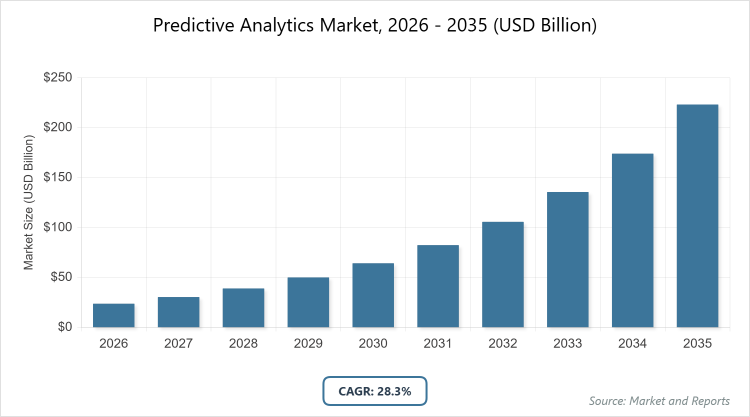
According to MarketnReports, the global Predictive Analytics market size was estimated at USD 23.70 billion in 2025 and is expected to reach USD 286.30 billion by 2035, growing at a CAGR of 28.3% from 2026 to 2035. Predictive Analytics Market is driven by the exponential growth of data and advancements in AI and machine learning.
What are the Key Insights of the Predictive Analytics Market?
- The global Predictive Analytics market was valued at USD 23.70 billion in 2025 and is projected to reach USD 286.30 billion by 2035.
- Growing at a CAGR of 28.3% during the forecast period.
- The market is driven by the exponential growth in data volume and advancements in AI and machine learning.
- The solutions segment dominated the component segment with a share of 80.6%.
- The solutions segment dominates due to increasing demand for advanced analytical tools that enable data-driven decision-making across sectors, enhancing operational efficiency and competitive advantages through capabilities like data mining and machine learning.
- The on-premise segment dominated the deployment mode segment with the largest revenue share.
- The on-premise segment dominates because it provides superior control and security for sensitive data, appealing to organizations requiring strict compliance and governance, offering stability in industries where data privacy is critical.
- The large enterprises segment dominated the organization size segment with the largest revenue share.
- The large enterprises segment dominates owing to their access to extensive resources and vast datasets, allowing effective implementation of sophisticated tools for trend forecasting and strategic decisions, thereby boosting efficiency and market edge.
- The BFSI segment dominated the vertical segment with the largest revenue share.
- The BFSI segment dominates as it relies heavily on data analytics for risk management, fraud detection, and compliance, with digital transformation enhancing customer experiences and operational streamlining through predictive insights.
- North America dominated the region segment with a share of 33.4%.
- North America dominates due to its advanced technological infrastructure, strong focus on data-driven strategies in key industries, presence of leading tech firms, and a robust innovation ecosystem fostering adoption.
What is the Industry Overview of the Predictive Analytics Market?
Predictive analytics refers to the use of historical data, statistical algorithms, and machine learning techniques to identify the likelihood of future outcomes based on patterns and trends. The market encompasses tools and services that enable organizations to forecast behaviors, optimize operations, and make proactive decisions across various industries. It involves extracting insights from vast datasets to anticipate customer needs, manage risks, and improve efficiency, driven by the integration of big data and artificial intelligence. This market plays a crucial role in transforming raw data into actionable intelligence, supporting strategic planning in sectors like finance, healthcare, and retail where anticipating changes can provide a competitive advantage.
What are the Market Dynamics of the Predictive Analytics Market?
Growth Drivers
The exponential growth of data from IoT devices, digital platforms, and social media is a primary driver, as organizations seek advanced tools to process and derive insights from this information overload. This surge compels businesses to adopt predictive analytics for informed decision-making, enhancing competitiveness in dynamic environments. Additionally, the rising integration of AI and machine learning improves model accuracy, enabling real-time forecasting and personalization. Digital transformation initiatives across industries further accelerate adoption, as companies prioritize data-driven strategies to optimize supply chains, customer engagement, and risk assessment. Regulatory pressures in sectors like finance and healthcare also push for predictive tools to ensure compliance and mitigate threats effectively.
Restraints
High implementation costs and complexity in integrating predictive analytics with existing systems pose significant restraints, particularly for smaller organizations lacking technical expertise. Data privacy concerns and stringent regulations, such as GDPR, can hinder adoption by increasing compliance burdens and limiting data usage. Moreover, the shortage of skilled professionals in data science and analytics creates barriers, as businesses struggle to maintain and optimize these solutions. Inaccurate data quality or insufficient historical data can lead to unreliable predictions, eroding trust in the technology. Finally, resistance to change within traditional organizations may slow the shift toward data-centric cultures, impacting overall market penetration.
Opportunities
The expanding adoption of cloud-based solutions presents opportunities for scalability and cost-efficiency, allowing even SMEs to access advanced predictive tools without heavy infrastructure investments. Emerging markets in Asia Pacific offer growth potential through digitalization and government support for AI initiatives, fostering innovation in sectors like e-commerce and manufacturing. Advancements in real-time analytics open doors for applications in IoT and edge computing, enabling instant insights for industries such as transportation and healthcare. Partnerships between tech providers and industry verticals can drive customized solutions, enhancing personalization and operational optimization. Additionally, the increasing focus on sustainability creates avenues for predictive analytics in resource management and environmental forecasting.
Challenges
Ensuring data accuracy and integration from diverse sources remains a challenge, as disparate systems can lead to inconsistencies and flawed predictions. Rapid technological evolution requires continuous updates, straining resources for maintenance and training. Cybersecurity threats pose risks, as predictive models rely on sensitive data vulnerable to breaches. Ethical concerns around bias in algorithms can undermine credibility, necessitating transparent and fair practices. Finally, measuring ROI on predictive analytics investments is complex, as benefits like improved decision-making are often intangible, making justification difficult for stakeholders.
Predictive Analytics Market: Report Scope
| Report Attributes | Report Details |
| Report Name | Predictive Analytics Market |
| Market Size 2025 | USD 23.70 Billion |
| Market Forecast 2035 | USD 286.30 Billion |
| Growth Rate | CAGR of 28.3% |
| Report Pages | 220 |
| Key Companies Covered | SAS Institute Inc., IBM Corporation, SAP SE, Oracle, Microsoft, Salesforce, Inc., Alteryx, Altair Engineering Inc., Cloud Software Group, Inc., QlikTech International AB, and Others |
| Segments Covered | By Component, By Deployment Mode, By Organization Size, By Vertical, and By Region |
| Regions Covered | North America, Europe, Asia Pacific (APAC), Latin America, and The Middle East and Africa (MEA) |
| Base Year | 2025 |
| Historical Year | 2020 – 2024 |
| Forecast Year | 2026 – 2035 |
| Customization Scope | Avail customized purchase options to meet your exact research needs. |
What is the Market Segmentation of the Predictive Analytics Market?
The Predictive Analytics market is segmented by Component, Deployment Mode, Organization Size, Vertical, and region.
Based on Component Segment. The solutions segment is the most dominant, holding 80.6% share, due to its essential role in providing advanced tools for data analysis and forecasting, which organizations prioritize for gaining insights and competitive edges; it drives the market by enabling efficient processing of big data through features like machine learning, directly contributing to operational improvements and revenue growth. The services segment is the second most dominant, expected to grow fastest, as it supports implementation and maintenance, helping businesses integrate solutions seamlessly; this drives market expansion by addressing skill gaps and ensuring long-term value extraction from analytics investments.
Based on Deployment Mode Segment. The on-premise segment is the most dominant with the largest share, preferred for its security and control over sensitive data, which is vital in regulated industries; it drives the market by offering reliable infrastructure that builds trust and facilitates compliance, thereby encouraging adoption among large-scale operations. The cloud segment is the second most dominant, projected to grow at the highest rate, owing to its flexibility and lower costs; it propels market growth by enabling scalable access for diverse users, accelerating digital transformation and real-time data processing across global enterprises.
Based on Organization Size Segment. The large enterprises segment is the most dominant with the largest share, leveraging vast resources for sophisticated implementations; it dominates because of the ability to handle complex datasets for strategic forecasting, driving the market through investments that set industry standards and foster innovation in analytics applications. The small and medium enterprises segment is the second most dominant, anticipated to grow fastest, as cloud accessibility reduces barriers; it contributes to market drive by allowing SMEs to optimize operations and customer engagement, expanding the user base and democratizing advanced analytics.
Based on Vertical Segment. The BFSI segment is the most dominant with the largest share, relying on analytics for risk and fraud management; it leads due to the need for precise predictions in financial transactions, driving the market by enhancing security and customer trust, which boosts overall adoption in high-stakes environments. The retail and e-commerce segment is the second most dominant, expected to grow at the highest CAGR, fueled by demand for personalization; it advances the market through inventory optimization and targeted marketing, increasing efficiency and sales in consumer-driven sectors.
What are the Recent Developments in the Predictive Analytics Market?
- In October 2024, Oracle launched Oracle Analytics Intelligence for Life Sciences, an AI-powered cloud platform that integrates diverse data sets into a unified workspace, streamlining research processes in healthcare by enabling multidisciplinary inquiries and actionable insights.
- In June 2023, Accenture acquired Nextira, an Amazon Web Services Premier Partner specializing in cloud-native innovation and predictive analytics, bolstering Accenture’s Cloud First capabilities with enhanced AI, machine learning, and data analytics for improved client outcomes across industries.
What is the Regional Analysis of the Predictive Analytics Market?
- North America to dominate the global market.
North America The region leads with a 33.4% share, attributed to its sophisticated technological ecosystem and emphasis on data-driven approaches in healthcare, finance, and retail. Investments in AI and machine learning by major firms accelerate adoption, fostering innovation and efficiency. The United States dominates within the region, driven by substantial analytics investments, vast data volumes, and AI integration, positioning it as a hub for predictive solutions that enhance decision-making across sectors.
Asia Pacific This region is set for the fastest growth, propelled by widespread digital technologies, smartphone penetration, and IoT expansion. Governments in countries like India and China invest in AI and digital transformation, enabling businesses to harness data for better efficiency. China dominates the region, supported by initiatives like the New Generation Artificial Intelligence Development Plan, which boosts AI capabilities amid a thriving digital economy, allowing enterprises to use predictive tools for forecasting and consumer analysis.
Europe Growth is driven by increasing demand for data-informed decisions, AI advancements, and digital initiatives, with big data availability aiding sectors like healthcare and retail. The region benefits from collaborative efforts in innovation, enhancing operational engagement. Germany stands out as a dominant country, leveraging its strong industrial base and focus on Industry 4.0 to integrate predictive analytics for manufacturing optimization and supply chain management.
Latin America Adoption is rising due to digitalization in emerging economies, with businesses using predictive tools for market insights and risk management. Challenges like infrastructure gaps are offset by cloud solutions. Brazil dominates, fueled by its large economy and investments in tech, applying analytics in agriculture and finance to improve productivity and economic forecasting.
Middle East and Africa The region sees growth from oil & gas and smart city projects, with analytics aiding resource optimization and urban planning. Government pushes for diversification boost adoption. The UAE dominates, driven by Vision 2031 initiatives emphasizing AI, using predictive analytics in sectors like tourism and logistics for strategic planning and efficiency gains.
Who are the Key Market Players in the Predictive Analytics Market?
- SAS Institute Inc. This player focuses on comprehensive analytics platforms that enable advanced modeling and insights, emphasizing scalability and integration with enterprise systems to drive data-driven strategies.
- IBM Corporation IBM leverages its Watson platform for AI-enhanced predictive analytics, offering tools like SPSS Modeler for pattern detection and decision optimization across industries.
- SAP SE SAP integrates predictive capabilities into its ERP solutions, providing real-time forecasting and analytics to enhance business processes and customer experiences.
- Oracle Oracle’s cloud-based analytics, including recent launches like Analytics Intelligence for Life Sciences, emphasize data integration and AI for efficient insight generation.
- Microsoft Through Azure, Microsoft deploys machine learning models for predictive analytics, focusing on cloud accessibility and innovation in AI-driven solutions.
- Salesforce, Inc. Salesforce incorporates predictive tools in CRM for customer behavior analysis, optimizing marketing and engagement through personalized strategies.
- Alteryx Alteryx offers self-service analytics platforms that simplify data preparation and predictive modeling, targeting ease of use for non-technical users.
- Altair Engineering Inc. Altair provides simulation-driven analytics, combining predictive modeling with engineering insights for industries like manufacturing.
- Cloud Software Group, Inc. This group focuses on data management and analytics software, enabling secure and scalable predictive solutions.
- QlikTech International AB Qlik emphasizes associative analytics for intuitive data exploration and predictive forecasting, aiding quick decision-making.
What are the Market Trends in the Predictive Analytics Market?
- Surge in data from IoT and digital channels demands advanced tools for actionable insights.
- Growing adoption of cloud computing enhances scalability and accessibility of solutions.
- Digital transformation pushes for efficient data processing and personalization.
- AI and ML advancements improve model accuracy and real-time forecasting.
- Shift toward data-driven strategies emphasizes timely decision-making.
- Regulatory needs in finance and healthcare boost risk management applications.
- Increased SME adoption via affordable cloud platforms democratizes analytics.
- Retail focus on personalization drives inventory and marketing optimization.
- Integration with edge computing enables instant IoT insights.
- Emphasis on ethical AI addresses bias for trustworthy predictions.
What are the Market Segments and their Subsegments Covered in the Predictive Analytics Report?
By Component
-
Solutions
- Customer Analytics
- Financial Analytics
- Marketing & Sales Analytics
- Network Analytics
- Risk Analytics
- Supply Chain Analytics
- Web and Social Media Analytics
- Others
-
Services
- Deployment/Installation
- Support & Maintenance
- Training & Consulting
By Deployment Mode
- Cloud
- On-Premise
By Organization Size
- Large Enterprises
- Small and Medium Enterprises
By Vertical
- Aerospace & Defense
- Automotive & Transportation
- BFSI
- Healthcare
- IT & Telecommunication
- Media & Entertainment
- Retail and e-commerce
- Others
By Region
- North America
- U.S.
- Canada
- Europe
- UK
- Germany
- France
- Rest of Europe
- Asia Pacific
- China
- India
- Japan
- Rest of Asia Pacific
- Latin America
- Brazil
- Mexico
- Rest of Latin America
- Middle East & Africa
- UAE
- South Africa
- Rest of Middle East & Africa
Chapter 1. Preface
1.1 Report Description and Scope1.2 Research Scope1.3 Research Methodology1.3.1 Market Research Type1.3.2 Market Research MethodologyChapter 2. Executive Summary
2.1 Global Predictive Analytics Market, (2026 - 2035) (USD Billion)2.2 Global Predictive Analytics Market: SnapshotChapter 3. Global Predictive Analytics Market - Industry Analysis
3.1 Predictive Analytics Market: Market Dynamics3.2 Market Drivers3.2.1 The Predictive Analytics market is driven by exploding data from IoT and digital platforms, AI/ML integration, digital transformation, and regulatory demands for data-driven decision-making.3.3 Market Restraints3.3.1 The Predictive Analytics market is restrained by high implementation costs, integration complexity, data privacy regulations, skilled talent shortages, poor data quality, and organizational resistance to adopting data-driven practices.3.4 Market Opportunities3.4.1 Opportunities in the Predictive Analytics market arise from cloud adoption for scalability, growth in Asia-Pacific, real-time analytics for IoT, industry-specific partnerships, and applications in sustainability and resource management.3.5 Market Challenges3.5.1 The Predictive Analytics market faces challenges from data accuracy and integration issues, rapid tech evolution, cybersecurity risks, algorithmic bias, and difficulty in measuring ROI from intangible benefits.3.6 Porter’s Five Forces Analysis3.7 Market Attractiveness Analysis3.7.1 Market Attractiveness Analysis By Component3.7.2 Market Attractiveness Analysis By Deployment Mode3.7.3 Market Attractiveness Analysis By Organization Size3.7.4 Market Attractiveness Analysis By VerticalChapter 4. Global Predictive Analytics Market- Competitive Landscape
4.1 Company Market Share Analysis4.1.1 Global Predictive Analytics Market: Company Market Share, 20254.2 Strategic Development4.2.1 Acquisitions & mergers4.2.2 New Product launches4.2.3 Agreements, partnerships, collaborations, and joint ventures4.2.4 Research and development and regional expansion4.3 Price Trend AnalysisChapter 5. Global Predictive Analytics Market - Component Analysis
5.1 Global Predictive Analytics Market Overview: Component5.1.1 Global Predictive Analytics Market share, By Component, 2025 and 20355.2 Solutions (Customer Analytics5.2.1 Global Predictive Analytics Market by Solutions (Customer Analytics, 2026 - 2035 (USD Billion)5.3 Financial Analytics5.3.1 Global Predictive Analytics Market by Financial Analytics, 2026 - 2035 (USD Billion)5.4 Marketing & Sales Analytics5.4.1 Global Predictive Analytics Market by Marketing & Sales Analytics, 2026 - 2035 (USD Billion)5.5 Network Analytics5.5.1 Global Predictive Analytics Market by Network Analytics, 2026 - 2035 (USD Billion)5.6 Risk Analytics5.6.1 Global Predictive Analytics Market by Risk Analytics, 2026 - 2035 (USD Billion)5.7 Supply Chain Analytics5.7.1 Global Predictive Analytics Market by Supply Chain Analytics, 2026 - 2035 (USD Billion)5.8 Web and Social Media Analytics5.8.1 Global Predictive Analytics Market by Web and Social Media Analytics, 2026 - 2035 (USD Billion)5.9 Others)5.9.1 Global Predictive Analytics Market by Others), 2026 - 2035 (USD Billion)5.10 Services (Deployment/Installation5.10.1 Global Predictive Analytics Market by Services (Deployment/Installation, 2026 - 2035 (USD Billion)5.11 Support & Maintenance5.11.1 Global Predictive Analytics Market by Support & Maintenance, 2026 - 2035 (USD Billion)Chapter 6. Global Predictive Analytics Market - Deployment Mode Analysis
6.1 Global Predictive Analytics Market Overview: Deployment Mode6.1.1 Global Predictive Analytics Market Share, By Deployment Mode, 2025 and 20356.2 Cloud6.2.1 Global Predictive Analytics Market by Cloud, 2026 - 2035 (USD Billion)6.3 On-Premise6.3.1 Global Predictive Analytics Market by On-Premise, 2026 - 2035 (USD Billion)Chapter 7. Global Predictive Analytics Market - Organization Size Analysis
7.1 Global Predictive Analytics Market Overview: Organization Size7.1.1 Global Predictive Analytics Market Share, By Organization Size, 2025 and 20357.2 Large Enterprises7.2.1 Global Predictive Analytics Market by Large Enterprises, 2026 - 2035 (USD Billion)7.3 Small and Medium Enterprises7.3.1 Global Predictive Analytics Market by Small and Medium Enterprises, 2026 - 2035 (USD Billion)Chapter 8. Global Predictive Analytics Market - Vertical Analysis
8.1 Global Predictive Analytics Market Overview: Vertical8.1.1 Global Predictive Analytics Market Share, By Vertical, 2025 and 20358.2 Aerospace & Defense8.2.1 Global Predictive Analytics Market by Aerospace & Defense, 2026 - 2035 (USD Billion)8.3 Automotive & Transportation8.3.1 Global Predictive Analytics Market by Automotive & Transportation, 2026 - 2035 (USD Billion)8.4 BFSI8.4.1 Global Predictive Analytics Market by BFSI, 2026 - 2035 (USD Billion)8.5 Healthcare8.5.1 Global Predictive Analytics Market by Healthcare, 2026 - 2035 (USD Billion)8.6 IT & Telecommunication8.6.1 Global Predictive Analytics Market by IT & Telecommunication, 2026 - 2035 (USD Billion)8.7 Media & Entertainment8.7.1 Global Predictive Analytics Market by Media & Entertainment, 2026 - 2035 (USD Billion)8.8 Retail and e-commerce8.8.1 Global Predictive Analytics Market by Retail and e-commerce, 2026 - 2035 (USD Billion)8.9 Others8.9.1 Global Predictive Analytics Market by Others, 2026 - 2035 (USD Billion)Chapter 9. Predictive Analytics Market - Regional Analysis
9.1 Global Predictive Analytics Market Regional Overview9.2 Global Predictive Analytics Market Share, by Region, 2025 & 2035 (USD Billion)9.3 North America9.3.1 North America Predictive Analytics Market, 2026 - 2035 (USD Billion)9.3.1.1 North America Predictive Analytics Market, by Country, 2026 - 2035 (USD Billion)9.3.2 North America Predictive Analytics Market, by Component, 2026 - 20359.3.2.1 North America Predictive Analytics Market, by Component, 2026 - 2035 (USD Billion)9.3.3 North America Predictive Analytics Market, by Deployment Mode, 2026 - 20359.3.3.1 North America Predictive Analytics Market, by Deployment Mode, 2026 - 2035 (USD Billion)9.3.4 North America Predictive Analytics Market, by Organization Size, 2026 - 20359.3.4.1 North America Predictive Analytics Market, by Organization Size, 2026 - 2035 (USD Billion)9.3.5 North America Predictive Analytics Market, by Vertical, 2026 - 20359.3.5.1 North America Predictive Analytics Market, by Vertical, 2026 - 2035 (USD Billion)9.4 Europe9.4.1 Europe Predictive Analytics Market, 2026 - 2035 (USD Billion)9.4.1.1 Europe Predictive Analytics Market, by Country, 2026 - 2035 (USD Billion)9.4.2 Europe Predictive Analytics Market, by Component, 2026 - 20359.4.2.1 Europe Predictive Analytics Market, by Component, 2026 - 2035 (USD Billion)9.4.3 Europe Predictive Analytics Market, by Deployment Mode, 2026 - 20359.4.3.1 Europe Predictive Analytics Market, by Deployment Mode, 2026 - 2035 (USD Billion)9.4.4 Europe Predictive Analytics Market, by Organization Size, 2026 - 20359.4.4.1 Europe Predictive Analytics Market, by Organization Size, 2026 - 2035 (USD Billion)9.4.5 Europe Predictive Analytics Market, by Vertical, 2026 - 20359.4.5.1 Europe Predictive Analytics Market, by Vertical, 2026 - 2035 (USD Billion)9.5 Asia Pacific9.5.1 Asia Pacific Predictive Analytics Market, 2026 - 2035 (USD Billion)9.5.1.1 Asia Pacific Predictive Analytics Market, by Country, 2026 - 2035 (USD Billion)9.5.2 Asia Pacific Predictive Analytics Market, by Component, 2026 - 20359.5.2.1 Asia Pacific Predictive Analytics Market, by Component, 2026 - 2035 (USD Billion)9.5.3 Asia Pacific Predictive Analytics Market, by Deployment Mode, 2026 - 20359.5.3.1 Asia Pacific Predictive Analytics Market, by Deployment Mode, 2026 - 2035 (USD Billion)9.5.4 Asia Pacific Predictive Analytics Market, by Organization Size, 2026 - 20359.5.4.1 Asia Pacific Predictive Analytics Market, by Organization Size, 2026 - 2035 (USD Billion)9.5.5 Asia Pacific Predictive Analytics Market, by Vertical, 2026 - 20359.5.5.1 Asia Pacific Predictive Analytics Market, by Vertical, 2026 - 2035 (USD Billion)9.6 Latin America9.6.1 Latin America Predictive Analytics Market, 2026 - 2035 (USD Billion)9.6.1.1 Latin America Predictive Analytics Market, by Country, 2026 - 2035 (USD Billion)9.6.2 Latin America Predictive Analytics Market, by Component, 2026 - 20359.6.2.1 Latin America Predictive Analytics Market, by Component, 2026 - 2035 (USD Billion)9.6.3 Latin America Predictive Analytics Market, by Deployment Mode, 2026 - 20359.6.3.1 Latin America Predictive Analytics Market, by Deployment Mode, 2026 - 2035 (USD Billion)9.6.4 Latin America Predictive Analytics Market, by Organization Size, 2026 - 20359.6.4.1 Latin America Predictive Analytics Market, by Organization Size, 2026 - 2035 (USD Billion)9.6.5 Latin America Predictive Analytics Market, by Vertical, 2026 - 20359.6.5.1 Latin America Predictive Analytics Market, by Vertical, 2026 - 2035 (USD Billion)9.7 The Middle-East and Africa9.7.1 The Middle-East and Africa Predictive Analytics Market, 2026 - 2035 (USD Billion)9.7.1.1 The Middle-East and Africa Predictive Analytics Market, by Country, 2026 - 2035 (USD Billion)9.7.2 The Middle-East and Africa Predictive Analytics Market, by Component, 2026 - 20359.7.2.1 The Middle-East and Africa Predictive Analytics Market, by Component, 2026 - 2035 (USD Billion)9.7.3 The Middle-East and Africa Predictive Analytics Market, by Deployment Mode, 2026 - 20359.7.3.1 The Middle-East and Africa Predictive Analytics Market, by Deployment Mode, 2026 - 2035 (USD Billion)9.7.4 The Middle-East and Africa Predictive Analytics Market, by Organization Size, 2026 - 20359.7.4.1 The Middle-East and Africa Predictive Analytics Market, by Organization Size, 2026 - 2035 (USD Billion)9.7.5 The Middle-East and Africa Predictive Analytics Market, by Vertical, 2026 - 20359.7.5.1 The Middle-East and Africa Predictive Analytics Market, by Vertical, 2026 - 2035 (USD Billion)Chapter 10. Company Profiles
10.1 SAS Institute Inc.10.1.1 Overview10.1.2 Financials10.1.3 Product Portfolio10.1.4 Business Strategy10.1.5 Recent Developments10.2 IBM Corporation10.2.1 Overview10.2.2 Financials10.2.3 Product Portfolio10.2.4 Business Strategy10.2.5 Recent Developments10.3 SAP SE10.3.1 Overview10.3.2 Financials10.3.3 Product Portfolio10.3.4 Business Strategy10.3.5 Recent Developments10.4 Oracle10.4.1 Overview10.4.2 Financials10.4.3 Product Portfolio10.4.4 Business Strategy10.4.5 Recent Developments10.5 Microsoft10.5.1 Overview10.5.2 Financials10.5.3 Product Portfolio10.5.4 Business Strategy10.5.5 Recent Developments10.6 Salesforce Inc.10.6.1 Overview10.6.2 Financials10.6.3 Product Portfolio10.6.4 Business Strategy10.6.5 Recent Developments10.7 Alteryx10.7.1 Overview10.7.2 Financials10.7.3 Product Portfolio10.7.4 Business Strategy10.7.5 Recent Developments10.8 Altair Engineering Inc.10.8.1 Overview10.8.2 Financials10.8.3 Product Portfolio10.8.4 Business Strategy10.8.5 Recent Developments10.9 Cloud Software Group Inc.10.9.1 Overview10.9.2 Financials10.9.3 Product Portfolio10.9.4 Business Strategy10.9.5 Recent Developments10.10 QlikTech International AB10.10.1 Overview10.10.2 Financials10.10.3 Product Portfolio10.10.4 Business Strategy10.10.5 Recent Developments
Frequently Asked Questions
Predictive analytics involves using historical data, statistical methods, and machine learning to forecast future events and behaviors, helping organizations make proactive decisions.
Key factors include data explosion from digital sources, AI and ML advancements, cloud adoption, digital transformation, and regulatory demands for risk management.
The market is projected to grow from approximately USD 23.70 billion in 2025 to USD 286.30 billion by 2035.
The CAGR is expected to be 28.3% during the period.
North America will contribute notably, holding the largest share due to technological advancements and industry adoption.
Major players include SAS Institute Inc., IBM Corporation, SAP SE, Oracle, Microsoft, Salesforce, Inc., Alteryx, Altair Engineering Inc., Cloud Software Group, Inc., and QlikTech International AB.
The report provides in-depth analysis of market size, trends, segments, dynamics, regional insights, key players, and forecasts, offering strategic recommendations for stakeholders.
Stages include data collection and storage, data processing and cleaning, model development and training, deployment and integration, and ongoing monitoring and refinement.
Trends are shifting toward real-time analytics, AI integration, and cloud solutions, while consumers prefer personalized experiences driven by accurate predictions in retail and services.
Regulations like GDPR and data privacy laws impact data usage, while environmental factors such as sustainability goals drive analytics for resource optimization and green initiatives.