
Phycocyanin Market Size and Forecast 2026 to 2035
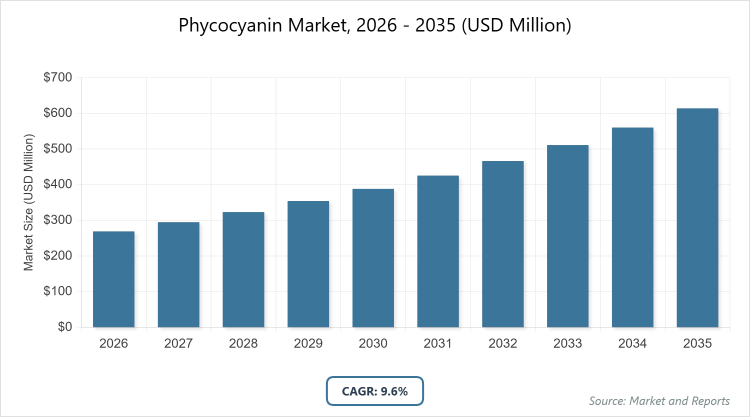
According to MarketnReports, the global Phycocyanin market size was estimated at USD 269.2 million in 2025 and is expected to reach USD 614.2 million by 2035, growing at a CAGR of 9.6% from 2026 to 2035. Phycocyanin Market is driven by the growing demand for natural food colorants, increasing health awareness, and expanding applications in nutraceuticals and cosmetics.
What are the Key Insights of the Phycocyanin Market?
- The phycocyanin market is projected to grow from $269.2 million in 2025 to $614.2 million by 2035, registering a CAGR of 9.6%.
- Powder form dominated with a major share, attributed to its ease of use and versatility.
- Food grade segment dominated among grades, driven by widespread adoption in natural coloring applications.
- Food & beverages application dominated, owing to increasing demand for clean-label products.
- North America dominated regionally with the highest market share.
What is the Industry Overview of the Phycocyanin Market?
Phycocyanin represents a natural blue pigment derived from spirulina and other algae, serving as a versatile ingredient in various industries due to its dual role in providing vibrant coloration and nutritional benefits. It is extracted from cyanobacteria like Arthrospira platensis and functions as a photosynthetic accessory pigment, offering antioxidant properties and health-enhancing attributes. The market encompasses its utilization in food coloring as a safer alternative to synthetic dyes, in dietary supplements for immune support, in pharmaceuticals for therapeutic applications, and in cosmetics for natural formulations. This sector is characterized by a shift toward organic and clean-label products, influenced by consumer preferences for health-conscious choices and regulatory pressures against artificial additives, fostering innovation in extraction techniques and product diversification to meet evolving demands across global supply chains.
What are the Market Dynamics in the Phycocyanin Market?
Growth Drivers
The phycocyanin market is propelled by rising consumer awareness of the adverse health effects associated with synthetic food colors, such as allergies, hyperactivity, and potential carcinogenic risks, leading to increased adoption of natural alternatives like phycocyanin in food processing, dietary supplements, and therapeutic products; supportive government initiatives for spirulina cultivation further enhance production capabilities, while the surge in demand for immunity-boosting nutraceuticals, especially post-pandemic, underscores its antioxidant and anti-inflammatory properties, driving overall market expansion.
Restraints
High costs involved in the extraction, purification, and production of phycocyanin pose significant barriers to market growth, as these processes require advanced technology and quality control measures to maintain purity and stability, making it less competitive against cheaper synthetic options; additionally, the risk of algae contamination during cultivation can compromise product quality and safety, deterring widespread adoption in sensitive applications like pharmaceuticals and food.
Opportunities
Emerging markets in Asia-Pacific present substantial opportunities due to favorable climatic conditions for algae cultivation and growing investments in biotechnology, enabling cost-effective production and export; moreover, expanding applications in cosmetics for creating customized natural shades and in pharmaceuticals for innovative therapeutic formulations open new revenue streams, as brands increasingly seek plant-based ingredients to align with consumer trends toward sustainability and wellness.
Challenges
The presence of close substitutes, such as other natural pigments like beetroot extract or anthocyanins, challenges phycocyanin’s market penetration by offering similar coloring properties at potentially lower costs; coupled with limited consumer awareness about phycocyanin’s specific benefits in certain regions, this creates hurdles in educating end-users and building brand loyalty amidst a competitive landscape of alternative natural colorants.
Phycocyanin Market: Report Scope
| Report Attributes | Report Details |
| Report Name | Phycocyanin Market |
| Market Size 2025 | USD 269.2 Million |
| Market Forecast 2035 | USD 614.2 Million |
| Growth Rate | CAGR of 9.6% |
| Report Pages | 230 |
| Key Companies Covered |
Bluetec Naturals Co., DDW Inc., DIC Corporation, Earthrise Nutritionals LLC, Japan Algae Co. Ltd., Parry Nutraceuticals, Phyco-Biotech Laboratories, Qingdao ZolanBio Co. Ltd., Sigma-Aldrich Corporation, and Yunnan Green A Biological Project Co. Ltd. |
| Segments Covered | By Form, By Grade, By Application, and By Region. |
| Regions Covered | North America, Europe, Asia Pacific (APAC), Latin America, The Middle East and Africa (MEA) |
| Base Year | 2025 |
| Historical Year | 2020 – 2024 |
| Forecast Year | 2026 – 2035 |
| Customization Scope | Avail customized purchase options to meet your exact research needs. |
What is the Market Segmentation in the Phycocyanin Market?
The Phycocyanin market is segmented by form, grade, application, and region.
By Form
The powder form stands as the most dominant segment in the phycocyanin market, holding a substantial share due to its advantages in easy solubility, extended shelf life, and flexibility in dosing for various applications, which facilitates seamless integration into food, beverage, and supplement formulations; this dominance drives the market by enabling efficient supply chain logistics and reducing transportation costs, while the liquid form emerges as the second most dominant, valued for its immediate usability in liquid-based products like beverages and cosmetics, though it requires more stringent storage conditions to prevent degradation, thereby supporting niche applications that prioritize quick dispersion and vibrant color intensity.
By Grade
Food grade phycocyanin emerges as the most dominant segment, primarily because of stringent regulations banning synthetic colors in many countries and rising consumer preference for organic and clean-label ingredients, which positions it as a preferred natural colorant in everyday consumables; this dominance propels market growth by aligning with health trends and enabling premium pricing in food products, whereas pharma grade ranks as the second most dominant, leveraged for its high purity and therapeutic benefits like antioxidant effects in medical formulations, contributing to market expansion through specialized applications in health supplements and diagnostics that demand rigorous quality standards.
By Application
The food & beverages application dominates the phycocyanin market, driven by the global shift away from artificial dyes amid health concerns and regulatory bans, allowing phycocyanin to provide safe, vibrant blue hues in products like confectionery and drinks; this leadership accelerates overall market growth by tapping into the vast consumer base seeking natural ingredients, with pharmaceuticals as the second most dominant segment, utilizing phycocyanin’s bioactive properties for anti-inflammatory and anticancer therapies, thereby fostering innovation in drug development and enhancing market value through high-margin medical uses.
What are the Recent Developments in the Phycocyanin Market?
- DDW Inc. introduced an advanced blue phycocyanin liquid formulation with enhanced light stability by up to 40%, addressing key challenges in food and beverage applications where color retention under exposure is critical, thereby boosting its adoption in shelf-stable products and contributing to market competitiveness through improved performance.
- Increased launches of natural and organic food color products incorporating phycocyanin have been observed, reflecting industry efforts to meet clean-label demands, with companies focusing on sustainable sourcing from spirulina to appeal to eco-conscious consumers and expand market reach.
- During the COVID-19 period, phycocyanin saw heightened integration into dietary supplements and nutraceuticals for immunity enhancement, as its antioxidant properties aligned with global health priorities, leading to surged demand and strategic production ramp-ups by key players to capitalize on this trend.
What is the Regional Analysis of the Phycocyanin Market?
North America to dominate the market
North America leads the phycocyanin market with significant applications in food & beverages, pharmaceuticals, and cosmetics, fueled by high health consciousness, prevalence of diseases linked to artificial colors, and robust regulatory support for natural ingredients; the United States dominates this region due to its advanced food processing industry, large consumer base for organic products, and substantial investments in biotechnology, driving innovation and market share through widespread adoption in clean-label foods and supplements.
Europe exhibits strong growth in the phycocyanin market, supported by bans on synthetic colors like Allura red AC in countries such as Denmark, Belgium, France, and Switzerland, which promote natural alternatives; Germany stands as the dominating country here, owing to its stringent food safety regulations, thriving pharmaceutical sector, and emphasis on sustainable sourcing, enabling expanded use in nutraceuticals and cosmetics while contributing to regional market dynamics through export-oriented production.
Asia-Pacific is poised for the highest growth in the phycocyanin market, benefiting from favorable environments for spirulina cultivation and increasing industrialization in biotechnology; China dominates this region with its vast algae production capabilities, cost-effective manufacturing, and rising domestic demand for natural colorants in food and pharmaceuticals, propelling market expansion through economies of scale and integration into global supply chains.
LAMEA represents an emerging segment in the phycocyanin market, with potential in nutraceuticals and food applications amid growing awareness of natural ingredients; Brazil dominates this region, leveraging its agricultural strengths for algae farming, supportive government policies for bio-based products, and expanding consumer markets for health-focused goods, thereby fostering regional growth through localized production and export opportunities.
Who are the Key Market Players and Their Strategies in the Phycocyanin Market?
- Bluetec Naturals Co. focuses on sustainable spirulina cultivation and product innovation to enhance purity and yield, aiming to capture emerging markets through partnerships and expanded distribution networks.
- DDW Inc. emphasizes research-driven advancements, such as improved stability formulations, to differentiate in competitive segments and build brand loyalty via targeted marketing in food & beverages.
- DIC Corporation leverages vertical integration in algae production and extraction to ensure quality control, pursuing global expansions and acquisitions to strengthen its position in pharmaceuticals and cosmetics.
- Earthrise Nutritionals LLC prioritizes organic certifications and eco-friendly practices to appeal to health-conscious consumers, investing in R&D for new applications in nutraceuticals.
- Japan Algae Co. Ltd. adopts technological upgrades in biotechnology for efficient phycocyanin extraction, focusing on export strategies to high-demand regions like North America and Europe.
- Parry Nutraceuticals concentrates on cost-effective production methods and collaborations with food giants to drive volume sales, emphasizing clean-label trends in its strategy.
- Phyco-Biotech Laboratories specializes in high-purity grades for pharma applications, using innovation in purification techniques to meet regulatory standards and expand into therapeutic markets.
- Qingdao ZolanBio Co. Ltd. pursues scale-up in manufacturing and supply chain optimizations to reduce costs, targeting Asia-Pacific growth through local partnerships.
- Sigma-Aldrich Corporation integrates phycocyanin into its broad chemical portfolio, focusing on analytical-grade offerings and R&D collaborations for customized solutions.
- Yunnan Green A Biological Project Co. Ltd. invests in regional cultivation hubs and sustainability initiatives to boost output, aiming at export markets with competitive pricing strategies.
What are the Market Trends in the Phycocyanin Market?
- Phasing out of synthetic colors in food & beverages due to safety concerns and regulatory restrictions, boosting demand for natural blue pigments like phycocyanin.
- Rising popularity of phycocyanin in customized color blends for shades such as green, lavender, and violet in cosmetics and food products.
- Increasing incorporation of spirulina-derived phycocyanin in pharmaceuticals for its antioxidant and anti-inflammatory benefits.
- Growth in consumer preference for organic and clean-label products, driving innovation in extraction and formulation techniques.
- Expansion of applications in nutraceuticals amid heightened focus on immunity and wellness post-global health events.
What Market Segments are Covered in the Phycocyanin Market Report?
By Form
- Powder
- Liquid
By Grade
- Food Grade
- Pharma Grade
- Reagent & Analytical Grade
By Application
- Food & Beverages
- Pharmaceuticals
- Cosmetics
- Nutraceuticals
- Others
By Region
-
- North America
- U.S.
- Canada
- Europe
- UK
- Germany
- France
- Rest of Europe
- Asia Pacific
- China
- India
- Japan
- Rest of Asia Pacific
- Latin America
- Brazil
- Mexico
- Rest of Latin America
- Middle East & Africa
- UAE
- South Africa
- Rest of Middle East & Africa
Chapter 1. Preface
1.1 Report Description and Scope1.2 Research Scope1.3 Research Methodology1.3.1 Market Research Type1.3.2 Market Research MethodologyChapter 2. Executive Summary
2.1 Global Phycocyanin Market, (2026 - 2035) (USD Million)2.2 Global Phycocyanin Market: SnapshotChapter 3. Global Phycocyanin Market - Industry Analysis
3.1 Phycocyanin Market: Market Dynamics3.2 Market Drivers3.2.1 The phycocyanin market is driven by rising awareness of the health risks of synthetic food colors, growing demand for natural and immunity-boosting nutraceuticals, supportive government initiatives for spirulina cultivation, and its expanding use in food, supplements, and therapeutic applications.3.3 Market Restraints3.3.1 High extraction and purification costs, reliance on advanced technology and strict quality control, and risks of algae contamination that affect product purity and safety limit the competitiveness and wider adoption of phycocyanin, especially against low-cost synthetic alternatives.3.4 Market Opportunities3.4.1 Emerging Asia-Pacific markets offer strong growth opportunities through favorable algae-cultivation climates and rising biotech investments, while expanding use of phycocyanin in cosmetics and pharmaceuticals supports new revenue streams driven by sustainability and wellness trends.3.5 Market Challenges3.5.1 The presence of alternative natural pigments like beetroot extract and anthocyanins, along with limited regional consumer awareness of phycocyanin’s benefits, poses challenges to market penetration and brand loyalty in a competitive natural colorant landscape.3.6 Porter’s Five Forces Analysis3.7 Market Attractiveness Analysis3.7.1 Market Attractiveness Analysis By Form3.7.2 Market Attractiveness Analysis By Grade3.7.3 Market Attractiveness Analysis By ApplicationChapter 4. Global Phycocyanin Market- Competitive Landscape
4.1 Company Market Share Analysis4.1.1 Global Phycocyanin Market: Company Market Share, 20254.2 Strategic Development4.2.1 Acquisitions & mergers4.2.2 New Product launches4.2.3 Agreements, partnerships, collaborations, and joint ventures4.2.4 Research and development and regional expansion4.3 Price Trend AnalysisChapter 5. Global Phycocyanin Market - Form Analysis
5.1 Global Phycocyanin Market Overview: Form5.1.1 Global Phycocyanin Market share, By Form, 2025 and 20355.2 Powder5.2.1 Global Phycocyanin Market by Powder, 2026 - 2035 (USD Million)5.3 Liquid5.3.1 Global Phycocyanin Market by Liquid, 2026 - 2035 (USD Million)Chapter 6. Global Phycocyanin Market - Grade Analysis
6.1 Global Phycocyanin Market Overview: Grade6.1.1 Global Phycocyanin Market Share, By Grade, 2025 and 20356.2 Food Grade6.2.1 Global Phycocyanin Market by Food Grade, 2026 - 2035 (USD Million)6.3 Pharma Grade6.3.1 Global Phycocyanin Market by Pharma Grade, 2026 - 2035 (USD Million)6.4 Reagent & Analytical Grade6.4.1 Global Phycocyanin Market by Reagent & Analytical Grade, 2026 - 2035 (USD Million)Chapter 7. Global Phycocyanin Market - Application Analysis
7.1 Global Phycocyanin Market Overview: Application7.1.1 Global Phycocyanin Market Share, By Application, 2025 and 20357.2 Food & Beverages7.2.1 Global Phycocyanin Market by Food & Beverages, 2026 - 2035 (USD Million)7.3 Pharmaceuticals7.3.1 Global Phycocyanin Market by Pharmaceuticals, 2026 - 2035 (USD Million)7.4 Cosmetics7.4.1 Global Phycocyanin Market by Cosmetics, 2026 - 2035 (USD Million)7.5 Nutraceuticals7.5.1 Global Phycocyanin Market by Nutraceuticals, 2026 - 2035 (USD Million)7.6 Others7.6.1 Global Phycocyanin Market by Others, 2026 - 2035 (USD Million)Chapter 8. Phycocyanin Market - Regional Analysis
8.1 Global Phycocyanin Market Regional Overview8.2 Global Phycocyanin Market Share, by Region, 2025 & 2035 (USD Million)8.3 North America8.3.1 North America Phycocyanin Market, 2026 - 2035 (USD Million)8.3.1.1 North America Phycocyanin Market, by Country, 2026 - 2035 (USD Million)8.3.2 North America Phycocyanin Market, by Form, 2026 - 20358.3.2.1 North America Phycocyanin Market, by Form, 2026 - 2035 (USD Million)8.3.3 North America Phycocyanin Market, by Grade, 2026 - 20358.3.3.1 North America Phycocyanin Market, by Grade, 2026 - 2035 (USD Million)8.3.4 North America Phycocyanin Market, by Application, 2026 - 20358.3.4.1 North America Phycocyanin Market, by Application, 2026 - 2035 (USD Million)8.4 Europe8.4.1 Europe Phycocyanin Market, 2026 - 2035 (USD Million)8.4.1.1 Europe Phycocyanin Market, by Country, 2026 - 2035 (USD Million)8.4.2 Europe Phycocyanin Market, by Form, 2026 - 20358.4.2.1 Europe Phycocyanin Market, by Form, 2026 - 2035 (USD Million)8.4.3 Europe Phycocyanin Market, by Grade, 2026 - 20358.4.3.1 Europe Phycocyanin Market, by Grade, 2026 - 2035 (USD Million)8.4.4 Europe Phycocyanin Market, by Application, 2026 - 20358.4.4.1 Europe Phycocyanin Market, by Application, 2026 - 2035 (USD Million)8.5 Asia Pacific8.5.1 Asia Pacific Phycocyanin Market, 2026 - 2035 (USD Million)8.5.1.1 Asia Pacific Phycocyanin Market, by Country, 2026 - 2035 (USD Million)8.5.2 Asia Pacific Phycocyanin Market, by Form, 2026 - 20358.5.2.1 Asia Pacific Phycocyanin Market, by Form, 2026 - 2035 (USD Million)8.5.3 Asia Pacific Phycocyanin Market, by Grade, 2026 - 20358.5.3.1 Asia Pacific Phycocyanin Market, by Grade, 2026 - 2035 (USD Million)8.5.4 Asia Pacific Phycocyanin Market, by Application, 2026 - 20358.5.4.1 Asia Pacific Phycocyanin Market, by Application, 2026 - 2035 (USD Million)8.6 Latin America8.6.1 Latin America Phycocyanin Market, 2026 - 2035 (USD Million)8.6.1.1 Latin America Phycocyanin Market, by Country, 2026 - 2035 (USD Million)8.6.2 Latin America Phycocyanin Market, by Form, 2026 - 20358.6.2.1 Latin America Phycocyanin Market, by Form, 2026 - 2035 (USD Million)8.6.3 Latin America Phycocyanin Market, by Grade, 2026 - 20358.6.3.1 Latin America Phycocyanin Market, by Grade, 2026 - 2035 (USD Million)8.6.4 Latin America Phycocyanin Market, by Application, 2026 - 20358.6.4.1 Latin America Phycocyanin Market, by Application, 2026 - 2035 (USD Million)8.7 The Middle-East and Africa8.7.1 The Middle-East and Africa Phycocyanin Market, 2026 - 2035 (USD Million)8.7.1.1 The Middle-East and Africa Phycocyanin Market, by Country, 2026 - 2035 (USD Million)8.7.2 The Middle-East and Africa Phycocyanin Market, by Form, 2026 - 20358.7.2.1 The Middle-East and Africa Phycocyanin Market, by Form, 2026 - 2035 (USD Million)8.7.3 The Middle-East and Africa Phycocyanin Market, by Grade, 2026 - 20358.7.3.1 The Middle-East and Africa Phycocyanin Market, by Grade, 2026 - 2035 (USD Million)8.7.4 The Middle-East and Africa Phycocyanin Market, by Application, 2026 - 20358.7.4.1 The Middle-East and Africa Phycocyanin Market, by Application, 2026 - 2035 (USD Million)Chapter 9. Company Profiles
9.1 Bluetec Naturals Co.9.1.1 Overview9.1.2 Financials9.1.3 Product Portfolio9.1.4 Business Strategy9.1.5 Recent Developments9.2 DDW Inc.9.2.1 Overview9.2.2 Financials9.2.3 Product Portfolio9.2.4 Business Strategy9.2.5 Recent Developments9.3 DIC Corporation9.3.1 Overview9.3.2 Financials9.3.3 Product Portfolio9.3.4 Business Strategy9.3.5 Recent Developments9.4 Earthrise Nutritionals LLC9.4.1 Overview9.4.2 Financials9.4.3 Product Portfolio9.4.4 Business Strategy9.4.5 Recent Developments9.5 Japan Algae Co. Ltd.9.5.1 Overview9.5.2 Financials9.5.3 Product Portfolio9.5.4 Business Strategy9.5.5 Recent Developments9.6 Parry Nutraceuticals9.6.1 Overview9.6.2 Financials9.6.3 Product Portfolio9.6.4 Business Strategy9.6.5 Recent Developments9.7 Phyco-Biotech Laboratories9.7.1 Overview9.7.2 Financials9.7.3 Product Portfolio9.7.4 Business Strategy9.7.5 Recent Developments9.8 Qingdao ZolanBio Co. Ltd.9.8.1 Overview9.8.2 Financials9.8.3 Product Portfolio9.8.4 Business Strategy9.8.5 Recent Developments9.9 Sigma-Aldrich Corporation9.9.1 Overview9.9.2 Financials9.9.3 Product Portfolio9.9.4 Business Strategy9.9.5 Recent Developments9.10 Yunnan Green A Biological Project Co. Ltd.9.10.1 Overview9.10.2 Financials9.10.3 Product Portfolio9.10.4 Business Strategy9.10.5 Recent Developments
- North America
Frequently Asked Questions
Phycocyanin is a water-soluble, fluorescent blue pigment protein extracted from cyanobacteria like Arthrospira platensis, used for its nutritional and coloring properties in food, supplements, and therapeutics.
Key factors include rising demand for natural colorants, bans on synthetic dyes, health awareness, government support for spirulina production, and expansions in pharmaceuticals and cosmetics applications.
The phycocyanin market is projected to grow from $269.2 million in 2025 to $614.2 million by 2035.
The CAGR value of the phycocyanin market during 2026-2035 is expected to be 9.6%.
North America will contribute notably to the phycocyanin market value, driven by high adoption in food & beverages and health-focused products.
Major players include Bluetec Naturals Co., DDW Inc., DIC Corporation, Earthrise Nutritionals LLC, Japan Algae Co. Ltd., Parry Nutraceuticals, Phyco-Biotech Laboratories, Qingdao ZolanBio Co. Ltd., Sigma-Aldrich Corporation, and Yunnan Green A Biological Project Co. Ltd.
The global phycocyanin market report offers in-depth analysis of market size, forecasts, segments, dynamics, regional insights, key players, trends, and opportunities for stakeholders.
The value chain includes algae cultivation, extraction and purification, formulation and processing, distribution, and end-use applications in industries like food & beverages and pharmaceuticals.
Market trends are shifting toward sustainable sourcing and organic certifications, while consumer preferences favor natural, plant-based ingredients for health and environmental reasons.
Regulatory bans on synthetic colors and environmental emphasis on sustainable algae farming are positively affecting growth by promoting natural alternatives like phycocyanin.