
Online Gambling & Betting Market Size, Share and Trends 2026 to 2035
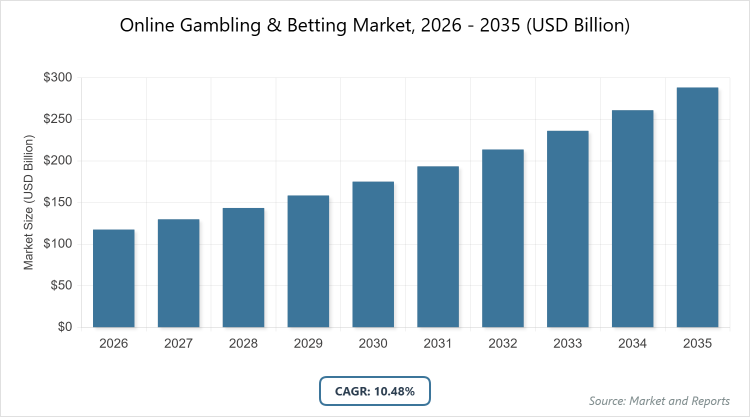
According to our latest research, the global Online Gambling & Betting market size was estimated at USD 117.6 billion in 2025 and is expected to reach USD 287.4 billion by 2035, growing at a CAGR of 10.48% from 2026 to 2035.
The Online Gambling and Betting Market is primarily driven by increasing smartphone and internet penetration, widespread legalization and regulatory support, and technological advancements such as AI-driven personalization and secure digital payment systems.
What Are the Key Insights in the Online Gambling & Betting Market?
- The global online gambling & betting market is projected to grow from USD 117.6 billion in 2026 to USD 287.4 billion by 2035, at a CAGR of 10.48%.
- Dominated Subsegment in Type: Sports Betting holds the largest share due to its popularity and integration with live events.
- Dominated Subsegment in Device: Mobile dominates with over 65% market share for its convenience and accessibility.
- Dominated Subsegment in End-Use: Casinos lead among game types, followed by lotteries for their broad appeal.
- Dominated Region: Europe contributes the highest value, accounting for approximately 57% of the global market.
What Defines the Online Gambling & Betting Market?
Industry Overview
The online gambling and betting market refers to the digital platforms and services that enable users to participate in wagering activities such as sports betting, casino games, poker, lotteries, and bingo through internet-enabled devices like smartphones, computers, and tablets. It encompasses an ecosystem of operators, software providers, and payment gateways that facilitate real-time transactions, live streaming of events, and interactive gaming experiences while adhering to varying regulatory frameworks across jurisdictions.
This market thrives on technological integrations like AI for personalized recommendations, secure encryption for data protection, and mobile optimization for on-the-go access, catering to a global audience seeking entertainment, convenience, and potential financial gains. As consumer preferences shift towards digital leisure, the market bridges traditional gambling with modern tech, promoting responsible gaming practices amid concerns over addiction and fraud.
What Drives the Growth of the Online Gambling & Betting Market?
Growth Drivers
The online gambling and betting market is fueled by widespread smartphone adoption, with nearly 80% of online gamblers using mobile devices for access, coupled with high-speed internet proliferation and the legalization of sports betting in key regions like North America, which expand user accessibility and drives revenue through innovative features like live in-play wagering, esports integration, and microbetting options.
Technological advancements in AI, VR, and 5G enhance user engagement by offering immersive experiences, personalized betting recommendations, and real-time data analytics, while partnerships between operators and sports leagues or esports organizations boost visibility, trust, and user acquisition among younger demographics like millennials and Gen Z. Additionally, the rise of cryptocurrency payments and blockchain technology provides anonymity, faster transactions, and lower fees, attracting tech-savvy users in emerging economies, alongside the surge in virtual sports and metaverse-based platforms that create new entertainment avenues during off-seasons or global events.
Restraints
Restraints include stringent regulatory hurdles, advertising restrictions, and outright bans in several countries, which limit market entry, increase compliance costs for operators, and create operational complexities, alongside growing concerns over problem gambling that prompt governments to impose self-exclusion mandates, deposit limits, and mandatory responsible gaming tools, with statistics showing 23% of sports bettors self-identifying as addicted and higher rates among Gen Z.
Cybersecurity threats, such as data breaches, fraudulent activities, and the rise of unregulated offshore sites, erode user confidence and divert revenue from legitimate platforms, while high taxation in mature markets like Europe squeezes profit margins and economic downturns reduce disposable income for recreational betting. Furthermore, public scrutiny from anti-gambling campaigns, coupled with challenges in verifying user age and location, heightens risks of fines and reputational damage for non-compliant operators.
Opportunities
Opportunities emerge from the untapped potential in Asia-Pacific and Latin America, where relaxing regulations, growing digital infrastructure, and a young demographic could open new markets for mobile-first betting apps, localized content, and fantasy sports, with projections indicating double-digit growth in regions like Brazil following recent legalizations. Integration of blockchain for transparent transactions, NFTs in gaming rewards, and Web3 gambling platforms could attract innovative users seeking decentralized experiences, while expansions into virtual sports, esports betting, and metaverse-based casinos offer diversification beyond traditional wagering.
Collaborations with fintech for seamless payments, AI-driven responsible gaming tools, and mergers & acquisitions (dominating 60.8% in online casinos and 48.6% in sports betting) present avenues to consolidate market share, enhance sustainability, and capitalize on macroeconomic rebounds in 2026, fostering long-term growth amid maturing industries.
Challenges
Challenges involve navigating fragmented global regulations, where operators must adapt to diverse licensing requirements, face potential bans or fines, and comply with evolving anti-money laundering (AML) standards, compounded by the need to combat addiction through mandatory tools like spending alerts and predictive analytics, with problem gambling advocates highlighting issues like a 37% addiction rate among Gen Z bettors and high suicide risks.
Technological disparities in developing regions hinder seamless user experiences on lower-end devices, while intense competition from sweepstakes casinos and prediction markets demands continuous innovation in odds calculation, user retention strategies, and banking integrations amid complex payment landscapes. Balancing profitability with social responsibility remains a persistent hurdle, as public scrutiny, lobbying against unregulated models, and the decline of sweepstakes due to opposition from regulated gaming could reshape market dynamics in 2026.
Online Gambling & Betting Market: Report Scope
| Report Attributes | Report Details |
| Report Name | Online Gambling & Betting Market |
| Market Size 2025 | USD 117.6 Billion |
| Market Forecast 2035 | USD 287.4 Billion |
| Growth Rate | CAGR of 10.48% |
| Report Pages | 225 |
| Key Companies Covered | Bet365 Group Ltd., Flutter Entertainment, Entain plc, DraftKings Inc., 888 Holdings plc, Betsson AB, and Kindred Group |
| Segments Covered | By Type, By Device, By End-Use, By Region |
| Regions Covered | North America, Europe, Asia Pacific (APAC), Latin America, The Middle East and Africa (MEA) |
| Base Year | 2025 |
| Historical Year | 2020 – 2024 |
| Forecast Year | 2026 – 2035 |
| Customization Scope | Avail customized purchase options to meet your exact research needs. |
How Is the Online Gambling & Betting Market Divided and What Drives Segment Dominance?
The online gambling & betting market is segmented by type, device, end-use, and region.
By type, with Sports Betting as the most dominant subsegment, followed by Casino Games as the second most dominant; Sports Betting leads because of its alignment with global sporting events, real-time engagement via live streaming, regulatory approvals in regions like the US and Europe that enable microbetting and parlays, and its ability to attract a broad demographic through partnerships with leagues, which enhance user participation and revenue, thereby driving overall market growth by fostering innovation in data-driven odds and expanding into esports, contributing to nearly 48% of the market share while adapting to trends like 5G-enabled in-play options that boost retention and spend.
By device, Mobile is the most dominant subsegment, with Desktop as the second most dominant; Mobile dominates owing to the ubiquity of smartphones with nearly 80% of gamblers using them, 5G advancements enabling seamless live betting and push notifications, app-based interfaces that support geolocation services and personalized features, and high penetration in emerging markets where fixed broadband is limited, propelling market expansion by increasing accessibility for on-the-go users, accounting for over 57% share, and integrating with payment methods like e-wallets to reduce friction and attract younger, tech-savvy audiences.
By end-use, Casinos is the most dominant, followed by Lotteries as the second most dominant; Casinos lead due to their variety of games like slots, roulette, and live dealer options powered by RNG and VR technology, appealing to entertainment seekers with high jackpot potentials, bonuses, and cross-platform loyalty programs, driving the market by generating consistent revenue streams through M&A activities (60.8% dominance in deals), user retention via AI personalization, and expansions into hybrid models that blend online with social gaming, while adapting to regulations for fair play and responsible features.
What Are the Recent Developments in the Online Gambling & Betting Market?
- In October 2025, Flutter Entertainment acquired a major stake in a Brazilian betting platform, expanding its footprint in Latin America amid regulatory liberalizations, which aims to capitalize on the region’s growing mobile user base and integrate local sports content for enhanced engagement.
- DraftKings launched AI-powered responsible gaming tools in November 2025 across its US operations, including real-time spending alerts and predictive analytics to identify at-risk behaviors, responding to heightened regulatory scrutiny and aiming to foster sustainable user habits while maintaining compliance.
- In December 2025, Entain partnered with a blockchain firm to introduce crypto-based betting options on its platforms, targeting tech-savvy users in Europe and Asia, which enhances transaction speed and anonymity while addressing fraud concerns through decentralized ledgers.
How Do Regional Analysis the Online Gambling & Betting Market?
- Europe to dominate the market
Europe dominates the online gambling & betting market with around 57% share, driven by mature regulatory environments like the UK’s Gambling Commission and Malta’s licensing hubs, high internet penetration exceeding 90% in countries such as Germany and Sweden, and a strong culture of sports wagering integrated with events like the Premier League, projecting a steady CAGR of 8-10% amid GDPR compliance for data protection; the United Kingdom leads the region through innovative operators like Bet365 offering live streaming and in-play features, a market valued at over USD 50 billion in 2025 with liberal advertising policies boosting user growth, though challenges from tax hikes (up to 21% on gross gaming revenue) and addiction awareness campaigns are offset by trends in esports betting, mobile apps, and M&A activities that attract international investments and sustain market leadership.
North America holds about 25% of the market, characterized by rapid legalization following the 2018 PASPA repeal, with states like New Jersey generating over USD 1 billion monthly in handle and Pennsylvania leading in integrated casino-sportsbook models, expecting a CAGR of 12% fueled by partnerships with NBA/NFL leagues and expansions into more states; the United States dominates due to operators like DraftKings and FanDuel leveraging AI for personalized odds and aggressive marketing in newly legal markets, addressing identity fraud through advanced verification while navigating state-by-state regulations and federal oversight on advertising, with opportunities in crypto integrations and prediction markets like Kalshi’s 75% sports share offsetting hurdles like banking complexities and problem gambling concerns.
Asia-Pacific represents 10-15% share, emerging quickly with deregulation in markets like India and Japan, where mobile betting surges amid cricket popularity and esports viewership exceeding 500 million, with a projected CAGR over 15% as 5G rollout enhances access and real-time features; India leads through platforms adapting to local preferences like fantasy cricket (bypassing gambling bans), a young demographic of over 600 million internet users, and growing fintech integrations for payments, though strict prohibitions in China and cultural stigmas pose challenges, opportunities in blockchain for transparent wagering and localized content promise inclusion for unbanked populations and drive revenue in underserved areas.
Latin America accounts for 5-7%, growing via reforms in Brazil and Mexico that legalize online platforms, with soccer betting driving demand amid events like Copa America, projecting a 20% CAGR supported by mobile fintech advances and a population of over 600 million; Brazil dominates with its massive market potential post-2025 regulations, enabling operators to enter with localized apps and responsible tools, generating economic benefits through job creation and taxes, despite economic volatility, corruption concerns, and infrastructure gaps, partnerships for AI fraud detection aid market maturation and user trust.
The Middle East & Africa holds under 5%, with limited but growing adoption in South Africa and UAE through licensed sites focusing on sports and virtual gaming, with a CAGR around 12% amid digital payment advances like mobile money; South Africa leads via established operators and enthusiasm for rugby/cricket, supported by regulatory frameworks and investments in cybersecurity, yet widespread prohibitions in Islamic nations and connectivity issues in rural Africa hinder progress, offset by potential in esports for regulated entertainment and financial inclusion initiatives.
Who Are the Key Market Players and Strategies in the Online Gambling & Betting Market and Their Approaches?
- Bet365 Group Ltd. focuses on live streaming and in-play betting innovations, expanding globally through acquisitions and regulatory compliance to capture sports enthusiasts.
- Flutter Entertainment leverages its FanDuel brand for US market dominance, investing in data analytics and partnerships with leagues to enhance user engagement and loyalty.
- Entain plc pursues M&A strategies, like BetMGM joint ventures, while emphasizing responsible gaming tech to navigate regulations and diversify into esports.
- DraftKings Inc. emphasizes daily fantasy sports integration with betting, using AI for personalized odds and aggressive marketing in newly legal states.
- 888 Holdings plc adopts a tech-driven approach with casino-focused platforms, securing licenses in Europe and North America for cross-selling opportunities.
- Betsson AB targets emerging markets with localized apps and crypto payments, focusing on sustainability to build long-term user trust.
- Kindred Group prioritizes ethical practices and innovation in VR gaming, expanding through affiliations and advocacy for unified regulations.
What Market Trends are in the Online Gambling & Betting Market?
- Rise of mobile and 5G-enabled live betting for real-time engagement.
- Integration of cryptocurrencies and blockchain for secure, anonymous transactions.
- Growth in esports and virtual sports wagering among younger demographics.
- AI-driven personalization and predictive analytics for user retention.
- Emphasis on responsible gaming tools like self-exclusion and spending limits.
- Expansion of the metaverse and VR casinos for immersive experiences.
- Increasing M&A activities to consolidate market share in regulated regions.
What Market Segments are Covered in the Online Gambling & Betting Market Report Encompass?
By Type
- Sports Betting
- Casino Games
- Poker
- Lottery
- Bingo
- Others
By Device
- Mobile
- Desktop
- Tablet
By End-Use
- Entertainment
- Commercial
By Region
- North America
- U.S.
- Canada
- Europe
- UK
- Germany
- France
- Rest of Europe
- Asia Pacific
- China
- India
- Japan
- Rest of Asia Pacific
- Latin America
- Brazil
- Mexico
- Rest of Latin America
- Middle East & Africa
- UAE
- South Africa
- Rest of Middle East & Africa
Frequently Asked Questions
Online gambling & betting involve digital platforms where users wager money on outcomes of games, sports events, or lotteries via internet devices, encompassing activities like casino slots, poker, and sports predictions with real-time features.
Key factors include regulatory liberalizations, mobile technology advancements, esports popularity, cryptocurrency adoption, and AI integrations, alongside challenges from addiction concerns and cybersecurity.
The market value is expected to grow from USD 116.6 billion in 2026 to USD 286.4 billion by 2035.
The CAGR for the online gambling & betting market from 2026 to 2035 is projected at 10.5%.
Europe will contribute notably, holding approximately 57% of the market value due to established regulations and high adoption.
Major players include Bet365 Group Ltd., Flutter Entertainment, Entain plc, DraftKings Inc., 888 Holdings plc, Betsson AB, and Kindred Group, driving growth through innovations and expansions.
The report offers comprehensive insights into market size, trends, segmentation, regional analysis, key players, drivers, restraints, and forecasts to guide strategic decisions.
Stages include software development by providers, platform operation by companies, payment processing, affiliate marketing, user engagement, and regulatory compliance.
Trends evolve towards mobile-first experiences and esports, with consumers preferring personalized, secure platforms emphasizing responsible gaming and crypto options.
Regulatory factors like legalization in the US and Europe drive growth but impose AML and advertising restrictions, while environmental factors include digital sustainability efforts reducing physical casino footprints.