
Kinesio Tape Market Size, Share and Trends 2026 to 2035
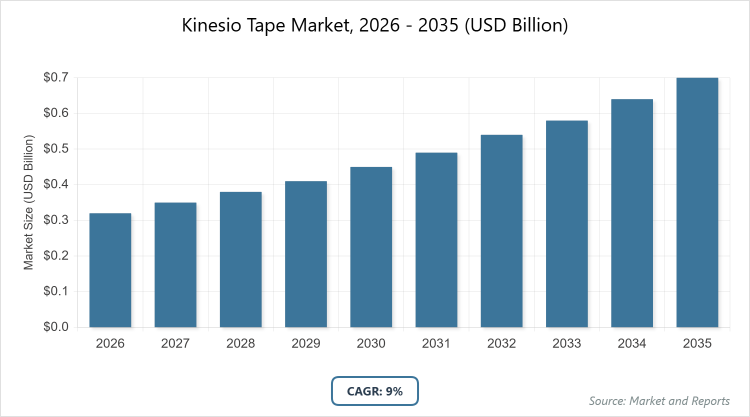
According to MarketnReports, the global Kinesio Tape market size was estimated at USD 0.32 billion in 2025 and is expected to reach USD 0.76 billion by 2035, growing at a CAGR of 9% from 2026 to 2035. The Kinesio Tape Market is driven by the increasing prevalence of sports injuries and the growing adoption of non-invasive pain management solutions.
What are the Key Insights into Kinesio Tape?
- The global Kinesio Tape market was valued at USD 0.32 billion in 2025 and is projected to reach USD 0.76 billion by 2035.
- The market is expected to grow at a CAGR of 9% during the forecast period from 2026 to 2035.
- The market is driven by rising sports participation, increasing awareness of non-invasive therapies, and expanding applications in rehabilitation and home care.
- In the product type segment, pre-cut strips dominate with a 55% share due to their convenience for quick application without cutting tools, appealing to both professionals and individual users for efficient injury management.
- In the application segment, sports protection dominates with a 60% share as it supports athletes in preventing injuries and enhancing performance during high-intensity activities.
- In the end-user segment, sports teams & athletes dominate with a 40% share owing to widespread adoption in professional sports for immediate support and recovery.
- North America dominates the regional market with a 42% share, driven by advanced sports medicine infrastructure, high sports participation rates, and strong presence of key manufacturers.
What is the Industry Overview of Kinesio Tape?
The Kinesio Tape market encompasses elastic therapeutic tapes designed to support muscles, ligaments, and tendons without restricting movement, commonly used in sports medicine, rehabilitation, and pain management. Market definition includes adhesive strips made from cotton or synthetic materials that mimic skin elasticity, providing biomechanical support, reducing inflammation, and facilitating lymphatic drainage in various therapeutic applications.
What are the Market Dynamics of Kinesio Tape?
Growth Drivers
The primary growth drivers for the Kinesio Tape market include the surge in sports-related injuries and musculoskeletal disorders, fueled by increasing global participation in fitness and athletic activities. Additionally, the aging population contributes significantly, as older adults seek non-pharmacological solutions for chronic pain and mobility issues, with kinesio tape offering gentle support without side effects. Advancements in tape materials, such as improved adhesives and breathable fabrics, enhance user comfort and efficacy, encouraging adoption in clinical and home settings. Furthermore, endorsements from professional athletes and integration into physiotherapy protocols amplify market penetration.
Restraints
High costs associated with premium branded Kinesio tapes pose a restraint, particularly in price-sensitive emerging markets where generic alternatives dominate. Limited scientific evidence supporting long-term efficacy in certain applications can deter healthcare professionals from widespread recommendation, leading to slower adoption in regulated medical environments. Skin irritation or allergic reactions from adhesives remain a concern for sensitive users, potentially limiting repeat purchases. Supply chain disruptions, including raw material shortages for cotton and synthetics, also impact production and availability.
Opportunities
Opportunities abound in the expansion of e-commerce platforms, enabling direct-to-consumer sales and educational content on proper tape application, which can boost accessibility in underserved regions. Innovation in smart tapes integrated with sensors for real-time monitoring of muscle activity presents a niche for tech-savvy consumers and sports professionals. Growing demand in developing economies, driven by rising healthcare awareness and sports infrastructure investments, offers untapped potential. Partnerships between manufacturers and sports organizations for custom-branded products could further enhance market visibility.
Challenges
Challenges include intense competition from alternative therapies like compression garments and braces, which may offer similar benefits at competitive prices. Regulatory hurdles in classifying kinesio tape as a medical device vary by region, complicating international expansion and requiring compliance with stringent standards. Counterfeit products erode brand trust and market share for established players. Educating end-users on correct application techniques remains a barrier, as improper use can lead to suboptimal results and negative perceptions.
Kinesio Tape Market: Report Scope
| Report Attributes | Report Details |
| Report Name | Kinesio Tape Market |
| Market Size 2025 | USD 0.32 Billion |
| Market Forecast 2035 | USD 0.76 Billion |
| Growth Rate | CAGR of 9% |
| Report Pages | 220 |
| Key Companies Covered | Kinesio Holding Corporation, KT Tape, RockTape, Mueller Sports Medicine, SpiderTech, Nitto Denko Corporation, StrengthTape, 3M Company, and Others |
| Segments Covered | By Product Type, By Application, By End-User, and By Region |
| Regions Covered | North America, Europe, Asia Pacific (APAC), Latin America, and The Middle East and Africa (MEA) |
| Base Year | 2025 |
| Historical Year | 2020 – 2024 |
| Forecast Year | 2026 – 2035 |
| Customization Scope | Avail customized purchase options to meet your exact research needs. |
What is the Market Segmentation of Kinesio Tape?
The Kinesio Tape market is segmented by product type, application, end-user, and region.
By Product Type, the pre-cut strips subsegment is the most dominant, holding approximately 55% market share, due to its user-friendly design that eliminates the need for scissors or measuring, making it ideal for quick application in sports and rehabilitation scenarios. This dominance drives the market by catering to time-constrained professionals and amateurs, increasing overall adoption rates through convenience and reduced waste. The roll form is the second most dominant, with about 30% share, offering versatility for custom cuts in clinical settings, which helps propel market growth by allowing tailored applications for diverse injury types and body areas, enhancing therapeutic outcomes.
By Application, Sports protection emerges as the most dominant subsegment, capturing around 60% share, primarily because it provides immediate support during physical activities, reducing injury risks for athletes and fitness enthusiasts. This leads to market growth by aligning with the global rise in sports participation and preventive health trends. Medical rehabilitation ranks as the second most dominant, with a roughly 25% share, aiding recovery from surgeries and injuries through improved circulation and pain relief, thereby driving the market via integration into physiotherapy programs that emphasize non-invasive recovery methods.
By End-User, Sports teams & athletes represent the most dominant subsegment at about 40% share, driven by professional endorsements and the need for performance enhancement without mobility restrictions. This dominance accelerates market expansion through high-visibility usage in events like the Olympics, influencing consumer trends. Hospitals & clinics are the second most dominant, holding around 25% share, as they incorporate tape into standard care protocols for post-operative support, contributing to market growth by validating its efficacy in medical environments and encouraging broader healthcare adoption.
What are the Recent Developments in Kinesio Tape?
- In November 2024, Essity expanded its athletics-tape production facility in France to reduce lead times for European customers, enhancing supply chain efficiency and supporting regional market growth amid rising demand.
- In January 2025, UTR Sports announced a partnership with KT Tape to integrate kinesiology therapeutic tape into sports recovery solutions, aiming to broaden accessibility for athletes through bundled offerings.
- In July 2024, a major medical journal published a study highlighting the efficacy of kinesiology tape in managing lower back pain, providing evidence-based support that could boost adoption in clinical settings.
- In April 2023, KT Tape introduced a pre-cut strip specifically designed for ankle support, addressing common sports injuries and improving user convenience.
- In January 2023, Mueller Sports Medicine launched a new line of eco-friendly kinesiology tape, focusing on sustainable materials to appeal to environmentally conscious consumers.
What is the Regional Analysis of Kinesio Tape?
- North America to dominate the global market.
North America continues to hold the largest market share at approximately 42%, with the United States serving as the clear dominating country within the region. This leadership position is underpinned by a deeply entrenched sports culture, extensive professional and collegiate athletic programs, and one of the world’s most advanced sports medicine and rehabilitation ecosystems. High participation rates in organized sports—from youth leagues to elite professional levels such as the NFL, NBA, MLB, and NCAA—create consistent demand for performance-enhancing and injury-prevention products like kinesio tape. Additionally, strong consumer awareness, widespread availability through major retail channels (both physical and online), frequent product innovation by U.S.-based manufacturers, and proactive endorsements from high-profile athletes and medical professionals further solidify the region’s dominance.
Europe represents the second-largest regional market and continues to experience steady growth, largely propelled by rising participation in fitness and recreational sports, an increasing focus on preventive healthcare, and a growing elderly population seeking effective non-invasive pain management solutions. Germany stands out as the dominating country in this region, benefiting from its long-standing emphasis on high-quality physiotherapy practices, well-established sports medicine associations, and a healthcare system that readily integrates kinesiology taping into standard rehabilitation protocols. Other key contributors, such as the United Kingdom, France, and Spain, are also seeing expanded use in both clinical and sports settings, supported by favorable regulatory environments for Class I medical devices and increasing public awareness campaigns promoting active lifestyles.
Asia Pacific is currently the fastest-growing regional market, exhibiting the highest compound annual growth rate during the forecast period, driven by rapid economic development, rising disposable incomes, expanding sports infrastructure, and increasing government initiatives to promote physical activity and wellness. China leads the region as the dominating country, fueled by massive population scale, fast-growing middle-class interest in fitness and sports, significant investments in professional leagues (such as the Chinese Super League and CBA), and expanding e-commerce penetration that makes kinesio tape widely accessible even in tier-2 and tier-3 cities. Japan and South Korea also contribute meaningfully through their advanced healthcare systems and strong culture of sports participation, while India and Southeast Asian nations are emerging as high-potential markets due to rising awareness of sports injuries and growing private healthcare facilities.
Latin America demonstrates moderate but consistent growth in the kinesio tape market, supported by a vibrant sports culture and gradually improving access to modern rehabilitation products. Brazil remains the dominating country in the region, benefiting from its passionate football culture, frequent hosting of international sporting events, and a large base of both professional and amateur athletes who rely on kinesio tape for injury prevention and recovery. Other countries such as Mexico, Argentina, and Colombia are also seeing increased uptake, particularly in urban centers where private clinics and fitness centers are expanding. However, economic volatility, uneven healthcare infrastructure, and price sensitivity in many segments continue to moderate the pace of adoption compared to more developed regions.
The Middle East and Africa represent an emerging market with relatively lower current penetration but growing potential, particularly in countries investing in sports tourism, youth development programs, and basic rehabilitation services. South Africa leads the region as the dominating country, driven by its well-developed sports ecosystem (including rugby, cricket, and soccer), increasing participation in international competitions, and a growing number of physiotherapy professionals incorporating kinesio tape into treatment plans. Other markets, such as the United Arab Emirates, are showing promise due to heavy investment in elite sports facilities and events, while parts of the Gulf Cooperation Council countries are beginning to adopt the product in the luxury fitness and medical tourism sectors.
What are the Key Market Players in Kinesio Tape?
- Kinesio Holding Corporation. As a pioneer in kinesiology tape, Kinesio Holding Corporation focuses on research-backed products and global training programs for practitioners, emphasizing quality adhesives and educational partnerships to maintain market leadership.
- KT Tape. KT Tape employs aggressive marketing through athlete endorsements and rebranding efforts, such as its 2023 visual identity update, to expand consumer reach via e-commerce and specialized products like pre-cut strips.
- RockTape. RockTape differentiates through durable, water-resistant tapes and collaborations with CrossFit communities, prioritizing innovation in material strength to target high-performance users.
- Mueller Sports Medicine. Mueller Sports Medicine integrates sustainable practices, like its 2023 eco-friendly line, with broad distribution in retail and medical channels to capture environmentally aware segments.
- SpiderTech. SpiderTech specializes in pre-shaped tapes for specific body parts, using anatomical designs and clinical partnerships to enhance precision in therapeutic applications.
- Nitto Denko Corporation. Nitto Denko leverages industrial expertise in adhesives for hypoallergenic innovations, focusing on B2B supply chains to support large-scale healthcare providers.
- StrengthTape. StrengthTape targets niche markets with ion-infused tapes for enhanced recovery, employing digital marketing and influencer collaborations to build brand loyalty among fitness enthusiasts.
- 3M Company. 3M applies its material science prowess to develop breathable, long-lasting tapes, strategizing through mergers and R&D investments to penetrate medical and consumer segments.
What are the Market Trends in Kinesio Tape?
- Development of hypoallergenic and skin-friendly adhesives to reduce irritation for sensitive users.
- Integration of smart technology, such as sensors for monitoring muscle activity.
- Rise of eco-friendly and biodegradable materials in response to sustainability demands.
- Expansion of pre-cut and specialized shapes for targeted applications like ankle or shoulder support.
- Growing use in non-sports areas, including posture correction and pediatric care.
- Increased e-commerce availability with educational tutorials for self-application.
What Market Segments and Subsegments are Covered in the Kinesio Tape Report?
By Product Type
- Pre-cut Strips
- Roll Form
- Serrated Strips
- Single Tapes
- Bulk Roll Tapes
- Pre-shaped Strips
- Elastic Tapes
- Cotton-based Tapes
- Synthetic Tapes
- Hypoallergenic Tapes
- Others
By Application
- Sports Protection
- Medical Rehabilitation
- Pain Management
- Posture Correction
- Lymphatic Drainage
- Neurological Support
- Pediatric Uses
- Post-operative Care
- Musculoskeletal Support
- Injury Prevention
- Others
By End-User
- Sports Teams & Athletes
- Hospitals & Clinics
- Rehabilitation Centers
- Home Care Settings
- Physiotherapy Clinics
- Fitness Centers
- Professional Users
- Individual Consumers
- Occupational Therapy Centers
- Chiropractic Clinics
- Others
By Region
-
- North America
- U.S.
- Canada
- Europe
- UK
- Germany
- France
- Rest of Europe
- Asia Pacific
- China
- India
- Japan
- Rest of Asia Pacific
- Latin America
- Brazil
- Mexico
- Rest of Latin America
- Middle East & Africa
- UAE
- South Africa
- Rest of Middle East & Africa
- North America
Frequently Asked Questions
Kinesio Tape refers to elastic therapeutic adhesive strips used to support muscles and ligaments, reduce pain, and improve circulation without limiting range of motion.
Key factors include rising sports injuries, aging population needs, advancements in tape materials, and increasing adoption in rehabilitation and home care.
The market is projected to grow from USD 0.32 billion in 2025 to USD 0.76 billion by 2035.
The CAGR is expected to be 9%.
North America will contribute notably, holding around 42% share due to advanced infrastructure and high sports participation.
Major players include Kinesio Holding Corporation, KT Tape, RockTape, Mueller Sports Medicine, and SpiderTech.
The report provides comprehensive analysis including size, trends, segments, regional outlook, key players, and forecasts.
Stages include raw material sourcing, manufacturing, distribution, retail/e-commerce sales, and end-user application.
Trends are shifting toward eco-friendly materials, smart integrations, and pre-cut designs, with consumers preferring convenient, hypoallergenic options.
Regulatory classifications as medical devices and environmental pushes for sustainable materials influence production and market expansion.