
Intimate Apparel Market Size, Share and Trends 2026 to 2035
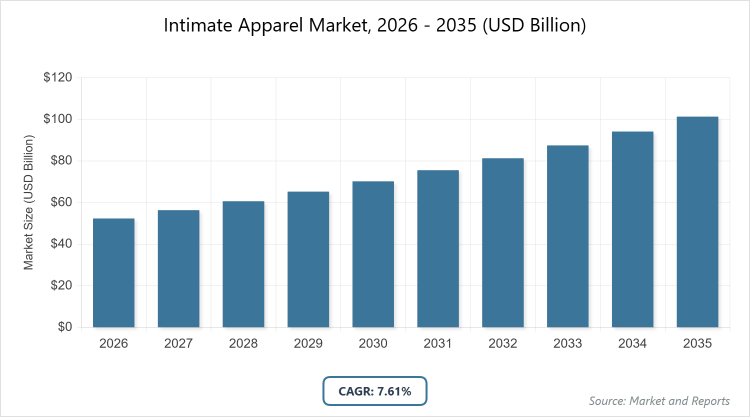
The global Intimate Apparel Market size was estimated at USD 52.36 Billion in 2025 and is expected to reach USD 101.31 Billion by 2035, growing at a CAGR of 7.61% from 2026 to 2035. The intimate apparel market is primarily driven by a shift toward comfort and body positivity, technological innovations in high-performance and sustainable fabrics, and the increasing disposable income of working women globally.
What are the Key Insights?
- The global intimate apparel market is projected to grow from USD 52.36 billion in 2026 to USD 101.31 billion by 2035.
- The market is expected to register a CAGR of 7.61% during the forecast period from 2026 to 2035.
- In the product type segment, the bras subsegment dominates, followed by panties.
- In the material segment, cotton dominates, followed by polyester.
- In the consumer group segment, women dominates, followed by men.
- In the distribution channel segment, online retail dominates, followed by specialty stores.
- North America dominates as the leading region in the intimate apparel market.
What is the Industry Overview?
The intimate apparel market encompasses the design, production, distribution, and retailing of undergarments and innerwear items that prioritize comfort, functionality, style, and body support for everyday use and special occasions. This industry includes a wide array of products such as bras, panties, shapewear, lingerie sets, and other related garments made from various fabrics to cater to diverse consumer needs, including support during physical activities, enhancement of body shape, and aesthetic appeal for personal confidence. It serves both functional purposes like hygiene and protection while also aligning with fashion trends, body positivity movements, and lifestyle changes, making it an essential segment of the broader apparel sector that responds to evolving cultural norms around self-expression and wellness.
What are the Market Dynamics?
Growth Drivers
The intimate apparel market is propelled by rising consumer demand for comfortable, innovative products featuring seamless designs, wireless options, and high-performance fabrics that blend functionality with style, alongside a growing emphasis on body positivity and inclusivity that encourages brands to offer wider size ranges and diverse representations. Technological advancements in smart fabrics, moisture-wicking materials, and 3D knitting further drive growth by enhancing product appeal, while the surge in e-commerce platforms provides convenient access, personalized shopping experiences through AI-driven recommendations, and global reach. Additionally, increasing disposable incomes in emerging economies, coupled with social media influences and celebrity endorsements, boost awareness and adoption of premium and sustainable intimate wear, fostering market expansion as consumers prioritize wellness, athleisure-inspired items, and eco-friendly choices.
Restraints
The intimate apparel market faces restraints from intense competition among established and emerging brands, which pressures companies to continuously innovate while maintaining affordable pricing, often leading to margin squeezes for smaller players unable to scale production or invest in advanced technologies. Price sensitivity among consumers in developing regions limits the uptake of premium products, as budget constraints push buyers toward basic, low-cost alternatives rather than high-quality or sustainable options. Supply chain disruptions, including fluctuations in raw material costs for fabrics like cotton and polyester, combined with regulatory hurdles related to environmental standards and labor practices, further hinder growth by increasing operational expenses and delaying product launches.
Opportunities
Opportunities in the intimate apparel market abound with the expansion of sustainable and eco-friendly product lines using organic cotton, recycled materials, and biodegradable fabrics to attract environmentally conscious consumers, alongside the integration of smart technologies like sensors for health monitoring and adaptive designs for maternity or disabilities to tap into niche segments. The rise of personalization through AI, virtual fitting rooms, and custom sizing offers brands a chance to enhance customer loyalty and differentiate in a crowded space, while penetrating emerging markets in Asia Pacific and Latin America via e-commerce and localized manufacturing can capitalize on urbanization, rising middle-class populations, and shifting preferences toward inclusive and athleisure-focused wear. Collaborations with influencers and wellness brands also present avenues to broaden reach and drive sales through targeted marketing.
Challenges
Challenges in the intimate apparel market include navigating rapidly evolving consumer preferences for sustainability and inclusivity, which require brands to overhaul supply chains and product portfolios without compromising on quality or profitability, while also addressing the complexities of global regulations on material sourcing and ethical manufacturing. Balancing innovation with cost-effectiveness poses difficulties, as investments in advanced technologies like 3D scanning or smart fabrics can strain resources for mid-tier players, and supply chain vulnerabilities from geopolitical issues or raw material shortages exacerbate production delays. Moreover, intense online competition and the need for robust digital infrastructure to combat counterfeit products and ensure data privacy add layers of operational complexity in maintaining brand trust and market share.
Intimate Apparel Market: Report Scope
| Report Attributes | Report Details |
| Report Name | Intimate Apparel Market |
| Market Size 2025 | USD 52.36 Billion |
| Market Forecast 2035 | USD 101.31 Billion |
| Growth Rate | CAGR of 7.61% |
| Report Pages | 215 |
| Key Companies Covered |
Hanes Brands, L Brands (Victoria’s Secret), Berkshire Hathaway (Fruit of the Loom), Jockey International, Wacoal, Fast Retailing, Triumph International, American Eagle (Aerie), Gunze, PVH, and Marks & Spencer. |
| Segments Covered | By Fuel Type, By Power Rating, By Application, By End-User, By Region |
| Regions Covered | Asia Pacific, North America, Europe, Latin America, The Middle East and Africa |
| Base Year | 2025 |
| Historical Year | 2020 – 2024 |
| Forecast Year | 2026 – 2035 |
| Customization Scope | Avail customized purchase options to meet your exact research needs. |
What is the Market Segmentation?
B product type category, followed by panties as the second most dominant. Bras dominate due to their essential role in providing daily support, comfort, and style versatility, catering to a wide range of needs from sports activities to formal wear, which drives the market by encouraging repeat purchases and innovations like wireless and padded designs that align with body positivity trends, ultimately boosting overall industry growth through high consumer demand and premium pricing opportunities; panties, as the second dominant, complement this by offering everyday hygiene and variety in styles such as seamless or lace options, helping to drive the market via affordability and bundling with bras, enhancing accessibility and expanding the consumer base in both developed and emerging regions.
By material category, followed by polyester as the second most dominant. Cotton dominates because of its natural breathability, softness, and hypoallergenic properties that appeal to consumers seeking comfort and skin-friendly options, driving the market by supporting sustainable trends through organic variants and enabling mass adoption in price-sensitive segments, which increases volume sales and brand loyalty; polyester, as the second dominant, contributes through its durability, affordability, and moisture-wicking capabilities that make it ideal for activewear-inspired intimates, helping to propel market growth by facilitating cost-effective production and appealing to budget-conscious buyers in fast-growing online channels.
By consumer group category, followed by men as the second most dominant. Women dominate owing to the broader variety of products tailored to diverse body types, lifestyles, and occasions, from supportive bras to shapewear, which drives the market by leveraging fashion trends, body positivity campaigns, and high spending power, resulting in sustained innovation and higher revenue contributions; men, as the second dominant, are gaining traction with increasing focus on comfort-driven underwear and athleisure options, helping to expand the market through targeted marketing and e-commerce growth, attracting a younger demographic and diversifying the industry’s consumer base.
By distribution channel category, followed by specialty stores as the second most dominant. Online retail dominates due to its convenience, wide product selection, discreet purchasing, and features like virtual try-ons and easy returns, driving the market by enhancing accessibility in urban and rural areas alike, boosting sales through digital marketing and global reach; specialty stores, as the second dominant, provide personalized experiences, expert fittings, and tactile product evaluation, contributing to market growth by building trust in premium brands and catering to consumers who prefer in-person shopping for fit-sensitive items.
What are the Recent Developments?
- In March 2025, Hanes launched the “Hanes Moves” athleisure collection, expanding its offerings for men, women, and children with versatile, comfortable designs that blend everyday wear with active functionality, aiming to capture the growing demand for multifunctional intimates.
- In June 2025, S&S Activewear partnered with HanesBrands for an exclusive North American printwear supply agreement effective by December 31, 2025, strengthening supply chain efficiency and ensuring consistent availability of high-quality fabrics for customized products.
- In August 2024, Fast Retailing’s GU brand opened its first US flagship store alongside an e-commerce site and app, introducing new collections to tap into the American market’s preference for affordable, trendy intimate apparel.
- In February 2025, Victoria’s Secret & Co. introduced a Digital Product Passport on select bra collections, enhancing transparency in supply chains and appealing to eco-conscious consumers by detailing material sourcing and production processes.
- In July 2025, Savage X Fenty expanded its adaptive wear line for people with disabilities, incorporating inclusive designs like magnetic closures and adjustable fits to broaden accessibility and align with body positivity initiatives.
What is the Regional Analysis?
North America holds a leading position in the intimate apparel market, accounting for approximately 35% of the global share, driven by high consumer spending power, strong emphasis on wellness and body positivity, and the presence of major brands that innovate with sustainable and tech-integrated products; the dominating country is the United States, where e-commerce penetration, diverse size offerings, and marketing campaigns fuel demand, contributing significantly to regional growth through premium sales and digital transformations.
Europe represents about 25% of the market, characterized by a focus on premium and eco-friendly intimate wear, with consumers prioritizing ethical production and inclusive designs amid stringent environmental regulations; Germany emerges as the dominating country, supported by its robust manufacturing base, high disposable incomes, and brands like Triumph International that drive innovation in sustainable fabrics, enhancing the region’s market through exports and consumer trends toward luxury comfort.
Asia Pacific accounts for around 20% of the global market and is the fastest-growing region, propelled by urbanization, rising middle-class populations, and increasing adoption of Western fashion influences alongside local manufacturing advantages; China is the dominating country, with its massive consumer base, low-cost production, and booming e-commerce platforms like those from Wacoal Holdings enabling rapid expansion, driving the market via affordable yet stylish options and technological integrations.
Latin America is an emerging region in the intimate apparel market, benefiting from growing disposable incomes and urbanization that boost demand for comfortable and fashionable undergarments; Brazil stands out as the dominating country, where cultural emphasis on body aesthetics and expanding retail networks, including online channels, support market growth through localized products and collaborations with global brands.
The Middle East and Africa region shows potential for growth in the intimate apparel market, driven by increasing urbanization, younger demographics, and rising awareness of wellness products; the United Arab Emirates is the dominating country, with its affluent consumers, luxury retail hubs, and e-commerce adoption facilitating demand for premium and inclusive intimates, contributing to regional expansion through tourism-influenced trends and sustainable offerings.
Who are the Key Market Players and Their Strategies?
Hanes Brands: Focuses on sustainability initiatives by launching eco-friendly lines and partnering for exclusive supply agreements to optimize supply chains, while emphasizing athleisure collections to cater to active lifestyles and enhance market penetration through affordable, high-quality products.
L Brands (Victoria’s Secret): Employs digital innovations like AI-driven personalized shopping and virtual fitting rooms, alongside rebranding for inclusivity and body positivity, to expand customer reach and loyalty via e-commerce and collaborations with tech firms.
Berkshire Hathaway (Fruit of the Loom): Prioritizes cost-effective production and broad distribution through offline and online channels, leveraging economies of scale to offer value-driven basics while investing in sustainable materials to appeal to budget-conscious consumers.
Jockey International: Concentrates on global expansion with high-quality, comfort-focused products, including outdoor and athleisure lines, and uses influencer marketing to target emerging markets and promote innovative designs for diverse body types.
Wacoal: Adopts strategies centered on eco-friendly collections and regional adaptations, particularly in Asia, by integrating smart textiles and sustainable practices to meet demands for functionality and environmental responsibility.
Fast Retailing: Expands through flagship stores and e-commerce launches in new markets like the US, focusing on affordable trendy designs and digital apps to capture younger demographics and drive sales via quick fashion cycles.
Triumph International: Emphasizes European premium positioning with sustainable and inclusive offerings, using ethical manufacturing and marketing campaigns to build brand trust and grow in both mature and emerging regions.
American Eagle (Aerie): Targets body positivity with diverse model representations and adaptive wear, investing in distribution centers and online personalization to enhance accessibility and foster loyalty among millennial and Gen Z consumers.
Gunze: Focuses on technological advancements in fabrics for comfort and performance, particularly in Asian markets, through R&D in smart intimates to differentiate and expand via e-commerce partnerships.
PVH: Utilizes license extensions and collaborations for smooth transitions in product lines, emphasizing premium branding like Calvin Klein with influencer endorsements to boost visibility and sales in luxury segments.
Marks & Spencer: Integrates bra fitting technologies and sustainable sourcing, focusing on mid-range offerings through department stores and online platforms to cater to practical consumer needs and drive repeat business.
What are the Market Trends?
- Increasing adoption of sustainable materials like organic cotton and recycled fabrics to meet eco-conscious consumer demands.
- Rise in digital transformations, including virtual fitting rooms, AI personalization, and augmented reality for enhanced online shopping experiences.
- Growth of athleisure-inspired intimates that blend comfort, style, and functionality for active lifestyles.
- Emphasis on body positivity and inclusivity, with expanded size ranges and diverse marketing representations.
- Integration of smart technologies in fabrics for health monitoring and adaptive features.
- Expansion of premium and luxury segments driven by rising disposable incomes and fashion influences.
- Shift toward seamless and wireless designs prioritizing everyday comfort and versatility.
- Booming e-commerce in emerging markets, facilitating discreet and convenient purchases.
- Influence of social media and celebrity endorsements in shaping trends and boosting brand visibility.
- Focus on transparent supply chains and ethical production to build consumer trust.
What Market Segments are Covered in the Report?
By Product Type:
- Bras
- Panties
- Shapewear
- Lingerie
- Others
By Material
- Cotton
- Polyester
- Nylon
- Silk
- Sustainable Fabrics (Organic Cotton, Recycled Fabrics)
By Consumer Group:
- Women
- Men
- Unisex
By Distribution Channel:
- Online Retail
- Offline Retail (Supermarkets, Department Stores, Specialty Stores)
By Price Range:
- Economy
- Mid-Range
- Premium
By Region
-
- North America
- U.S.
- Canada
- Europe
- UK
- Germany
- France
- Rest of Europe
- Asia Pacific
- China
- India
- Japan
- Rest of Asia Pacific
- Latin America
- Brazil
- Mexico
- Rest of Latin America
- Middle East & Africa
- UAE
- South Africa
- Rest of Middle East & Africa
- North America
Chapter 1. Preface
Chapter 2. Executive Summary
Chapter 3. Global Intimate Apparel Market - Industry Analysis
Chapter 4. Global Intimate Apparel Market- Competitive Landscape
Chapter 5. Global Intimate Apparel Market - Product Type Analysis
Chapter 6. Global Intimate Apparel Market - Material Analysis
Chapter 7. Global Intimate Apparel Market - Consumer Group Analysis
Chapter 8. Global Intimate Apparel Market - Distribution Channel Analysis
Chapter 9. Global Intimate Apparel Market - Price Range Analysis
Chapter 10. Intimate Apparel Market - Regional Analysis
Chapter 11. Company Profiles
Frequently Asked Questions
The intimate apparel market refers to the industry focused on undergarments and innerwear such as bras, panties, shapewear, and lingerie, emphasizing comfort, style, and functionality while incorporating trends like sustainability and inclusivity.
Key factors include rising demand for comfortable and innovative products, body positivity movements, e-commerce expansion, technological advancements in fabrics, and increasing focus on sustainability, alongside growth in emerging markets driven by higher disposable incomes.
The intimate apparel market is projected to grow from USD 52.36 billion in 2026 to USD 101.31 billion by 2035.
The CAGR of the intimate apparel market during 2026-2035 is expected to be 7.61%.
North America will contribute notably to the intimate apparel market value, holding approximately 35% of the global share due to high consumer spending and innovation.
Major players include Hanes Brands, L Brands (Victoria's Secret), Berkshire Hathaway (Fruit of the Loom), Jockey International, Wacoal, Fast Retailing, Triumph International, American Eagle (Aerie), Gunze, PVH, and Marks & Spencer.
The global intimate apparel market report provides comprehensive insights into market size, growth forecasts, segmentation, regional analysis, key players, trends, drivers, restraints, opportunities, challenges, and recent developments.
The value chain includes raw material sourcing (fabrics like cotton and polyester), design and manufacturing, distribution through online and offline channels, marketing and branding, and end-consumer retail sales with after-sales support like fittings.
Market trends and consumer preferences are evolving toward sustainability, digital personalization, athleisure functionality, body inclusivity, and smart fabric integrations, with a shift from basic items to premium, eco-friendly, and tech-enhanced products.
Regulatory factors include stringent environmental standards on material sourcing and waste management, while environmental factors involve demands for sustainable practices like using recycled fabrics and reducing carbon footprints, influencing production costs and brand strategies.