
Hand Sanitizer Market Size, Share and Trends 2026 to 2035
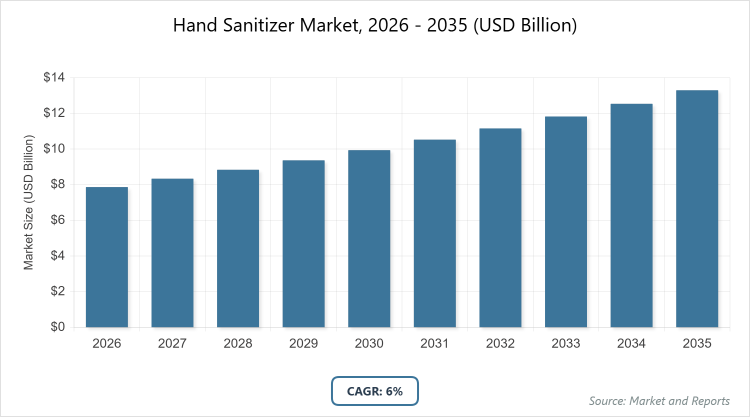
According to MarketnReports, the global Hand Sanitizer market size was estimated at USD 7.87 billion in 2025 and is expected to reach USD 13.30 billion by 2035, growing at a CAGR of 6.0% from 2026 to 2035. Hand Sanitizer Market is driven by sustained hygiene awareness and innovation in eco-friendly formulations.
What is the Overview of Hand Sanitizer Market?
The hand sanitizer market involves the production, distribution, and consumption of antiseptic solutions designed to reduce infectious agents on the hands, typically containing alcohol or alternative active ingredients for quick and effective disinfection without water. This market encompasses various forms such as gels, foams, sprays, and wipes, catering to hygiene needs in healthcare, household, and commercial settings to prevent the spread of pathogens. Market definition refers to the industry focused on portable, convenient hygiene products that promote public health by offering an alternative to soap and water, driven by global health concerns, regulatory standards for sanitation, and consumer preferences for skin-friendly, scented, or natural variants that integrate sustainability and efficacy in daily routines.
What are the Key Insights into Hand Sanitizer Market?
- The global hand sanitizer market was valued at USD 7.87 billion in 2025 and is projected to reach USD 13.30 billion by 2035.
- The market is expected to grow at a CAGR of 6.0% during the forecast period from 2026 to 2035.
- The market is driven by increasing hygiene awareness and regulatory support for infection control measures.
- In the product type segment, gel dominates with a 40% share.
- This dominance is due to its ease of use, quick absorption, and effective formulation, driving market growth by appealing to consumers seeking convenient and non-sticky options.
- In the application segment, healthcare dominates with a 35% share.
- This is attributed to stringent sanitation protocols in medical facilities, fueling expansion through high-volume demand for reliable disinfection products.
- In the end-user segment, hospitals & clinics dominate with a 30% share.
- This stems from the need for infection prevention in clinical environments, propelling the market by ensuring compliance with health standards.
- North America dominates the global market with a 37% share.
- This is owing to high consumer awareness, advanced distribution channels, and presence of major players in the United States.
What are the Market Dynamics in Hand Sanitizer?
Growth Drivers
Growth drivers in the hand sanitizer market are primarily anchored in heightened global awareness of personal hygiene post-pandemic, which has ingrained regular sanitization habits among consumers, leading to sustained demand across households and public spaces. Regulatory mandates from health organizations emphasizing infection control in healthcare and food services further propel adoption, while innovations in natural, alcohol-free formulas attract eco-conscious buyers seeking skin-friendly options. The expansion of e-commerce and retail channels enhances accessibility, particularly in urban areas, and partnerships for bulk supply in commercial sectors amplify volume sales. Additionally, rising travel and tourism activities boost portable sanitizer usage, driving overall market expansion through diversified applications and consumer convenience.
Restraints
Restraints in the hand sanitizer market include market saturation in developed regions where post-pandemic demand has stabilized, leading to intense competition and price pressures that erode margins for manufacturers. Concerns over skin irritation from frequent use of alcohol-based products deter some consumers, prompting shifts to alternatives but limiting traditional segment growth. Supply chain vulnerabilities, such as fluctuations in raw material prices like ethanol, increase production costs and disrupt availability. Moreover, the proliferation of counterfeit or substandard products undermines trust and regulatory compliance, hindering market penetration in emerging economies with lax enforcement.
Opportunities
Opportunities in the hand sanitizer market arise from the growing preference for sustainable and organic formulations, enabling brands to differentiate with plant-based ingredients that appeal to health-conscious and environmentally aware consumers, opening new premium segments. Expansion into untapped rural and developing markets through affordable, travel-sized packaging presents potential for volume growth, supported by government hygiene campaigns. Integration with smart dispensers and IoT for touchless applications in public spaces offers innovation avenues, while collaborations with skincare brands for moisturizing variants address irritation issues. Furthermore, rising focus on child-friendly and scented products targets family demographics, fostering brand loyalty and market diversification.
Challenges
Challenges in the hand sanitizer market encompass evolving consumer perceptions that view sanitizers as temporary solutions post-pandemic, requiring continuous education on long-term hygiene benefits to maintain demand. Regulatory variations across regions complicate formulation standards, particularly for export-oriented manufacturers navigating alcohol content limits and labeling requirements. Environmental concerns over plastic packaging waste push for sustainable alternatives, adding R&D costs. Additionally, intense competition from soap and water alternatives in water-abundant areas challenges market share, while economic downturns reduce discretionary spending on premium products.
Hand Sanitizer Market: Report Scope
| Report Attributes | Report Details |
| Report Name | Hand Sanitizer Market |
| Market Size 2025 | USD 7.87 Billion |
| Market Forecast 2035 | USD 13.30 Billion |
| Growth Rate | CAGR of 6.0% |
| Report Pages | 220 |
| Key Companies Covered | Reckitt Benckiser Group, GOJO Industries, Procter & Gamble, Unilever, Henkel AG & Company, and Others |
| Segments Covered | By Product Type, By Application, By End-User, and By Region |
| Regions Covered | North America, Europe, Asia Pacific (APAC), Latin America, and The Middle East and Africa (MEA) |
| Base Year | 2025 |
| Historical Year | 2020 – 2024 |
| Forecast Year | 2026 – 2035 |
| Customization Scope | Avail customized purchase options to meet your exact research needs. |
The Hand Sanitizer market is segmented by product type, application, end-user, and region.
Based on Product Type Segment, the most dominant subsegment is gel, while the second most dominant is foam. Gel leads due to its portability, quick-drying nature, and widespread availability in various sizes, driving market growth by offering convenient hygiene solutions that encourage frequent use in daily routines and support bulk purchases in commercial settings; foam ranks second as it provides a luxurious feel with better coverage and less residue, contributing to expansion through appeal in premium and child-friendly applications that enhance user experience and promote brand differentiation.
Based on Application Segment, the most dominant subsegment is healthcare, while the second most dominant is household. Healthcare dominates owing to mandatory disinfection protocols to prevent hospital-acquired infections, propelling market growth via high-volume procurement that ensures compliance and reduces transmission risks; household follows as the second dominant, driven by daily personal hygiene needs, enhancing the market through retail innovations like family packs that foster habitual use and sustain post-pandemic demand.
Based on End-User Segment, the most dominant subsegment is hospitals & clinics, while the second most dominant is households. Hospitals & clinics lead because of critical infection control requirements in medical environments, fueling market growth by demanding reliable, high-efficacy products for staff and patients that minimize outbreaks; households rank second with routine sanitation for family health, advancing the market through e-commerce accessibility and varied formulations for home use that build consumer loyalty.
What are Recent Developments in Hand Sanitizer?
- In May 2025, Full Alliance Group launched Jusspray, an alcohol-free hospital-grade sanitizing spray featuring hypochlorous acid for rapid germ elimination while being gentle on skin.
- In May 2025, Church & Dwight acquired Touchland for USD 700 million, with potential additional USD 180 million based on sales, to expand its hygiene portfolio with design-focused sanitizers.
- In April 2025, Bath & Body Works reintroduced full-size hand sanitizers in stores and online, responding to customer demand for their scented, moisturizing formulas.
- In January 2025, Touchland launched Gentle Mist Hand Sanitizer, a 70% alcohol product with niacinamide for skin support, targeting clean beauty consumers.
What is the Regional Analysis for Hand Sanitizer Market?
- North America to dominate the global market.
North America maintains dominance in the hand sanitizer market, supported by high hygiene standards, robust healthcare infrastructure, and consumer awareness amplified by public health campaigns, driving consistent demand for advanced formulations. The region’s growth is fueled by e-commerce expansion and regulatory emphasis on sanitation in public spaces. The United States dominates within North America, propelled by major players like GOJO Industries innovating with touchless dispensers and widespread retail availability through chains like Walmart, alongside CDC guidelines promoting usage; Canada contributes through strong export markets and eco-friendly trends, while Mexico benefits from manufacturing proximity, though economic disparities limit premium adoption.
Europe holds a significant share in the hand sanitizer market, characterized by stringent EU regulations on product efficacy and environmental impact, fostering innovation in natural ingredients. The focus on sustainability drives demand for biodegradable options. Germany emerges as the dominating country, supported by its industrial base and high compliance with hygiene norms in healthcare, with companies like Henkel leading in alcohol-free variants; the UK and France follow with retail expansions, while Eastern Europe offers growth in affordable generics, despite varying infrastructure.
Asia Pacific is the fastest-growing region in the hand sanitizer market, driven by urbanization, rising middle-class health consciousness, and government hygiene initiatives. Increasing e-commerce penetration accelerates accessibility. China dominates within the region, bolstered by massive production capacities and post-pandemic habits, with firms like Unilever adapting local scents; India contributes through rural outreach programs, Japan emphasizes high-tech dispensers, but challenges include counterfeit issues in unregulated areas.
Latin America exhibits steady growth in the hand sanitizer market, influenced by improving healthcare access and tourism-related hygiene needs. Affordable gel formats gain traction. Brazil leads as the dominating country, with its large population adopting sanitizers amid urban density, supported by local manufacturers; Mexico benefits from US trade influences, Argentina focuses on natural products, though inflation affects pricing.
The Middle East and Africa (MEA) region shows emerging potential in the hand sanitizer market, driven by hospitality sectors and oil economies emphasizing worker safety. Investments in public health boost demand. South Africa dominates within MEA, supported by its developed retail sector and awareness campaigns, with companies like Reckitt Benckiser promoting scented lines; the UAE invests in luxury variants for tourism, Saudi Arabia through health reforms, but water scarcity shifts preferences to alternatives.
Who are the Key Market Players in Hand Sanitizer?
Reckitt Benckiser Group focuses on sustainable packaging transitions and acquisitions to expand eco-friendly lines, strengthening its position in premium hygiene segments.
GOJO Industries employs innovation in touchless dispensers and hospital-grade formulas, targeting healthcare through partnerships for bulk supply.
Procter & Gamble pursues natural ingredient integrations and e-commerce expansions, emphasizing skin-friendly products for household consumers.
Unilever adopts regional customization with scented variants, investing in alcohol-free options to capture emerging markets.
Henkel AG & Company concentrates on R&D for gentle formulations, leveraging acquisitions to enhance distribution in Europe.
3M Company emphasizes high-efficacy solutions for industrial use, collaborating on regulatory compliance to build trust.
What are the Market Trends in Hand Sanitizer?
– Growing demand for natural and alcohol-free formulations to address skin sensitivity.
- Rise in eco-friendly and biodegradable packaging amid sustainability concerns.
- Expansion of scented and moisturizing variants for enhanced user experience.
- Integration of smart dispensers for touchless application in public spaces.
- Surge in e-commerce sales for convenient, subscription-based purchases.
- Focus on child-friendly products with fun scents and packaging.
- Adoption of plant-based ingredients aligning with clean beauty trends.
- Emphasis on premium, luxury sanitizers in hospitality sectors.
What Market Segments and Subsegments are Covered in the Hand Sanitizer Report?
By Product Type
-
- Gel
- Foam
- Liquid
- Spray
- Wipes
- Alcohol-Based
- Non-Alcohol-Based
- Natural/Organic
- Scented
- Unscented
- Others
By Application
-
- Healthcare
- Household
- Commercial
- Industrial
- Educational Institutions
- Hospitality
- Public Places
- Transportation
- Food Service
- Personal Care
- Others
By End-User
-
- Hospitals & Clinics
- Households
- Offices
- Schools & Universities
- Hotels & Restaurants
- Retail Stores
- Manufacturing Facilities
- Government Buildings
- Airports & Stations
- Others
- Others
By Region
-
- North America
- U.S.
- Canada
- Europe
- UK
- Germany
- France
- Rest of Europe
- Asia Pacific
- China
- India
- Japan
- Rest of Asia Pacific
- Latin America
- Brazil
- Mexico
- Rest of Latin America
- Middle East & Africa
- UAE
- South Africa
- Rest of Middle East & Africa
- North America
Chapter 1. Preface
Chapter 2. Executive Summary
Chapter 3. Global Hand Sanitizer Market - Industry Analysis
Chapter 4. Global Hand Sanitizer Market- Competitive Landscape
Chapter 5. Global Hand Sanitizer Market - Product Type Analysis
Chapter 6. Global Hand Sanitizer Market - Application Analysis
Chapter 7. Global Hand Sanitizer Market - End-User Analysis
Chapter 8. Hand Sanitizer Market - Regional Analysis
Chapter 9. Company Profiles
Frequently Asked Questions
Hand sanitizers are antiseptic solutions, typically alcohol-based, used to reduce microbes on hands for hygiene without water.
Key factors include hygiene awareness, regulatory support, natural product innovations, and e-commerce expansion.
The Hand Sanitizer market is projected to grow from approximately USD 7.87 billion in 2025 to USD 13.30 billion by 2035.
The Hand Sanitizer market is expected to register a CAGR of 6.0% during the forecast period from 2026 to 2035.
North America will contribute notably, holding around 37% of the market share due to high awareness and infrastructure.
Major players include Reckitt Benckiser Group, GOJO Industries, Procter & Gamble, Unilever, Henkel AG & Company, and 3M Company, driving growth through innovations and expansions.
The report provides comprehensive analysis including market size, trends, segmentation, regional insights, key players, and forecasts.
The value chain includes raw material sourcing, formulation and manufacturing, packaging, distribution, and retail sales.
Trends are evolving toward natural, eco-friendly products, with preferences shifting to skin-friendly and scented variants.
Regulatory factors include safety standards for alcohol content, while environmental factors involve sustainable packaging demands reducing plastic use.