
Firefighting Foam Market Size, Share and Trends 2026 to 2035
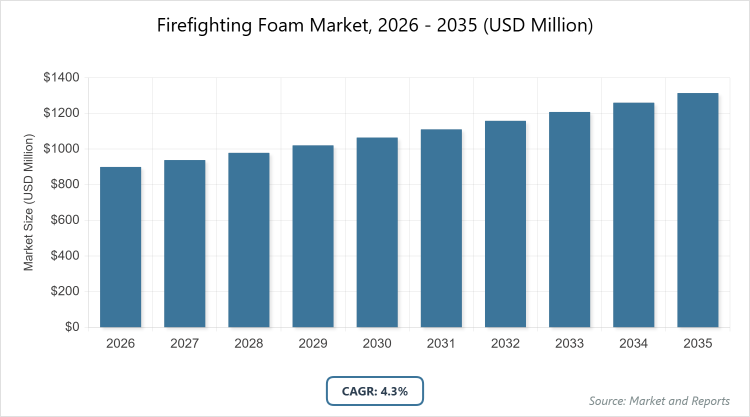
The global Firefighting Foam Market size was estimated at USD 8.99.9 Million in 2025 and is expected to reach USD 1,314.4 Million by 2035, growing at a CAGR of 4.3% from 2026 to 2035. The global firefighting foam market is primarily driven by stringent fire safety regulations and the rapid transition toward environmentally friendly, fluorine-free alternatives due to increasing bans on PFAS-containing chemicals.
What are the Key Insights into the Firefighting Foam Market?
- Market Value in 2026: USD 899.9 million
- Projected Market Value in 2035: USD 1,314.4 million
- CAGR (2026-2035): 4.3%
- Dominated Subsegment in Type: Aqueous Film Forming Foam (AFFF)
- Dominated Subsegment in End-Use: Oil & Gas
- Dominated Region: Asia Pacific
What is the Firefighting Foam Industry Overview?
Firefighting foam is a specialized suppression agent composed of a mixture of water, foam concentrate, and air that forms a blanket over flammable liquids to extinguish fires by cooling the fuel, separating it from oxygen, and suppressing vapor release. These foams are engineered for use in high-risk environments where traditional water-based methods are ineffective, particularly against hydrocarbon and polar solvent fires, and they expand upon application to create a durable barrier that prevents reignition while allowing for rapid knockdown of flames. Utilized primarily in industrial settings, they incorporate surfactants and stabilizers to enhance performance, enabling versatile deployment through sprinklers, nozzles, or aerial drops to mitigate fire hazards and protect assets without causing extensive water damage.
What are the Market Dynamics in the Firefighting Foam Sector?
The firefighting foam market is driven by stringent fire safety regulations across industries like oil and gas, aviation, and chemicals, where the need for effective suppression of Class B fires fuels demand for advanced foam solutions that minimize casualties and property loss. Rapid industrialization in emerging economies, coupled with increasing investments in infrastructure and rising fire incidents due to climate change and human error, further accelerates adoption, while innovations in foam formulations enhance efficacy and compatibility with modern firefighting equipment.
Restraints
Environmental concerns significantly restrain the firefighting foam market, as traditional formulations containing per- and polyfluoroalkyl substances (PFAS) contribute to soil and water contamination, leading to regulatory bans and phase-outs that increase compliance costs for manufacturers. High development expenses for alternative fluorine-free foams, along with performance limitations in extreme conditions, also hinder market growth by slowing the transition and adoption in cost-sensitive regions.
Opportunities
Opportunities in the firefighting foam market arise from the global shift toward fluorine-free and biodegradable alternatives, driven by environmental regulations, which allow companies to innovate and capture share in sectors like aviation and marine where sustainable solutions are prioritized. Expanding liquefied natural gas (LNG) infrastructure and wildfire management needs present avenues for specialized high-expansion foams, while partnerships with governments for training and equipment upgrades can enhance market penetration in developing regions.
Challenges
Challenges in the firefighting foam market include navigating complex regulatory landscapes that vary by region, requiring substantial R&D to develop compliant yet effective products without compromising fire suppression capabilities. Supply chain disruptions for raw materials like surfactants, combined with the need for extensive testing and certification of new formulations, pose operational hurdles that can delay product launches and increase costs for industry players.
Firefighting Foam Market : Report Scope
| Report Attributes | Report Details |
| Report Name | Firefighting Foam Market |
| Market Size 2025 | USD 899.9 Million |
| Market Forecast 2035 | USD 1,314.4 Million |
| Growth Rate | CAGR of 4.3% |
| Report Pages | 215 |
| Key Companies Covered |
Johnson Controls, Perimeter Solutions, Angus Fire, National Foam, Dr. Sthamer, Dafo Fomtec AB, Solberg, Chemguard, Kerr Fire, SFFECO Global. |
| Segments Covered | By Type, By End-Use, By Region. |
| Regions Covered | Asia Pacific, North America, Europe, Latin America, The Middle East and Africa. |
| Base Year | 2025 |
| Historical Year | 2020 – 2024 |
| Forecast Year | 2026 – 2035 |
| Customization Scope | Avail customized purchase options to meet your exact research needs. |
How is the Firefighting Foam Market Segmented?
By Type
Aqueous Film Forming Foam (AFFF) stands as the most dominant segment in the type category, commanding a substantial market share owing to its superior ability to rapidly form a thin aqueous film that suppresses vapors and extinguishes hydrocarbon fires effectively in high-risk environments like petrochemical plants and airports; this dominance is rooted in its proven track record of quick knockdown and reignition prevention, propelling market growth by enabling reliable fire control in industries where flammable liquids pose constant threats. Alcohol Resistant Aqueous Film Forming Foam (AR-AFFF) emerges as the second most dominant, excelling in combating polar solvent fires such as those involving alcohols or ketones by creating a polymeric barrier that resists foam breakdown; its growing prominence is driven by expanding chemical and pharmaceutical sectors, contributing to overall market expansion through versatile applications that address diverse fire hazards and support regulatory compliance for safer industrial operations.
By End-Use
The oil and gas segment is the most dominant in end-use, capturing a significant portion due to the inherent fire risks associated with hydrocarbon storage, refining, and transportation, where foams provide essential vapor suppression and cooling to prevent catastrophic explosions; this leadership is fueled by global energy demands and infrastructure expansions, driving market growth by integrating advanced foam systems into safety protocols that reduce downtime and enhance asset protection. Aviation follows as the second most dominant, relying on specialized foams for aircraft rescue and firefighting to handle fuel spills and engine fires swiftly; its importance stems from stringent international safety standards and increasing air traffic, bolstering market progress by fostering innovations in low-viscosity, high-performance foams tailored for rapid deployment in airport emergencies.
What are the Recent Developments in the Firefighting Foam Market?
In August 2024, National Foam launched AvioF3 Green Mil 3% Fluorine Free Foam Concentrate, a sustainable solution optimized for military and civilian aviation crash rescue, offering effective suppression without environmental harm from PFAS compounds. In April 2025, Perimeter Solutions introduced SOLBERG SPARTAN 1% Fluorine-Free Class A/B Foam Concentrate at the Fire Department Instructors Conference, designed to provide tactical advantages in suppressing a broad range of fires with minimal environmental impact. In April 2025, Dafo Fomtec AB unveiled Enviro MIL, a fluorine-free firefighting foam concentrate that meets high-performance standards for industrial and marine applications, emphasizing biodegradability and compliance with emerging regulations.
How Does Regional Analysis Shape the Firefighting Foam Market?
Asia Pacific dominates the firefighting foam market, fueled by rapid industrialization, urban expansion, and increasing fire safety investments, with China as the leading country due to its vast manufacturing base, extensive oil and gas operations, and government mandates for enhanced fire protection in petrochemical and mining sectors; this region’s growth is amplified by infrastructure projects and regulatory enforcement, promoting widespread adoption of advanced foams for risk mitigation.
North America holds a strong position with steady demand from energy and aviation industries, where the United States dominates through its robust regulatory framework, high incidence of industrial fires, and focus on transitioning to fluorine-free alternatives; Canada’s contributions in mining and marine further support the area, leveraging technological advancements to address environmental concerns and drive innovation.
Europe exhibits mature growth driven by strict environmental regulations and safety standards, with Germany leading via its chemical and automotive sectors that prioritize PFAS-free foams for compliance and sustainability; the United Kingdom bolsters this with marine and aviation applications, aligning with EU directives to foster eco-friendly solutions amid phasing out legacy products.
Latin America shows emerging potential, led by Brazil’s oil and mining industries that utilize foams for hazard-prone operations in tropical environments, though economic fluctuations temper expansion; the region’s focus on infrastructure safety presents opportunities for growth in fire suppression technologies.
The Middle East and Africa demonstrate growing interest, with Saudi Arabia as a key player in oil and gas applications where foams combat refinery and storage fires; South Africa’s mining sector adds to this, while challenges like regulatory inconsistencies limit broader uptake.
Who are the Key Market Players and What are Their Strategies in Firefighting Foam?
Johnson Controls focuses on innovation in fluorine-free concentrates, transitioning away from PFAS-based products through R&D investments and launches like Chemguard NFF to meet regulatory demands and expand in aviation and oil sectors via global partnerships.
Perimeter Solutions emphasizes sustainable formulations, leveraging acquisitions and technology advancements to develop high-performance fluorine-free foams like SOLBERG SPARTAN, targeting mining and marine applications with a strategy of certification and supply chain optimization.
Angus Fire pursues product diversification in eco-friendly foams, investing in testing facilities and collaborations to enhance foam stability and compatibility, aiming to dominate in Europe and Asia Pacific through targeted marketing in high-risk industries.
National Foam specializes in military-grade fluorine-free solutions, employing patent strategies and government contracts to grow in aviation, while focusing on biodegradability to align with environmental trends and secure long-term procurement deals.
Dr. Sthamer adopts a strategy of customization for industrial clients, prioritizing low-toxicity formulations and R&D in polymeric barriers to improve resistance in chemical fires, supported by European regulatory compliance and export expansion.
Dafo Fomtec AB concentrates on biodegradable alternatives, utilizing Scandinavian innovation hubs for product development and distributor networks to penetrate emerging markets in marine and mining with emphasis on training and application support.
Solberg targets niche high-expansion foams, implementing vertical integration for cost control and rapid prototyping to address wildfire and warehouse needs, while exploring bio-based surfactants for sustainability.
Chemguard focuses on multi-hazard concentrates, investing in surfactant technology and acquisitions to broaden its portfolio, catering to oil and gas with strategies centered on performance certification and global logistics.
Kerr Fire pursues aggressive licensing and partnerships, specializing in AR-AFFF for polar solvents to strengthen presence in chemicals and aviation, driven by compliance with international standards.
SFFECO Global leverages Middle Eastern manufacturing for cost-effective solutions, emphasizing export to Africa and Asia with strategies involving equipment bundling and after-sales services for municipal and industrial users.
What are the Current Market Trends in Firefighting Foam?
- Rapid transition to fluorine-free foams driven by PFAS regulations and environmental concerns.
- Increasing demand for biodegradable and low-toxicity formulations in aviation and marine sectors.
- Advancements in high-expansion foams for wildfire and LNG infrastructure protection.
- Growing integration of automated foam systems in industrial fire safety protocols.
- Emphasis on R&D for enhanced compatibility with modern firefighting equipment and tactics.
What Market Segments are Covered in the Firefighting Foam Report?
By Type:
- Aqueous Film Forming Foam (AFFF)
- Alcohol Resistant Aqueous Film Forming Foam (AR-AFFF)
- Protein Foam
- Synthetic Detergent Foam
- Others
By End-Use:
- Oil & Gas
- Aviation
- Marine
- Mining
- Others
By Region
-
- North America
- U.S.
- Canada
- Europe
- UK
- Germany
- France
- Rest of Europe
- Asia Pacific
- China
- India
- Japan
- Rest of Asia Pacific
- Latin America
- Brazil
- Mexico
- Rest of Latin America
- Middle East & Africa
- UAE
- South Africa
- Rest of Middle East & Africa
- North America
Frequently Asked Questions
Firefighting foam is a suppression agent that forms a blanket of bubbles to extinguish fires involving flammable liquids by cooling the surface, suppressing vapors, and separating fuel from oxygen sources.
Key factors include regulatory shifts toward fluorine-free products, rising industrial fire incidents, expansion in oil and gas infrastructure, and advancements in eco-friendly foam technologies.
The market is projected to grow from USD 899.9 million in 2026 to USD 1,314.4 million by 2035.
The CAGR is anticipated to be 4.3% during 2026-2035.
Asia Pacific will contribute notably, driven by rapid industrialization in China.
Major players include Johnson Controls, Perimeter Solutions, Angus Fire, National Foam, and Dr. Sthamer.
The report provides comprehensive insights into market size, forecasts, segmentation, regional analysis, key players, drivers, restraints, opportunities, trends, and recent developments.
The value chain includes raw material procurement (e.g., surfactants, stabilizers), formulation and manufacturing, distribution and testing, end-use application, and disposal or recycling.
Trends are moving toward sustainable, PFAS-free foams, with consumers favoring environmentally safe, high-performance options for industrial and emergency applications.
Bans on PFAS-containing foams due to contamination risks are pushing innovation in alternatives, while environmental awareness drives demand for biodegradable solutions.