
Electric Vehicle Market Size, Share and Trends 2026 to 2035
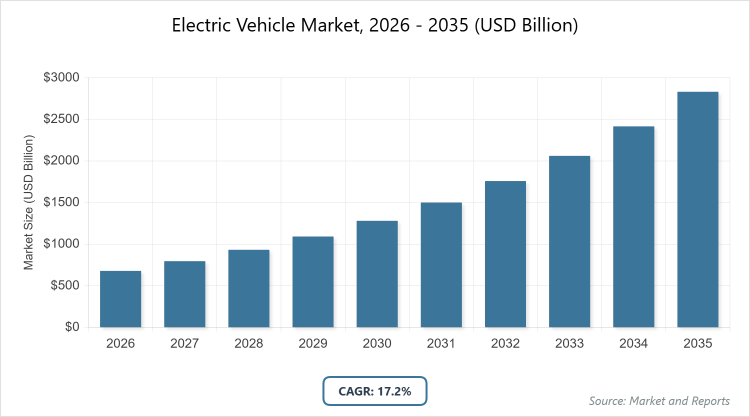
According to MarketnReports, the global Electric Vehicle Market size was estimated at USD 678.66 Billion in 2025 and is expected to reach USD 3338.87 Billion by 2035, growing at a CAGR of 17.2% from 2026 to 2035. Electric Vehicle Market is driven by government incentives, advancements in battery technology, and rising environmental awareness.
What is the Industry Overview of the Electric Vehicle Market?
The Electric Vehicle Market encompasses battery-powered, plug-in hybrid, and fuel cell vehicles designed for sustainable transportation, reducing reliance on fossil fuels through electric propulsion systems that offer lower emissions, energy efficiency, and cost savings over time. This market supports global decarbonization efforts by integrating renewable energy sources, advanced batteries, and smart charging infrastructure, addressing urban mobility challenges and consumer demands for eco-friendly options. It includes vehicles for personal, commercial, and public use, with innovations in autonomous driving and connectivity enhancing safety and convenience.
The market definition covers all electric-powered vehicles excluding conventional internal combustion engines, driven by policy incentives, technological breakthroughs in range and charging speed, and shifting preferences towards green mobility solutions that promote energy independence and reduced operating costs.
What are the Key Insights into the Electric Vehicle Market?
- The global Electric Vehicle Market size was estimated at USD 678.66 Billion in 2025 and is expected to reach USD 3338.87 Billion by 2035.
- Growing at a CAGR of 17.2% from 2026 to 2035.
- The Electric Vehicle Market is driven by government incentives promoting zero-emission vehicles, advancements in battery technology reducing costs, and increasing consumer awareness of environmental sustainability.
- Dominated subsegment in Type: Battery Electric Vehicle with 68.8% share, because of its zero-emission profile, improving range capabilities, and supportive infrastructure developments making it ideal for urban commuting.
- Dominated subsegment in Vehicle Type: Passenger Cars with 57.48% share, because of high consumer demand for affordable personal mobility solutions and widespread availability of models from major manufacturers.
- Dominated subsegment in End-User: Personal with 60% share, because of rising individual adoption driven by tax rebates, lower fuel costs, and environmental consciousness among urban dwellers.
- Dominated region: Asia Pacific with 65% share, because of massive government subsidies, rapid urbanization, and leading manufacturing capabilities in China accelerating EV penetration.
What are the Market Dynamics of the Electric Vehicle Market?
Growth Drivers
The growth drivers for the Electric Vehicle Market include stringent global emission regulations pushing automakers towards zero-emission technologies, with governments offering incentives like tax credits and rebates to accelerate adoption and reduce carbon footprints in transportation. Advancements in battery technology, such as solid-state batteries and faster charging, lower costs and extend range, making EVs more competitive with traditional vehicles and appealing to cost-conscious consumers.
Increasing infrastructure investments in charging networks, including ultra-fast chargers and home installations, alleviate range anxiety and support widespread use in urban and rural areas. Rising environmental awareness and corporate sustainability goals drive demand, while falling lithium-ion prices from economies of scale enable affordable models for mass markets. Partnerships between OEMs and tech firms enhance connectivity and autonomous features, further boosting consumer interest and market expansion.
Restraints
Restraints in the Electric Vehicle Market arise from high upfront costs compared to internal combustion vehicles, limiting accessibility in developing regions despite long-term savings, as battery prices remain a significant barrier without sufficient subsidies. Infrastructure gaps, particularly in rural areas and emerging markets, hinder adoption due to insufficient charging stations and grid capacity for widespread electrification. Supply chain vulnerabilities for critical materials like lithium and cobalt lead to price volatility and shortages, impacted by geopolitical tensions and mining constraints.
Regulatory inconsistencies across regions complicate global manufacturing and sales, while consumer concerns over battery life, resale value, and recycling pose psychological barriers. Economic slowdowns also reduce discretionary spending on premium EVs, slowing penetration in price-sensitive segments.
Opportunities
Opportunities in the Electric Vehicle Market emerge through expansions in emerging markets with supportive policies, enabling partnerships for localized production and affordable models tailored to regional needs, tapping into growing middle-class demand. Innovations in vehicle-to-grid technology allow EVs to serve as energy storage, creating revenue streams through utility collaborations and enhancing grid stability with renewables. Fleet electrification in logistics and public transport offers scalable applications, driven by total cost of ownership benefits and corporate ESG commitments.
Advancements in wireless charging and battery swapping reduce downtime, attracting commercial users, while AI integrations for predictive maintenance improve reliability. Government funding for R&D in next-gen batteries opens avenues for breakthrough efficiencies, positioning companies to capture premium segments in autonomous and connected mobility.
Challenges
Challenges in the Electric Vehicle Market include scaling charging infrastructure to match demand, as rapid adoption strains grids and requires massive investments in high-voltage networks without disrupting urban landscapes. Achieving battery recycling and sustainable sourcing to minimize environmental impact demands advanced technologies and global standards, amid concerns over resource depletion. Competition from hydrogen and alternative fuels fragments investments, while standardizing charging protocols across brands and regions complicates interoperability.
Educating consumers on EV benefits and dispelling myths about performance in extreme weather requires targeted campaigns. Economic disparities in adoption rates between developed and developing nations risk uneven growth, necessitating inclusive policies to ensure equitable transition.
Electric Vehicle Market: Report Scope
| Report Attributes | Report Details |
| Report Name | Electric Vehicle Market |
| Market Size 2025 | USD 678.66 Billion |
| Market Forecast 2035 | USD 3338.87 Billion |
| Growth Rate | CAGR of 17.2% |
| Report Pages | 220 |
| Key Companies Covered |
Tesla Inc., BYD Company Ltd., Volkswagen AG, General Motors Company, Ford Motor Company, Hyundai Motor Company, Kia Corporation, BMW AG, Mercedes-Benz Group AG, Rivian Automotive Inc., and Others |
| Segments Covered | By Type, By Vehicle Type, By End-User, and By Region |
| Regions Covered | North America, Europe, Asia Pacific (APAC), Latin America, and The Middle East and Africa (MEA) |
| Base Year | 2025 |
| Historical Year | 2020 – 2024 |
| Forecast Year | 2026 – 2035 |
| Customization Scope | Avail customized purchase options to meet your exact research needs. |
How is the Market Segmentation Structured in the Electric Vehicle Market?
The Electric Vehicle market is segmented by type, vehicle type, end-user, and region.
Based on Type Segment. The most dominant segment is Battery Electric Vehicle, which holds the largest market share due to its full reliance on electricity for zero emissions, benefiting from falling battery costs and extensive charging infrastructure; this dominance drives the market by aligning with global decarbonization goals, encouraging investments in renewable integration, and accelerating consumer shift from fossil fuels. The second most dominant segment is Plug-in Hybrid Electric Vehicle, valued for its dual fuel flexibility reducing range anxiety; it contributes to market growth by serving as a transitional technology, building hybrid familiarity, and expanding accessibility in areas with limited charging.
Based on Vehicle Type Segment. The most dominant segment is Passenger Cars, accounting for the majority share owing to high individual demand for daily commuting and family use with diverse model options; this leads market growth by democratizing EV access through affordable sedans and SUVs, stimulating mass production economies, and fostering urban mobility solutions. The second most dominant segment is Commercial Vehicles, driven by fleet electrification for logistics; it propels expansion by offering lower operational costs, complying with emission regulations, and enabling sustainable supply chains.
Based on End-User Segment. The most dominant segment is Personal, commanding the majority share due to rising consumer adoption for cost savings and environmental benefits; this dominance fuels market growth by increasing home charging demand, promoting policy incentives, and building widespread acceptance. The second most dominant segment is Commercial, driven by business efficiencies; it aids growth by scaling fleet transitions, reducing fuel expenses, and supporting corporate sustainability targets.
What are the Recent Developments in the Electric Vehicle Market?
- In May 2025, the IEA released the Global EV Outlook 2025, highlighting over 20 million EV sales globally, with China leading at 45% market share and emphasizing policy uncertainties impacting growth.
- In October 2025, Tesla announced expansions in affordable models like the refreshed Model 3, aiming to boost mass adoption amid regulatory changes in the US.
- In December 2025, BYD launched new battery tech for extended range, partnering with European firms to enter markets with stricter emissions standards.
How Does Regional Analysis Impact the Electric Vehicle Market?
- Asia Pacific to dominate the global market.
Asia Pacific, valued at USD 444.13 billion in 2025 and projected to reach USD 2183.27 billion by 2035 at a CAGR of 17.2%, dominates with over 65% revenue share due to massive government subsidies exceeding billions for EV production, rapid urbanization with over 50% population in cities demanding clean transport, and advanced battery supply chains controlling 80% global lithium-ion output; India contributes through initiatives like FAME III for local manufacturing, but China as the dominating country leads with over 10 million annual sales, supported by state-owned enterprises like BYD and aggressive targets for 60% EV penetration by 2030, driving export growth and technological innovations in fast-charging.
Europe exhibits strong growth, propelled by EU Green Deal allocating EUR 100 billion for electrification, with CO2 targets pushing 25% EV sales share in 2025; Germany as the dominating country advances through automotive giants like Volkswagen investing EUR 60 billion in EV platforms, leading in premium segments.
North America advances steadily, fueled by federal incentives like the revised IRA for domestic production, with California mandates boosting 11% US sales share; the United States dominates with Tesla’s Gigafactories and GM’s Ultium platform, supporting 2.25 million annual sales.
Latin America emerges gradually, driven by resource-rich lithium triangle and urban air quality improvements; Brazil leads with ethanol-hybrid synergies and VW investments for local EV assembly.
The Middle East and Africa progress incrementally, influenced by oil diversification and solar-integrated charging; the United Arab Emirates dominates through NEV mandates in Dubai and Masdar’s renewable-powered fleets.
Who are the Key Market Players in the Electric Vehicle Market?
Tesla Inc. Tesla Inc. focuses on autonomous driving tech, with strategies including Gigafactory expansions for battery cost reduction and vertical integration for supply chain control.
BYD Company Ltd. BYD Company Ltd. emphasizes affordable EVs, strategizing through blade battery innovations and global partnerships for export growth.
Volkswagen AG. Volkswagen AG invests in modular platforms, employing strategies like ID family expansions and alliances for charging networks.
General Motors Company. General Motors Company targets fleet electrification, with strategies involving Ultium batteries and Super Cruise autonomy.
Ford Motor Company. Ford Motor Company focuses on electric trucks, strategizing via F-150 Lightning production ramps and dealer training.
Hyundai Motor Company. Hyundai Motor Company integrates hydrogen, employing strategies for Ioniq lineup and sustainable materials.
Kia Corporation. Kia Corporation emphasizes design-led EVs, with strategies including EV6 crossovers and fast-charging tech.
BMW AG. BMW AG invests in premium i models, strategizing through Neue Klasse architecture for efficiency.
Mercedes-Benz Group AG. Mercedes-Benz Group AG focuses on luxury EQ series, with strategies involving software-defined vehicles.
Rivian Automotive Inc. Rivian Automotive Inc. targets adventure EVs, employing Amazon partnerships for fleet deliveries.
What are the Market Trends in the Electric Vehicle Market?
- Rapid adoption of affordable models with extended range amid battery cost declines.
- Integration of AI for autonomous features and predictive maintenance.
- Expansion of fast-charging networks with renewable energy sources.
- Shift towards sustainable materials and recycling in manufacturing.
- Growth in commercial fleets for logistics and public transport electrification.
What Market Segments and their Subsegments are Covered in the Electric Vehicle Report?
By Type
-
- Battery Electric Vehicle
- Plug-in Hybrid Electric Vehicle
- Hybrid Electric Vehicle
- Fuel Cell Electric Vehicle
- Others
By Vehicle Type
-
- Passenger Cars
- Commercial Vehicles
- Two-Wheelers
- Buses
- Trucks
- Others
By End-User
-
- Personal
- Commercial
- Government
- Others
By Region
-
- North America
- U.S.
- Canada
- Europe
- UK
- Germany
- France
- Rest of Europe
- Asia Pacific
- China
- India
- Japan
- Rest of Asia Pacific
- Latin America
- Brazil
- Mexico
- Rest of Latin America
- Middle East & Africa
- UAE
- South Africa
- Rest of Middle East & Africa
- North America
Chapter 1. Preface
Chapter 2. Executive Summary
Chapter 3. Global Electric Vehicle Market - Industry Analysis
Chapter 4. Global Electric Vehicle Market- Competitive Landscape
Chapter 5. Global Electric Vehicle Market - Type Analysis
Chapter 6. Global Electric Vehicle Market - Vehicle Type Analysis
Chapter 7. Global Electric Vehicle Market - End-User Analysis
Chapter 8. Electric Vehicle Market - Regional Analysis
Chapter 9. Company Profiles
Frequently Asked Questions
Electric vehicles are automobiles powered by electric motors using rechargeable batteries or fuel cells, offering zero or low emissions for sustainable transportation.
Key factors include government incentives, battery advancements, charging infrastructure expansion, and environmental regulations.
The market is projected to grow from USD 795.49 billion in 2026 to USD 3338.87 billion by 2035.
The CAGR is expected to be 17.2% during 2026-2035.
Asia Pacific will contribute notably, holding 65% share, driven by subsidies in China.
Major players include Tesla Inc., BYD Company Ltd., Volkswagen AG, General Motors Company, Ford Motor Company, and Hyundai Motor Company, among others.
The report provides comprehensive analysis including market size, forecasts, segmentation, dynamics, regional insights, key players, trends, and strategic recommendations.
The value chain includes raw material sourcing (batteries, metals), component manufacturing, vehicle assembly, distribution, sales, and after-sales services.
Trends focus on affordability and sustainability, with preferences shifting towards long-range, tech-integrated models.
Regulations mandate emissions reductions, while environmental factors promote green manufacturing.