
E-Waste Management Market Size, Share and Forecast 2026 to 2035
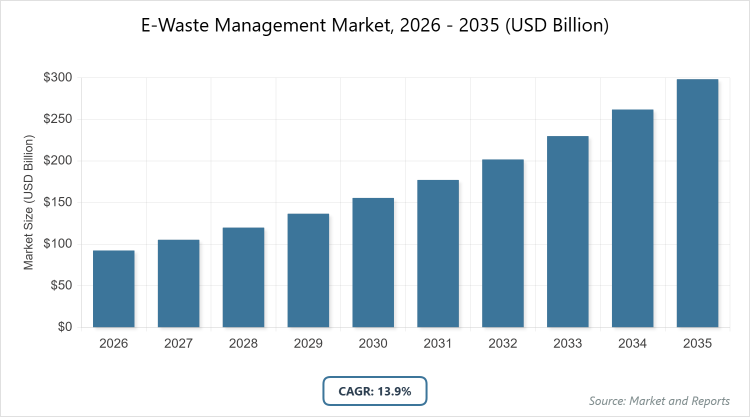
According to our latest research, the global e-waste management market is projected to grow from USD 92.45 billion in 2026 to USD 297.73 billion by 2035, growing at a CAGR is estimated at 13.9% during 2026-2035. The E-Waste Management Market is primarily driven by shortening electronic product lifecycles and stringent global regulatory mandates, such as Extended Producer Responsibility (EPR), which compel manufacturers and consumers to adopt circular economy practices for hazardous waste mitigation and valuable metal recovery.
What are the Key Insights into the E-Waste Management Market?
- Global market value projected to reach USD 297.73 billion by 2035 from USD 92.45 billion in 2026.
- Compound Annual Growth Rate (CAGR) estimated at 13.9% during 2026-2035.
- Metal dominates the processed material segment.
- Consumer Electronics dominates the source segment.
- Recycled dominates the application segment.
- Asia Pacific dominates the regional market.
What is the E-Waste Management Market?
Industry Overview
The e-waste management market involves the systematic collection, processing, recycling, and disposal of discarded electronic and electrical equipment, such as computers, smartphones, appliances, and industrial devices, to recover valuable materials like metals, plastics, and rare earth elements while minimizing environmental harm from hazardous substances like lead, mercury, and cadmium. This market encompasses formal and informal sectors that handle the dismantling, refurbishing, and safe disposal of e-waste, driven by the need to address the growing volume of obsolete electronics generated by rapid technological advancements and consumer demand.
It integrates regulatory compliance, technological innovations in sorting and extraction, and circular economy principles to promote resource recovery and reduce landfill dependency, serving stakeholders from manufacturers and recyclers to governments and consumers focused on sustainability and pollution prevention in a global context where improper handling poses significant health and ecological risks.
What are the Market Dynamics in the E-Waste Management Market?
Growth Drivers
The e-waste management market is driven by the surge in electronic device consumption globally, fueled by rapid technological advancements and shortening product lifecycles, which generate increasing volumes of waste requiring efficient recycling to recover scarce resources and comply with stringent environmental regulations aimed at reducing pollution. Growing awareness of the circular economy encourages manufacturers to adopt extended producer responsibility (EPR) schemes, while innovations in recycling technologies, such as automated sorting and hydrometallurgical processes, enhance material recovery rates and economic viability. Additionally, government initiatives and international agreements like the Basel Convention promote formal recycling infrastructure, supported by corporate sustainability goals that prioritize eco-friendly practices to mitigate supply chain risks and appeal to environmentally conscious consumers.
Restraints
Restraints in the e-waste management market include inadequate infrastructure in developing regions, where informal recycling practices dominate, leading to health hazards and low recovery efficiency due to limited access to advanced technologies and funding. High operational costs for formal recycling facilities, coupled with fluctuating commodity prices for recovered materials, deter investments and profitability, while complex supply chains for e-waste collection complicate logistics and traceability. Regulatory inconsistencies across countries hinder cross-border trade and standardized practices, exacerbating illegal dumping and export issues that undermine global efforts to manage e-waste sustainably.
Opportunities
Opportunities in the e-waste management market arise from advancements in AI and robotics for precise material separation, enabling higher recovery yields of critical minerals like gold and copper amid supply shortages, while urban mining initiatives in densely populated areas offer localized solutions to tap into valuable urban waste streams. Expanding EPR policies and incentives in emerging economies create avenues for public-private partnerships to build recycling hubs, and the integration of blockchain for transparent supply chains can enhance trust and attract investments. Furthermore, the rise of refurbishment and resale markets for electronics aligns with consumer preferences for sustainable products, opening new revenue models focused on extending device lifespans.
Challenges
Challenges in the e-waste management market encompass the dominance of informal sectors in many regions, which employ unsafe methods leading to environmental contamination and worker exploitation, while formal systems struggle with insufficient collection rates due to consumer apathy and lack of awareness. Rapidly evolving e-waste compositions from new technologies complicate recycling processes, requiring constant R&D investments, and geopolitical tensions affect the availability of processing facilities. Additionally, enforcing global regulations against illegal exports remains difficult, necessitating international cooperation to address transboundary movements and ensure equitable distribution of recycling benefits.
E-Waste Management Market: Report Scope
| Report Attributes | Report Details |
| Report Name | E-Waste Management Market |
| Market Size 2025 | USD 92.45 Billion |
| Market Forecast 2035 | USD 297.73 Billion |
| Growth Rate | CAGR of 13.9% |
| Report Pages | 220 |
| Key Companies Covered | Aurubis AG, Boliden Group, Electronic Recyclers International (ERI), Sims Lifecycle Services, Umicore SA, Veolia Environnement SA, and TES – Sustainable IT Lifecycle Services |
| Segments Covered | By Processed Material, By Source, By Application, By Region |
| Regions Covered | North America, Europe, Asia Pacific (APAC), Latin America, The Middle East and Africa (MEA) |
| Base Year | 2025 |
| Historical Year | 2020 – 2024 |
| Forecast Year | 2026 – 2035 |
| Customization Scope | Avail customized purchase options to meet your exact research needs. |
What is the Market Segmentation Analysis for the E-Waste Management Market?
The e-waste management market is segmented by processed material, source, application, and region.
By processed material segment, Metal emerges as the most dominant subsegment, followed by Plastic as the second most dominant. Metal leads due to its high economic value from recoverable precious elements like gold, silver, and copper, which are in demand for new electronics manufacturing amid resource scarcity, and advanced extraction technologies that achieve high recovery rates; this dominance drives the market by incentivizing investments in sophisticated recycling facilities, reducing dependency on virgin mining, and supporting circular economy goals that lower environmental impacts while generating substantial revenue from secondary raw materials. Plastic, as the second dominant, benefits from growing regulations on plastic waste and innovations in chemical recycling, contributing to market growth by enabling the repurposing of durable components and addressing pollution concerns through sustainable alternatives.
By source segment, Consumer Electronics is the most dominant subsegment in the source segment, followed by Industrial Electronics as the second most dominant. Consumer Electronics dominates owing to the rapid obsolescence of devices like smartphones and laptops driven by consumer upgrades and short product cycles, generating the largest volume of e-waste globally; this leadership propels the market by necessitating scalable collection and processing infrastructures, fostering public awareness campaigns, and enabling economies of scale in recycling that attract investments and drive technological advancements for efficient material recovery. Industrial Electronics, from equipment in manufacturing and telecom, contributes through specialized handling of complex components, supporting growth via B2B partnerships and compliance-driven recycling.
By application segment, Recycled is the most dominant subsegment in the application segment, followed by Disposed as the second most dominant. Recycled leads because of increasing regulatory pressures and corporate commitments to sustainability, which prioritize material recovery over landfilling to conserve resources and minimize toxins; this dominance accelerates market dynamics by promoting innovative processes like urban mining, creating jobs in green sectors, and integrating with supply chains for reused materials that reduce costs and environmental footprints, thereby expanding the overall market through value-added services. Disposed, involving safe incineration or landfilling, serves as a necessary backup for non-recyclable waste, contributing to compliance and risk management.
What are the Recent Developments in the E-Waste Management Market?
- In October 2025, Henkel introduced new eco-friendly adhesives for easier disassembly in electronics, aiming to facilitate recycling and align with EU circular economy directives.
- In December 2025, Sims Recycling Solutions expanded its facilities in Asia with AI-sorting technology, enhancing metal recovery efficiency amid rising regional e-waste volumes.
What is the Regional Analysis of the E-Waste Management Market?
- Asia Pacific to dominate the market
Asia Pacific dominates the e-waste management market with over 47% share, driven by massive electronic production and consumption, rapid urbanization, and government policies promoting recycling infrastructure; China leads as the dominating country through its national circular economy strategies, extensive collection networks, and investments in advanced processing plants that handle domestic and imported waste, supported by regulations like the EPR framework that enforce producer accountability and foster innovation in material recovery to address pollution challenges in densely populated areas.
Europe maintains a strong position with high recycling rates and stringent regulations under the WEEE Directive, where Germany emerges as the dominating country via its efficient formal systems, collaborations with manufacturers for EPR, and focus on urban mining that exports best practices across the EU, enabling sustainable resource loops amid limited raw material access.
North America shows steady growth through technological leadership and corporate initiatives, led by the United States as the dominating country with its state-level laws, major recyclers like ERI, and emphasis on data destruction for electronics from tech hubs, addressing high per capita generation rates.
Latin America exhibits emerging potential with increasing awareness and foreign investments, with Brazil dominating through its national policy on solid waste, urban collection programs, and partnerships tackling informal sectors to reduce environmental impacts.
The Middle East and Africa region, though smaller, is advancing via resource recovery needs, dominated by South Africa with its e-waste associations, government frameworks, and initiatives in mining synergies for metal extraction from waste.
Who are the Key Market Players and Their Strategies in the E-Waste Management Market?
- Aurubis AG focuses on advanced smelting technologies for copper and precious metal recovery, pursuing acquisitions to expand global processing capacity and emphasize sustainable sourcing.
- Boliden Group leverages hydrometallurgical innovations, investing in R&D for efficient recycling and forming partnerships with electronics manufacturers for closed-loop systems.
- Electronic Recyclers International (ERI) prioritizes data security and compliance, expanding through certifications and collaborations with tech firms for responsible disposal.
- Sims Lifecycle Services adopts AI-sorting strategies, focusing on urban mining expansions and sustainability reporting to attract corporate clients.
- Umicore SA concentrates on battery recycling, employing mergers for material expertise and targeting EV waste streams with eco-friendly processes.
- Veolia Environnement SA utilizes integrated waste management, investing in digital tracking for transparency and scaling operations in emerging markets.
- TES – Sustainable IT Lifecycle Services emphasizes end-to-end services, pursuing global certifications and innovations in asset recovery for the IT sectors.
What are the Market Trends in the E-Waste Management Market?
- Adoption of AI and robotics for automated sorting and disassembly to improve efficiency and safety in recycling processes.
- Emphasis on circular economy models promoting refurbishment and resale to extend product lifecycles.
- Growth in urban mining initiatives to recover valuable metals from city waste streams.
- Integration of blockchain for transparent tracking of e-waste from collection to recycling.
- Rise in EPR regulations holding producers accountable for end-of-life management.
- Expansion of formal recycling infrastructure in developing regions to combat informal sectors.
- Focus on recovering rare earth elements amid supply chain vulnerabilities.
- Development of eco-design standards for easier recyclability in new electronics.
- Surge in public-private partnerships for awareness and collection campaigns.
- Use of chemical recycling for plastics to address non-mechanical waste challenges.
What Market Segments are Covered in the E-Waste Management Market Report?
By Processed Material
- Metal
- Plastic
- Glass
- Others
By Source
- Industrial Electronics
- Consumer Electronics
- Others
By Application
- Recycled
- Disposed
By Region
- North America
- U.S.
- Canada
- Europe
- UK
- Germany
- France
- Rest of Europe
- Asia Pacific
- China
- India
- Japan
- Rest of Asia Pacific
- Latin America
- Brazil
- Mexico
- Rest of Latin America
- Middle East & Africa
- UAE
- South Africa
- Rest of Middle East & Africa
Chapter 1. Preface
Chapter 2. Executive Summary
Chapter 3. Global E-Waste Management Market - Industry Analysis
Chapter 4. Global E-Waste Management Market- Competitive Landscape
Chapter 5. Global E-Waste Management Market - Processed Material Analysis
Chapter 6. Global E-Waste Management Market - Source Analysis
Chapter 7. Global E-Waste Management Market - Application Analysis
Chapter 8. E-Waste Management Market - Regional Analysis
Chapter 9. Company Profiles
Frequently Asked Questions
E-waste management involves the collection, recycling, and disposal of discarded electronic devices to recover materials and prevent environmental harm from toxins.
Key factors include rising electronic consumption, stringent regulations, technological advancements in recycling, circular economy adoption, and resource scarcity.
The market is projected to grow from USD 92.45 billion in 2026 to USD 297.73 billion by 2035.
The CAGR is estimated at 13.9% during 2026-2035.
Asia Pacific will contribute notably, holding the largest share due to high generation and processing volumes.
Major players include Aurubis AG, Boliden Group, Electronic Recyclers International (ERI), Sims Lifecycle Services, Umicore SA, Veolia Environnement SA, and TES – Sustainable IT Lifecycle Services.
The report provides insights into market size, forecasts, segmentation, regional analysis, key players, trends, dynamics, and developments.
The value chain includes e-waste generation, collection, transportation, dismantling, processing/recovery, and final disposal or resale.
Trends are evolving toward AI automation and circular models, with consumers preferring sustainable practices and refurbished products for environmental reasons.
Regulatory factors include EPR laws and Basel Convention restrictions on exports, while environmental factors involve toxic leaching risks driving sustainable recycling demands.