
Drone Package Delivery Market Size, Share and Trends 2026 to 2035
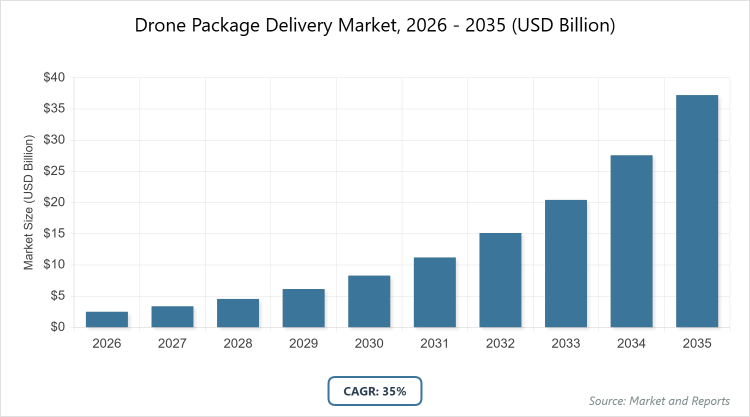
According to MarketnReports, the global Drone Package Delivery market size was estimated at USD 2.5 billion in 2025 and is expected to reach USD 50 billion by 2035, growing at a CAGR of 35% from 2026 to 2035. The rapid expansion of e-commerce and the demand for faster, cost-effective last-mile delivery solutions.
What are the Key Insights into Drone Package Delivery Market?
- The global drone package delivery market size was valued at USD 2.5 billion in 2025 and is projected to reach USD 50 billion by 2035.
- The market is expected to grow at a CAGR of 35% during the forecast period from 2026 to 2035.
- The market is driven by the growth of e-commerce, advancements in drone technology, and the need for efficient last-mile delivery solutions.
- In the type segment, the rotary-wing drones subsegment dominated with a 65% share, due to their superior maneuverability, vertical takeoff/landing capabilities, and suitability for urban environments with limited space.
- In the application segment, the e-commerce subsegment held the largest share at around 55%, driven by partnerships with major platforms and the demand for rapid parcel delivery in densely populated areas.
- In the end-user segment, the commercial subsegment accounted for 80% of the market, primarily because of widespread adoption by logistics companies and retailers seeking cost reductions and faster service.
- Asia Pacific dominated the regional market with a 45% share, attributed to rapid e-commerce growth, supportive regulations, and high population density in countries like China and India.
What is the Drone Package Delivery Market?
Industry Overview
The drone package delivery market involves the use of unmanned aerial vehicles (UAVs) to transport goods directly to customers, offering faster, more efficient alternatives to traditional ground delivery in urban and remote areas. Market definition includes fixed-wing, rotary-wing, and hybrid drones equipped with advanced navigation, payload systems, and safety features to handle packages ranging from small parcels to medical supplies, integrated with logistics platforms for automated routing and tracking, addressing challenges like traffic congestion, labor shortages, and sustainability goals in the evolving last-mile delivery ecosystem.
What are the Market Dynamics of Drone Package Delivery Market?
Growth Drivers
Growth drivers in the drone package delivery market are propelled by the explosive rise of e-commerce platforms, which require faster and more cost-effective last-mile solutions to meet consumer expectations for same-day or two-hour delivery. Technological advancements in battery life, autonomous navigation, and obstacle avoidance have improved drone reliability, while supportive regulations in key markets enable commercial operations. Sustainability benefits, such as reduced carbon emissions compared to ground vehicles, align with corporate ESG goals, further accelerating investments from logistics giants and retailers.
Restraints
Restraints include stringent regulatory frameworks that limit beyond-visual-line-of-sight (BVLOS) operations and impose airspace restrictions, delaying widespread deployment. High initial costs for drone fleets, maintenance, and infrastructure like landing pads hinder adoption, particularly in developing regions. Public concerns over privacy, noise, and safety, along with limited payload capacity and weather dependency, also slow market penetration.
Opportunities
Opportunities emerge from expanding into healthcare and food delivery, where drones can provide critical, rapid transport for medical supplies and perishables in remote or congested areas. Integration with AI and robotics for automated loading/unloading creates new efficiencies, while partnerships with e-commerce platforms offer scalable models. Emerging markets in the Asia Pacific and Africa present untapped potential through government-backed trials and investments in rural connectivity.
Challenges
Challenges involve achieving reliable BVLOS operations amid airspace congestion and ensuring cybersecurity against hacking risks. Scalability requires significant infrastructure development, while varying global regulations complicate cross-border deployments. Competition from traditional delivery methods and high energy consumption in drones pose ongoing hurdles for profitability.
Drone Package Delivery Market: Report Scope
| Report Attributes | Report Details |
| Report Name | Drone Package Delivery Market |
| Market Size 2025 | USD 2.5 Billion |
| Market Forecast 2035 | USD 50 Billion |
| Growth Rate | CAGR of 35% |
| Report Pages | 220 |
| Key Companies Covered |
Amazon Prime Air, Wing (Alphabet), Zipline, UPS Flight Forward, Manna Aero, and Others |
| Segments Covered | By Type (Fixed-Wing Drones, Rotary-Wing Drones, Hybrid Drones, and Others), By Application (E-commerce, Healthcare, Food Delivery, Logistics, and Others), By End-User (Commercial, Government, and Others), and By Region |
| Regions Covered | North America, Europe, Asia Pacific (APAC), Latin America, and The Middle East and Africa (MEA) |
| Base Year | 2025 |
| Historical Year | 2020 – 2024 |
| Forecast Year | 2026 – 2035 |
| Customization Scope | Avail customized purchase options to meet your exact research needs. |
What is the Market Segmentation of the Drone Package Delivery Market?
The Drone Package Delivery market is segmented by type, application, end-user, and region.
Based on Type Segment, the rotary-wing drones subsegment is the most dominant, holding over 65% share, followed by hybrid drones as the second most dominant. Rotary-wing drones’ dominance arises from their ability to hover, take off vertically, and navigate tight urban spaces, driving the market by enabling precise deliveries in congested areas and supporting scalability for e-commerce giants.
Based on Application Segment, e-commerce leads with approximately 55% share, with healthcare as the second dominant. E-commerce’s leading position is fueled by massive order volumes and consumer demand for speed, propelling market growth through partnerships that reduce delivery times and costs, thus expanding operational feasibility.
Based on the End-User Segment, commercial dominates with 80% share, followed by government. Commercial supremacy stems from logistics and retail companies’ focus on efficiency, aiding market drive by funding large-scale pilots and deployments that validate the technology for widespread use.
What are the Recent Developments in the Drone Package Delivery Market?
- In November 2025, Amazon Prime Air expanded its drone delivery service to multiple U.S. cities, completing over 100,000 deliveries with improved battery life and BVLOS capabilities.
- In October 2025, Zipline launched a new medical delivery network in Ghana, partnering with the government to transport vaccines and blood samples across rural areas.
- In September 2025, Wing (Alphabet) announced trials in Australia, achieving 5-minute deliveries for groceries and pharmaceuticals in suburban areas.
- In July 2025, UPS Flight Forward received FAA approval for expanded commercial operations, focusing on healthcare logistics in the U.S.
- In June 2025, Manna Aero completed successful trials in Ireland, delivering hot meals via drone with a 15-minute average time.
What is the Regional Analysis of Drone Package Delivery Market?
- Asia Pacific to dominate the global market.
Asia Pacific leads the drone package delivery market, holding approximately 45% share, driven by explosive e-commerce growth and supportive regulations. China dominates within the region, supported by JD.com and SF Express pilots, massive urban populations, and government-backed drone corridors that enable rapid scaling.
North America exhibits strong growth at a CAGR of 38%, bolstered by FAA approvals and corporate investments. The United States leads as the dominant country, fueled by Amazon and Walmart trials, advanced infrastructure, and consumer demand for fast delivery.
Europe shows steady expansion with a CAGR of 34%, focused on regulatory harmonization. The United Kingdom is the leading country, driven by trials in rural areas and partnerships with retailers like Tesco.
Latin America demonstrates emerging potential, with growth from logistics needs. Brazil dominates, thanks to e-commerce expansion and pilot programs in urban centers.
The Middle East and Africa region holds about 8% share, with expansion through healthcare deliveries. The United Arab Emirates leads, propelled by Dubai’s smart city initiatives and Zipline partnerships.
Who are the Key Market Players in the drone package delivery market?
- Amazon Prime Air focuses on autonomous fleets and BVLOS operations, leveraging its e-commerce scale for widespread adoption.
- Wing (Alphabet) emphasizes safety and regulatory compliance, prioritizing suburban and rural deliveries with quiet, efficient drones.
- Zipline specializes in medical logistics, using fixed-wing drones for long-range, high-precision deliveries in challenging terrains.
- UPS Flight Forward integrates drone delivery into its existing logistics network, focusing on healthcare and retail partnerships.
- Manna Aero develops affordable, high-speed drones for food and small parcel delivery, targeting urban markets.
What are the Market Trends in the drone package delivery market?
- Increasing adoption of BVLOS operations with advanced regulatory approvals.
- Integration of AI for autonomous navigation and route optimization.
- Expansion into healthcare and emergency deliveries for critical supplies.
- Focus on sustainable, electric-powered drones to reduce emissions.
- Partnerships between e-commerce giants and drone operators for scalability.
- Growth in hybrid drone models combining fixed-wing range with rotary-wing precision.
- Emphasis on safety features like detect-and-avoid systems.
- Rise in subscription-based delivery models for frequent users.
What are the Market Segments and their Subsegments Covered in the Drone Package Delivery Report?
By Type
- Fixed-Wing Drones
- Rotary-Wing Drones
- Hybrid Drones
- Others
By Application
- E-commerce
- Healthcare
- Food Delivery
- Logistics
- Others
By End-User
- Commercial
- Government
- Others
By Region
- North America
- U.S.
- Canada
- Europe
- UK
- Germany
- France
- Rest of Europe
- Asia Pacific
- China
- India
- Japan
- Rest of Asia Pacific
- Latin America
- Brazil
- Mexico
- Rest of Latin America
- Middle East & Africa
- UAE
- South Africa
- Rest of Middle East & Africa
Chapter 1. Preface
Chapter 2. Executive Summary
Chapter 3. Global Artificial Intelligence Market - Industry Analysis
Chapter 4. Global Artificial Intelligence Market- Competitive Landscape
Chapter 5. Global Artificial Intelligence Market - Type Analysis
Chapter 6. Global Artificial Intelligence Market - Application Analysis
Chapter 7. Global Artificial Intelligence Market - End-User Analysis
Chapter 8. Artificial Intelligence Market - Regional Analysis
Chapter 9. Company Profiles
Frequently Asked Questions
Drone package delivery involves using unmanned aerial vehicles to transport goods directly to customers, offering faster and more efficient last-mile logistics.
Key factors include e-commerce growth, regulatory advancements, technological improvements, and sustainability demands.
The market is projected to grow from USD 3.4 billion in 2026 to USD 50 billion by 2035.
The CAGR is expected to be 35% from 2026 to 2035.
Asia Pacific will contribute notably, holding around 45% of the market value due to e-commerce and population density.
Major players include Amazon Prime Air, Wing (Alphabet), Zipline, UPS Flight Forward, and Manna Aero.
The report provides comprehensive analysis including market size, trends, segmentation, regional insights, key players, growth drivers, restraints, opportunities, challenges, and forecasts from 2026 to 2035.
The value chain includes drone manufacturing, software development, regulatory approval, logistics integration, delivery operations, and maintenance services.
Trends are shifting toward autonomous operations and sustainability, while consumers prefer faster, eco-friendly delivery options.
Regulations on airspace and safety drive approvals, while environmental benefits like reduced emissions promote adoption.