
Crowdfunding Market Size, Share, Growth, and Forecast 2026 to 2035
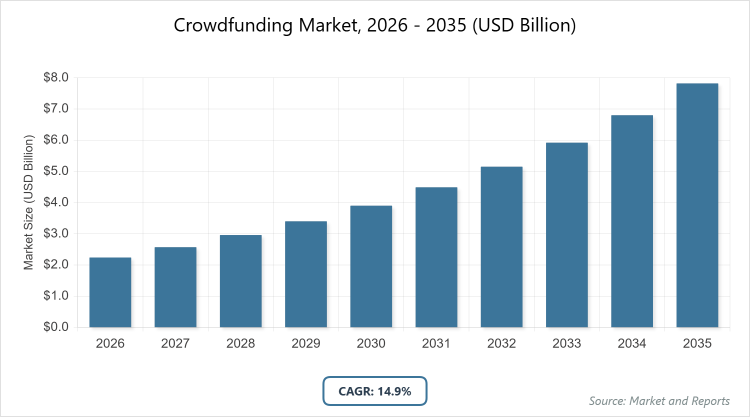
According to our latest research, the global crowdfunding market is projected to grow from USD 2.24 billion in 2026 to USD 7.83 billion by 2035, growing at a CAGR is 14.9% during 2026-2035. The Crowdfunding Market is primarily driven by the democratization of capital access through digital transformation, which enables entrepreneurs and social causes to bypass traditional financial institutions by connecting directly with a global pool of retail and institutional investors.
What are the Key Insights into the Crowdfunding Market?
- Global market value projected to reach USD 7.83 billion by 2035 from USD 2.24 billion in 2026.
- Compound Annual Growth Rate (CAGR) estimated at 14.9% during 2026-2035.
- Equity-based dominates the type segment.
- Food & Beverage dominates the application segment.
- North America dominates the regional market.
What is the Crowdfunding Market?
Industry Overview
The crowdfunding market encompasses online platforms and services that enable individuals, startups, non-profits, and businesses to raise funds from a large number of contributors, typically in small amounts, to support projects, ventures, or causes. This alternative financing model includes various types such as reward-based, where backers receive products or perks; equity-based, offering shares in return; debt-based, involving loans with interest; and donation-based, focused on charitable giving without financial returns. Crowdfunding democratizes access to capital by bypassing traditional financial institutions, leveraging social media for promotion, and fostering community engagement to validate ideas and build audiences.
It serves diverse sectors like technology, arts, healthcare, and real estate, with platforms handling transactions, compliance, and campaign management to ensure transparency and trust. The market thrives on digital innovation, regulatory evolution, and shifting consumer preferences toward inclusive, impact-driven investments, transforming how ideas are funded in a connected global economy.
What are the Market Dynamics in the Crowdfunding Market?
Growth Drivers
The crowdfunding market is driven by the integration of social media platforms that amplify campaign visibility and engagement at low costs, alongside widespread digital accessibility that democratizes fundraising for startups and individuals facing barriers to traditional financing. Technological advancements, such as secure payment gateways and user-friendly interfaces, enhance platform efficiency and user experience, while the rising popularity of alternative models like equity crowdfunding attracts investors seeking high returns without debt burdens. Additionally, increasing awareness through success stories and educational initiatives boosts participation, supported by evolving regulations that build investor confidence and enable cross-border opportunities.
Restraints
Restraints in the crowdfunding market include limited public awareness and understanding of its mechanisms, which curtails broader participation, compounded by trust issues arising from concerns over campaign legitimacy, potential fund misuse, and fraudulent activities that erode investor confidence. The absence of stringent oversight in some regions exacerbates skepticism, while unsuccessful projects and lack of guarantees deter potential backers. Furthermore, platform dependency on viral marketing can lead to inconsistent success rates, limiting scalability for niche or less marketable campaigns.
Opportunities
Opportunities in the crowdfunding market lie in expanding into emerging economies with thriving entrepreneurial ecosystems and limited traditional financing options, where rising internet penetration and mobile technology adoption can drive platform growth. The development of niche portals for sectors like climate tech or creator economies, along with hybrid financing instruments, offers diversification, while supportive policies in regions like Asia facilitate SME funding. Leveraging AI for personalized recommendations and blockchain for transparency can enhance user trust, opening avenues for institutional involvement and thematic funds focused on ESG initiatives.
Challenges
Challenges in the crowdfunding market stem from a complex and fragmented regulatory landscape lacking standardization across jurisdictions, which creates uncertainty, compliance burdens, and operational costs for platforms. Fraudulent activities in laxly regulated areas undermine trust, necessitating robust frameworks to balance investor protection with innovation. Economic volatility heightens risks in early-stage investments, while campaign proliferation leads to fatigue and lower conversion rates, requiring platforms to innovate in engagement and verification to sustain growth.
Crowdfunding Market: Report Scope
| Report Attributes | Report Details |
| Report Name | Crowdfunding Market |
| Market Size 2025 | USD 2.24 Billion |
| Market Forecast 2035 | USD 7.83 Billion |
| Growth Rate | CAGR of 14.9% |
| Report Pages | 220 |
| Key Companies Covered | Kickstarter PBC, Indiegogo Inc., GoFundMe Inc., Fundable LLC, Crowdcube Limited, GoGetFunding, Crowdfunder Inc., and Alibaba Group Holding Limited |
| Segments Covered | By Type, By Application, By Region |
| Regions Covered | North America, Europe, Asia Pacific (APAC), Latin America, The Middle East and Africa (MEA) |
| Base Year | 2025 |
| Historical Year | 2020 – 2024 |
| Forecast Year | 2026 – 2035 |
| Customization Scope | Avail customized purchase options to meet your exact research needs. |
What is the Market Segmentation Analysis for the Crowdfunding Market?
The crowdfunding market is segmented by type, application, and region.
By type segment, equity-based crowdfunding emerges as the most dominant subsegment, followed by debt-based crowdfunding as the second most dominant. Equity-based crowdfunding leads with over 46% market share, driven by its appeal to investors seeking ownership stakes and high potential returns, particularly for startups avoiding debt, and facilitated by regulatory advancements like SEC’s Regulation Crowdfunding that lower barriers for non-accredited investors; this dominance propels the market by attracting diverse funding for innovative ventures, enhancing platform revenues through fees, and encouraging technological integrations for secure equity transactions that broaden participation and sustain long-term growth.
By application segment, Food & Beverage is the most dominant subsegment in the application segment, followed by Technology as the second most dominant. Food & Beverage dominates with over 32% share, attributed to consumer interest in innovative products, sustainable practices, and compelling narratives that leverage storytelling and social media for viral campaigns, making it ideal for small-scale launches and market testing; this leadership drives the market by generating high engagement volumes, boosting platform traffic through relatable, shareable content, and fostering repeat backers who support community-oriented projects, thereby increasing overall funding success rates and market visibility.
What are the Recent Developments in the Crowdfunding Market?
- In November 2025, Bricksave acquired Alte to become one of the largest global real estate crowdfunding platforms, aiming to democratize property investments and expand market reach with integrated tools for fractional ownership.
- In 2025, GoFundMe enhanced its platform with advanced campaign tools and social sharing features to improve engagement and visibility for personal and nonprofit fundraising efforts.
- In February 2025, Wefunder reported 129% year-over-year revenue growth, expanding its investor base to over 6,700 participants and facilitating more than USD 19 million in investments for startups.
What is the Regional Analysis of the Crowdfunding Market?
North America holds the dominant position in the crowdfunding market with over 40% global share, fueled by robust digital infrastructure, high internet penetration, a mature startup ecosystem, and favorable regulations like the SEC’s Regulation Crowdfunding that encourage broad participation; the United States dominates this region through leading platforms such as Kickstarter, Indiegogo, and GoFundMe, which drive innovation in equity and reward-based models, supported by social media virality and investor education initiatives that enhance campaign success and market expansion.
Europe represents a growing market with emphasis on cross-border equity crowdfunding under the ECSP regulation, where the United Kingdom leads as the dominating country via platforms like Crowdcube and Seedrs, focusing on SME funding, ESG-aligned projects, and regulatory harmonization that facilitates scalability across the EU, boosting investor confidence and sector diversification.
Asia Pacific is the fastest-growing region, propelled by mobile-first adoption, blockchain integrations, and supportive policies for SMEs; China dominates here with its massive user base, government-backed fintech initiatives, and platforms like Jingdong that leverage e-commerce synergies for real estate and tech campaigns, addressing funding gaps in emerging economies.
Latin America exhibits potential through increasing digital inclusion and entrepreneurial activity, led by Brazil as the dominating country with platforms catering to social impact and consumer goods, supported by regional investments and mobile penetration that tackle traditional financing barriers.
The Middle East and Africa region, though smaller, is advancing via young demographics and impact investing, with South Africa dominating through platforms like Thundafund that focus on local causes and startups, aided by improving regulations and partnerships to enhance accessibility.
Who are the Key Market Players and Their Strategies in the Crowdfunding Market?
- Kickstarter PBC focuses on creative and reward-based projects, employing community engagement strategies and AI-driven analytics to improve campaign visibility and success rates.
- Indiegogo Inc. expands into equity crowdfunding, leveraging partnerships and sustainability initiatives to attract eco-conscious investors and diversify offerings.
- GoFundMe Inc. emphasizes personal and nonprofit fundraising, introducing recurring campaigns and social media integrations to enhance donor retention and engagement.
- Fundable LLC targets business equity raises, using mergers and tech enhancements for streamlined operations and personalized investor matching.
- Crowdcube Limited specializes in SME equity, pursuing regulatory compliance and cross-border expansions to capitalize on EU opportunities.
- GoGetFunding focuses on global personal causes, adopting mobile optimizations and fraud detection tools to build trust in emerging markets.
- Crowdfunder Inc. prioritizes startup funding, forming alliances with venture capitalists for hybrid models and data analytics for campaign optimization.
- Alibaba Group Holding Limited integrates crowdfunding with e-commerce, emphasizing Asian market localization and blockchain for secure transactions.
What are the Market Trends in the Crowdfunding Market?
- Integration of AI and machine learning for personalized campaign recommendations and predictive analytics to boost success rates.
- Adoption of blockchain for enhanced transparency, security, and fractional ownership in equity and real estate models.
- Shift toward equity-based and hybrid financing, blurring lines between debt and equity for flexible investor returns.
- Growth in social impact and ESG-focused campaigns, aligning with corporate commitments and consumer preferences.
- Expansion of mobile-first platforms in emerging markets to leverage increasing smartphone penetration.
- Rise in institutional investor participation through syndication and thematic funds.
- Diversification into niche sectors like food & beverage and technology for targeted engagement.
- Use of social media for virality, with features like video and daily updates increasing funding by significant margins.
- Emphasis on regulatory compliance tools for cross-border operations and investor protection.
- Development of recurring donation models for sustained support in nonprofit and creator economies.
What Market Segments are Covered in the Crowdfunding Market Report?
By Type
- Equity-based Crowdfunding
- Debt-based Crowdfunding
- Others
By Application
- Food & Beverage
- Technology
- Media
- Real Estate
- Healthcare
- Others
By Region
- North America
- U.S.
- Canada
- Europe
- UK
- Germany
- France
- Rest of Europe
- Asia Pacific
- China
- India
- Japan
- Rest of Asia Pacific
- Latin America
- Brazil
- Mexico
- Rest of Latin America
- Middle East & Africa
- UAE
- South Africa
- Rest of Middle East & Africa
Chapter 1. Preface
Chapter 2. Executive Summary
Chapter 3. Global Crowdfunding Market - Industry Analysis
Chapter 4. Global Crowdfunding Market- Competitive Landscape
Chapter 5. Global Crowdfunding Market - Type Analysis
Chapter 6. Global Crowdfunding Market - Application Analysis
Chapter 7. Crowdfunding Market - Regional Analysis
Chapter 8. Company Profiles
Crowdfunding is a method of raising capital through small contributions from a large number of individuals via online platforms, often for projects, startups, or causes, in exchange for rewards, equity, loans, or donations. Key factors include social media integration for campaign promotion, technological advancements like AI and blockchain, regulatory support for equity models, expansion in emerging markets, and rising demand for alternative financing amid traditional barriers. The market is projected to grow from USD 2.24 billion in 2026 to USD 7.83 billion by 2035. The CAGR is estimated at 14.9% during 2026-2035. North America will contribute notably, holding the largest share due to advanced infrastructure and regulatory frameworks. Major players include Kickstarter PBC, Indiegogo Inc., GoFundMe Inc., Fundable LLC, Crowdcube Limited, GoGetFunding, Crowdfunder Inc., and Alibaba Group Holding Limited. The report provides comprehensive insights into market size, forecasts, segmentation, regional analysis, key players, trends, dynamics, recent developments, and strategic recommendations for stakeholders. The value chain includes campaign creation by issuers, platform facilitation for promotion and transactions, investor contributions via secure gateways, regulatory compliance and fund disbursement, and post-funding delivery of rewards or returns. Trends are evolving toward AI personalization, blockchain transparency, and ESG alignment, with consumers preferring community-driven, inclusive models that offer low-barrier investments and support for innovative, sustainable projects. Regulatory factors include investor protection laws like SEC Regulation Crowdfunding and EU ECSP, promoting trust but adding compliance costs; environmental factors involve the rise of ESG campaigns encouraging sustainable projects amid global climate goals.Frequently Asked Questions