
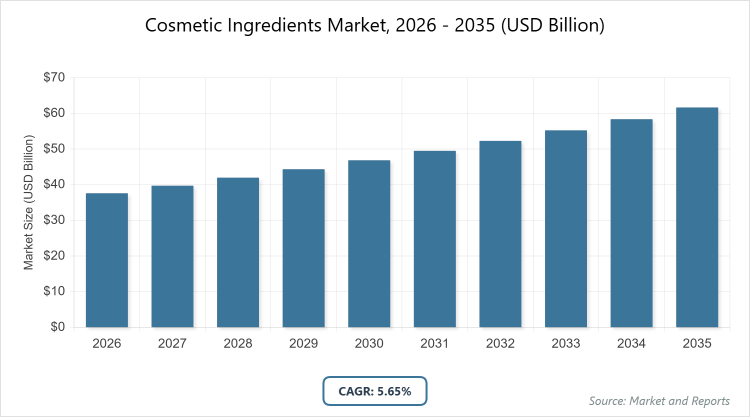
Cosmetic Ingredients Market Size, Share and Trends 2026 to 2035
According to MarketnReports, the global Cosmetic Ingredients market size was estimated at USD 37.61 billion in 2025 and is expected to reach USD 65.16 billion by 2035, growing at a CAGR of 5.65% from 2026 to 2035. Increasing demand for natural and sustainable ingredients.
What are the Key Insights into the cosmetic ingredients market?
- The global Cosmetic Ingredients market was valued at USD 37.61 billion in 2025 and is projected to reach USD 65.16 billion by 2035.
- The market is expected to grow at a CAGR of 5.65% during the forecast period.
- The market is driven by rising consumer awareness and demand for natural, organic, and sustainable beauty products.
- In the ingredient type segment, surfactants dominate with 29% share due to their essential role in cleansing and emulsifying formulations across various products.
- In the application segment, skin care dominates with 38% share as it addresses anti-aging, hydration, and protection needs driven by increasing skincare routines.
- In the end-use segment, personal care products dominate with 42% share owing to broad consumer adoption and integration in daily hygiene essentials.
- Asia Pacific dominates the regional market with 40% share because of its large population, growing middle class, and major manufacturing hubs like China and India.
What is the Cosmetic Ingredients Market?
Industry Overview
The cosmetic ingredients market comprises a wide array of substances used in the formulation of beauty and personal care products, including surfactants, emollients, preservatives, and actives derived from natural or synthetic sources, which enhance product efficacy, texture, stability, and sensory appeal. This market involves the sourcing, manufacturing, and distribution of these components to cosmetic brands and formulators, emphasizing innovation in bio-based and eco-friendly alternatives to meet consumer demands for safe, effective, and sustainable solutions. Market definition encompasses all raw materials and compounds integrated into skincare, haircare, makeup, and other cosmetic applications, focusing on regulatory compliance, performance optimization, and alignment with global trends toward clean beauty and personalization.
What are the Market Dynamics Shaping the Cosmetic Ingredients Market?
Growth Drivers
The growth drivers in the cosmetic ingredients market are primarily fueled by the escalating consumer preference for natural and organic products, prompting manufacturers to innovate with bio-based alternatives that reduce environmental impact and appeal to health-conscious users. Advancements in biotechnology and green chemistry enable the development of high-performance actives like peptides and botanicals, enhancing product efficacy in anti-aging and hydration applications. Rising disposable incomes in emerging economies, coupled with the expansion of e-commerce platforms, increase accessibility to premium cosmetics, driving demand for specialized ingredients. Additionally, stringent regulations promoting clean labeling and sustainability encourage investments in R&D, fostering collaborations between suppliers and brands to create multifunctional formulations that meet diverse consumer needs.
Restraints
Restraints in the cosmetic ingredients market include the high costs associated with sourcing and developing natural and bio-based materials, which often result in premium pricing that limits accessibility for mass-market products. Supply chain disruptions, exacerbated by geopolitical tensions and climate change affecting raw material availability, lead to volatility in prices and shortages. Regulatory complexities across regions, such as varying standards for ingredient safety and labeling, increase compliance burdens and delay product launches. Moreover, consumer skepticism toward greenwashing claims necessitates rigorous certification, while competition from synthetic alternatives offering cost advantages hinders the widespread adoption of sustainable options in price-sensitive markets.
Opportunities
Opportunities in the cosmetic ingredients market stem from the integration of advanced technologies like AI and biotechnology to create personalized formulations, tailoring actives to individual skin types and concerns for enhanced efficacy. The growing trend toward multifunctional ingredients, such as hybrid emollients with anti-pollution properties, opens avenues in urban markets where environmental stressors drive demand. Expansion into untapped regions with rising beauty awareness, supported by digital marketing and influencer partnerships, can boost penetration. Furthermore, investments in upcycled and waste-derived materials align with circular economy principles, attracting eco-conscious consumers and enabling brands to differentiate through innovative, sustainable sourcing strategies.
Challenges
Challenges in the cosmetic ingredients market revolve around ensuring consistent quality and efficacy of natural ingredients, as variability in botanical sourcing due to seasonal and geographical factors can affect product performance. Balancing innovation with affordability remains difficult, with R&D costs for novel actives often passed to consumers, limiting market expansion in developing areas. Intellectual property issues and counterfeit ingredients undermine trust, while evolving regulations on microplastics and allergens require ongoing reformulation. Additionally, educating consumers on ingredient benefits versus misconceptions demands robust marketing, as misinformation can slow adoption of emerging sustainable options.
Cosmetic Ingredients Market: Report Scope
| Report Attributes | Report Details |
| Report Name | Cosmetic Ingredients Market |
| Market Size 2025 | USD 37.61 Billion |
| Market Forecast 2035 | USD 65.16 Billion |
| Growth Rate | CAGR of 5.65% |
| Report Pages | 220 |
| Key Companies Covered |
BASF SE, Evonik Industries AG, Croda International Plc, Dow Inc., Clariant International Ltd., Symrise AG, and Others |
| Segments Covered | By Ingredient Type, By Application, By End-Use, and By Region |
| Regions Covered | North America, Europe, Asia Pacific (APAC), Latin America, and The Middle East and Africa (MEA) |
| Base Year | 2025 |
| Historical Year | 2020 – 2024 |
| Forecast Year | 2026 – 2035 |
| Customization Scope | Avail customized purchase options to meet your exact research needs. |
How is the Market Segmentation Structured in the Cosmetic Ingredients Market?
The Cosmetic Ingredients market is segmented by ingredient type, application, end-use, and region.
Based on the Ingredient Type Segment, surfactants are the most dominant subsegment, followed by emollients as the second most dominant. Surfactants dominate due to their critical function in creating stable emulsions and foams essential for cleansing products like shampoos and body washes, which drives the market by enabling versatile formulations that meet consumer demands for effective and gentle personal care items; emollients follow as they provide moisturization and skin barrier protection in a wide range of skincare products, propelling market growth through their role in addressing hydration needs amid rising awareness of skin health.
Based on Application Segment, skin care is the most dominant subsegment, followed by hair care as the second most dominant. Skin care leads because of heightened focus on anti-aging, UV protection, and hydration amid global aging populations and environmental concerns, which accelerates market expansion by incorporating advanced actives that enhance product efficacy and consumer loyalty; hair care gains traction for its use in conditioning and scalp health solutions, driving the market via innovations in natural extracts that cater to diverse hair types and promote overall wellness.
Based on the end-use segment, personal care products are the most dominant subsegment, followed by cosmetics brands as the second most dominant. Personal care products dominate owing to their everyday essential nature in hygiene and grooming routines, enabling broad ingredient integration that boosts market penetration through high-volume sales; cosmetics brands thrive on premium formulations emphasizing aesthetics and performance, propelling growth by leveraging trends like clean beauty to attract discerning consumers and foster brand differentiation.
What are the Recent Developments in the Cosmetic Ingredients Market?
- In April 2025, BASF launched Verdessence RiceTouch, a biodegradable sensory modifier based on rice starch, enhancing natural and sustainable cosmetic formulations.
- In March 2025, DIC Corporation showcased new cosmetic pigments and functional ingredients at in-cosmetics Global 2025, focusing on innovation in color and texture.
- In October 2024, BASF introduced Emulgade Verde, a line of naturally based emulsifiers for biodegradable and mild cosmetic products.
- In July 2023, Evonik acquired Novachem, strengthening its sustainable actives portfolio and expanding access to biotech ingredients in Latin America.
How does Regional Analysis Impact the Cosmetic Ingredients Market?
- Asia Pacific to dominate the global market.
Asia Pacific leads the cosmetic ingredients market, driven by rapid urbanization, rising disposable incomes, and a booming beauty industry that emphasizes natural and premium products; China dominates as the key country, with its massive manufacturing base and consumer demand for innovative skincare, supported by government initiatives promoting domestic production and e-commerce growth.
North America exhibits strong growth in the cosmetic ingredients market, fueled by high consumer awareness of clean beauty and technological advancements in formulations; the United States is the dominating country, where leading firms like Dow and Ashland drive innovation through R&D investments, backed by regulatory focus on safety and sustainability.
Europe demonstrates substantial expansion in the cosmetic ingredients market, supported by stringent regulations like REACH and a preference for organic certifications; Germany emerges as the dominating country, with companies such as BASF and Evonik leading in green chemistry and exporting high-quality ingredients globally.
Latin America shows emerging potential in the cosmetic ingredients market, aided by abundant natural resources and growing middle-class consumption; Brazil stands out as the dominating country, leveraging its biodiversity for botanical extracts and partnerships with international brands to enhance local production.
The Middle East and Africa represent nascent growth in the cosmetic ingredients market, propelled by increasing urbanization and halal-certified demands; the United Arab Emirates dominates, with Dubai’s trade hubs facilitating imports and investments in luxury beauty formulations.
Who are the Key Market Players in the Cosmetic Ingredients Market?
- BASF SE focuses on sustainable innovations like bio-based emulsifiers and actives, partnering with biotech firms to expand its Verdessence portfolio for eco-friendly formulations.
- Evonik Industries AG employs strategies emphasizing high-performance actives and acquisitions like Novachem to strengthen biotech capabilities and regional presence in sustainable ingredients.
- Croda International Plc leverages its expertise in natural extracts and conditioning agents, investing in R&D for multifunctional solutions targeting premium skincare markets.
- Dow Inc. adopts a diversified approach with silicone and polymer technologies, prioritizing low-carbon production to meet regulatory demands and consumer preferences for clean beauty.
- Clariant International Ltd. concentrates on botanical and mild surfactants, pursuing collaborations for clean-label products to enhance competitiveness in organic segments.
- Symrise AG prioritizes sensorial actives and fragrances, focusing on ethical sourcing and innovation in microbiome-friendly ingredients for holistic beauty applications.
What are the Market Trends in the cosmetic ingredients market?
- Rising demand for natural and bio-based ingredients to align with clean beauty preferences.
- Integration of biotechnology for advanced activities like peptides and enzymes.
- Shift toward multifunctional ingredients for simplified formulations.
- Emphasis on sustainability with upcycled and waste-derived materials.
- Growing adoption of AI in ingredient personalization and efficacy testing.
- Expansion of microbiome-friendly and barrier-repair actives.
- Increased focus on transparent labeling and regulatory compliance.
What Market Segments and their Subsegments are Covered in the Cosmetic Ingredients Report?
By Ingredient Type
- Surfactants
- Emollients
- Emulsifiers
- Rheology Modifiers
- Conditioning Polymers
- Preservatives
- Antioxidants
- Actives
- Polymers
- Botanical Extracts
- Others
By Application
- Skin Care
- Hair Care
- Makeup
- Fragrance
- Oral Care
- Others
By End-Use
- Personal Care Products
- Cosmetics Brands
- Manufacturers
- Others
By Region
- North America
- U.S.
- Canada
- Europe
- UK
- Germany
- France
- Rest of Europe
- Asia Pacific
- China
- India
- Japan
- Rest of Asia Pacific
- Latin America
- Brazil
- Mexico
- Rest of Latin America
- Middle East & Africa
- UAE
- South Africa
- Rest of Middle East & Africa
Chapter 1. Preface
Chapter 2. Executive Summary
Chapter 3. Global Cosmetic Ingredients Market - Industry Analysis
Chapter 4. Global Cosmetic Ingredients Market- Competitive Landscape
Chapter 5. Global Cosmetic Ingredients Market - Ingredient Type Analysis
Chapter 6. Global Cosmetic Ingredients Market - Application Analysis
Chapter 7. Global Cosmetic Ingredients Market - End-Use Analysis
Chapter 8. Cosmetic Ingredients Market - Regional Analysis
Chapter 9. Company Profiles
Frequently Asked Questions
Cosmetic ingredients are substances used in formulating beauty and personal care products to enhance texture, efficacy, stability, and sensory properties, including natural or synthetic compounds like surfactants and emollients.
Key factors include rising demand for natural products, technological advancements in biotechnology, regulatory push for sustainability, and increasing consumer awareness of clean beauty.
The cosmetic ingredients market is projected to grow from USD 37.61 billion in 2025 to USD 65.16 billion by 2035.
The market is expected to grow at a CAGR of 5.65% from 2026 to 2035.
Asia Pacific will contribute notably, holding around 40% market share due to population growth and manufacturing strength.
Major players include BASF SE, Evonik Industries AG, Croda International Plc, Dow Inc., Clariant International Ltd., and Symrise AG, driving growth through sustainable innovations.
The report provides in-depth analysis including market size, trends, segmentation, regional insights, key players, and forecasts from 2026 to 2035.
Stages include raw material sourcing, manufacturing and processing, formulation development, distribution to brands, and end-product integration.
Trends evolve toward natural, multifunctional, and sustainable ingredients, with consumers preferring transparent, eco-friendly options for personalized beauty.
Factors include REACH regulations, bans on microplastics, and sustainability mandates like the EU Green Deal, promoting eco-friendly and clean-label ingredients.