
Concrete Floor Coating Market Size, Share and Trends 2026 to 2035
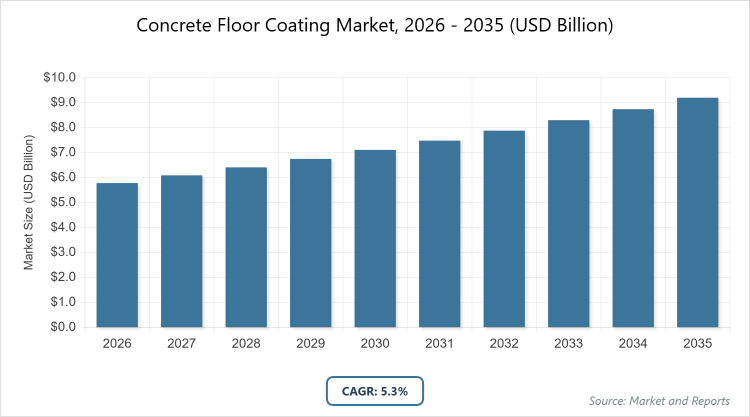
According to MarketReports, the global concrete floor coating market size was estimated at USD 5.78 billion in 2025 and is expected to reach USD 9.25 billion by 2035, growing at a CAGR of 5.3% from 2026 to 2035. The Concrete Floor Coating Market is primarily driven by rapidly expanding global construction and renovation activities, alongside an increasing demand for durable, high-performance, and aesthetically pleasing surfaces in the industrial, commercial, and residential sectors.
What are the Key Insights into the Concrete Floor Coating Market?
- The global concrete floor coating market is projected to grow from approximately USD 5.78 billion in 2026 to USD 9.25 billion by 2035, reflecting a compound annual growth rate (CAGR) of around 5.3%.
- Among product types, epoxy dominates as the leading subsegment, holding around 30% share due to its versatility and cost-effectiveness.
- In application segments, residential holds the dominant position, capturing about 60% share, driven by decorative and durable needs.
- By end-use, industrial is the most prominent, benefiting from protective requirements in harsh environments.
- Asia Pacific emerges as the dominant region, contributing around 35% market shar,e owing to construction growth and industrialization.
What is the Concrete Floor Coating Industry?
Industry Overview
The concrete floor coating industry involves the development, production, and application of protective and decorative layers applied to concrete surfaces to enhance durability, aesthetics, and resistance to factors like abrasion, chemicals, moisture, and UV exposure, commonly used in residential, commercial, and industrial settings for flooring in garages, warehouses, showrooms, and homes. These coatings, formulated from materials such as epoxy, polyurethane, or polyaspartic resins, provide seamless, easy-to-clean finishes that extend the lifespan of concrete while offering customization options for color, texture, and performance, addressing needs from slip resistance to thermal insulation.
Positioned within the broader construction and chemicals sector, the market emphasizes innovation in eco-friendly, low-VOC formulations and quick-cure technologies to meet regulatory standards and consumer preferences for sustainable building practices, ultimately supporting infrastructure maintenance, renovation projects, and new constructions amid global urbanization and industrial expansion.
What Drives the Concrete Floor Coating Market?
Growth Drivers
The concrete floor coating market is propelled by surging construction activities in residential and commercial sectors, driven by urbanization and infrastructure investments that demand durable, low-maintenance flooring solutions resistant to wear and chemicals, coupled with rising awareness of aesthetic enhancements in interior design.
Technological advancements in eco-friendly formulations, such as water-based and low-VOC coatings, align with green building certifications like LEED, attracting environmentally conscious consumers and builders while improving indoor air quality. Additionally, the expansion of industrial applications in manufacturing and warehousing, alongside government regulations promoting sustainable materials, fosters adoption through cost-effective, long-lasting protections that reduce repair needs and operational downtime.
Restraints
Fluctuating raw material prices for resins and additives, influenced by supply chain disruptions and petroleum volatility, elevate production costs and challenge affordability for end-users in price-sensitive markets. Stringent environmental regulations on VOC emissions restrict traditional solvent-based products, forcing manufacturers to invest in reformulations amid compliance complexities. Moreover, intense competition from alternative flooring options like tiles or vinyl, combined with skilled labor shortages for proper application, hinders market penetration in developing regions.
Opportunities
The shift toward sustainable and bio-based coatings presents avenues for innovation, driven by consumer demand for green products and corporate sustainability goals, allowing premium pricing in regulated markets. Emerging economies offer untapped potential through rapid industrialization and construction booms, where localized production and partnerships can capture demand for protective industrial floors. Furthermore, advancements in polyaspartic technologies for faster curing enable entry into time-sensitive applications like commercial renovations, supported by e-commerce expansion for direct sales.
Challenges
Compliance with diverse global environmental standards increases R&D costs, as varying VOC limits require adaptive formulations that may compromise performance. Market saturation in developed regions intensifies price competition, eroding margins for smaller players amid counterfeit products in unregulated areas. Additionally, application complexities on uneven surfaces demand skilled installers, while economic slowdowns in construction delay projects and reduce demand.
Concrete Floor Coating Market: Report Scope
| Report Attributes | Report Details |
| Report Name | Concrete Floor Coating Market |
| Market Size 2025 | USD 5.78 Billion |
| Market Forecast 2035 | USD 9.25 Billion |
| Growth Rate | CAGR of 5.3% |
| Report Pages | 210 |
| Key Companies Covered | AkzoNobel N.V., The Sherwin-Williams Company, PPG Industries, Inc, BASF SE, RPM International Inc, Sika AG, Asian Paints Limited, Kansai Paint Co., Ltd, The Dow Chemical Company, and Tennant Company |
| Segments Covered | By Product Type, By Application, By End-Use, By Region |
| Regions Covered | North America, Europe, Asia Pacific (APAC), Latin America, The Middle East and Africa (MEA) |
| Base Year | 2025 |
| Historical Year | 2020 – 2024 |
| Forecast Year | 2026 – 2035 |
| Customization Scope | Avail customized purchase options to meet your exact research needs. |
How is the Concrete Floor Coating Market Segmented?
The concrete floor coating market is segmented by product type, application, end-use, and region.
By product type, including epoxy, polyurethanes, polyaspartic, and others, with epoxy emerging as the most dominant due to its exceptional adhesion, chemical resistance, and affordability, making it suitable for a wide range of industrial and commercial applications; this dominance drives the market by enabling high-volume usage and supporting growth through proven reliability, while polyaspartic ranks as the second most dominant, valued for its rapid curing and UV stability, contributing via premium segments in outdoor and quick-turnaround projects.
By application, the market divides into indoor and outdoor, where indoor dominates owing to its extensive use in residential and commercial spaces for seamless, aesthetic finishes; its prevalence propels market expansion by integrating with interior design trends, whereas outdoor follows as the second dominant, essential for weather-resistant coatings in driveways and patios, enhancing growth via infrastructure demands.
By end-use, segments include residential, commercial, and industrial, with industrial leading as it requires robust protection against heavy traffic and chemicals in factories and warehouses; this segment fuels overall dynamics by generating steady demand from manufacturing expansions, while residential secures second place, driven by home renovations and eco-friendly preferences, supporting resilience through consumer markets.
What are the Recent Developments in the Concrete Floor Coating Market?
- In February 2021, The Sherwin-Williams Company acquired Tennant Coatings, expanding its portfolio with high-performance industrial floor coatings and strengthening its position in the commercial and industrial sectors amid growing demand for durable solutions.
- In 2022, Seal for Life Industries, a subsidiary of Arsenal Capital Partners, acquired Verdia, Inc. and Mascoat Ltd., enhancing its offerings in sealing and protective coatings, including polyurethane concrete flooring and polyaspartic formulations, to capitalize on the rising need for thermal insulation and protective solutions.
- In 2023, Sika AG acquired Bexel Consulting A/S, a Danish software company specializing in industrial floor coatings design, aiming to bolster its digital capabilities and innovation in the concrete floor coatings segment for improved efficiency.
How Does Regional Performance Vary in the Concrete Floor Coating Market?
- Asia Pacific to dominate the market
Asia Pacific dominates the concrete floor coating market, propelled by rapid industrialization, urbanization, and construction booms in infrastructure and real estate; China leads this region with its massive manufacturing sector, government investments in green buildings, and high demand for protective coatings in factories, fostering localized production and exports while India contributes through residential renovations amid population growth. Japan and South Korea further enhance regional strength with advanced, high-performance formulations for seismic and humid environments, alongside Southeast Asian countries like Vietnam and Indonesia accelerating adoption via foreign investments in manufacturing hubs and affordable housing projects.
North America exhibits strong growth, supported by stringent environmental regulations and investments in commercial spaces; the United States stands out as the dominating country, leveraging abundant resources, high buying power, and innovations in VOC-free coatings, with Canada adding through infrastructure projects and sustainable building initiatives in cold climates. Mexico supports regional expansion via trade agreements and growing industrial corridors requiring chemical-resistant floors.
Europe maintains a mature market, influenced by EU sustainability directives and heritage restorations; Germany emerges as the leading country, excelling in high-quality, eco-innovative coatings and exports, while the UK and France propel adoption in residential sectors. Italy and Spain contribute via tourism-driven renovations and Mediterranean climate-adapted products, with Scandinavia focusing on energy-efficient and non-slip solutions, and Eastern Europe emerging through EU-funded infrastructure upgrades.
Latin America shows emerging growth, driven by urban housing needs; Brazil predominates with industrial expansions and public works, supporting local adaptations amid economic recovery. Mexico and Argentina support through trade agreements and mining-related protective coatings, while Chile advances via sustainable mining practices and Peru through coastal infrastructure developments.
The Middle East & Africa region represents developing potential, focused on oil-funded projects; the United Arab Emirates leads via luxury developments and imports, with Saudi Arabia advancing through Vision 2030 initiatives and harsh climate-resistant formulations. South Africa grows via affordable housing and industrial maintenance needs, complemented by Qatar’s high-end commercial projects and Nigeria’s gradual urbanization, driving demand for durable warehouse floors.
Who are the Key Market Players in the Concrete Floor Coating Industry?
- AkzoNobel N.V. focuses on sustainable innovations and acquisitions to expand eco-friendly portfolios in industrial applications.
- The Sherwin-Williams Company invests in product launches like Dura-Plate and acquisitions for enhanced industrial coatings.
- PPG Industries, Inc. emphasizes R&D in low-VOC solutions and partnerships for commercial sectors.
- BASF SE leverages chemical expertise for advanced polyaspartic formulations targeting green buildings.
- RPM International Inc. pursues global expansions and durability-focused products for harsh environments.
- Sika AG adopts acquisitions like Bexel for digital design enhancements in floor coatings.
- Asian Paints Limited optimizes cost-effective solutions for emerging Asian markets.
- Kansai Paint Co., Ltd. focuses on UV-resistant coatings for outdoor applications.
- The Dow Chemical Company innovates in polyurethane technologies for flexibility.
- Tennant Company targets maintenance-free industrial floors post-acquisition integrations.
What are the Current Market Trends in Concrete Floor Coatings?
- Increasing demand for eco-friendly, low-VOC, and waterborne coatings to comply with environmental regulations.
- Growth in polyaspartic coatings for fast curing and UV stability in outdoor applications.
- Rise in decorative coatings for aesthetic enhancements in residential spaces.
- Adoption of powder-based coatings for solvent-free, durable industrial floors.
- Expansion of green building practices incorporating sustainable materials.
- Technological advancements in abrasion-resistant and chemical-proof formulations.
- Shift toward one-coat systems for improved productivity and cost savings.
What Market Segments are Covered in the Report?
By Product Type
- Epoxy
- Polyurethanes
- Polyaspartic
- Others
By Application
- Indoor
- Outdoor
By End-Use
- Residential
- Commercial
- Industrial
By Region
-
- North America
- U.S.
- Canada
- Europe
- UK
- Germany
- France
- Rest of Europe
- Asia Pacific
- China
- India
- Japan
- Rest of Asia Pacific
- Latin America
- Brazil
- Mexico
- Rest of Latin America
- Middle East & Africa
- UAE
- South Africa
- Rest of Middle East & Africa
- North America
Frequently Asked Questions
Concrete floor coatings are protective and decorative layers applied to concrete surfaces to improve durability, resistance to chemicals and abrasion, and aesthetic appeal, using materials like epoxy or polyurethane.
Key factors include rising construction activities, demand for eco-friendly and decorative coatings, industrialization, and green building practices.
The market is expected to grow from approximately USD 5.78 billion in 2026 to USD 9.25 billion by 2035, driven by construction and sustainability trends.
The compound annual growth rate (CAGR) is projected to be around 5.3% from 2026 to 2035, reflecting steady expansion.
Asia Pacific will contribute notably, holding around 35% share due to rapid industrialization and construction growth.
Major players include AkzoNobel N.V., The Sherwin-Williams Company, PPG Industries, Inc, BASF SE, RPM International Inc, Sika AG, Asian Paints Limited, Kansai Paint Co., Ltd, The Dow Chemical Company, and Tennant Company, driving growth through innovations and acquisitions.
The report offers insights into market size, trends, segmentation, regional analysis, key players, and forecasts to guide strategic decisions.
Stages include raw material sourcing (resins, additives), formulation and manufacturing, distribution through suppliers, application by contractors, and end-user maintenance.
Trends are moving toward eco-friendly, low-VOC, and fast-curing options, with consumers preferring durable, aesthetic, and sustainable coatings for residential and industrial use.
Regulations on VOC emissions push for waterborne and powder coatings, while environmental concerns drive demand for green materials, increasing costs but fostering innovation.