
Clean Energy Technologies Market Size, Share and Trends 2026 to 2035
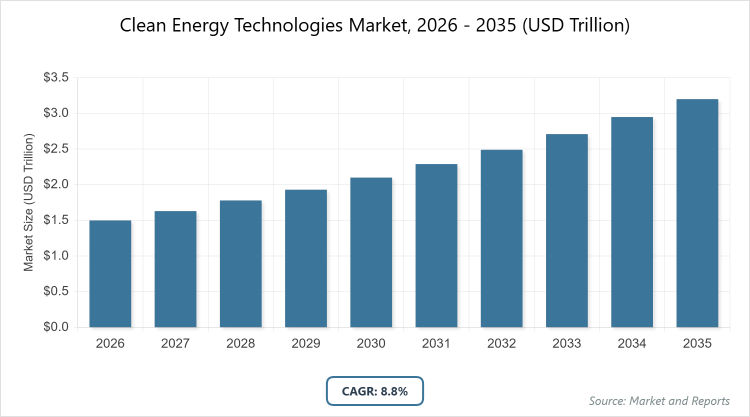
According to MarketnReports, the global Clean Energy Technologies market size was estimated at USD 1.5 trillion in 2025 and is expected to reach USD 3.5 trillion by 2035, growing at a CAGR of 8.8% from 2026 to 2035. Clean Energy Technologies Market is driven by global commitments to net-zero emissions and technological advancements in renewables.
What is Clean Energy Technologies? An Industry Overview
Clean energy technologies encompass a range of innovative solutions designed to generate, store, and distribute energy from renewable sources with minimal environmental impact, including solar panels, wind turbines, energy storage systems, and hydrogen fuel cells. The market definition includes hardware, software, and services that facilitate the transition from fossil fuels to sustainable alternatives, emphasizing efficiency, scalability, and integration with smart grids to reduce carbon emissions, enhance energy security, and support economic growth through job creation in green sectors while addressing climate change and resource depletion challenges.
What are the Key Insights of Clean Energy Technologies Market?
- The global Clean Energy Technologies market was valued at USD 1.5 trillion in 2025 and is projected to reach USD 3.5 trillion by 2035.
- The global Clean Energy Technologies market is expected to grow at a CAGR of 8.8% during the forecast period 2026-2035.
- The Clean Energy Technologies market is driven by policy incentives, falling costs of renewables, and increasing corporate sustainability goals.
- The solar energy subsegment dominates the technology segment with a 35% share due to rapid cost reductions and scalability in utility-scale projects.
- The industrial subsegment dominates the application segment with a 30% share owing to high energy demands and decarbonization efforts in manufacturing.
- The utilities subsegment dominates the end-user segment with a 40% share because of large-scale grid integrations and renewable mandates.
- Asia Pacific dominates the global Clean Energy Technologies market with a 45% share attributed to massive investments in solar and wind by China and India.
What are the Market Dynamics of Clean Energy Technologies?
Growth Drivers
The clean energy technologies market is propelled by supportive government policies, such as the U.S. Inflation Reduction Act allocating billions for renewables, incentivizing installations and reducing costs by up to 50% through tax credits and subsidies. Technological breakthroughs in battery storage and efficiency, like perovskite solar cells achieving over 25% conversion rates, enable greater grid stability and integration of intermittents, addressing energy reliability concerns. Rising corporate commitments to ESG goals, with over 70% of Fortune 500 companies pledging net-zero by 2050, drive demand for clean solutions, fostering innovation and supply chain investments to meet global decarbonization targets.
Restraints
Intermittency issues with sources like solar and wind require expensive storage solutions, limiting adoption in regions without robust grids and increasing overall system costs by 20-30%. High upfront capital requirements for projects, often exceeding USD 1 billion for large-scale wind farms, deter investments in developing economies with limited financing options. Regulatory hurdles and permitting delays, averaging 3-5 years in some countries, slow deployment, while trade barriers on components like solar panels create supply chain uncertainties and price volatility.
Opportunities
The expansion of green hydrogen production, projected to reach 80 million tons by 2030 under global strategies, offers opportunities for electrolysis tech integrated with renewables, creating new markets in heavy industry and transport. Emerging economies in Africa, with abundant solar resources, present avenues for off-grid solutions through microgrids, supported by international funding like the World Bank’s USD 5 billion for clean energy. Advancements in AI for predictive maintenance can reduce operational costs by 15%, enabling scalable deployments in remote areas and partnerships with utilities for smart energy management.
Challenges
Grid infrastructure limitations in aging systems hinder large-scale renewable integration, requiring trillions in upgrades to handle variable output without blackouts. Supply chain dependencies on rare earth materials for turbines and batteries face geopolitical risks, leading to shortages and price spikes. Public acceptance issues, such as opposition to wind farms due to visual and noise impacts, delay projects, while skill gaps in workforce training for new technologies demand extensive education programs to sustain growth.
Clean Energy Technologies Market: Report Scope
| Report Attributes | Report Details |
| Report Name | Clean Energy Technologies Market |
| Market Size 2025 | USD 1.5 Trillion |
| Market Forecast 2035 | USD 3.5 Trillion |
| Growth Rate | CAGR of 8.8% |
| Report Pages | 220 |
| Key Companies Covered | Siemens Energy, Tesla, Vestas, Enphase Energy, First Solar, Ørsted, and Others |
| Segments Covered | By Technology, By Application, By End-User, and By Region |
| Regions Covered | North America, Europe, Asia Pacific (APAC), Latin America, and The Middle East and Africa (MEA) |
| Base Year | 2025 |
| Historical Year | 2020 – 2024 |
| Forecast Year | 2026 – 2035 |
| Customization Scope | Avail customized purchase options to meet your exact research needs. |
The Clean Energy Technologies market is segmented by technology, application, end-user, and region.
Based on Technology Segment: The solar energy segment is the most dominant, holding a 35% market share, as it benefits from plummeting panel costs and versatile applications from residential rooftops to utility farms, driven by its modular scalability. This dominance drives market growth by accelerating global installations and reducing reliance on fossil fuels. The wind energy segment is the second most dominant with a 25% share, offering high capacity factors in offshore setups, which propels the market through large-scale power generation.
Based on Application Segment: The industrial segment is the most dominant, capturing a 30% share, due to heavy energy use in manufacturing requiring clean alternatives for decarbonization. Its dominance accelerates market growth by enabling corporate sustainability. The utilities segment ranks second with a 25% share, integrating renewables for grid supply, driving the market with energy transition.
Based on End-User Segment: The utilities segment is the most dominant, with a 40% share, attributed to large-scale adoption for power distribution. This leads market growth by facilitating grid modernization. The private sector segment is second with a 30% share, through corporate renewables, propelling growth with ESG investments.
What are the Recent Developments in Clean Energy Technologies Market?
- In 2025, Siemens Energy launched an advanced offshore wind turbine with 15MW capacity, improving efficiency by 20%.
- Tesla expanded its Megapack storage with AI optimization for grid stability.
- Vestas partnered with a utility for hybrid solar-wind projects in Europe.
- Enphase Energy introduced microinverters for residential solar with higher conversion rates.
- First Solar acquired a thin-film tech firm to boost panel durability.
What is the Regional Analysis of Clean Energy Technologies Market?
- Asia Pacific to dominate the global market
Asia Pacific holds a 45% share in the Clean Energy Technologies market, driven by aggressive renewable targets. China dominates, with massive solar installations exceeding 500 GW, supported by state subsidies.
Europe maintains a 25% position in the Clean Energy Technologies market, fueled by net-zero goals. Germany leads, with wind and solar expansions under Energiewende.
North America captures a 20% share in the Clean Energy Technologies market, propelled by policy incentives. The United States dominates, with IRA funding for storage and solar.
Latin America and Middle East & Africa hold 10%, emerging through solar potentials. Brazil leads in Latin America for hydro and wind, while UAE invests in solar parks.
Who are the Key Market Players and Strategies in Clean Energy Technologies?
Siemens Energy focuses on wind innovations, partnering for offshore projects.
Tesla emphasizes storage AI, expanding Megapack deployments.
Vestas prioritizes hybrid systems, acquiring for solar integrations.
Enphase Energy pursues residential microinverters, targeting efficiency.
First Solar specializes in thin-film acquisitions, boosting durability.
Ørsted develops offshore wind, focusing on green hydrogen.
What are the Market Trends in Clean Energy Technologies?
- Rapid growth in green hydrogen for industrial use.
- Integration of AI for energy management.
- Expansion of offshore wind farms.
- Shift to perovskite solar cells for efficiency.
- Rise in community solar projects.
- Focus on battery recycling for sustainability.
What are the Market Segments and their Subsegment Covered in the Clean Energy Technologies Report?
By Technology
-
- Solar Energy
- Wind Energy
- Hydro Energy
- Geothermal Energy
- Bioenergy
- Hydrogen Energy
- Tidal Energy
- Wave Energy
- Nuclear Energy
- Energy Storage
- Others
By Application
-
- Residential
- Commercial
- Industrial
- Transportation
- Utilities
- Agriculture
- Others
By End-User
-
- Government
- Private Sector
- Households
- Utilities
- Manufacturing
- Automotive
- Others
By Region
-
- North America
- U.S.
- Canada
- Europe
- UK
- Germany
- France
- Rest of Europe
- Asia Pacific
- China
- India
- Japan
- Rest of Asia Pacific
- Latin America
- Brazil
- Mexico
- Rest of Latin America
- Middle East & Africa
- UAE
- South Africa
- Rest of Middle East & Africa
- North America
Chapter 1. Preface
Chapter 2. Executive Summary
Chapter 3. Global Clean Energy Technologies Market - Industry Analysis
Chapter 4. Global Clean Energy Technologies Market- Competitive Landscape
Chapter 5. Global Clean Energy Technologies Market - Technology Analysis
Chapter 6. Global Clean Energy Technologies Market - Application Analysis
Chapter 7. Global Clean Energy Technologies Market - End-User Analysis
Chapter 8. Clean Energy Technologies Market - Regional Analysis
Chapter 9. Company Profiles
Frequently Asked Questions
Clean Energy Technologies are solutions for generating, storing, and distributing renewable energy with low environmental impact, including solar, wind, and storage systems.
Key factors include policy incentives, cost reductions, and corporate sustainability commitments.
The market is projected to grow from USD 1.6 trillion in 2026 to USD 3.5 trillion by 2035.
The market is expected to grow at a CAGR of 8.8% during 2026-2035.
Asia Pacific will contribute notably, holding a 45% share due to rapid renewable deployments.
Major players include Siemens Energy, Tesla, Vestas, Enphase Energy, First Solar, and Ørsted.
The report provides market size, trends, segmentation, regional insights, key players, and forecasts.
Stages include raw material sourcing, manufacturing, installation, operation, and maintenance.
Trends favor green hydrogen and AI integration, with preferences shifting to sustainable, efficient solutions.
Net-zero policies and emission regulations accelerate adoption of renewables.