
Biomedical Sensors Market Size, Share and Trends 2026 to 2035
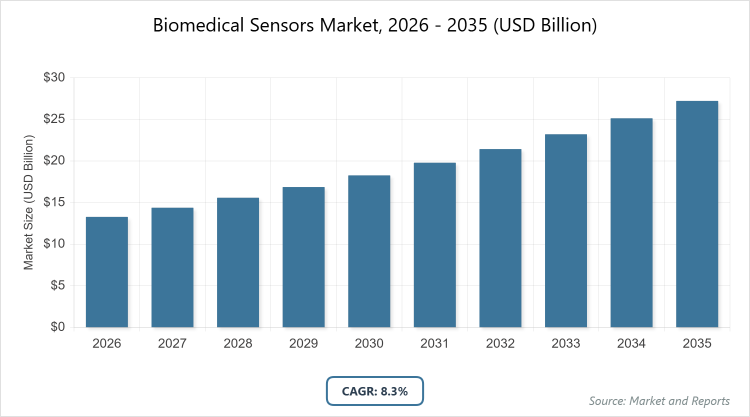
According to MarketnReports, the global Biomedical Sensors market size was estimated at USD 13.28 billion in 2025 and is expected to reach USD 29.5 billion by 2035, growing at a CAGR of 8.3% from 2026 to 2035. The biomedical sensors market is driven by technological advancements in wearable devices and the rising prevalence of chronic diseases.
What are the Key Insights of the biomedical sensors market?
- Market size valued at USD 13.28 billion in 2025 and projected to reach USD 29.5 billion by 2035
- CAGR of 8.3% during the forecast period 2026-2035
- The market is driven by increasing adoption of IoT in healthcare, an aging population, and advancements in miniaturized sensors for wearables
- Temperature Sensors dominate the product type segment with 25% share due to their widespread use in vital sign monitoring and fever detection in clinical settings
- Patient Monitoring dominates the application segment with 35% share, as it enables continuous tracking of health parameters in hospitals and home care
- Hospitals dominate the end-user segment with 40% share, owing to high demand for integrated sensor systems in critical care and diagnostics
- North America dominates with 35% market share attributed to advanced healthcare infrastructure, strong R&D investments, and high adoption of digital health technologies
What is Biomedical Sensors?
The biomedical sensors market encompasses devices that detect and measure physiological parameters, biochemical markers, or physical activities within the human body to support medical diagnostics, monitoring, and therapeutic applications. These sensors convert biological signals into electrical or optical outputs for real-time data analysis, enabling precise healthcare interventions. The market definition includes a wide array of technologies such as electrochemical, optical, piezoelectric, and thermal sensors integrated into wearables, implantables, and diagnostic equipment, addressing needs in chronic disease management, remote patient monitoring, and personalized medicine amid growing demands for non-invasive, accurate, and connected health solutions that enhance patient outcomes and reduce healthcare costs.
What are the Market Dynamics in Biomedical Sensors?
Growth Drivers
The growth drivers in the biomedical sensors market are primarily propelled by the escalating prevalence of chronic conditions such as diabetes, cardiovascular diseases, and respiratory disorders, which necessitate continuous monitoring through advanced sensors for early detection and management. Innovations in nanotechnology and wireless connectivity enable the development of compact, battery-efficient sensors that integrate seamlessly with IoT platforms, facilitating remote healthcare and telemedicine. Government initiatives promoting digital health ecosystems, along with increasing investments in wearable technologies by tech giants, accelerate adoption by improving data accuracy and patient engagement. The aging global population further amplifies demand for home-based monitoring solutions, driving market expansion through cost-effective, user-friendly devices that reduce hospital visits and enhance quality of life.
Restraints
Restraints in the biomedical sensors market include stringent regulatory approvals and certification processes, which delay product launches and increase development costs for manufacturers. Data privacy and cybersecurity concerns arise from the connectivity of sensors to networks, potentially exposing sensitive health information to breaches. High manufacturing expenses for advanced materials like biocompatible coatings limit accessibility in low-income regions, while interoperability issues between different sensor platforms hinder seamless integration in healthcare systems. Battery life limitations in wearable sensors also pose challenges for long-term usage without frequent recharging.
Opportunities
Opportunities in the biomedical sensors market emerge from the integration of AI and machine learning for predictive analytics, allowing sensors to forecast health events like hypoglycemic episodes in real-time. Expanding applications in emerging economies through affordable, portable devices can address unmet needs in rural healthcare. Collaborations between sensor developers and pharmaceutical companies for drug delivery systems, such as smart insulin pumps, open new revenue streams. Advancements in flexible electronics and biosensors for non-invasive monitoring, like sweat analysis for biomarkers, promise growth in preventive medicine and sports health.
Challenges
Challenges in the biomedical sensors market stem from ensuring sensor accuracy and reliability under varying physiological conditions, requiring ongoing calibration and validation. The need for biocompatible materials to prevent immune responses in implantable sensors demands extensive testing, increasing time-to-market. Power management for wireless sensors remains a hurdle, as does miniaturization without compromising sensitivity. Addressing ethical issues in data usage and gaining trust from healthcare providers for AI-integrated sensors are critical for widespread adoption.
Biomedical Sensors Market: Report Scope
| Report Attributes | Report Details |
| Report Name | Biomedical Sensors Market |
| Market Size 2025 | USD 13.28 Billion |
| Market Forecast 2035 | USD 29.5 Billion |
| Growth Rate | CAGR of 8.3% |
| Report Pages | 220 |
| Key Companies Covered | GE Healthcare, Honeywell International Inc., Abbott Laboratories, Masimo Corporation, Medtronic plc, STMicroelectronics, Texas Instruments Incorporated, Analog Devices, Inc., NXP Semiconductors, Sensirion AG, and Others |
| Segments Covered | By Product Type (Temperature Sensors, Pressure Sensors, Biochemical Sensors, Motion Sensors, Image Sensors, ECG Sensors, Inertial Sensors, Optical Sensors, Gas Sensors, Ultrasound Sensors, and Others), By Application (Diagnostics, Patient Monitoring, Therapeutics, Medical Imaging, Fitness and Wellness, Clinical Laboratory, Home Healthcare, Research and Development, Implantable Devices, Wearable Devices, and Others), By End-User (Hospitals, Clinics, Diagnostic Centers, Home Care Settings, Research Institutions, Pharmaceutical Companies, Ambulatory Surgical Centers, Rehabilitation Centers, Fitness Centers, Others), and By Region |
| Regions Covered | North America, Europe, Asia Pacific (APAC), Latin America, and The Middle East and Africa (MEA) |
| Base Year | 2025 |
| Historical Year | 2020 – 2024 |
| Forecast Year | 2026 – 2035 |
| Customization Scope | Avail customized purchase options to meet your exact research needs. |
How is the Biomedical Sensors Market Segmented?
The Biomedical Sensors market is segmented by product type, application, end-user, and region.
Based on Product Type Segment. Temperature Sensors is the most dominant with 25% share, followed by Pressure Sensors as the second most dominant at 20%. Temperature Sensors dominate due to their essential role in vital sign monitoring across medical devices, driving the market by enabling real-time fever detection and thermal regulation in critical care, which enhances patient safety and supports telemedicine growth; Pressure Sensors as second dominant are crucial for blood pressure and respiratory monitoring, propelling market expansion through integration in ventilators and wearables for chronic disease management.
Based on Application Segment. Patient Monitoring is the most dominant with 35% share, followed by Diagnostics at 28%. Patient Monitoring leads because of its application in continuous health tracking for hospitalized and remote patients, driving market growth by reducing readmissions through early intervention and IoT connectivity; Diagnostics follows as second dominant by providing accurate biomarker detection in lab settings, contributing to growth via point-of-care testing that speeds up disease identification.
Based on End-User Segment. Hospitals are the most dominant with 40% share, followed by Home Care Settings at 25%. Hospitals dominate owing to their need for advanced sensor-equipped equipment in ICUs and surgeries, propelling market growth by facilitating precise monitoring and data-driven decisions; Home Care Settings as second dominant grow through wearable sensors for elderly care, driving the market by enabling aging-in-place with cost savings and improved accessibility.
What are the Recent Developments in Biomedical Sensors?
- In June 2025, Roche and IBM announced a collaboration to develop predictive AI technology for continuous glucose monitoring systems, leveraging machine learning to anticipate glucose fluctuations based on lifestyle and physiological patterns, advancing personalized diabetes management.
- In April 2025, the California Institute of Technology unveiled the iCares smart bandage with microfluidic components for real-time wound fluid analysis, using AI to predict healing times, potentially revolutionizing chronic wound care.
- In March 2025, University of Turku researchers developed carbon nanotube sensors for detecting low levels of female hormones, overcoming chirality separation challenges to improve accuracy in continuous health monitoring.
- In April 2021, the Korea Institute of Science and Technology announced a novel thermostable sensor for smartphone cameras to check body temperature, addressing limitations of conventional microbolometers (noting this as an earlier but relevant advancement carried forward).
How is the Regional Analysis for Biomedical Sensors Market?
North America to dominate the global market.
North America dominates the biomedical sensors market due to its cutting-edge research facilities, high healthcare spending, and rapid adoption of wearable technologies. The United States leads as the dominating country with robust FDA support for innovations and major investments in AI-integrated sensors for chronic disease management.
Europe holds a significant position driven by strong regulatory frameworks and focus on preventive healthcare. Germany dominates the region through its engineering expertise and collaborations in biosensor development for diagnostics.
Asia Pacific shows the fastest growth fueled by expanding healthcare access and manufacturing capabilities. China dominates within the region with large-scale production of affordable sensors and government initiatives for digital health.
Latin America exhibits emerging growth through improving infrastructure and rising chronic disease awareness. Brazil leads the region with investments in telemedicine and sensor-based monitoring systems.
The Middle East and Africa are growing with focus on oil-funded healthcare advancements. The United Arab Emirates dominates through modern facilities incorporating advanced sensors in wellness programs.
Who are the Key Market Players in Biomedical Sensors?
- GE Healthcare leads with imaging and monitoring sensors, focusing on AI integrations and global expansions for hospital applications.
- Honeywell International Inc. emphasizes pressure and motion sensors, employing R&D in wireless technologies for wearable health devices.
- Abbott Laboratories specializes in glucose monitoring sensors, with strategies centered on continuous innovation and partnerships for diabetes management.
- Masimo Corporation prioritizes non-invasive monitoring, using acquisitions to enhance pulse oximetry and remote patient tech.
- Medtronic plc focuses on implantable sensors, with growth through miniaturization and IoT for chronic care.
- STMicroelectronics targets inertial and environmental sensors, leveraging semiconductor expertise for compact medical wearables.
- Texas Instruments Incorporated develops analog sensors, emphasizing low-power designs for battery-operated devices.
- Analog Devices, Inc. invests in biochemical sensors, with strategies on signal processing for accurate diagnostics.
- NXP Semiconductors concentrates on secure connectivity in sensors, focusing on healthcare IoT ecosystems.
- Sensirion AG specializes in humidity and gas sensors, employing sustainability in manufacturing for medical applications.
What are the Market Trends in Biomedical Sensors?
- Integration of AI for predictive health analytics in real-time monitoring
- Rise in wearable biosensors for continuous vital sign tracking
- Advancements in flexible and stretchable sensors for skin-like applications
- Growth in implantable sensors with wireless charging capabilities
- Emphasis on non-invasive glucose monitoring for diabetes management
- Expansion of IoT-enabled sensors for remote patient care
- Focus on biocompatible materials to reduce immune responses
- Proliferation of multi-parameter sensors for comprehensive diagnostics
- Shift toward sustainable and eco-friendly sensor manufacturing
- Adoption of nanotechnology for enhanced sensitivity and miniaturization
What Market Segments and Subsegments are Covered in the Biomedical Sensors Report?
By Product Type
- Temperature Sensors
- Pressure Sensors
- Biochemical Sensors
- Motion Sensors
- Image Sensors
- ECG Sensors
- Inertial Sensors
- Optical Sensors
- Gas Sensors
- Ultrasound Sensors
- Others
By Application
- Diagnostics
- Patient Monitoring
- Therapeutics
- Medical Imaging
- Fitness and Wellness
- Clinical Laboratory
- Home Healthcare
- Research and Development
- Implantable Devices
- Wearable Devices
- Others
By End-User
- Hospitals
- Clinics
- Diagnostic Centers
- Home Care Settings
- Research Institutions
- Pharmaceutical Companies
- Ambulatory Surgical Centers
- Rehabilitation Centers
- Fitness Centers
- Others
By Region
- North America
- U.S.
- Canada
- Europe
- UK
- Germany
- France
- Rest of Europe
- Asia Pacific
- China
- India
- Japan
- Rest of Asia Pacific
- Latin America
- Brazil
- Mexico
- Rest of Latin America
- Middle East & Africa
- UAE
- South Africa
- Rest of Middle East & Africa
Frequently Asked Questions
Biomedical sensors are devices that detect physiological or biochemical signals in the body for medical monitoring, diagnostics, and therapeutic purposes.
Key factors include technological innovations in wearables, rising chronic diseases, IoT adoption, and aging populations driving demand for remote monitoring.
The market is projected to grow from approximately USD 14.38 billion in 2026 to USD 29.5 billion by 2035.
The CAGR is expected to be 8.3% during 2026-2035.
North America will contribute notably, holding around 35% of the market share due to advanced infrastructure and R&D.
Major players include GE Healthcare, Honeywell International Inc., Abbott Laboratories, Masimo Corporation, Medtronic plc, STMicroelectronics, Texas Instruments Incorporated, Analog Devices, Inc., NXP Semiconductors, and Sensirion AG.
The report provides in-depth analysis of market size, trends, segmentation, regional insights, key players, and forecasts from 2026 to 2035.
Stages include raw material sourcing, sensor design and manufacturing, integration into devices, distribution to healthcare providers, and end-user application with data analysis.
Trends are evolving toward AI-integrated and wearable sensors, with preferences shifting to non-invasive, user-friendly devices for home health monitoring.
Regulatory factors include strict FDA approvals for safety, while environmental factors involve sustainable materials to reduce electronic waste.