
Battery Storage Inverter Market Size, Share and Trends 2026 to 2035
According to MarketnReports, the global Battery Storage Inverter market size was estimated at USD 8.9 billion in 2025 and is expected to reach USD 19.5 billion by 2035, growing at a CAGR of 9% from 2026 to 2035. Battery Storage Inverter Market is driven by increasing adoption of renewable energy sources and the need for efficient energy management.
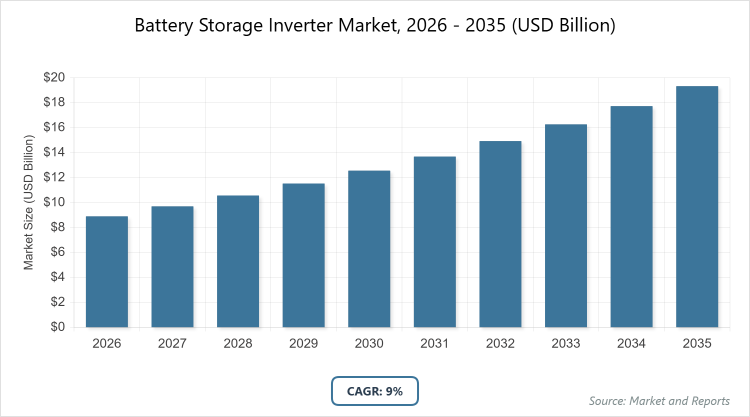
What are the Key Insights in Battery Storage Inverter?
- Market value in 2025: USD 8.9 Billion; Projected value in 2035: USD 19.5 Billion
- CAGR: 9%
- Market is driven by increasing renewable energy integration and grid stability needs
- Dominated subsegment of type: Three-Phase Electric Power with 60% share
- Three-Phase Electric Power dominates due to its efficiency in handling higher power loads, making it ideal for commercial and utility-scale applications where large-scale energy conversion and grid synchronization are required
- Dominated subsegment of end-use industry: Utility Scale with 50% share
- Utility Scale dominates because it supports large grid operations, enabling peak shaving, frequency regulation, and renewable energy storage at scale, driven by global decarbonization efforts
- Dominated region: Asia Pacific with 58% share
- Asia Pacific dominates due to rapid industrialization, massive renewable energy investments in countries like China and India, and government policies promoting grid modernization and carbon neutrality
What is the Battery Storage Inverter Market?
The Battery Storage Inverter Market encompasses devices that convert direct current (DC) from batteries into alternating current (AC) for grid or end-user applications, while also enabling reverse conversion for battery charging. This market includes hybrid, string, and central inverters designed for energy storage systems, supporting renewable integration, grid stability, and backup power. Market definition refers to the ecosystem involving manufacturing, distribution, and deployment of these inverters, driven by the shift toward sustainable energy solutions and enhanced power reliability across residential, commercial, and utility sectors.
What are the Market Dynamics in Battery Storage Inverter?
Growth Drivers
The primary growth driver in the Battery Storage Inverter Market is the escalating adoption of renewable energy sources like solar and wind, which require efficient storage solutions to manage intermittency. Governments worldwide are implementing policies to reduce carbon emissions, leading to increased investments in energy storage systems. Subsidies and tax incentives for renewable integration have boosted demand for inverters that enable seamless grid connectivity and energy optimization. Technological advancements in inverter efficiency, such as higher conversion rates and smart features, further propel market expansion by reducing energy losses and enhancing system reliability.
Restraints
High initial costs associated with battery storage inverters pose a significant restraint, particularly in developing regions where upfront investments in infrastructure and components like lithium-ion batteries deter widespread adoption. Supply chain disruptions, including raw material shortages for semiconductors and batteries, can inflate prices and delay projects. Technical challenges such as thermal management and compatibility with varying grid standards limit scalability, while concerns over battery lifecycle and recycling add to operational expenses, hindering market penetration in cost-sensitive segments.
Opportunities
Opportunities abound in the integration of battery storage inverters with emerging technologies like smart grids and IoT, enabling real-time monitoring and predictive maintenance for optimized energy use. The rise of electric vehicles and microgrids presents avenues for hybrid systems that combine storage with EV charging infrastructure. Expanding markets in emerging economies, supported by international funding for clean energy, offer growth potential. Innovations in long-duration storage and modular designs could address current limitations, opening doors to utility-scale projects and off-grid applications in remote areas.
Challenges
Challenges in the Battery Storage Inverter Market include regulatory inconsistencies across regions, which complicate compliance and standardization efforts. Grid infrastructure in many areas lacks the capacity to handle bidirectional energy flows, leading to integration issues. Cybersecurity risks associated with connected inverters pose threats to system stability. Fluctuating raw material prices, such as lithium and cobalt, impact manufacturing costs, while competition from alternative storage technologies like pumped hydro could divert investments away from battery-based solutions.
Battery Storage Inverter Market: Report Scope
| Report Attributes | Report Details |
| Report Name | Battery Storage Inverter Market |
| Market Size 2025 | USD 8.9 Billion |
| Market Forecast 2035 | USD 19.5 Billion |
| Growth Rate | CAGR of 9% |
| Report Pages | 240 |
| Key Companies Covered |
SMA Solar Technology AG, Sungrow, SolarEdge Technologies Inc., Huawei Technologies Co. Ltd., ABB, Schneider Electric, and Others |
| Segments Covered | By Type (Single-Phase Electric Power, Three-Phase Electric Power), By End-Use Industry (Residential, Commercial, Utility Scale), and By Region |
| Regions Covered | North America, Europe, Asia Pacific (APAC), Latin America, and The Middle East and Africa (MEA) |
| Base Year | 2025 |
| Historical Year | 2020 – 2024 |
| Forecast Year | 2026 – 2035 |
| Customization Scope | Avail customized purchase options to meet your exact research needs. |
What is the Market Segmentation in Battery Storage Inverter?
The Battery Storage Inverter market is segmented by type, end-use industry, and region.
Based on Type Segment: Three-Phase Electric Power emerges as the dominant segment, holding over 60% market share, followed by Single-Phase Electric Power as the second dominant. Three-Phase dominates due to its capability to manage high-power demands efficiently in large-scale applications, driving the market by enabling robust grid integration and supporting renewable energy scalability. This dominance helps propel overall market growth by facilitating utility and commercial deployments that stabilize energy supply and reduce reliance on fossil fuels.
Based on End-Use Industry Segment: Utility Scale is the most dominant, capturing around 50% share, with Commercial as the second dominant. Utility Scale leads because of its role in large grid operations, where it dominates by providing essential services like frequency regulation and peak load management, driving the market through enhanced grid resilience and renewable incorporation. This segment’s growth contributes significantly to the market by addressing global energy transition needs and supporting decarbonization goals.
What are the Recent Developments in Battery Storage Inverter?
- In November 2024, Deye launched a 2 kWh hybrid energy storage system for residential and off-grid solar applications, emphasizing compact design and improved efficiency to meet growing demand for home energy independence.
- In September 2024, EPC Power introduced the M System, a platform optimizing energy storage and solar plant designs, focusing on scalability and cost reduction for utility-scale projects.
- In May 2023, Savant Systems acquired POMCube’s battery and inverter package, enhancing their portfolio with advanced integration capabilities for smarter energy management in residential settings.
What is the Regional Analysis in Battery Storage Inverter?
Asia Pacific to dominate the global market.
Asia Pacific leads the Battery Storage Inverter Market with a 58% share, driven by rapid renewable energy adoption and industrialization in dominating countries like China and India. China, as the top contributor, benefits from massive government investments in solar and wind infrastructure, coupled with policies for carbon neutrality, fostering inverter demand for grid stability and energy storage.
North America holds a significant share, propelled by supportive policies and technological advancements, with the United States dominating through state-level mandates and tax incentives like the Investment Tax Credit, enabling widespread solar-plus-storage deployments in residential and utility sectors.
Europe emphasizes decarbonization, with Germany leading as the dominant country via its Energiewende initiative, promoting inverter integration in renewable projects for efficient energy transition and grid modernization.
Latin America shows emerging growth, led by Brazil, where increasing renewable investments and rural electrification efforts drive demand for off-grid and hybrid inverter solutions to enhance energy access.
The Middle East and Africa experience moderate expansion, with South Africa dominating through renewable energy tenders and efforts to address power shortages, utilizing inverters for solar storage in utility and commercial applications.
What are the Key Market Players in Battery Storage Inverter?
- SMA Solar Technology AG focuses on innovative string inverters with integrated battery management, emphasizing R&D for higher efficiency and smart grid compatibility to maintain leadership in utility-scale deployments.
- Sungrow pursues aggressive expansion through cost-effective hybrid inverters, leveraging vertical integration in manufacturing to offer competitive pricing and customized solutions for emerging markets.
- SolarEdge Technologies Inc. specializes in optimized DC inverters with power optimizers, adopting strategies like partnerships for energy storage ecosystems to enhance residential and commercial system performance.
- Huawei Technologies Co. Ltd. integrates AI and IoT in its smart inverters, prioritizing digital transformation and global supply chain optimization to capture share in large-scale renewable projects.
- ABB emphasizes modular and scalable inverters, with strategies centered on acquisitions and sustainability initiatives to strengthen its position in industrial and utility applications.
- Schneider Electric develops eco-friendly inverters with advanced monitoring, focusing on collaborative ventures and regulatory compliance to drive growth in diverse end-use sectors.
What are the Market Trends in Battery Storage Inverter?
- Integration with smart grids and IoT for real-time energy management and predictive analytics
- Advancements in hybrid inverters supporting bidirectional flow for EV charging and grid support
- Shift toward modular designs for scalability and easier maintenance in utility applications
- Emphasis on higher efficiency and longer lifespans through improved cooling and materials
- Growing adoption of AI-driven optimization to reduce energy losses and enhance system reliability
What are the Market Segments Covered in Battery Storage Inverter?
By Type
- Single-Phase Electric Power
- Three-Phase Electric Power
By End-Use Industry
- Residential
- Commercial
- Utility Scale
By Region
- North America
- U.S.
- Canada
- Europe
- UK
- Germany
- France
- Rest of Europe
- Asia Pacific
- China
- India
- Japan
- Rest of Asia Pacific
- Latin America
- Brazil
- Mexico
- Rest of Latin America
- Middle East & Africa
- UAE
- South Africa
- Rest of Middle East & Africa
Frequently Asked Questions
Battery storage inverters are electronic devices that convert DC power from batteries to AC power for use in electrical systems, while also allowing reverse conversion for charging, essential for renewable energy storage and grid stability.
Key factors include rising renewable energy adoption, government incentives for clean energy, technological advancements in inverter efficiency, and increasing demand for grid resilience amid climate change.
The market is projected to grow from USD 9.7 billion in 2026 to USD 19.5 billion by 2035.
The market is expected to grow at a CAGR of 9% during 2026-2035.
Asia Pacific will contribute notably, driven by rapid renewable investments in China and India.
Major players include SMA Solar Technology AG, Sungrow, SolarEdge Technologies Inc., Huawei Technologies Co. Ltd., ABB, and Schneider Electric.
The report provides comprehensive analysis including market size, trends, segmentation, regional insights, key players, and forecasts.
Stages include raw material sourcing, manufacturing of components like batteries and semiconductors, assembly of inverters, distribution through channels, installation, and end-use maintenance.
Trends lean toward smart, hybrid inverters with AI integration; consumers prefer energy-efficient, scalable solutions for sustainability and cost savings.
Factors include carbon emission regulations, subsidies for renewables, and environmental standards for battery recycling, promoting sustainable inverter designs.