
Advanced Driver Assistance System (ADAS) Sensors Market Size, Share and Trends 2026 to 2035
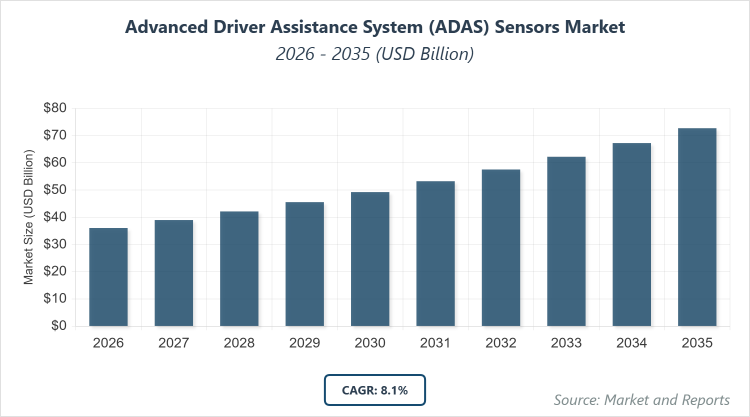
According to MarketnReports, the global Advanced Driver Assistance System (ADAS) Sensors market size was estimated at USD 36.07 billion in 2025 and is expected to reach USD 78.6 billion by 2035, growing at a CAGR of 8.1% from 2026 to 2035. Advanced Driver Assistance System (ADAS) Sensors Market is driven by the increasing adoption of autonomous vehicles and stringent safety regulations.
What is Advanced Driver Assistance System (ADAS) Sensors? An Industry Overview
Advanced Driver Assistance System (ADAS) sensors are specialized devices that detect and interpret environmental data to enable features like collision avoidance, lane keeping, and adaptive cruise control in vehicles, utilizing technologies such as radar, LiDAR, cameras, and ultrasonics for real-time perception. The market definition includes sensors that provide input for vehicle safety and automation systems, supporting levels of autonomy from assisted to fully autonomous driving, addressing road safety concerns, reducing human error, and facilitating the transition to intelligent transportation systems while complying with global automotive standards for enhanced driver experience and reduced accidents.
What are the Key Insights of Advanced Driver Assistance System (ADAS) Sensors Market?
- The global Advanced Driver Assistance System (ADAS) Sensors market was valued at USD 36.07 billion in 2025 and is projected to reach USD 78.6 billion by 2035.
- The global Advanced Driver Assistance System (ADAS) Sensors market is expected to grow at a CAGR of 8.1% during the forecast period 2026-2035.
- The Advanced Driver Assistance System (ADAS) Sensors market is driven by advancements in sensor fusion technologies and rising demand for vehicle safety features.
- The radar sensors subsegment dominates the sensor type segment with a 40% share due to its cost-effectiveness and reliability in adverse weather conditions.
- The passenger cars subsegment dominates the vehicle type segment with a 60% share owing to high consumer demand for safety in personal vehicles.
- The adaptive cruise control subsegment dominates the application segment with a 30% share because of its widespread integration in mid-range cars for highway safety.
- North America dominates the global Advanced Driver Assistance System (ADAS) Sensors market with a 35% share attributed to stringent safety regulations and presence of key automotive manufacturers in the U.S.
What are the Market Dynamics of Advanced Driver Assistance System (ADAS) Sensors?
Growth Drivers
The Advanced Driver Assistance System (ADAS) sensors market is propelled by stringent global safety regulations, such as the EU’s General Safety Regulation mandating ADAS features in new vehicles by 2024, driving manufacturers to integrate sensors for compliance and reducing accident rates by up to 20%. Technological advancements in AI and sensor fusion enhance accuracy, enabling features like automatic emergency braking, which appeals to consumers prioritizing safety amid rising road fatalities. Increasing EV adoption, with over 10 million units sold annually, requires advanced sensors for autonomous capabilities, fostering partnerships between tech firms and automakers to accelerate innovation and market penetration.
Restraints
High costs associated with advanced sensors like LiDAR, often exceeding USD 1,000 per unit, limit adoption in entry-level vehicles, constraining market growth in price-sensitive segments. Technical challenges in sensor performance under adverse weather, such as fog affecting cameras, reduce reliability and require additional R&D investments. Regulatory delays in approving new sensor technologies and varying standards across regions create barriers, slowing global standardization and increasing compliance costs for manufacturers.
Opportunities
The push toward autonomous vehicles opens opportunities for sensor integration in Level 3+ systems, with projections of over 20 million self-driving cars by 2030 creating demand for multi-sensor arrays. Emerging markets in Asia-Pacific offer growth through government incentives for smart mobility, where affordable radar-based ADAS can address high accident rates. Collaborations with tech giants for AI-enhanced sensors can unlock applications in fleet management, reducing operational costs by 15% through predictive maintenance.
Challenges
Ensuring data privacy and cybersecurity in connected ADAS systems remains a challenge, as hacks could compromise vehicle safety, requiring robust encryption that adds complexity. Supply chain disruptions for semiconductor components, critical for sensors, lead to shortages and price hikes. Interoperability issues between sensors from different vendors hinder seamless integration, while the need for continuous calibration in varying environments demands advanced algorithms to maintain accuracy.
Advanced Driver Assistance System (ADAS) Sensors Market: Report Scope
| Report Attributes | Report Details |
| Report Name | Advanced Driver Assistance System (ADAS) Sensors Market |
| Market Size 2025 | USD 36.07 Billion |
| Market Forecast 2035 | USD 78.6 Billion |
| Growth Rate | CAGR of 8.1% |
| Report Pages | 220 |
| Key Companies Covered | Mobileye, NVIDIA, Bosch, Continental, Denso, ZF Friedrichshafen, and Others |
| Segments Covered | By Sensor Type, By Vehicle Type, By Application, and By Region |
| Regions Covered | North America, Europe, Asia Pacific (APAC), Latin America, and The Middle East and Africa (MEA) |
| Base Year | 2025 |
| Historical Year | 2020 – 2024 |
| Forecast Year | 2026 – 2035 |
| Customization Scope | Avail customized purchase options to meet your exact research needs. |
The Advanced Driver Assistance System (ADAS) Sensors market is segmented by sensor type, vehicle type, application, and region.
Based on Sensor Type Segment: The radar sensors segment is the most dominant, holding a 40% market share, as they provide reliable long-range detection in all weather, driven by cost-effectiveness for features like ACC. This dominance drives market growth by enabling widespread ADAS adoption in mid-range vehicles. The LiDAR sensors segment is the second most dominant with a 25% share, offering high-resolution 3D mapping for autonomous driving, which propels the market through precision in urban environments.
Based on Vehicle Type Segment: The passenger cars segment is the most dominant, capturing a 60% share, due to consumer demand for safety in personal transport. Its dominance accelerates market growth by integrating ADAS in mass-produced models. The commercial vehicles segment ranks second with a 25% share, where fleet safety reduces accidents, driving the market with logistics applications.
Based on Application Segment: The adaptive cruise control segment is the most dominant, with a 30% share, attributed to its role in highway safety and comfort. This leads market growth by standardizing features in new cars. The automatic emergency braking segment is second with a 25% share, mandated by regulations, propelling growth through collision avoidance.
What are the Recent Developments in Advanced Driver Assistance System (ADAS) Sensors Market?
- In 2025, Mobileye launched an advanced LiDAR system with improved range for Level 3 autonomy.
- NVIDIA partnered with an automaker for AI sensor fusion in next-gen EVs.
- Bosch expanded ultrasonic sensor production for park assist applications.
- Continental introduced a new radar module with 4D imaging for urban driving.
- Denso acquired a startup for infrared night vision enhancements.
What is the Regional Analysis of Advanced Driver Assistance System (ADAS) Sensors Market?
- North America to dominate the global market
North America holds a 35% share in the Advanced Driver Assistance System (ADAS) Sensors market, driven by innovation and regulations. The United States dominates, with Tesla and GM leading ADAS integrations, supported by NHTSA mandates.
Europe maintains a strong position in the Advanced Driver Assistance System (ADAS) Sensors market, fueled by safety standards. Germany leads, with Bosch and ZF advancing for Mercedes and BMW, aligned with Euro NCAP.
Asia Pacific is the fastest-growing region for Advanced Driver Assistance System (ADAS) Sensors, propelled by EV boom. China dominates, with BYD and Huawei scaling LiDAR for local brands.
Latin America is emerging in the Advanced Driver Assistance System (ADAS) Sensors market, focusing on basic safety. Brazil leads, adopting radar for commercial fleets.
The Middle East and Africa show potential in the Advanced Driver Assistance System (ADAS) Sensors market, driven by luxury imports. The UAE is a key player, integrating in Dubai’s smart vehicles.
Who are the Key Market Players and Strategies in Advanced Driver Assistance System (ADAS) Sensors?
Mobileye focuses on LiDAR advancements, partnering for autonomous tech.
NVIDIA emphasizes AI fusion, expanding DRIVE platform.
Bosch prioritizes ultrasonic expansions, acquiring for park assist.
Continental pursues radar innovations, targeting urban applications.
Denso specializes in infrared acquisitions, enhancing night vision.
ZF Friedrichshafen develops multi-sensor systems for commercial vehicles.
What are the Market Trends in Advanced Driver Assistance System (ADAS) Sensors?
- Increasing adoption of sensor fusion for enhanced accuracy.
- Shift toward LiDAR for Level 3+ autonomy.
- Growth in ultrasonic for low-speed applications.
- Integration with AI for predictive safety.
- Expansion in EVs for optimized ADAS.
- Focus on cost reduction for mass-market vehicles.
What are the Market Segments and their Subsegment Covered in the Advanced Driver Assistance System (ADAS) Sensors Report?
By Sensor Type
-
- Radar Sensors
- LiDAR Sensors
- Camera Sensors
- Ultrasonic Sensors
- Infrared Sensors
- Others
By Vehicle Type
-
- Passenger Cars
- Commercial Vehicles
- Electric Vehicles
- Autonomous Vehicles
- Others
By Application
-
- Adaptive Cruise Control
- Blind Spot Detection
- Lane Departure Warning
- Automatic Emergency Braking
- Park Assist
- Others
By Region
-
- North America
- U.S.
- Canada
- Europe
- UK
- Germany
- France
- Rest of Europe
- Asia Pacific
- China
- India
- Japan
- Rest of Asia Pacific
- Latin America
- Brazil
- Mexico
- Rest of Latin America
- Middle East & Africa
- UAE
- South Africa
- Rest of Middle East & Africa
- North America
Chapter 1. Preface
Chapter 2. Executive Summary
Chapter 3. Global Advanced Driver Assistance System (ADAS) Sensors Market - Industry Analysis
Chapter 4. Executive Summary
Chapter 5. Global Advanced Driver Assistance System (ADAS) Sensors Market - Industry Analysis
Chapter 6. Global Advanced Driver Assistance System (ADAS) Sensors Market- Competitive Landscape
Chapter 7. Global Advanced Driver Assistance System (ADAS) Sensors Market - Sensor Type Analysis
Chapter 8. Global Advanced Driver Assistance System (ADAS) Sensors Market - Vehicle Type Analysis
Chapter 9. Global Advanced Driver Assistance System (ADAS) Sensors Market - Application Analysis
Chapter 10. Advanced Driver Assistance System (ADAS) Sensors Market - Regional Analysis
Chapter 11. Company Profiles
Frequently Asked Questions
Advanced Driver Assistance System (ADAS) Sensors are devices that detect environmental data for vehicle safety features like collision avoidance.
Key factors include autonomous vehicle demand, safety regulations, and sensor tech advancements.
The market is projected to grow from USD 39.4 billion in 2026 to USD 78.6 billion by 2035.
The market is expected to grow at a CAGR of 8.1% during 2026-2035.
North America will contribute notably, holding a 35% share due to regulatory support.
Major players include Mobileye, NVIDIA, Bosch, Continental, Denso, and ZF Friedrichshafen.
The report provides market size, trends, segmentation, regional insights, key players, and forecasts.
Stages include raw material sourcing, manufacturing, integration, testing, and distribution.
Trends favor sensor fusion and AI, with preferences for safe, autonomous features.
Safety mandates and emission reductions drive ADAS adoption.