
3D Wheel Aligners Market Size, Share and Trends 2026 to 2035
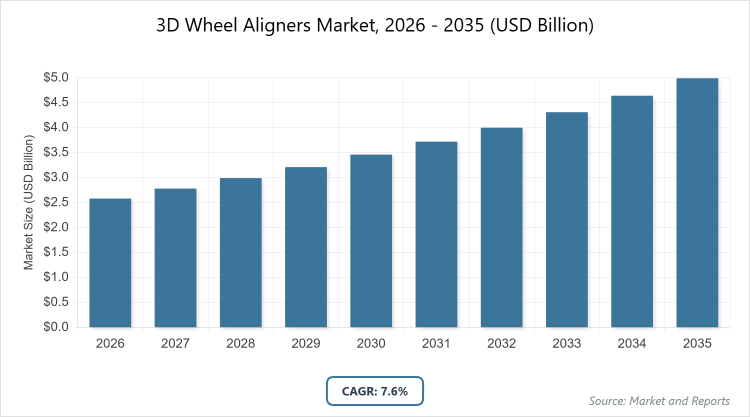
According to MarketnReports, the global 3D Wheel Aligners market size was estimated at USD 2.58 billion in 2025 and is expected to reach USD 5.37 billion by 2035, growing at a CAGR of 7.6% from 2026 to 2035. 3D Wheel Aligners Market is driven by technological advancements in automotive diagnostics and increasing demand for precise vehicle maintenance.
What are the Key Insights of 3D Wheel Aligners Market?
- Market size valued at USD 2.58 billion in 2025 and projected to reach USD 5.37 billion by 2035
- CAGR of 7.6% during the forecast period 2026-2035
- Market is driven by rising vehicle production, ADAS integration, and demand for efficient maintenance services
- High-Definition (HD) Aligners dominate the product type segment with 32% share due to their enhanced imaging accuracy and compatibility with diverse vehicle types
- Passenger Cars dominate the application segment with 45% share as they require frequent alignments amid growing global fleet sizes
- Independent Repair Shops dominate the end-user segment with 38% share owing to widespread adoption for cost-effective, high-volume services
- North America dominates with 35% market share attributed to advanced automotive infrastructure and high concentration of service centers
What is 3D Wheel Aligners?
The 3D wheel aligners market encompasses advanced automotive diagnostic equipment that utilizes three-dimensional imaging technology to measure and adjust vehicle wheel alignments with high precision, ensuring optimal tire contact, vehicle stability, and fuel efficiency. These systems employ cameras, sensors, and software to capture real-time data on camber, caster, toe, and thrust angles, offering superior accuracy over traditional 2D methods. The market definition includes hardware like imaging towers, targets, and consoles, along with integrated software for diagnostics, often featuring ADAS calibration capabilities, targeting automotive service sectors where quick, contactless alignments reduce labor time and enhance safety for modern vehicles equipped with complex suspension systems.
What are the Market Dynamics in 3D Wheel Aligners?
Growth Drivers
The growth drivers in the 3D wheel aligners market are propelled by the surge in global vehicle ownership and the integration of advanced driver-assistance systems (ADAS), which necessitate precise alignments to maintain sensor accuracy and vehicle safety. Innovations in imaging technologies, such as high-definition cameras and AI-driven software, enable faster diagnostics and reduced setup times, appealing to busy service centers. Stringent regulations on vehicle emissions and safety standards encourage regular maintenance, boosting demand for efficient tools that minimize tire wear and improve fuel economy. Expanding aftermarket services in emerging economies, coupled with fleet management needs for commercial vehicles, further drive adoption by offering scalable solutions that enhance operational efficiency and reduce downtime.
Restraints
Restraints in the 3D wheel aligners market include high initial investment costs for advanced systems, which can deter small-scale garages and independent operators in price-sensitive regions. The complexity of installation and the need for trained technicians to operate sophisticated software and hardware create barriers to entry and increase operational expenses. Compatibility issues with older vehicle models and varying standards across regions complicate widespread implementation. Additionally, supply chain disruptions for electronic components and cameras can lead to delays and higher prices, limiting market penetration in developing areas with limited infrastructure.
Opportunities
Opportunities in the 3D wheel aligners market arise from the rapid growth of electric vehicles (EVs), which require specialized alignments for battery optimization and regenerative braking systems, opening avenues for tailored solutions. Integration with cloud-based platforms for remote diagnostics and data analytics allows for predictive maintenance services, attracting fleet operators. Emerging markets in Asia Pacific offer potential through increasing automotive sales and government initiatives for road safety. Partnerships with OEMs for bundled ADAS calibration tools and expansions into agricultural and industrial vehicles can diversify applications, fostering innovation in portable and wireless systems.
Challenges
Challenges in the 3D wheel aligners market involve keeping pace with evolving vehicle designs, such as autonomous and connected cars, which demand continuous software updates and calibration advancements. Cybersecurity risks in networked systems require robust protections to safeguard diagnostic data. Shortages of skilled labor for maintenance and calibration, along with high training costs, hinder efficient utilization. Balancing affordability with cutting-edge features amid competitive pricing pressures remains a key issue, particularly in saturated markets where differentiation is crucial for sustained growth.
3D Wheel Aligners Market: Report Scope
| Report Attributes | Report Details |
| Report Name | 3D Wheel Aligners Market |
| Market Size 2025 | USD 2.58 Billion |
| Market Forecast 2035 | USD 5.37 Billion |
| Growth Rate | CAGR of 7.6% |
| Report Pages | 220 |
| Key Companies Covered | Hunter Engineering Company, Snap-on Incorporated, John Bean Technologies Corporation, RAVAmerica, CEMB, BendPak, Hofmann, Sonic Equipment Company, Launch Tech Co. Ltd., Beissbarth GmbH, and Others |
| Segments Covered | By Product Type (Optical Imaging Aligners, Laser Imaging Aligners, CCD Imaging Aligners, High-Definition (HD) Aligners, Cloud-Based Aligners, Auto Boom Aligners, and Others), By Application (Passenger Cars, Light Commercial Vehicles, Heavy Commercial Vehicles, Agricultural Vehicles, Industrial Vehicles, and Others), By End-User (Independent Repair Shops, Auto Dealerships, Tire Shops, Fleet Maintenance Facilities, OEMs, Garages, and Others), and By Region |
| Regions Covered | North America, Europe, Asia Pacific (APAC), Latin America, and The Middle East and Africa (MEA) |
| Base Year | 2025 |
| Historical Year | 2020 – 2024 |
| Forecast Year | 2026 – 2035 |
| Customization Scope | Avail customized purchase options to meet your exact research needs. |
How is the 3D Wheel Aligners Market Segmented?
The 3D Wheel Aligners market is segmented by product type, application, end-user, and region.
Based on Product Type Segment. High-Definition (HD) Aligners is the most dominant with 32% share, followed by Cloud-Based Aligners as the second most dominant at 25%. HD Aligners dominate due to their superior resolution and real-time data processing, which drive the market by enabling precise adjustments for modern vehicles with ADAS, reducing service times and improving accuracy; Cloud-Based Aligners as second dominant enhance connectivity for remote monitoring and updates, propelling growth through seamless integration with fleet management systems and facilitating data-driven maintenance decisions.
Based on Application Segment. Passenger Cars is the most dominant with 45% share, followed by Light Commercial Vehicles at 30%. Passenger Cars lead because of the high volume of personal vehicles requiring regular alignments for safety and efficiency, driving market expansion by aligning with global urbanization and rising disposable incomes; Light Commercial Vehicles follow as second dominant through their use in delivery and logistics, contributing to growth by addressing wear from heavy usage and supporting e-commerce-driven fleet expansions.
Based on End-User Segment. Independent Repair Shops is the most dominant with 38% share, followed by Auto Dealerships at 28%. Independent Repair Shops dominate owing to their accessibility and cost-effective services for diverse customers, propelling market growth by catering to aftermarket needs and quick turnaround; Auto Dealerships as second dominant leverage OEM integrations for warranty services, driving the market through brand-specific calibrations and customer loyalty programs.
What are the Recent Developments in 3D Wheel Aligners?
- In March 2025, Coats introduced its CWA6000 3D Wheel Aligner, a next-generation system engineered for faster measurements and improved workshop efficiency, featuring advanced 3D imaging and enhanced diagnostic capabilities.
- In January 2025, Snap On Inc. launched the John Bean V3500, a new wireless imaging wheel aligner featuring automated camera tracking and cloud-based vehicle specification updates to accelerate service times.
- In October 2024, Hunter Engineering Co. announced a strategic partnership to embed advanced ADAS calibration software directly into its WinAlign platform, streamlining the post-alignment reset process for technicians.
- In September 2024, Beissbarth Automotive GmbH revealed a major expansion of its distribution and service network in APAC to better serve the region’s rapidly growing demand for professional garage equipment.
How is the Regional Analysis for 3D Wheel Aligners Market?
North America to dominate the global market.
North America dominates the 3D wheel aligners market due to its robust automotive aftermarket, high vehicle ownership rates, and early adoption of advanced technologies like ADAS calibration. The United States leads as the dominating country with extensive networks of repair shops, stringent safety regulations, and investments in EV infrastructure, fostering demand for precise diagnostic tools.
Europe holds a significant share driven by strict emission standards and a focus on vehicle longevity, with growth in luxury and commercial segments. Germany dominates the region through its automotive manufacturing hub status and emphasis on precision engineering in service centers.
Asia Pacific exhibits the fastest growth fueled by rising vehicle production, urbanization, and expanding middle-class populations. China dominates within the region with massive automotive sales and government pushes for road safety enhancements.
Latin America shows steady progress through increasing fleet operations and aftermarket services. Brazil leads the region with growing investments in transportation infrastructure and commercial vehicle maintenance.
The Middle East and Africa are emerging with oil-driven economies shifting toward diversified services. The United Arab Emirates dominates through modern automotive facilities and tourism-related vehicle fleets.
Who are the Key Market Players in 3D Wheel Aligners?
- Hunter Engineering Company leads with innovative alignment systems like WinAlign, focusing on ADAS integration and global training programs to enhance technician efficiency.
- Snap-on Incorporated emphasizes user-friendly tools such as John Bean aligners, employing acquisitions and tech upgrades for wireless and cloud capabilities.
- John Bean Technologies Corporation specializes in precision equipment, with strategies centered on OEM partnerships and expansions in emerging markets.
- RAVAmerica targets North American services with durable aligners, prioritizing cost-effective solutions and customer support networks.
- CEMB focuses on vibration analysis integrations, using European manufacturing for high-quality, specialized aligners.
- BendPak offers versatile lift-compatible systems, with growth through product diversification and e-commerce distribution.
- Hofmann invests in laser and imaging advancements, employing sustainability initiatives for eco-friendly operations.
- Sonic Equipment Company concentrates on portable aligners, with strategies on affordability for small shops.
- Launch Tech Co. Ltd. aims at Asian markets with affordable tech, leveraging R&D for AI-enhanced diagnostics.
- Beissbarth GmbH expands service networks, focusing on ADAS calibration for premium vehicles.
What are the Market Trends in 3D Wheel Aligners?
- Integration of ADAS calibration for enhanced vehicle safety and sensor accuracy
- Adoption of cloud-based systems for remote diagnostics and real-time updates
- Shift toward wireless and portable aligners for flexible workshop use
- Emphasis on AI-driven automation to reduce manual errors and service times
- Growth in EV-specific alignments for battery and suspension optimization
- Focus on user-friendly interfaces with mobile app connectivity
- Rise in sustainable manufacturing with energy-efficient components
- Expansion of hybrid models combining 3D imaging with laser precision
- Increasing demand for multi-vehicle compatibility in fleet management
- Proliferation of training programs for technicians on advanced features
What Market Segments and Subsegments are Covered in the 3D Wheel Aligners Report?
By Product Type
- Optical Imaging Aligners
- Laser Imaging Aligners
- CCD Imaging Aligners
- High-Definition (HD) Aligners
- Cloud-Based Aligners
- Auto Boom Aligners
- Others
By Application
- Passenger Cars
- Light Commercial Vehicles
- Heavy Commercial Vehicles
- Agricultural Vehicles
- Industrial Vehicles
- Others
By End-User
- Independent Repair Shops
- Auto Dealerships
- Tire Shops
- Fleet Maintenance Facilities
- OEMs
- Garages
- Others
By Region
- North America
- U.S.
- Canada
- Europe
- UK
- Germany
- France
- Rest of Europe
- Asia Pacific
- China
- India
- Japan
- Rest of Asia Pacific
- Latin America
- Brazil
- Mexico
- Rest of Latin America
- Middle East & Africa
- UAE
- South Africa
- Rest of Middle East & Africa
Frequently Asked Questions
3D wheel aligners are advanced diagnostic tools using imaging technology to measure and adjust vehicle wheel angles for optimal performance and safety.
Key factors include ADAS adoption, vehicle production growth, technological innovations, and regulatory emphasis on safety and maintenance.
The market is projected to grow from approximately USD 2.78 billion in 2026 to USD 5.37 billion by 2035.
The CAGR is expected to be 7.6% during 2026-2035.
North America will contribute notably, holding around 35% of the market share due to advanced infrastructure and service demand.
Major players include Hunter Engineering Company, Snap-on Incorporated, John Bean Technologies Corporation, RAVAmerica, CEMB, BendPak, Hofmann, Sonic Equipment Company, Launch Tech Co. Ltd., and Beissbarth GmbH.
The report provides comprehensive insights on market size, trends, segmentation, regional analysis, key players, and forecasts to 2035.
Stages include component manufacturing (cameras, sensors), system assembly, software development, distribution to service centers, installation and calibration, and after-sales support.
Trends are shifting toward AI and cloud integration, with preferences for efficient, wireless systems that support EV and ADAS needs.
Regulatory factors include safety standards requiring precise alignments, while environmental factors involve energy-efficient designs to reduce workshop emissions.