
Aircraft MRO Market Size, Share and Trends 2026 to 2035
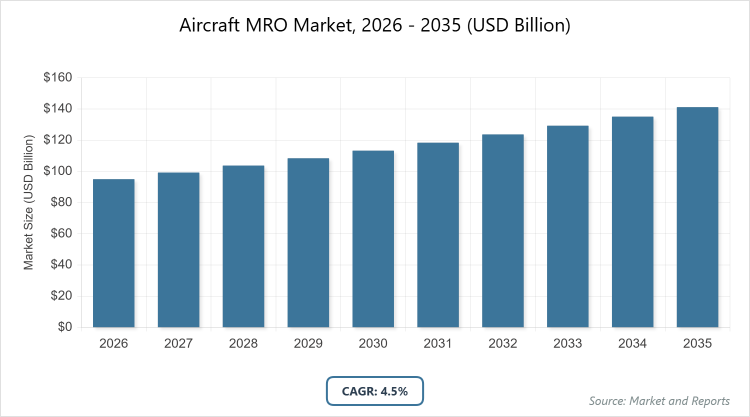
According to MarketnReports, the global Aircraft MRO Market size was estimated at USD 95 Billion in 2025 and is expected to reach USD 140 Billion by 2035, growing at a CAGR of 4.5% from 2026 to 2035. Aircraft MRO Market is driven by rising global air traffic and expanding aircraft fleets.
What is the Industry Overview of Aircraft MRO Market?
The Aircraft MRO Market encompasses the maintenance, repair, and overhaul services essential for ensuring the safety, efficiency, and longevity of aircraft worldwide. This market includes a broad spectrum of activities aimed at preserving airworthiness, from routine inspections to complex engine rebuilds, catering to both commercial and military aviation sectors. Market definition refers to the comprehensive ecosystem involving specialized services that address structural, mechanical, and electronic components of aircraft, driven by regulatory compliance, technological advancements, and the need to minimize operational downtime in an industry where reliability is paramount.
What are the Key Insights into Aircraft MRO Market?
- The global Aircraft MRO Market was valued at USD 95 billion in 2025 and is projected to reach USD 140 billion by 2035.
- The Aircraft MRO Market is anticipated to grow at a CAGR of 4.5% during the forecast period from 2026 to 2035.
- The market is driven by increasing air passenger traffic, fleet expansions in emerging economies, and the adoption of predictive maintenance technologies.
- Engine Overhaul dominates the Service Type segment with a 31% share due to its high complexity and cost, as engines require frequent overhauls to maintain performance and comply with stringent safety standards.
- Narrow-Body dominates the Aircraft Type segment with a 49% share owing to the proliferation of low-cost carriers and short-haul flights, which rely heavily on these efficient aircraft models.
- Independent MRO dominates the Organization Type segment with a 40% share because of their flexibility, cost-effectiveness, and ability to serve multiple airlines without OEM restrictions.
- North America holds the dominant regional share at 30% attributed to its large commercial fleet, advanced infrastructure, and presence of major airlines and MRO providers.
What are the Market Dynamics of Aircraft MRO Market?
Growth Drivers
The growth drivers in the Aircraft MRO Market are primarily fueled by the surge in global air travel demand, which necessitates expanded fleets and more frequent maintenance to ensure operational reliability. Aging aircraft fleets, particularly in developed regions, require extensive overhauls and upgrades, further propelling market expansion. Technological integrations such as AI-driven predictive maintenance reduce unscheduled downtimes and optimize costs, attracting investments from airlines seeking efficiency gains. Additionally, stringent regulatory requirements from bodies like the FAA and EASA mandate regular MRO activities, creating a stable demand pipeline. Emerging markets in Asia-Pacific contribute significantly through rapid urbanization and rising disposable incomes, leading to increased aircraft procurements and subsequent MRO needs.
Restraints
Restraints in the Aircraft MRO Market include escalating labor costs and a skilled workforce shortage, which hinder timely service delivery and increase operational expenses. Supply chain disruptions, exacerbated by geopolitical tensions and material shortages, delay parts availability and elevate costs. High capital investments required for advanced MRO facilities and equipment pose barriers for smaller providers, limiting market entry and expansion. Environmental regulations demanding sustainable practices add compliance burdens, requiring costly transitions to eco-friendly materials and processes. Moreover, the shift towards newer, more reliable aircraft models reduces the frequency of certain maintenance activities, potentially capping growth in traditional segments.
Opportunities
Opportunities in the Aircraft MRO Market arise from the increasing adoption of digital twins and IoT for real-time monitoring, enabling proactive maintenance strategies that enhance efficiency and open new service revenue streams. The rise of electric and hybrid aircraft presents avenues for specialized MRO services focused on battery systems and electric propulsion. Outsourcing trends among airlines to third-party providers allow for cost savings and focus on core operations, expanding the market for independent MRO firms. Sustainability initiatives, such as recycling aircraft parts and using green technologies, create niches for innovative providers. Furthermore, partnerships between OEMs and MRO companies can lead to integrated solutions, fostering growth in comprehensive service offerings.
Challenges
Challenges in the Aircraft MRO Market stem from the complexity of integrating advanced technologies like blockchain for parts traceability, which requires significant training and infrastructure upgrades. Volatility in fuel prices and economic uncertainties impact airline budgets, leading to deferred maintenance and reduced MRO spending. The global shortage of certified technicians exacerbates turnaround times, affecting service quality and customer satisfaction. Cybersecurity threats to digital MRO systems pose risks to data integrity and operational continuity. Additionally, varying international regulations complicate cross-border MRO operations, necessitating adaptive compliance strategies that can strain resources.
Aircraft MRO Market: Report Scope
| Report Attributes | Report Details |
| Report Name | Aircraft MRO Market: |
| Market Size 2025 | USD 95 Billion |
| Market Forecast 2035 | USD 140 Billion |
| Growth Rate | CAGR of 4.5% |
| Report Pages | 220 |
| Key Companies Covered | Lufthansa Technik, Delta TechOps, AAR Corp., GE Aviation, Safran SA, Airbus SE, ST Engineering, HAECO, MTU Aero Engines, Boeing Global Services, and Others |
| Segments Covered | By Service Type, By Aircraft Type, By Organization Type, and By Region |
| Regions Covered | North America, Europe, Asia Pacific (APAC), Latin America, and The Middle East and Africa (MEA) |
| Base Year | 2025 |
| Historical Year | 2020 - 2024 |
| Forecast Year | 2026 - 2035 |
| Customization Scope | Avail customized purchase options to meet your exact research needs. |
What is the Market Segmentation of Aircraft MRO Market?
The Aircraft MRO Market is segmented by Service Type, Aircraft Type, Organization Type, and region. All the segments have been analyzed based on present and future trends and the market is estimated from 2026 to 2035.
Based on Service Type Segment, Engine Overhaul emerges as the most dominant subsegment, commanding approximately 31% market share, followed by Airframe Maintenance as the second most dominant with around 25%. Engine Overhaul's dominance stems from the critical role engines play in aircraft performance, requiring specialized expertise and high-value investments that drive substantial revenue; this segment propels the overall market by addressing the need for enhanced fuel efficiency and reduced emissions through advanced repairs, thereby supporting airline profitability and regulatory adherence in a single integrated process.
Based on Aircraft Type Segment, Narrow-Body stands out as the most dominant subsegment with about 49% share, while Wide-Body is the second most dominant holding roughly 30%. Narrow-Body's leading position is due to its widespread use in high-frequency domestic and regional routes by budget airlines, which demand frequent maintenance to sustain operational intensity; this drives market growth by enabling cost-effective fleet management and quick turnaround times, contributing to the broader aviation ecosystem's efficiency and expansion.
Based on Organization Type Segment, Independent MRO is the most dominant subsegment at 40% share, with Original Equipment Manufacturer MRO as the second most dominant at 35%. Independent MRO's prominence arises from its agility in offering customized, multi-vendor services at competitive prices, appealing to diverse airline needs; it accelerates market advancement by fostering innovation in repair techniques and reducing dependency on OEMs, thus enhancing overall industry competitiveness and accessibility.
What are the Recent Developments in Aircraft MRO Market?
- In January 2026, AxioAero Group, backed by private equity firm CORE Industrial Partners, acquired Florida-based repair station Airway Aerospace, enhancing its portfolio that includes Aviation Concepts, to expand parts provision and inventory management capabilities in the MRO sector.
- In 2025, Bain Capital made a minority investment in Panama-based MRO Holdings, aiming to bolster its maintenance services amid growing demand for outsourced MRO solutions.
- HIG Capital invested in Florida-headquartered STS Aviation Group in 2025, focusing on expanding its aviation services including MRO, to capitalize on fleet growth opportunities.
- Greenbriar Equity purchased California-based MRO provider Sunvair in 2025, strengthening its position in aircraft repair and overhaul services.
- In June 2023, FEAM Aero and Northern Aerotech Group acquired SR Technics Group, enhancing their leadership in line maintenance services and targeting expansion in the Spanish market.
- Airbus Helicopters acquired ZF Luftfahrttechnik, boosting its MRO capabilities for helicopter dynamic components.
- In September 2024, Ramco Systems launched Aviation Software 6.0, incorporating AI-driven insights for improved MRO operations.
- In November 2023, MTU Maintenance signed a 5-year agreement with Sri Lankan Airlines for LEAP-1A engine maintenance.
- In October 2023, Safran partnered with Turkish Technic to provide maintenance services for Airbus A320 and A330 systems.
- In February 2024, BAE Systems acquired Ball Aerospace for USD 5.5 billion, enhancing space and defense MRO capabilities.
What is the Regional Analysis of Aircraft MRO Market?
North America to dominate the global market.
North America's dominance in the Aircraft MRO Market is underpinned by its vast commercial aviation fleet, advanced technological infrastructure, and stringent safety regulations enforced by the FAA, with the United States as the leading country due to major hubs like Atlanta and Chicago facilitating high-volume maintenance activities and attracting global investments.
Europe maintains a strong position through its focus on innovation and sustainability, supported by EASA regulations and collaborations among providers, where Germany stands out as the dominant country with companies like Lufthansa Technik driving efficiency in engine and component overhauls across the continent.
Asia-Pacific experiences rapid growth fueled by burgeoning air travel in emerging economies and fleet expansions by low-cost carriers, with China as the key dominating country leveraging its manufacturing prowess and government initiatives to develop indigenous MRO capabilities, reducing reliance on foreign services.
Latin America shows steady progress driven by increasing regional connectivity and tourism, where Brazil emerges as the dominant country with its growing aviation sector and investments in MRO facilities to support domestic airlines like LATAM.
The Middle East and Africa region benefits from strategic geographic positioning as aviation hubs, with the United Arab Emirates leading as the dominant country through entities like Emirates Engineering, which capitalize on transit traffic and advanced facilities to offer comprehensive MRO services globally.
What are the Key Market Players in Aircraft MRO Market?
Lufthansa Technik focuses on expanding its global footprint through strategic partnerships and investments in digital solutions like predictive maintenance platforms, enabling customized services for diverse aircraft types and enhancing operational efficiency for clients worldwide.
Delta TechOps emphasizes in-house capabilities and third-party contracts, leveraging its extensive facilities to provide cost-effective engine and component overhauls while investing in workforce training to address skill shortages and maintain high service standards.
AAR Corp. pursues growth via acquisitions and expansions, such as integrating new repair stations, to broaden its independent MRO offerings and capitalize on outsourcing trends among airlines seeking flexible, multi-platform support.
GE Aviation adopts a strategy of innovation in engine MRO, forming exclusive partnerships and license networks to control aftermarket services, ensuring proprietary technology access and long-term contracts with airlines for sustained revenue.
Safran SA concentrates on collaborative ventures, like joint maintenance agreements, to advance sustainable practices and electric propulsion MRO, positioning itself as a leader in next-generation aircraft support.
Airbus SE implements controlled expansion strategies, building OEM-integrated MRO networks to offer comprehensive airframe and modification services, fostering customer loyalty through bundled solutions.
ST Engineering invests in infrastructure development and AI-driven tools to optimize line maintenance and modifications, targeting emerging markets for diversified growth.
HAECO enhances its competitive edge through facility upgrades and green initiatives, providing specialized services for wide-body aircraft in the Asia-Pacific region.
MTU Aero Engines focuses on long-term service agreements and technological R&D to dominate engine overhaul segments, ensuring reliability and cost savings for operators.
Boeing Global Services leverages data analytics and global alliances to deliver integrated MRO solutions, emphasizing fleet optimization and regulatory compliance.
What are the Market Trends in Aircraft MRO Market?
- Adoption of AI and predictive maintenance to reduce downtime and enhance efficiency.
- Shift towards sustainable and green MRO practices, including parts recycling.
- Increased outsourcing to independent providers for cost optimization.
- Integration of digital twins and IoT for real-time monitoring.
- Growth in MRO for electric and hybrid aircraft systems.
- Emphasis on cybersecurity in digital MRO platforms.
- Expansion of MRO facilities in emerging markets.
- Use of blockchain for parts traceability and counterfeit prevention.
- Workforce development through training and automation.
- Strategic mergers and acquisitions to consolidate market presence.
What are the Market Segments and their Subsegments Covered in the Aircraft MRO Report?
- Service Type
- Engine Overhaul
- Airframe Maintenance
- Line Maintenance
- Modification
- Components
- Others
- Aircraft Type
- Narrow-Body
- Wide-Body
- Regional Jet
- Turboprop
- Others
- Organization Type
- Airline/Operator MRO
- Independent MRO
- Original Equipment Manufacturer MRO
- Others
- By Region
-
- North America
- U.S.
- Canada
- Europe
- UK
- Germany
- France
- Rest of Europe
- Asia Pacific
- China
- India
- Japan
- Rest of Asia Pacific
- Latin America
- Brazil
- Mexico
- Rest of Latin America
- Middle East & Africa
- UAE
- South Africa
- Rest of Middle East & Africa
- North America
Frequently Asked Questions
The Aircraft MRO Market refers to the industry providing maintenance, repair, and overhaul services for aircraft to ensure safety, compliance, and operational efficiency.
Key factors include rising air traffic, fleet expansions, technological advancements in predictive maintenance, and stringent regulatory requirements.
The market value is projected to grow from USD 95 billion in 2025 to USD 140 billion by 2035.
The CAGR is expected to be 4.5% during 2026-2035.
North America will contribute notably, holding around 30% of the market share due to its advanced infrastructure and large fleet.
Major players include Lufthansa Technik, Delta TechOps, AAR Corp., GE Aviation, and Safran SA.
The report offers in-depth analysis of market size, trends, segments, regional insights, key players, and forecasts.
Stages include planning and scheduling, inspection and diagnosis, repair and overhaul, testing and certification, and logistics for parts supply.
Trends are shifting towards digitalization and sustainability, with preferences for cost-effective, predictive services that minimize downtime.
Stringent safety regulations from FAA/EASA and environmental mandates for emissions reduction and sustainable practices are key influencers.