
P2p Lending Market Size, Share and Trends 2026 to 2035
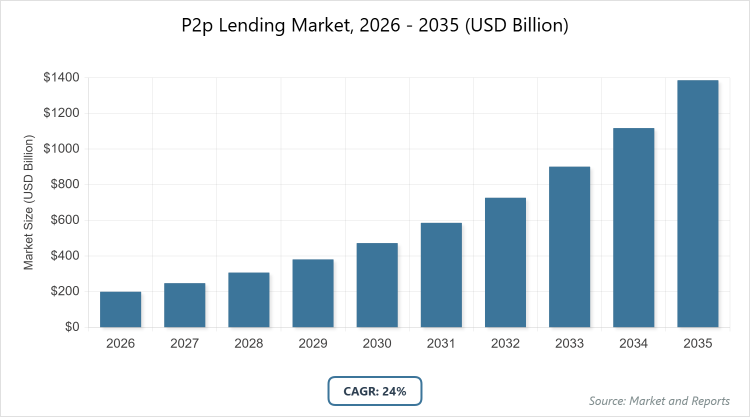
According to MarketnReports, the global P2p Lending Market size was estimated at USD 200 billion in 2025 and is expected to reach USD 1800 billion by 2035, growing at a CAGR of 24% from 2026 to 2035. P2p Lending Market is driven by rising demand for alternative financing options and fintech innovations.What are the key insights into the P2p Lending Market?
- The global P2p Lending Market was valued at USD 200 billion in 2025 and is projected to reach USD 1800 billion by 2035.
- The market is expected to grow at a CAGR of 24% during the forecast period from 2026 to 2035.
- The market is driven by increasing smartphone penetration, fintech advancements, and demand for quick, accessible loans in emerging economies.
- In the loan type segment, personal loans dominate with approximately 70% market share due to their appeal for debt consolidation and immediate financial needs among individuals.
- In the end-user segment, individuals hold about 60% share because of rising consumer borrowing for personal expenses in a digital economy.
- In the business model segment, traditional P2P model commands roughly 65% share owing to its core peer-matching efficiency and lower operational costs.
- Asia Pacific dominates the regional market with approximately 40% share, attributed to high population density, rapid fintech adoption in China and India, and government support for digital finance.
What is the industry overview of the P2p Lending Market?
The P2p Lending Market involves digital platforms that connect borrowers directly with individual or institutional lenders, bypassing traditional banks to facilitate loans through online marketplaces. Market definition refers to P2P lending as a fintech-driven model where technology enables credit assessment, loan origination, and repayment management, offering competitive interest rates, faster approvals, and broader access to capital for underserved segments like small businesses and consumers with non-traditional credit profiles. This market intersects finance and technology sectors, emphasizing risk mitigation via algorithms, blockchain for transparency, and regulatory compliance to build trust, while addressing gaps in conventional banking by promoting financial inclusion and diversified investment opportunities.
What are the market dynamics of the P2p Lending Market?
Growth Drivers
The growth drivers of the P2p Lending Market are significantly influenced by the proliferation of digital technologies and mobile banking, enabling seamless loan applications and approvals that reduce processing times from days to hours, appealing to tech-savvy millennials and Gen Z who represent over 50% of global borrowers. Economic uncertainties and high interest rates from traditional banks push consumers and SMEs toward P2P platforms for flexible terms, while AI-driven credit scoring expands access to unbanked populations, fostering inclusion in regions with low credit penetration. Regulatory sandboxes in countries like the UK and Singapore encourage innovation, attracting investments exceeding $10 billion annually, which in turn scales platforms and diversifies loan products, propelling overall market expansion.
Restraints
Restraints in the P2p Lending Market include heightened regulatory scrutiny and compliance costs, as governments impose stricter rules on data privacy and anti-money laundering, increasing operational expenses by up to 20% for platforms and deterring new entrants. Default risks remain high due to limited borrower verification in emerging markets, leading to investor caution and platform losses, exacerbated by economic downturns that spike non-performing loans. Cybersecurity threats, with over 1,000 reported breaches in fintech annually, erode user trust, while competition from neobanks offering similar services fragments market share, collectively hampering growth in saturated regions.
Opportunities
Opportunities in the P2p Lending Market stem from blockchain integration for transparent, tamper-proof transactions, reducing fraud and enabling cross-border lending, particularly in Asia Pacific where remittances exceed $700 billion yearly. Expansion into niche segments like green financing for sustainable projects attracts ESG-focused investors, while partnerships with traditional banks for hybrid models provide scale and credibility. Emerging economies in Africa and Latin America offer untapped potential with rising internet penetration, supported by mobile money ecosystems like M-Pesa, allowing platforms to capture underserved markets through localized, low-cost solutions and fostering long-term growth.
Challenges
Challenges in the P2p Lending Market involve managing credit risk amid volatile economic conditions, where fluctuating interest rates and unemployment can elevate default rates to 10-15%, requiring advanced analytics that strain smaller platforms' resources. Achieving scale without compromising user experience demands continuous tech upgrades, while varying global regulations create compliance complexities for international expansion. Building investor confidence in illiquid assets and educating borrowers on platform mechanics remain hurdles, potentially leading to mismatched expectations and disputes, which overall impede sustainable development in a competitive fintech landscape.
P2p Lending Market: Report Scope
| Report Attributes | Report Details |
| Report Name | P2p Lending Market |
| Market Size 2025 | USD 200 Billion |
| Market Forecast 2035 | USD 1800 Billion |
| Growth Rate | CAGR of 24% |
| Report Pages | 220 |
| Key Companies Covered |
LendingClub, Prosper, Upstart, Funding Circle, Zopa, and Others |
| Segments Covered | By Loan Type, By End-User, By Business Model, and By Region |
| Regions Covered | North America, Europe, Asia Pacific (APAC), Latin America, and The Middle East and Africa (MEA) |
| Base Year | 2025 |
| Historical Year | 2020 - 2024 |
| Forecast Year | 2026 - 2035 |
| Customization Scope | Avail customized purchase options to meet your exact research needs. |
How is the P2p Lending Market segmented?
The P2p Lending Market is segmented by loan type, end-user, business model, and region.By Loan Type Segment, personal loans are the most dominant, holding about 70% market share, followed by business loans as the second most dominant with around 20%. Personal loans' dominance arises from their versatility for everyday needs like debt consolidation and emergencies, driving the market by attracting a broad consumer base with quick disbursals and competitive rates; business loans contribute by supporting SMEs with flexible funding, enhancing economic growth and platform revenues.
By End-User Segment, individuals are the most dominant with approximately 60% share, while small and medium enterprises (SMEs) are the second most dominant at about 30%. Individuals' leadership stems from increasing personal borrowing amid rising living costs, boosting market expansion through high-volume transactions; SMEs support growth by filling banking gaps for startups, promoting entrepreneurship and diversified lending portfolios.
By Business Model Segment, traditional P2P model is the most dominant with around 65% share, followed by balance sheet model as the second most dominant at roughly 35%. Traditional P2P's prevalence results from direct peer connections minimizing intermediary costs, driving the market via efficiency and higher returns; balance sheet models aid expansion by providing lender guarantees, attracting risk-averse investors and stabilizing platforms.
What are the recent developments in the P2p Lending Market?
- In November 2025, LendingClub announced a partnership with a major fintech firm to integrate AI for enhanced credit risk assessment, aiming to reduce default rates by 15% and expand into emerging markets.
- In September 2025, Prosper launched a new mobile app feature for instant loan approvals using blockchain verification, targeting millennial borrowers and increasing user acquisition by 20%.
- In July 2025, Funding Circle secured $100 million in funding to bolster its SME lending segment, focusing on green loans to align with ESG trends.
- In April 2025, Upstart expanded operations in Asia Pacific through a joint venture, introducing localized credit models to tap into underserved regions.
What is the regional analysis of the P2p Lending Market?
Asia Pacific to dominate the global market.Asia Pacific leads the P2p Lending Market, propelled by rapid digital adoption and large unbanked populations, with China as the dominating country due to its massive fintech ecosystem and platforms like Lufax handling billions in loans, supported by government policies promoting inclusive finance.
North America exhibits strong growth through technological innovations and regulatory frameworks, led by the United States with platforms like LendingClub driving consumer lending amid high credit card debt levels.
Europe maintains a significant share via stringent regulations ensuring platform stability, dominated by the United Kingdom with Zopa's established presence and focus on ethical lending practices.
Latin America shows promising expansion from economic reforms, with Brazil dominating through increasing smartphone penetration and platforms addressing SME funding gaps.
The Middle East and Africa offer niche opportunities amid fintech investments, led by the United Arab Emirates with emerging platforms leveraging oil wealth for diversified lending.
Who are the key market players in the P2p Lending Market?
LendingClub focuses on AI-driven credit assessments and partnerships to expand consumer lending, enhancing user trust and market penetration in North America.
Prosper employs strategies of mobile-first innovations and diversified loan products, targeting personal borrowers to drive growth through accessibility.
Upstart prioritizes machine learning for risk management, collaborating with banks to scale operations and capture millennial demographics.
Funding Circle adopts a focus on SME financing and green loans, utilizing global expansions to strengthen its position in business lending.
Zopa concentrates on regulatory compliance and ethical practices, leveraging UK-based expertise to enter European markets effectively.
What are the market trends in the P2p Lending Market?
- Integration of AI and machine learning for personalized credit scoring and fraud detection.
- Rise in blockchain usage for secure, transparent cross-border transactions.
- Growing emphasis on ESG-compliant lending to attract sustainable investors.
- Expansion of mobile apps for seamless borrowing and investing experiences.
- Increasing partnerships between P2P platforms and traditional banks for hybrid models.
- Focus on financial inclusion in emerging markets through micro-lending initiatives.
What market segments and their subsegments are covered in the P2p Lending Market report?
By Loan Type
- Personal Loans
- Business Loans
- Real Estate Loans
- Student Loans
- Debt Consolidation
- Home Improvement
- Medical Expenses
- Travel Loans
- Wedding Loans
- Auto Loans
By End-User
- Individuals
- Small and Medium Enterprises (SMEs)
- Large Enterprises
By Business Model
- Traditional P2P Model
- Balance Sheet Model
By Region
- North America
- U.S.
- Canada
- Europe
- UK
- Germany
- France
- Rest of Europe
- Asia Pacific
- China
- India
- Japan
- Rest of Asia Pacific
- Latin America
- Brazil
- Mexico
- Rest of Latin America
- Middle East & Africa
- UAE
- South Africa
- Rest of Middle East & Africa
Frequently Asked Questions
The P2p Lending Market involves online platforms connecting borrowers and lenders for direct financing without traditional banks.
Key factors include fintech advancements, regulatory support, digital adoption, and demand for alternative credit.
The market is projected to grow from USD 200 billion in 2026 to USD 1800 billion by 2035.
The CAGR is expected to be 24%.
Asia Pacific will contribute notably, driven by fintech growth in China.
Major players include LendingClub, Prosper, Upstart, Funding Circle, and Zopa.
The report provides in-depth analysis of size, trends, segments, regions, players, and forecasts.
Stages include borrower application, credit assessment, loan matching, disbursement, repayment, and platform management.
Trends shift toward AI personalization, with consumers preferring quick, mobile-accessible loans.
Factors include data privacy laws and sustainable lending regulations promoting green finance.