
Biodegradable Plastics Market Size, Share and Trends 2026 to 2035
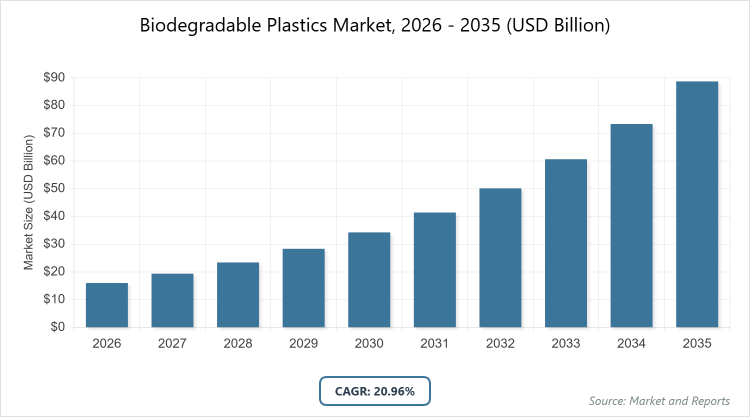
According to MarketnReports, the global Biodegradable Plastics market size was estimated at USD 16 billion in 2025 and is expected to reach USD 107.3 billion by 2035, growing at a CAGR of 20.96% from 2026 to 2035. Increasing environmental concerns and regulations on single-use plastics.
What are the Key Insights into the biodegradable plastics market?
- The global Biodegradable Plastics market was valued at USD 16 billion in 2025 and is projected to reach USD 107.3 billion by 2035.
- The market is expected to grow at a CAGR of 20.96% during the forecast period.
- The market is driven by stringent regulations on single-use plastics and growing consumer demand for sustainable products.
- In the type segment, PLA dominates with 35% share due to its versatility, cost-effectiveness, and widespread use in packaging and consumer goods.
- In the application segment, packaging dominates with 61% share as it addresses the need for eco-friendly alternatives in food and e-commerce sectors.
- In the end-use segment, food packaging dominates with 40% share owing to regulatory pressures and consumer preferences for sustainable materials.
- North America dominates the regional market with 35% share because of strong regulatory frameworks and high adoption of green technologies.
What is the Biodegradable Plastics Market?
Industry Overview
The biodegradable plastics market involves the development, production, and distribution of polymers designed to decompose naturally through biological processes, offering an eco-friendly alternative to traditional petroleum-based plastics by breaking down into non-toxic components like water, carbon dioxide, and biomass under specific environmental conditions. These materials, derived from renewable sources such as corn starch, sugarcane, or microbial fermentation, are utilized across various industries to reduce plastic pollution and support sustainable practices, with key types including PLA, PHA, and starch blends that enable applications in packaging, agriculture, and consumer goods while addressing global waste management challenges. Market definition encompasses all plastics that undergo biodegradation via microorganisms, focusing on their role in circular economy models, compliance with environmental regulations, and innovation in material science to improve performance, cost-effectiveness, and scalability for widespread adoption.
What are the Market Dynamics Shaping the Biodegradable Plastics Market?
Growth Drivers
The growth drivers in the biodegradable plastics market are propelled by escalating global awareness of plastic pollution and the urgent need for sustainable alternatives, prompting governments and corporations to adopt policies and initiatives that favor biodegradable materials over conventional plastics, thereby accelerating demand across sectors like packaging and agriculture. Advancements in biotechnology and material science have enabled the development of high-performance biodegradable polymers such as PLA and PHA, which offer comparable functionality to traditional plastics while degrading naturally, reducing environmental impact and attracting investments from eco-conscious brands. The rise of e-commerce and food delivery services has heightened the need for lightweight, compostable packaging solutions, while consumer preferences for green products drive market penetration in retail and consumer goods. Additionally, collaborations between raw material suppliers and manufacturers foster innovation in cost-effective production methods, expanding accessibility in emerging economies and supporting overall market expansion.
Restraints
Restraints in the biodegradable plastics market stem from high production costs associated with renewable feedstocks and specialized manufacturing processes, which make these materials 20-50% more expensive than petroleum-based plastics, limiting adoption in price-sensitive industries and regions. Limited infrastructure for composting and biodegradation facilities globally hinders effective end-of-life management, as many biodegradable plastics require industrial conditions to decompose, leading to consumer confusion and potential environmental backlash. Performance limitations, such as lower heat resistance and mechanical strength in certain applications, restrict their use in demanding sectors like automotive or electronics. Moreover, fluctuating raw material availability due to agricultural dependencies and competition with food production creates supply chain vulnerabilities, impeding scalable growth.
Opportunities
Opportunities in the biodegradable plastics market emerge from technological innovations in bio-based polymers, such as enhanced PHA formulations from waste streams, which lower costs and improve properties for expanding applications in medical devices and 3D printing. Growing regulatory bans on single-use plastics in Europe and Asia open markets for compliant alternatives, while corporate sustainability commitments from giants like Unilever and Coca-Cola drive demand through supply chain integrations. The expansion of recycling and composting programs in urban areas facilitates better waste management, encouraging consumer adoption. Furthermore, untapped potential in developing regions with rising middle-class populations offers avenues for localized production using abundant agricultural waste, fostering economic growth and market diversification.
Challenges
Challenges in the biodegradable plastics market include achieving consistent biodegradation rates across diverse environmental conditions, as variations in temperature, humidity, and microbial activity can lead to incomplete decomposition, undermining environmental benefits and regulatory claims. Balancing performance with affordability remains difficult, with R&D needed to match the durability of conventional plastics without premium pricing. Supply chain complexities from reliance on seasonal crops and global trade disruptions affect availability and costs. Additionally, educating consumers and stakeholders on proper disposal to avoid contamination in recycling streams is essential, as misconceptions can lead to greenwashing accusations and slower adoption.
Biodegradable Plastics Market: Report Scope
| Report Attributes | Report Details |
| Report Name | Biodegradable Plastics Market |
| Market Size 2025 | USD 16 Billion |
| Market Forecast 2035 | USD 107.3 Billion |
| Growth Rate | CAGR of 20.96% |
| Report Pages | 220 |
| Key Companies Covered |
BASF SE, NatureWorks LLC, Novamont S.p.A., Total Corbion PLA, Mitsubishi Chemical Corporation, Biome Bioplastics, and Others |
| Segments Covered | By Type, By Application, By End-Use, and By Region |
| Regions Covered | North America, Europe, Asia Pacific (APAC), Latin America, and The Middle East and Africa (MEA) |
| Base Year | 2025 |
| Historical Year | 2020 – 2024 |
| Forecast Year | 2026 – 2035 |
| Customization Scope | Avail customized purchase options to meet your exact research needs. |
How is the Market Segmentation Structured in the Biodegradable Plastics Market?
The Biodegradable Plastics market is segmented by type, application, end-use, and region.
Based on Type Segment, PLA is the most dominant subsegment, followed by starch blends as the second most dominant. PLA dominates due to its excellent processability, transparency, and biocompatibility derived from renewable sources like corn, making it ideal for high-volume applications in packaging and disposables, which drives the market by enabling cost-competitive alternatives to fossil-based plastics and supporting regulatory compliance for sustainable materials; starch blends follow with their low cost and biodegradability from natural starches, propelling growth through versatile use in flexible films and bags that address waste reduction in agriculture and consumer goods.
Based on Application Segment, packaging is the most dominant subsegment, followed by agriculture as the second most dominant. Packaging leads because of the surge in eco-friendly demands from e-commerce and food sectors for compostable films and containers, accelerating market expansion by replacing single-use plastics and aligning with global bans on non-degradable materials; agriculture gains traction for mulch films and seedling pots that enhance soil health and reduce microplastic pollution, driving the market via sustainable farming practices and government incentives for green agriculture.
Based on the end-use segment, food packaging is the most dominant subsegment, followed by single-use items as the second most dominant. Food packaging dominates owing to strict hygiene standards and consumer preferences for safe, biodegradable options in wraps and trays, fueling market growth through innovations that extend shelf life while minimizing environmental impact; single-use items like cutlery and straws rise with bans on plastic disposables, propelling the market by offering convenient, compostable alternatives in hospitality and retail.
What are the Recent Developments in the Biodegradable Plastics Market?
- In October 2025, BASF expanded its ecovio portfolio with new biodegradable blends for food packaging, targeting enhanced compostability in industrial facilities.
- In September 2025, NatureWorks LLC announced a partnership with a major retailer to supply PLA-based films for sustainable shopping bags, reducing plastic waste.
- In July 2025, Total Corbion PLA launched a high-heat resistant PLA grade for hot-fill applications, broadening its use in beverage packaging.
- In May 2025, Novamont S.p.A. acquired a bioplastics startup to advance PHA production from agricultural waste, boosting sustainability efforts.
How does Regional Analysis Impact the Biodegradable Plastics Market?
- North America is expected to dominate the global market.
North America leads the biodegradable plastics market, driven by stringent environmental regulations, high consumer awareness, and strong R&D investments in bio-based materials; the United States dominates as the key country, with policies like plastic bans and corporate sustainability goals accelerating adoption in packaging and agriculture.
Europe exhibits robust growth in the biodegradable plastics market, supported by EU directives on circular economy and single-use plastics; Germany stands out as the dominating country, leveraging its advanced chemical industry and eco-innovation for PLA and PHA production.
Asia Pacific is rapidly expanding in the biodegradable plastics market, propelled by industrialization and pollution concerns; China dominates as the key country, with massive manufacturing capacity and government incentives for green materials in packaging.
Latin America shows emerging potential in the biodegradable plastics market, aided by abundant renewable resources; Brazil is the dominating country, focusing on sugarcane-based PLA for export and domestic sustainable packaging.
The Middle East and Africa represent nascent growth in the biodegradable plastics market, driven by diversification from oil; the UAE emerges as a key player, investing in bio-plastic hubs for regional supply.
Who are the Key Market Players in the Biodegradable Plastics Market?
- BASF SE focuses on expanding its ecovio line through R&D in compostable blends, partnering with packaging firms for sustainable solutions.
- NatureWorks LLC employs strategies in PLA innovation, emphasizing renewable feedstocks and collaborations with brands for eco-friendly products.
- Novamont S.p.A. pursues acquisitions and bio-refinery expansions to enhance Mater-Bi production for agriculture and packaging.
- Total Corbion PLA leverages joint ventures for high-performance PLA grades, targeting heat-resistant applications in food service.
- Mitsubishi Chemical Corporation adopts sustainable sourcing for bio-based polyesters, focusing on the Asia-Pacific market growth.
- Biome Bioplastics concentrates on starch-based innovations, prioritizing R&D for flexible films in consumer goods.
What are the Market Trends in the biodegradable plastics market?
- Increasing adoption of PLA and PHA for high-performance applications in packaging.
- Shift toward bio-based feedstocks from waste to reduce costs and emissions.
- Growth in compostable films for food and e-commerce packaging.
- Regulatory bans on single-use plastics are boosting market demand.
- Advancements in microbial fermentation for scalable PHA production.
- Expansion of biodegradable textiles and medical devices.
- Consumer preference for certified compostable products.
What Market Segments and their Subsegments are Covered in the Biodegradable Plastics Report?
By Type
- PLA
- Starch Blends
- PBAT
- PHA
- PBS
- Cellulose Based
- Polyester
- Regenerative Cellulose
- Cellulose Derivative
- Others
By Application
- Packaging
- Agriculture
- Textiles
- Consumer Goods
- Electronics
- Medical
- Food & Beverages
- Personal Care
- Others
By End-Use
- Food Packaging
- Single-Use Items
- Disposable Tableware
- Agricultural Films
- Others
By Region
- North America
- U.S.
- Canada
- Europe
- UK
- Germany
- France
- Rest of Europe
- Asia Pacific
- China
- India
- Japan
- Rest of Asia Pacific
- Latin America
- Brazil
- Mexico
- Rest of Latin America
- Middle East & Africa
- UAE
- South Africa
- Rest of Middle East & Africa
Chapter 1. Preface
Chapter 2. Executive Summary
Chapter 3. Global Biodegradable Plastics Market - Industry Analysis
Chapter 4. Global Biodegradable Plastics Market- Competitive Landscape
Chapter 5. Global Biodegradable Plastics Market - Type Analysis
Chapter 6. Global Biodegradable Plastics Market - Application Analysis
Chapter 7. Global Biodegradable Plastics Market - End-Use Analysis
Chapter 8. Biodegradable Plastics Market - Regional Analysis
Chapter 9. Company Profiles
Frequently Asked Questions
Biodegradable plastics are polymers that decompose naturally through biological processes into non-toxic components, derived from renewable sources and used as eco-friendly alternatives to traditional plastics.
Key factors include regulatory bans on plastics, rising sustainability awareness, technological advancements in bio-polymers, and demand from packaging sectors.
The biodegradable plastics market is projected to grow from USD 16 billion in 2025 to USD 107.3 billion by 2035.
The market is expected to grow at a CAGR of 20.96% from 2026 to 2035.
North America will contribute notably, holding around 35% market share due to strong regulations and adoption.
Major players include BASF SE, NatureWorks LLC, Novamont S.p.A., Total Corbion PLA, Mitsubishi Chemical Corporation, and Biome Bioplastics, driving growth through innovations.
The report provides detailed analysis including market size, trends, segmentation, regional insights, key players, and forecasts from 2026 to 2035.
Stages include raw material sourcing from renewables, polymer synthesis, compounding, product manufacturing, distribution, and end-of-life biodegradation.
Trends shift toward bio-based and compostable materials, with consumers preferring sustainable, certified products for packaging and disposables.
Factors include plastic bans, EU Green Deal, and sustainability mandates promoting bio-plastics to reduce pollution and carbon footprints.