
Electric Brake Booster Market Size and Forecast 2026 to 2035
According to MarketnReports, the global Electric Brake Booster market size was estimated at USD 2.59 billion in 2025 and is expected to reach USD 50.87 billion by 2035, growing at a CAGR of 24.96% from 2026 to 2035. Electric Brake Booster Market is driven by the rising adoption of electric and hybrid vehicles, increasing focus on vehicle safety, and demand for advanced brake-by-wire systems.
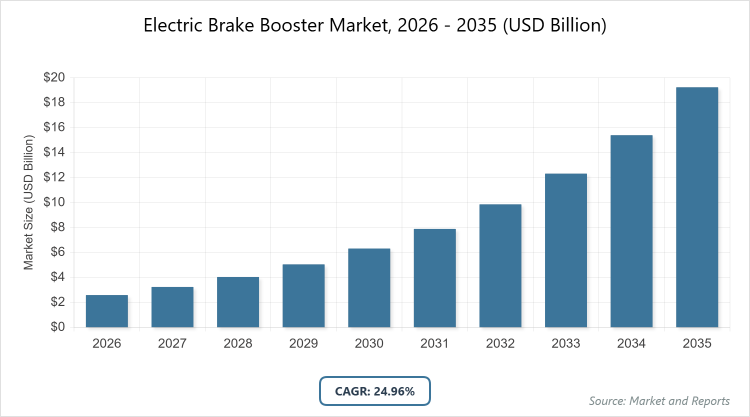
What are the Key Insights of the Electric Brake Booster Market?
- Market valued at USD 2.59 billion in 2025, projected to reach USD 50.87 billion by 2035, growing at a CAGR of 24.96% during 2026-2035.
- Dominant subsegment in Brake Type: Disc Brake.
- Dominant subsegment in Booster Type: Dual Diaphragm Booster.
- Dominant subsegment in EV Type: Hybrid Electric Vehicle.
- Dominant region: Asia-Pacific.
What is the Industry Overview of the Electric Brake Booster Market?
The electric brake booster market revolves around an advanced automotive component designed to enhance braking systems by utilizing an electric motor to amplify the force applied through the brake pedal, thereby replacing conventional vacuum-based boosters. This technology integrates seamlessly with modern vehicle features such as regenerative braking, electronic stability control, and autonomous driving capabilities, offering improved response times, precise modulation, and energy efficiency. It plays a crucial role in elevating vehicle safety and performance, particularly in electric and hybrid vehicles where traditional systems fall short in optimizing energy recovery and adapting to variable driving conditions. The market encompasses the development, manufacturing, and integration of these boosters into various vehicle types, driven by the evolution of automotive electrification and the push for smarter, more sustainable mobility solutions.
What are the Market Dynamics Affecting the Electric Brake Booster Market?
Growth Drivers
The primary growth drivers for the electric brake booster market stem from the surging global demand for electric vehicles, which necessitate advanced braking technologies to ensure optimal energy recovery and safety during operation. This is complemented by the increasing emphasis on autonomous driving systems that require precise and rapid braking responses, fostering innovation in electric-assisted components to meet the evolving needs of intelligent transportation. Additionally, supportive government policies and incentives promoting green mobility further accelerate adoption, as manufacturers invest in enhancing vehicle efficiency and compliance with stringent emission standards.
Restraints
The electric brake booster market faces significant restraints due to the inadequate infrastructure for electric vehicles, including limited charging stations, specialized maintenance facilities, and service networks, which hinder widespread adoption and create barriers for consumers transitioning from traditional internal combustion engine vehicles. This lack of robust support systems exacerbates range anxiety and slows market penetration in regions where EV ecosystems are still developing, ultimately impacting the scalability and accessibility of advanced braking technologies.
Opportunities
Opportunities in the electric brake booster market are abundant with the rising adoption of brake-by-wire systems, which eliminate mechanical linkages in favor of electronic controls, offering greater flexibility, reduced weight, and enhanced integration with vehicle electronics for improved performance in autonomous and electric applications. This shift opens avenues for innovation in sustainable braking solutions, allowing manufacturers to capitalize on the demand for eco-friendly technologies that align with global trends toward electrification and smart mobility.
Challenges
Challenges in the electric brake booster market include overcoming consumer hesitation linked to EV limitations such as range anxiety and insufficient support infrastructure, which can delay the transition to vehicles equipped with these advanced systems. Moreover, ensuring compatibility and reliability across diverse vehicle models while addressing potential technical complexities in integration poses ongoing hurdles for manufacturers aiming to standardize and scale production.
Table Code (Report Scope)
Electric Brake Booster Market: Report Scope
| Report Attributes | Report Details |
| Report Name | Electric Brake Booster Market |
| Market Size 2025 | USD 2.59 Billion |
| Market Forecast 2035 | USD 50.87 Billion |
| Growth Rate | CAGR of 24.96% |
| Report Pages | 222 |
| Key Companies Covered |
Robert Bosch GmbH, ZF Friedrichshafen AG, Continental AG, and Hitachi Ltd. |
| Segments Covered | By Brake Type, By Booster Type, By EV Type, and By Region. |
| Regions Covered | North America, Europe, Asia Pacific (APAC), Latin America, The Middle East and Africa (MEA) |
| Base Year | 2025 |
| Historical Year | 2020 – 2024 |
| Forecast Year | 2026 – 2035 |
| Customization Scope | Avail customized purchase options to meet your exact research needs. |
What is the Market Segmentation of the Electric Brake Booster Market?
The Electric Brake Booster market is segmented by brake type, booster type, ev type, and region.
In the segmentation by brake type, the disc brake subsegment emerges as the most dominant, followed by the drum brake as the second most dominant. The disc brake’s dominance stems from its superior performance in providing quicker response times, better heat dissipation, and precise control, which are essential for modern vehicles, especially electric and hybrid ones where regenerative braking integration demands high efficiency and safety. This subsegment drives the market by enabling enhanced stopping power and reduced fade under heavy use, aligning with the industry’s shift toward advanced safety features and contributing significantly to overall market growth through widespread adoption in passenger and commercial vehicles.
For the booster type segmentation, the dual diaphragm booster is the most dominant subsegment, with the single diaphragm booster as the second most dominant. The dual diaphragm’s leading position is attributed to its ability to deliver amplified braking force and consistent performance using two diaphragms powered by an electric motor, making it ideal for larger vehicles and demanding applications where responsiveness and power are critical. It propels market expansion by supporting the integration of sophisticated features like stability control and energy recovery, thereby meeting the needs of the growing EV sector and fostering innovation in braking efficiency.
Within the EV type segmentation, the hybrid electric vehicle subsegment is the most dominant, followed by the plug-in electric vehicle as the second most dominant. Hybrids dominate due to their combination of internal combustion engines with electric propulsion, requiring advanced electric brake boosters for seamless regenerative braking that recovers energy and enhances fuel efficiency. This subsegment accelerates market growth by addressing the transitional needs of consumers moving toward electrification, offering practical solutions for range extension and emission reduction, which in turn boosts demand for compatible braking technologies across global automotive markets.
What are the Recent Developments in the Electric Brake Booster Market?
- In November 2023, Continental established a partner consortium aimed at digitizing the production of car components, collaborating with IT firms, universities, and startups to advance manufacturing processes and integrate smart technologies into braking systems, thereby enhancing efficiency and innovation in the electric brake booster sector.
- In May 2023, ZF Aftermarket expanded its portfolio of spare parts for electric vehicles by introducing the Electronic Brake Booster under the TRW brand, focusing on providing reliable aftermarket solutions that support the maintenance and longevity of advanced braking systems in EVs.
What is the Regional Analysis of the Electric Brake Booster Market?
Asia-Pacific to dominate the market
The Asia-Pacific region dominates the electric brake booster market, primarily driven by rapid EV adoption in China, which serves as the leading country with significant growth in sales and exports, accounting for a substantial portion of global EV presence on roads. This dominance is fueled by a burgeoning middle class, increasing disposable incomes, and heightened awareness of vehicle safety, alongside major investments such as Bosch’s facility expansions for booster production. The region’s automotive industry expansion, coupled with government initiatives promoting green transportation, positions it as a hub for innovation and manufacturing, contributing to robust market growth through high-volume production and technological advancements in braking systems.
North America represents a rapidly growing region in the electric brake booster market, with the United States as the dominating country, benefiting from substantial government incentives like the Inflation Reduction Act that have spurred billions in investments for EV supply chains and battery production. The focus on technological advancements, such as controllable hydraulic boosters for regenerative braking, supports market expansion by addressing the demand for efficient and safe EV components, while collaborations between automakers and tech firms further enhance integration with autonomous features, driving adoption amid a shift toward sustainable mobility.
Europe holds a significant share in the electric brake booster market, led by Germany as the dominating country, where stringent emission regulations and a strong automotive heritage propel the development of advanced braking technologies. The region’s emphasis on sustainability and innovation, including partnerships for brake-by-wire systems, fosters growth by aligning with EU-wide goals for reducing carbon footprints and enhancing vehicle safety, resulting in increased demand for electric boosters in both passenger and commercial EVs across key markets like the UK and France.
The Middle East and Africa region is emerging in the electric brake booster market, with the United Arab Emirates as the dominating country, driven by investments in smart city infrastructure and diversification from oil-dependent economies toward sustainable transport. Although adoption is nascent, initiatives for EV infrastructure and regulatory support for green technologies are creating opportunities, particularly in urban areas where advanced braking systems can improve safety and efficiency in growing fleets of hybrid vehicles.
Latin America shows potential in the electric brake booster market, dominated by Brazil, where rising urbanization and government policies aimed at reducing emissions are encouraging EV integration. The region’s focus on affordable hybrid solutions and infrastructure development supports gradual market growth, with electric boosters playing a key role in enhancing braking performance amid expanding automotive manufacturing and consumer interest in energy-efficient vehicles.
Who are the Key Market Players and What are Their Strategies in the Electric Brake Booster Market?
- Robert Bosch GmbH employs strategies centered on expanding manufacturing capabilities, such as investing in production facilities in high-growth regions like Asia-Pacific to produce iBoosters, while focusing on R&D for integrating electric boosters with autonomous and regenerative systems to maintain technological leadership.
- ZF Friedrichshafen AG pursues innovation through product expansions like the Electronic Brake Booster under its TRW brand for EV aftermarkets, alongside developing brake-by-wire technologies to enhance flexibility and reduce environmental impact, targeting the growing demand for sustainable braking solutions.
- Continental AG adopts collaborative approaches, including forming consortia with IT firms and academia for digitizing production processes, aiming to streamline manufacturing and incorporate smart features into brake boosters for improved efficiency in electric and autonomous vehicles.
- Hitachi Ltd. focuses on leveraging its expertise in electronics to develop precise control systems for electric brake boosters, emphasizing integration with hybrid and EV platforms to support energy recovery and safety, while expanding global partnerships to penetrate emerging markets.
What are the Market Trends in the Electric Brake Booster Market?
- Increasing preference for electric vehicles and sustainable green technologies to reduce emissions.
- Advancements in brake system technologies, including brake-by-wire and regenerative braking for enhanced efficiency.
- Regulatory measures and government incentives promoting EV adoption worldwide.
- Integration of electric brake boosters with autonomous driving systems for precise control and safety.
- Growing focus on aftermarket solutions and spare parts for EV maintenance.
What Market Segments are Covered in the Report?
By Brake Type
- Disc Brake
- Drum Brake
By Booster Type
- Single Diaphragm Booster
- Dual Diaphragm Booster
- Others
By EV Type
- Battery Electric Vehicle
- Plug-in Electric Vehicle
- Hybrid Electric Vehicle
By Region
-
- North America
- U.S.
- Canada
- Europe
- UK
- Germany
- France
- Rest of Europe
- Asia Pacific
- China
- India
- Japan
- Rest of Asia Pacific
- Latin America
- Brazil
- Mexico
- Rest of Latin America
- Middle East & Africa
- UAE
- South Africa
- Rest of Middle East & Africa
- North America
Frequently Asked Questions
Electric brake boosters are automotive components that utilize an electric motor to amplify the force from the brake pedal, providing quicker response times, precise control, and integration with regenerative braking and autonomous systems, replacing traditional vacuum boosters for improved efficiency and safety in electric and hybrid vehicles.
Key factors influencing growth include rising EV demand, advancements in autonomous driving technologies, government incentives for green mobility, adoption of brake-by-wire systems, and increasing focus on vehicle safety and energy efficiency, though infrastructure limitations may pose challenges.
The electric brake booster market is projected to grow from USD 2.59 billion in 2025 to USD 50.87 billion by 2035.
The CAGR value of the electric brake booster market during 2026-2035 is expected to be 24.96%.
Asia-Pacific will contribute notably to the electric brake booster market value, driven by high EV adoption in countries like China.
The major players driving growth include Robert Bosch GmbH, ZF Friedrichshafen AG, Continental AG, and Hitachi Ltd.
The global electric brake booster market report provides comprehensive insights into market size, growth forecasts, segmentation, dynamics, regional analysis, competitive landscape, recent developments, trends, and value chain aspects.
The value chain includes raw material sourcing for components like electric motors and diaphragms, manufacturing and assembly of boosters, integration into vehicle braking systems, distribution through automotive suppliers, and end-use in EVs with aftermarket support.
Market trends are shifting toward sustainable technologies like regenerative and brake-by-wire systems, while consumer preferences favor vehicles with enhanced safety, efficiency, and autonomous features, driving demand for advanced electric boosters.
Regulatory factors include emission standards and EV incentives promoting adoption, while environmental concerns like reducing carbon footprints and resource efficiency are pushing innovations in eco-friendly braking technologies.