
Wedge Sneakers Market Size, Share and Trends 2026 to 2035
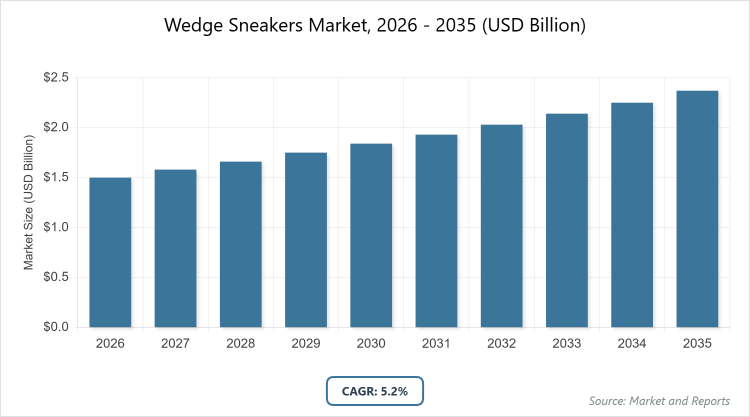
According to MarketnReports, the global Wedge Sneakers market size was estimated at USD 1.5 billion in 2025 and is expected to reach USD 2.5 billion by 2035, growing at a CAGR of 5.2% from 2026 to 2035. The wedge sneakers market is driven by increasing demand for comfortable yet stylish footwear blending athletic and fashion elements.
What are the Key Insights into the Wedge Sneakers Market?
- The global wedge sneakers market was valued at USD 1.5 billion in 2025 and is projected to reach USD 2.5 billion by 2035.
- The market is expected to grow at a CAGR of 5.2% during the forecast period from 2026 to 2035.
- The wedge sneakers market is driven by the revival of 2010s fashion trends and rising demand for comfortable, elevated footwear.
- The synthetic segment dominates the material category with a 55% share due to its affordability, durability, and versatility in design, allowing brands to offer a wide range of colors and patterns that appeal to budget-conscious consumers.
- The women’s segment dominates the end-user category with an 80% share as wedge sneakers align with female fashion preferences for stylish height without compromising comfort, boosted by celebrity endorsements and social media influence.
- North America dominates the regional market with a 40% share owing to high fashion awareness, strong retail infrastructure, and early adoption of retro trends like the 2010s wedge revival.
What is the Industry Overview of the Wedge Sneakers Market?
Wedge sneakers represent a unique fusion of athletic footwear and elevated heel design, offering consumers the comfort of sneakers combined with the height and style of wedge heels. This market encompasses footwear that integrates hidden or visible wedge soles into sneaker structures, primarily targeting fashion-forward individuals seeking versatile options for casual and semi-formal wear. The market definition includes all types of wedge-based sneakers made from various materials, distributed through online and offline channels, and catering to diverse end-users, with a focus on innovation in design, sustainability, and comfort to meet evolving consumer preferences in the broader footwear industry.
What are the Market Dynamics in the Wedge Sneakers Market?
Growth Drivers
The primary growth drivers in the wedge sneakers market stem from the resurgence of retro fashion trends, particularly the revival of 2010s styles popularized by icons like Isabel Marant. Consumers are increasingly seeking footwear that combines comfort with aesthetic appeal, driving demand for wedge designs that provide height without the discomfort of traditional heels. Additionally, the athleisure boom and growing emphasis on versatile wardrobe staples have propelled wedge sneakers as ideal for casual outings, work, and travel. Sustainability initiatives, such as using recycled materials in production, further fuel growth by attracting eco-conscious buyers, while collaborations between brands and celebrities amplify visibility and sales through social media platforms.
Restraints
Despite positive momentum, the wedge sneakers market faces restraints from fluctuating raw material costs, particularly for synthetic and leather components, which can increase production expenses and retail prices. Competition from alternative footwear styles, like platform sneakers or flat athletic shoes, poses a challenge as consumers may opt for simpler, lower-cost options amid economic uncertainties. Moreover, seasonal demand variations limit year-round sales, with peak interest in warmer months, and supply chain disruptions from global events can delay product launches, hindering market expansion in emerging regions where infrastructure is less developed.
Opportunities
Opportunities abound in the wedge sneakers market through technological advancements, such as incorporating smart features like customizable insoles or app-integrated fitness tracking, to appeal to tech-savvy consumers. Expanding into untapped markets in the Asia-Pacific, where rising disposable incomes and urbanization are boosting fashion spending, presents significant potential. Brands can capitalize on the sustainability trend by developing eco-friendly lines using bio-based materials, while e-commerce growth enables direct-to-consumer models for personalized designs. Partnerships with influencers and limited-edition releases can create buzz, driving premium pricing and loyalty among younger demographics like Gen Z.
Challenges
Key challenges in the wedge sneakers market include maintaining quality consistency across global supply chains, as variations in manufacturing standards can lead to product defects and returns. Intellectual property issues arise from knockoff designs flooding the market, eroding brand value for premium players. Shifting consumer preferences toward minimalist footwear amid fast fashion cycles require constant innovation, straining R&D budgets. Additionally, regulatory pressures on environmental compliance, such as restrictions on non-biodegradable materials, challenge traditional production methods, while intense competition from established sneaker giants demands that smaller brands to differentiate through niche offerings.
Wedge Sneakers Market: Report Scope
| Report Attributes | Report Details |
| Report Name | Wedge Sneakers Market |
| Market Size 2025 | USD 1.5 Billion |
| Market Forecast 2035 | USD 2.5 Billion |
| Growth Rate | CAGR of 5.2% |
| Report Pages | 205 |
| Key Companies Covered | Isabel Marant, Nike, Adidas, Chloé, Puma, Skechers, Steve Madden, and Others |
| Segments Covered | By Type, By Material, By Distribution Channel, By End-User, and By Region |
| Regions Covered | North America, Europe, Asia Pacific (APAC), Latin America, and The Middle East and Africa (MEA) |
| Base Year | 2025 |
| Historical Year | 2020 – 2024 |
| Forecast Year | 2026 – 2035 |
| Customization Scope | Avail customized purchase options to meet your exact research needs. |
What is the Market Segmentation of the Wedge Sneakers Market?
The Wedge Sneakers market is segmented by type, material, distribution channel, end-user, and region.
By Type: The low wedge segment dominates with a significant share, followed by the medium wedge as the second most dominant. The low wedge’s popularity stems from its subtle elevation that enhances everyday comfort without overwhelming the sneaker’s athletic feel, making it ideal for prolonged wear in casual settings; this dominance drives the market by appealing to a broad audience seeking practical style, boosting overall adoption and sales volume through versatile pairing with jeans, dresses, and athleisure outfits.
By Material: The synthetic segment dominates with a substantial share, followed by leather as the second most dominant. Synthetic materials lead due to their cost-effectiveness, water resistance, and ease of customization, enabling brands to produce vibrant, durable options at lower prices; this drives market growth by making wedge sneakers accessible to mass consumers, encouraging repeat purchases and expanding reach in price-sensitive regions.
By Distribution Channel: The online segment dominates with a major share, followed by offline as the second most dominant. Online channels prevail because of convenience, wider variety, and competitive pricing through e-commerce platforms like Amazon and brand websites; this propels the market by facilitating global access, personalized shopping experiences via virtual try-ons, and rapid trend adoption, increasing impulse buys and customer engagement.
By End-User: The women segment dominates with an overwhelming share, followed by men as the second most dominant. Women’s dominance arises from targeted fashion marketing and the shoe’s ability to blend femininity with sporty elements, offering stylish height for various body types; it drives the market by leveraging social media trends and celebrity influences, fostering brand loyalty and higher premium sales.
What are the Recent Developments in the Wedge Sneakers Market?
- Isabel Marant relaunched its iconic Bekett wedge sneaker as the Balskee model in early 2025, incorporating updated sustainable materials and modern colorways, which saw a 630% surge in demand on resale platforms like Lyst, signaling a strong revival of the 2010s trend.
- Chloé introduced a new line of wedge sneakers in its fall 2025 collection, featuring suede and fur accents for tactile appeal, emphasizing boho-grunge aesthetics that aligned with 2000s revival trends and boosted sales through celebrity endorsements.
- Nike collaborated with fashion influencers to release a limited-edition wedge sneaker series in mid-2025, integrating performance cushioning with elevated wedges, which expanded its market reach among athleisure enthusiasts and drove online traffic.
- Adidas updated its wedge sneaker offerings in 2025 with eco-friendly recycled synthetics, targeting sustainability-focused consumers and resulting in increased market share in Europe through targeted digital campaigns.
What is the Regional Analysis of Wedge Sneakers Market?
- North America is expected to dominate the global market.
North America leads the wedge sneakers market with approximately 40% share, propelled by elevated consumer spending on premium fashion items, a deeply ingrained culture of athleisure and streetwear, and swift adoption of nostalgic trends such as the 2010s wedge revival popularized by social media and celebrities. The United States dominates within the region, accounting for the majority of sales due to its advanced retail infrastructure, including major chains like Nordstrom and Foot Locker, alongside robust e-commerce platforms from Amazon and Zappos that facilitate personalized shopping and rapid delivery. Canada contributes significantly to growing urban fashion scenes in cities like Toronto and Vancouver, where consumers favor versatile, comfortable footwear for diverse climates, while Mexico emerges as a key manufacturing and export hub, benefiting from lower production costs and proximity to U.S. markets, though it faces challenges from economic fluctuations.
Europe holds a substantial market position with about 30% share, underpinned by its rich fashion heritage, emphasis on high-quality craftsmanship, and increasing demand for hybrid footwear that merges style with functionality in urban lifestyles. France leads as the dominating country, fueled by iconic designers like Isabel Marant and Chloé, whose relaunches of wedge models have reignited interest in cities like Paris, where bohemian and grunge aesthetics thrive amid sustainability trends using vegan leathers and recycled synthetics. The United Kingdom follows closely, with strong growth in London and Manchester driven by high-street fashion retailers and e-commerce giants like ASOS, catering to premium-seeking consumers influenced by celebrity endorsements and seasonal demands for versatile wear. Germany and Italy add depth through their manufacturing prowess—Germany for durable, tech-enhanced designs and Italy for luxury leather options—while Eastern Europe shows emerging potential with rising disposable incomes.
Asia-Pacific exhibits the most rapid growth trajectory with around 20% current share but is anticipated to surpass others in expansion rate, registering a CAGR of approximately 6.4% from 2026 to 2035, thanks to accelerated urbanization, burgeoning middle-class populations, and a shift toward Western-influenced fashion amid rising disposable incomes. China dominates the region as the key country, where affordable synthetic wedge sneakers flood markets via platforms like Alibaba and Tmall, supported by local manufacturing hubs in Guangdong that enable low-cost production and quick trend adaptations, appealing to youth-driven social media trends and K-pop-inspired styles in cities like Shanghai and Beijing. India follows with significant potential, driven by increasing fashion consciousness in metros like Mumbai and Delhi, where e-commerce from Flipkart and Myntra boosts accessibility, though challenged by price sensitivity and infrastructure gaps.
Latin America demonstrates emerging potential with roughly 5% market share, characterized by evolving fashion awareness, athleisure integration into daily life, and partnerships with global brands that introduce premium wedge options to vibrant streetwear scenes. Brazil stands out as the dominating country, leading through its dynamic urban culture in São Paulo and Rio de Janeiro, where local retailers and e-commerce like Mercado Libre drive demand for colorful, comfortable designs suited to tropical climates, bolstered by celebrity influences and economic recovery post-pandemic. Mexico adds value as a bridge between North American trends and local manufacturing, with growth in cities like Mexico City fueled by affordable imports and rising middle-class spending, while Argentina and Colombia show promise through increasing online penetration and youth fashion trends.
The Middle East and Africa (MEA) represent nascent yet promising markets with around 5% combined share, experiencing growth from luxury fashion aspirations, tourism-driven retail, and diversification beyond traditional sectors into modern footwear trends. The United Arab Emirates dominates, particularly in Dubai and Abu Dhabi, where high-end malls like The Dubai Mall attract premium wedge sneakers from brands like Steve Madden, supported by expatriate populations, high disposable incomes from oil wealth, and influencer-led social media campaigns emphasizing stylish comfort for urban lifestyles. Saudi Arabia follows with accelerating growth under Vision 2030, promoting fashion retail expansions in Riyadh and Jeddah amid rising women’s participation in the workforce and leisure activities.
Who are the Key Market Players in the Wedge Sneakers Market?
- Isabel Marant focuses on reviving classic designs with modern twists, such as the Balskee wedge sneaker, emphasizing sustainable materials and collaborations to maintain premium positioning and appeal to fashion elites.
- Nike employs innovation in cushioning and performance features for its wedge lines, leveraging global marketing and athlete endorsements to expand market share through direct-to-consumer strategies.
- Adidas prioritizes eco-friendly production and digital customization, using partnerships with influencers to target younger demographics and enhance brand loyalty in competitive regions.
- Chloé integrates bohemian aesthetics with wedge designs, focusing on tactile materials like suede to differentiate in luxury segments and drive sales via runway shows and e-commerce.
- Puma adopts affordable yet stylish approaches, emphasizing collaborations and online accessibility to capture mass-market growth, particularly in emerging economies.
- Skechers concentrates on comfort-driven innovations and wide distribution networks, using celebrity campaigns to boost visibility and sales in casual wear categories.
- Steve Madden pursues trend-forward designs at accessible prices, leveraging retail expansions and social media to target urban consumers seeking versatile fashion options.
What are the Market Trends in the Wedge Sneakers Market?
- Revival of 2010s styles, including hidden wedge designs like Isabel Marant’s Bekett, blending nostalgia with modern versatility.
- Incorporation of sustainable materials, such as recycled synthetics and bio-based fabrics, to appeal to eco-conscious consumers.
- Rise of tactile textures like fur, suede, and deer print for added sensory appeal in premium lines.
- Integration of slim runner silhouettes with wedge elements for a sleek, athletic-fashion hybrid.
- Emphasis on customizable features via apps and online tools for personalized height and fit options.
- Growth in powder-pink and red colorways aligns with feminine, bold fashion statements.
- Adoption of gorpcore influences, combining wedge heels with outdoor-ready durability.
What Market Segments and Subsegments are Covered in the Wedge Sneakers Report?
By Type
-
- Low Wedge
- Medium Wedge
- High Wedge
- Others
By Material
-
- Leather
- Synthetic
- Canvas
- Others
By Distribution Channel
-
- Online
- Offline
- Others
By End-User
-
- Women
- Men
- Children
- Others
By Region
-
- North America
- U.S.
- Canada
- Europe
- UK
- Germany
- France
- Rest of Europe
- Asia Pacific
- China
- India
- Japan
- Rest of Asia Pacific
- Latin America
- Brazil
- Mexico
- Rest of Latin America
- Middle East & Africa
- UAE
- South Africa
- Rest of Middle East & Africa
- North America
Chapter 1. Preface
Chapter 2. Executive Summary
Chapter 3. Global Wedge Sneakers Market - Industry Analysis
Chapter 4. Global Wedge Sneakers Market- Competitive Landscape
Chapter 5. Global Wedge Sneakers Market - Type Analysis
Chapter 6. Global Wedge Sneakers Market - Material Analysis
Chapter 7. Global Wedge Sneakers Market - Distribution Channel Analysis
Chapter 8. Global Wedge Sneakers Market - End-User Analysis
Chapter 9. Wedge Sneakers Market - Regional Analysis
Chapter 10. Company Profiles
Frequently Asked Questions
Wedge sneakers are a type of footwear that combines the casual, athletic design of sneakers with an elevated wedge heel, providing height and style while maintaining comfort for everyday wear.
Key factors include the revival of retro fashion trends, increasing demand for sustainable materials, technological innovations in comfort, and expanding e-commerce channels driving accessibility.
The market is projected to grow from USD 1.5 billion in 2025 to USD 2.5 billion by 2035.
The CAGR is expected to be 5.2% from 2026 to 2035.
North America will contribute notably, holding around 40% of the market share due to strong fashion trends and consumer spending.
Major players include Isabel Marant, Nike, Adidas, Chloé, Puma, Skechers, and Steve Madden.
The report provides comprehensive analysis including market size, trends, segmentation, regional insights, key players, and forecasts from 2026 to 2035.
The value chain includes raw material sourcing, design and manufacturing, distribution through online/offline channels, marketing, and end-user consumption with after-sales support.
Trends are shifting toward sustainability, retro revivals, and customization, with consumers preferring comfortable, versatile designs influenced by social media and celebrity endorsements.
Regulations on sustainable sourcing and waste reduction are pushing brands toward eco-friendly materials, while environmental concerns drive demand for low-impact production, influencing growth positively through innovation.