
Wearable Artificial Kidney Market Size, Share and Trends 2026 to 2035
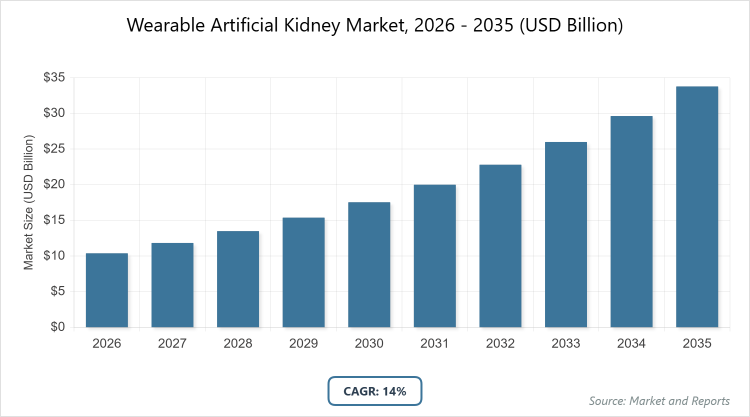
According to MarketnReports, the global Wearable Artificial Kidney Market size was estimated at USD 10.39 Billion in 2025 and is expected to reach USD 38.55 Billion by 2035, growing at a CAGR of 14% from 2026 to 2035. Wearable Artificial Kidney Market is driven by increasing prevalence of chronic kidney diseases and demand for portable dialysis solutions.
What is the Industry Overview of Wearable Artificial Kidney Market?
The Wearable Artificial Kidney (WAK) market encompasses innovative medical devices designed to provide continuous renal replacement therapy in a portable, body-worn format, mimicking the functions of natural kidneys such as blood filtration, electrolyte balance, and waste removal. This market is defined by the development and commercialization of compact dialysis systems that allow patients greater mobility compared to traditional stationary hemodialysis machines, targeting individuals with end-stage renal disease or acute kidney conditions. It integrates advanced technologies like sorbent regeneration, ultrafiltration membranes, and real-time monitoring sensors to enable home-based or on-the-go treatment, reducing the need for frequent clinic visits and improving quality of life. The industry focuses on bridging the gap between organ transplantation shortages and rising kidney failure cases through bioengineering and miniaturization advancements.
What are the Key Insights into Wearable Artificial Kidney Market?
- The global Wearable Artificial Kidney market was valued at USD 10.39 Billion in 2025 and is projected to reach USD 38.55 Billion by 2035.
- The market is expected to grow at a CAGR of 14% during the forecast period from 2026 to 2035.
- The market is driven by the rising incidence of chronic kidney diseases, technological innovations in portable dialysis, and increasing demand for home-based therapies.
- In the technology segment, sorbent-based systems dominate with a 45% share due to their efficiency in regenerating dialysate and enabling continuous use without large fluid volumes.
- In the application segment, end-stage renal disease holds the largest share at 50% because it addresses the long-term needs of patients requiring ongoing dialysis, driving adoption through improved patient mobility and reduced healthcare costs.
- In the end-user segment, hospitals dominate with a 40% share owing to their role in initial device deployment, clinical trials, and management of complex cases.
- North America dominates the regional market with a 43.7% share due to the presence of leading manufacturers, high R&D investments, and supportive regulatory frameworks like FDA expedited pathways.
What are the Market Dynamics of Wearable Artificial Kidney Market?
Growth Drivers
The primary growth drivers for the Wearable Artificial Kidney market include the escalating global burden of kidney-related disorders, fueled by rising diabetes and hypertension rates, which necessitate advanced renal replacement options. Technological progress in miniaturization, battery efficiency, and biocompatible materials has accelerated device development, making WAKs more practical for daily wear. Government initiatives and funding, such as those from KidneyX and Medicare reimbursements for home dialysis, further propel market expansion by encouraging innovation and accessibility. Additionally, patient preference for non-invasive, mobile solutions over traditional dialysis reduces treatment burdens and healthcare expenditures, fostering widespread adoption.
Restraints
High development and manufacturing costs pose significant restraints, limiting affordability and market penetration, particularly in low-income regions where reimbursement policies are inadequate. Regulatory challenges, including stringent approval processes for implantable or wearable medical devices, delay commercialization and increase compliance expenses. Technical limitations, such as short battery life, risk of infections from prolonged wear, and the need for frequent maintenance, hinder user acceptance. Moreover, the lack of widespread clinical validation and long-term efficacy data creates hesitation among healthcare providers and patients.
Opportunities
Emerging opportunities lie in the integration of AI and IoT for real-time health monitoring, enabling personalized treatment adjustments and predictive analytics for kidney health. Expansion into developing markets in Asia-Pacific and Latin America, driven by improving healthcare infrastructure and rising awareness, offers untapped potential. Collaborations between tech firms and medical companies could accelerate bioartificial kidney advancements, combining regenerative medicine with wearables. Additionally, post-pandemic focus on home healthcare and telemedicine creates avenues for WAK adoption in remote monitoring scenarios.
Challenges
Key challenges include achieving full miniaturization without compromising filtration efficiency, as current devices still require periodic recharging or component replacement. Ensuring biocompatibility to prevent adverse reactions like clotting or inflammation remains a technical hurdle in long-term use. Supply chain disruptions for specialized components, such as advanced membranes and sensors, can delay production. Finally, addressing equity issues, such as access disparities in underserved populations, requires overcoming economic and infrastructural barriers.
Wearable Artificial Kidney Market Report Scope
| Report Attributes | Report Details |
| Report Name | Wearable Artificial Kidney Market |
| Market Size 2025 | USD 10.39 Billion |
| Market Forecast 2035 | USD 38.55 Billion |
| Growth Rate | CAGR of 14% |
| Report Pages | 220 |
| Key Companies Covered | AWAK Technologies, Nextkidney, Triomed AB, SB-KAWASUMI LABORATORIES, INC., Asahi Kasei Medical Co., Ltd., B. Braun SE, Blood Purification Technologies Inc., Nanodialysis BV, Semperit AG Holding, KidneyX, and Others |
| Segments Covered | By Technology, By Application, By End-User, and By Region |
| Regions Covered | North America, Europe, Asia Pacific (APAC), Latin America, and The Middle East and Africa (MEA) |
| Base Year | 2025 |
| Historical Year | 2020 – 2024 |
| Forecast Year | 2026 – 2035 |
| Customization Scope | Avail customized purchase options to meet your exact research needs. |
What is the Market Segmentation of Wearable Artificial Kidney Market?
The Wearable Artificial Kidney Market is segmented by technology, application, end-user, and region. All the segments have been analyzed based on present and future trends and the market is estimated from 2026 to 2035.
Based on Technology Segment, sorbent-based systems emerge as the most dominant, holding a 45% share, followed by membrane filtration devices as the second most dominant at 25%. Sorbent-based systems lead due to their ability to recycle dialysate efficiently, reducing fluid needs and enabling lighter, more portable designs that enhance patient freedom; this drives the market by lowering logistical burdens and supporting continuous therapy, while membrane filtration devices contribute through precise ultrafiltration, aiding in fluid balance management and complementing sorbent tech in hybrid models to expand treatment versatility.
Based on Application Segment, end-stage renal disease is the most dominant with a 50% share, followed by acute kidney injury at 30%. End-stage renal disease dominates because it affects millions globally requiring lifelong dialysis, where WAKs provide a life-changing alternative to clinic-bound sessions, driving market growth via improved compliance and reduced mortality risks; acute kidney injury, as the second dominant, benefits from WAKs’ rapid deployment in critical care, accelerating recovery and minimizing hospital stays to fuel demand in emergency settings.
Based on End-User Segment, hospitals are the most dominant with a 40% share, followed by dialysis centers at 30%. Hospitals lead owing to their infrastructure for device trials, surgical integrations, and handling severe cases, propelling market expansion through centralized expertise and volume-driven economies; dialysis centers, as second dominant, optimize WAK use for outpatient management, enhancing efficiency and patient throughput to support broader adoption in specialized renal care.
What are the Recent Developments in Wearable Artificial Kidney Market?
- In 2024, AWAK Technologies announced successful Phase II clinical trials for its sorbent-based wearable peritoneal dialysis device, demonstrating improved patient mobility and reduced infection rates, marking a step toward commercial launch in North America and Europe.
- Quanta Dialysis Technologies received FDA clearance in 2025 for its SC+ portable hemodialysis system, incorporating wearable elements for home use, which expanded access to flexible dialysis options and boosted investor confidence in the sector.
- The Kidney Project at UCSF, in collaboration with KidneyX, advanced its bioartificial implantable kidney prototype in 2025, securing additional funding for human trials and highlighting progress in regenerative wearable technologies.
- Nextkidney partnered with Asahi Kasei Medical in 2025 to integrate advanced membrane tech into its portable WAK, aiming to enhance filtration efficiency and target emerging markets in Asia-Pacific.
What is the Regional Analysis of Wearable Artificial Kidney Market?
North America to dominate the global market.
North America holds the largest share at 43.7%, driven by robust R&D ecosystems, key players like AWAK Technologies and Quanta Dialysis, and favorable policies such as FDA’s breakthrough device designations; the United States dominates within the region due to high CKD prevalence, advanced healthcare infrastructure, and substantial investments in biotech, enabling rapid innovation and adoption of WAKs for improved patient outcomes.
Europe follows with significant growth, supported by EU funding for medical tech and collaborations like those under Horizon Europe programs; Germany leads the region with its strong manufacturing base and focus on precision engineering, fostering developments in biocompatible materials and contributing to market expansion through exports and clinical integrations.
Asia-Pacific exhibits the fastest growth, propelled by rising kidney disease rates and improving healthcare access; China dominates here with massive patient populations, government initiatives for affordable medtech, and partnerships with global firms, driving WAK adoption in urban centers and addressing unmet needs in rural areas.
Latin America shows emerging potential, aided by increasing awareness and foreign investments; Brazil leads with its expanding dialysis networks and regulatory reforms, promoting WAK trials and imports to tackle diabetes-driven renal failures.
The Middle East and Africa lag but grow steadily through international aid and tech transfers; South Africa dominates regionally with better infrastructure and pilot programs for portable devices, aiming to reduce dialysis dependency in resource-limited settings.
What are the Key Market Players in Wearable Artificial Kidney Market?
AWAK Technologies. AWAK Technologies focuses on developing sorbent-based peritoneal dialysis wearables, emphasizing miniaturization and user-friendly designs; their strategy includes clinical trials expansion, partnerships with hospitals for real-world testing, and securing regulatory approvals to penetrate North American and Asian markets, driving innovation in continuous therapy.
Nextkidney. Nextkidney prioritizes portable hemodialysis solutions with integrated monitoring, adopting a strategy of R&D collaborations with tech firms for AI enhancements and targeting home care segments; this approach accelerates product iterations and market entry in Europe, capitalizing on demand for patient-centric devices.
Triomed AB. Triomed AB specializes in carbon-based sorbent systems for WAKs, employing strategies like licensing technologies to larger medtech companies and focusing on cost reduction for emerging markets; this enables broader accessibility and positions them as a key player in affordable renal care advancements.
SB-KAWASUMI LABORATORIES, INC. SB-KAWASUMI LABORATORIES, INC. leverages its expertise in vascular access for WAK integration, with strategies centered on supply chain optimization and joint ventures in Asia; this strengthens their role in device durability and supports global expansion through reliable component supply.
Asahi Kasei Medical Co., Ltd. Asahi Kasei Medical Co., Ltd. invests in membrane filtration tech for wearables, pursuing mergers and acquisitions to consolidate market share; their strategy includes sustainability-focused innovations, enhancing device efficiency and appealing to eco-conscious healthcare providers worldwide.
Blood Purification Technologies Inc. Blood Purification Technologies Inc. develops advanced filtration modules, with strategies involving patent protections and academic partnerships for bioartificial elements; this fosters cutting-edge research and positions them for leadership in next-generation WAK hybrids.
B. Braun SE. B. Braun SE emphasizes comprehensive renal care ecosystems, integrating WAKs with digital platforms; their strategy of global distribution networks and training programs drives adoption in hospitals, ensuring seamless integration into existing workflows.
Nanodialysis BV. Nanodialysis BV focuses on nanotechnology for compact WAKs, adopting crowdfunding and grants for R&D; this agile strategy accelerates prototypes and targets niche applications like pediatric care, expanding their innovative footprint.
What are the Market Trends in Wearable Artificial Kidney Market?
- Integration of AI and machine learning for real-time monitoring and predictive adjustments in dialysis parameters.
- Shift toward home-based and telemedicine-enabled WAKs to reduce clinic dependency and enhance patient autonomy.
- Advancements in biocompatible materials and battery technology to extend device wear time and minimize adverse effects.
- Growing emphasis on regenerative medicine, combining stem cells with wearables for bioartificial kidney hybrids.
- Increasing collaborations between medtech firms and tech giants for IoT-enabled data analytics and remote oversight.
- Focus on cost-effective designs for emerging markets, addressing affordability in high-prevalence regions like Asia-Pacific.
- Regulatory accelerations, such as FDA breakthrough statuses, speeding up clinical trials and market entries.
What Market Segments and their Subsegments are Covered in the Wearable Artificial Kidney Report?
- By Technology
-
- Sorbent-Based Systems
- Membrane Filtration Devices
- Bioengineered Kidneys
- Portable Hemodialysis Units
- Wearable Ultrafiltration Devices
- Pump-Driven Dialyzers
- Nanotechnology-Enabled Devices
- AI-Integrated Monitors
- Regenerative Dialysis Modules
- Hybrid Peritoneal-Hemodialysis Systems
- Others
- By Application
- End-Stage Renal Disease
- Acute Kidney Injury
- Chronic Kidney Disease Stage 4-5
- Hypertension-Induced Renal Failure
- Diabetes-Related Kidney Damage
- Post-Surgical Renal Support
- Pediatric Renal Care
- Geriatric Kidney Management
- Transplant Bridge Therapy
- Home-Based Renal Therapy
- Others
- By End-User
- Hospitals
- Dialysis Centers
- Home Care Settings
- Ambulatory Surgical Centers
- Specialty Clinics
- Research Institutions
- Military and Remote Facilities
- Rehabilitation Centers
- Long-Term Care Facilities
- Telehealth Providers
- Others
- By Region
-
- North America
- U.S.
- Canada
- Europe
- UK
- Germany
- France
- Rest of Europe
- Asia Pacific
- China
- India
- Japan
- Rest of Asia Pacific
- Latin America
- Brazil
- Mexico
- Rest of Latin America
- Middle East & Africa
- UAE
- South Africa
- Rest of Middle East & Africa
- North America
Frequently Asked Questions
The Wearable Artificial Kidney market refers to the industry focused on portable, body-worn devices that perform kidney functions like blood purification and fluid balance, offering mobility to patients with renal failure.
Key factors include rising chronic kidney disease prevalence, technological advancements in miniaturization and AI, supportive government policies, and increasing demand for home-based dialysis solutions.
The market is valued at USD 10.39 Billion in 2025 and projected to reach USD 38.55 Billion by 2035.
The CAGR is expected to be 14% from 2026 to 2035.
North America will contribute notably, holding a 43.7% share due to advanced R&D and regulatory support.
Major players include AWAK Technologies, Nextkidney, Triomed AB, SB-KAWASUMI LABORATORIES, INC., Asahi Kasei Medical Co., Ltd., B. Braun SE, and Blood Purification Technologies Inc.
The report provides comprehensive analysis including market size, trends, segmentation, regional insights, key players, and forecasts from 2026 to 2035.
Stages include R&D and design, component manufacturing, device assembly, clinical testing, regulatory approval, distribution, and post-market surveillance with patient support.
Trends are shifting toward AI-integrated, home-use devices, with consumers preferring portable, user-friendly options that enhance mobility and reduce treatment disruptions.
Regulatory factors like FDA breakthrough designations accelerate approvals, while environmental concerns push for sustainable materials and energy-efficient designs to minimize waste.