
Waste To Energy Market Size, Share and Trends 2026 to 2035
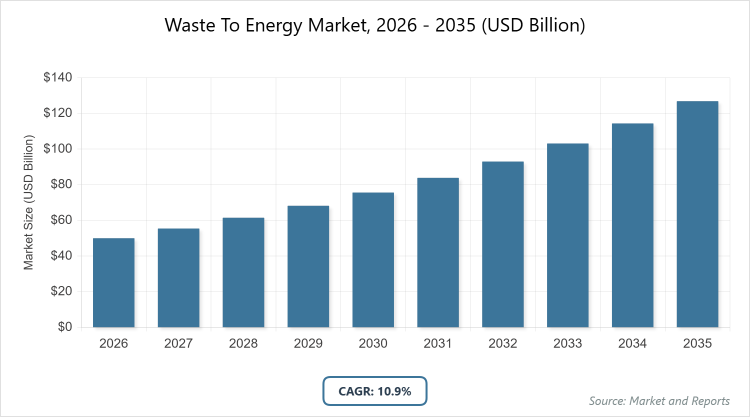
According to MarketnReports, the global Waste To Energy market size was estimated at USD 50 billion in 2025 and is expected to reach USD 140 billion by 2035, growing at a CAGR of 10.9% from 2026 to 2035. Rising municipal waste volumes and the global push for sustainable energy alternatives.
What are the Key Insights of the Waste To Energy Market?
- The Waste To Energy market was valued at USD 50 billion in 2025 and is projected to reach USD 140 billion by 2035.
- The Waste To Energy market is expected to grow at a CAGR of 10.9% during the forecast period 2026-2035.
- The Waste To Energy market is driven by escalating waste generation from urbanization, strict environmental regulations, and demand for renewable energy sources.
- Incineration dominates the technology segment with a 70% share, due to its maturity, high energy recovery rates, and widespread use in large-scale facilities.
- Electricity Generation dominates the application segment with a 75% share, as the primary output is power supply, supporting grid stability and reducing fossil fuel reliance.
- Municipal Solid Waste dominates the waste type segment with a 60% share, driven by abundant urban waste streams and efficient collection systems.
- Europe dominates the regional segment with a 40% share, owing to stringent waste management laws, advanced infrastructure, and strong policy support for sustainable practices.
What is the Waste To Energy Market?
Industry Overview
The Waste To Energy (WtE) market involves processes that convert non-recyclable waste materials into usable forms of energy, such as electricity, heat, or fuels, through thermal or biological methods. Market definition includes technologies that reduce landfill dependency, mitigate greenhouse gas emissions, and contribute to renewable energy supply, encompassing plant construction, operations, and integration with waste management systems for environmental and energy security benefits.
What are the Market Dynamics in the Waste To Energy Market?
Growth Drivers
The Waste To Energy market is propelled by rapid urbanization and industrialization, leading to higher waste volumes that necessitate efficient disposal methods. Government incentives, subsidies, and mandates for renewable energy integration further accelerate adoption, as WtE provides a dual benefit of waste reduction and energy production. Technological advancements in emission control and energy efficiency also make WtE more viable, enabling broader implementation in both developed and developing economies.
Restraints
High capital costs for plant construction and maintenance pose a major restraint, particularly in emerging markets with limited funding. Public opposition due to concerns over air pollution and emissions, despite modern controls, can delay projects. Additionally, competition from other renewables like solar and wind, which are often cheaper, limits WtE expansion in some regions.
Opportunities
Opportunities arise from advancements in cleaner technologies like gasification and pyrolysis, which offer higher efficiency and lower emissions. Emerging markets in Asia and Latin America present growth potential through public-private partnerships and international funding for waste management. Integration with circular economy models, such as combining WtE with recycling, can enhance sustainability and create new revenue streams.
Challenges
Challenges include managing toxic residues and ash from thermal processes, requiring specialized disposal. Regulatory variations across countries complicate global operations and project approvals. Furthermore, feedstock inconsistency and supply chain issues for waste collection can affect operational efficiency and energy output.
Waste To Energy Market: Report Scope
| Report Attributes | Report Details |
| Report Name | Waste To Energy Market |
| Market Size 2025 | USD 50 Billion |
| Market Forecast 2035 | USD 140 Billion |
| Growth Rate | CAGR of 10.9% |
| Report Pages | 220 |
| Key Companies Covered |
Veolia, Suez, Covanta, Hitachi Zosen Inova, China Everbright, and Others |
| Segments Covered | By Technology, By Application, By Waste Type, and By Region |
| Regions Covered | North America, Europe, Asia Pacific (APAC), Latin America, and The Middle East and Africa (MEA) |
| Base Year | 2025 |
| Historical Year | 2020 – 2024 |
| Forecast Year | 2026 – 2035 |
| Customization Scope | Avail customized purchase options to meet your exact research needs. |
What is the Market Segmentation of the Waste To Energy Market?
The Waste To Energy market is segmented by technology, application, waste type, and region.
Based on the Technology Segment, incineration is the most dominant with a 70% share, followed by gasification at 15%. Incineration’s dominance is attributed to its proven reliability, high energy recovery, and ability to handle diverse waste streams, driving market growth by enabling large-scale power generation and waste volume reduction in densely populated areas.
Based on Application Segment, electricity generation is the most dominant with a 75% share, followed by heat generation at 20%. Electricity generation leads due to its alignment with global energy demands and grid integration, propelling the market by providing a reliable renewable power source that offsets fossil fuel use and supports energy security.
Based on Waste Type Segment, municipal solid waste is the most dominant with a 60% share, followed by industrial waste at 25%. Municipal solid waste dominates because of its consistent availability from urban centers, fueling market expansion by offering a steady feedstock for WtE plants and addressing urban waste management challenges.
What are the Recent Developments in the Waste To Energy Market?
- In 2025, Veolia commissioned a new incineration-based WtE plant in France, enhancing energy output and reducing landfill use through advanced emission controls.
- Suez announced a partnership in 2025 with local governments in Asia to develop gasification facilities, focusing on cleaner energy production from industrial waste.
- Covanta expanded its operations in the U.S. in 2025 by upgrading existing plants with carbon capture technology to meet stricter environmental standards.
- China Everbright International launched a major WtE project in 2025 in Southeast Asia, integrating anaerobic digestion for organic waste to produce biogas.
What is the Regional Analysis of the Waste To Energy Market?
- Europe is to dominate the global market.
Europe holds the largest share at 40%, with Germany as the dominating country due to its rigorous environmental policies, extensive network of WtE facilities, and leadership in emission reduction technologies that support sustainable waste management.
Asia Pacific is the fastest-growing region, led by China through massive investments in WtE infrastructure, rapid urbanization, and government initiatives to reduce landfill dependency in cities like Shanghai and Beijing.
North America maintains steady growth, with the United States dominating via established players like Covanta and supportive policies for renewable energy in states with high waste volumes.
Latin America shows emerging potential, dominated by Brazil with increasing WtE projects focused on municipal waste and bioenergy production amid growing environmental awareness.
The Middle East and Africa exhibit gradual expansion, with the UAE leading through ambitious sustainability goals and investments in advanced WtE technologies for waste-to-power in urban centers.
Who are the Key Market Players in the Waste To Energy Market?
- Veolia Environnement SA focuses on integrated waste management solutions, expanding WtE facilities globally through acquisitions and technology upgrades for emission control.
- Suez SA emphasizes innovation in gasification and anaerobic digestion, partnering with municipalities for large-scale projects and sustainable waste-to-energy conversions.
- Covanta Holding Corp prioritizes efficient incineration plants in North America, investing in plant modernizations and community engagement to address environmental concerns.
- Hitachi Zosen Inova AG specializes in advanced thermal technologies, delivering turnkey WtE solutions with a focus on high-efficiency energy recovery and low emissions.
- China Everbright International drives growth in Asia with large-scale projects, leveraging government support for rapid deployment of incineration and biogas facilities.
What are the Market Trends in the Waste To Energy Market?
- Shift towards advanced technologies like gasification and pyrolysis for cleaner energy production.
- Increasing integration of WtE with carbon capture and storage systems.
- Growth in public-private partnerships for WtE infrastructure development.
- Emphasis on circular economy models combining recycling and energy recovery.
- Adoption of anaerobic digestion for organic waste streams.
What Market Segments and Subsegments are Covered in the Artificial Intelligence Report?
By Technology
- Incineration
- Gasification
- Pyrolysis
- Anaerobic Digestion
- Landfill Gas
- Others
By Application
- Electricity Generation
- Heat Generation
- Transport Fuels
- Others
By Waste Type
- Municipal Solid Waste
- Industrial Waste
- Agriculture Waste
- Others
By Region
- North America
- U.S.
- Canada
- Europe
- UK
- Germany
- France
- Rest of Europe
- Asia Pacific
- China
- India
- Japan
- Rest of Asia Pacific
- Latin America
- Brazil
- Mexico
- Rest of Latin America
- Middle East & Africa
- UAE
- South Africa
- Rest of Middle East & Africa
Frequently Asked Questions
Waste to energy refers to the process of generating energy in the form of electricity or heat from the treatment of waste materials, reducing landfill use and providing renewable power.
Key factors include rising waste volumes, government regulations on waste management, incentives for renewables, and advancements in cleaner WtE technologies.
The market is projected to grow from approximately USD 55 billion in 2026 to USD 140 billion by 2035.
The expected CAGR is 10.9% from 2026 to 2035.
Europe will contribute notably, driven by strong regulatory frameworks and infrastructure.
Major players include Veolia, Suez, Covanta, Hitachi Zosen Inova, and China Everbright.
The report provides detailed analysis of market size, trends, segments, regional insights, key players, and forecasts.
Stages include waste collection and sorting, processing and conversion, energy generation, and distribution or utilization of power and heat.
Trends are shifting towards cleaner technologies and circular economy integration, with preferences favoring low-emission and efficient energy recovery solutions.
Environmental regulations on emissions, landfill bans, and renewable energy targets drive growth, while strict air quality standards influence technology adoption.