
Virtual Power Plant Market Size, Share and Trends 2026 to 2035
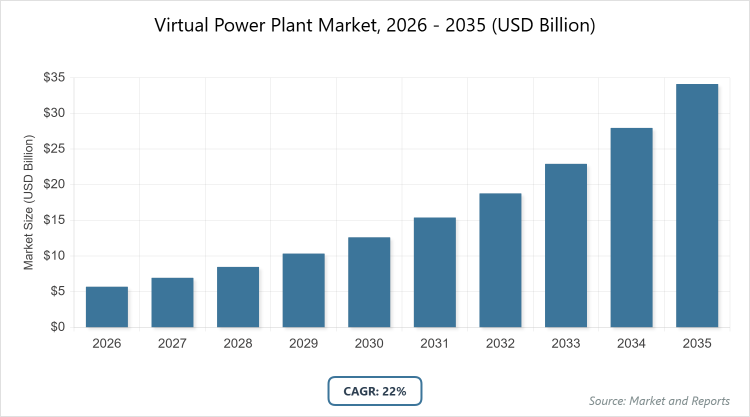
According to MarketnReports, the global Virtual Power Plant market size was estimated at USD 5.7 billion in 2025 and is expected to reach USD 40 billion by 2035, growing at a CAGR of 22% from 2026 to 2035. Virtual Power Plant Market is driven by the increasing integration of renewable energy sources and the need for grid flexibility and stability.
What is Virtual Power Plant? An Industry Overview
A virtual power plant (VPP) is an aggregated system of distributed energy resources, including solar panels, wind turbines, battery storage, electric vehicles, and demand response assets, managed through advanced software to operate as a unified power entity. The market definition encompasses platforms, technologies, and services that enable real-time monitoring, optimization, and trading of energy from decentralized sources, providing utilities with enhanced grid reliability, peak load management, and ancillary services. This industry supports the transition to sustainable energy by integrating renewables, reducing reliance on traditional power plants, and fostering energy efficiency across residential, commercial, and industrial sectors.
What are the Key Insights of Virtual Power Plant Market?
- The global Virtual Power Plant market was valued at USD 5.7 billion in 2025 and is projected to reach USD 40 billion by 2035.
- The global Virtual Power Plant market is expected to grow at a CAGR of 22% during the forecast period 2026-2035.
- The Virtual Power Plant market is driven by the rising adoption of distributed energy resources and advancements in AI-driven energy management systems.
- The demand response subsegment dominates the technology segment with a 45% share due to its effectiveness in balancing grid loads during peak times.
- The battery energy storage systems subsegment dominates the source segment with a 35% share owing to its role in providing flexible and scalable energy storage solutions.
- The industrial subsegment dominates the end-user segment with a 40% share because of high energy consumption and the need for reliable power optimization.
- North America dominates the global Virtual Power Plant market with a 37% share attributed to supportive policies like FERC Order 2222 and high DER penetration.
What are the Market Dynamics of Virtual Power Plant?
Growth Drivers
The expansion of the Virtual Power Plant market is fueled by the global push toward renewable energy integration, where VPPs address intermittency challenges by aggregating diverse resources for stable supply. Supportive government incentives, such as subsidies for battery storage and EV adoption, coupled with declining costs of solar and wind technologies, are accelerating deployments. Furthermore, the rise of smart grid infrastructure and IoT-enabled devices allows for precise energy forecasting and automation, enabling utilities to reduce operational costs and enhance system resilience against extreme weather events.
Restraints
Significant upfront costs for implementing advanced control software, communication networks, and DER hardware limit adoption, especially among small-scale operators in emerging economies. Regulatory hurdles, including varying standards for grid interconnection and data sharing, create barriers to seamless VPP operations across borders. Additionally, concerns over data security and potential cyber threats to interconnected systems deter investments, as breaches could compromise grid stability and consumer privacy.
Opportunities
The proliferation of electric vehicles presents opportunities for VPPs to utilize EV batteries as mobile storage units, offering vehicle-to-grid services and new revenue models. Expanding into emerging markets with growing urbanization provides scope for VPPs to support off-grid and microgrid solutions, addressing energy access gaps. Innovations in blockchain for peer-to-peer energy trading and AI for predictive maintenance open avenues for enhanced efficiency and monetization of excess capacity.
Challenges
Interoperability issues among heterogeneous DERs, such as differing protocols between solar inverters and battery systems, complicate aggregation and control. Ensuring fair compensation mechanisms for participants while aligning with utility profit models poses economic challenges. Moreover, scaling VPPs to handle large volumes of real-time data requires robust infrastructure, and fluctuating energy prices can impact the viability of long-term contracts.
Virtual Power Plant Market: Report Scope
| Report Attributes | Report Details |
| Report Name | Virtual Power Plant Market |
| Market Size 2025 | USD 5.7 Billion |
| Market Forecast 2035 | USD 40 Billion |
| Growth Rate | CAGR of 22% |
| Report Pages | 220 |
| Key Companies Covered | Siemens, ABB, Tesla, Schneider Electric, Enel X, Next Kraftwerke, General Electric, and Others |
| Segments Covered | By Technology, By Source, By End-User, and By Region |
| Regions Covered | North America, Europe, Asia Pacific (APAC), Latin America, and The Middle East and Africa (MEA) |
| Base Year | 2025 |
| Historical Year | 2020 – 2024 |
| Forecast Year | 2026 – 2035 |
| Customization Scope | Avail customized purchase options to meet your exact research needs. |
The Virtual Power Plant market is segmented by technology, source, end-user, and region.
Based on Technology Segment: The demand response segment is the most dominant, holding a 45% market share, as it enables rapid load adjustments to stabilize grids and avoid blackouts, driven by its low implementation barriers and immediate cost savings for utilities. This dominance propels market growth by facilitating higher renewable penetration without infrastructure overhauls. The mixed asset segment is the second most dominant with a 30% share, integrating generation, storage, and demand for versatile operations, which drives the market through improved resource efficiency and multi-revenue streams from energy markets.
Based on Source Segment: The battery energy storage systems segment is the most dominant, capturing a 35% share, due to its ability to store excess renewable energy and dispatch it during peaks, supported by falling battery prices and policy incentives. Its dominance accelerates market growth by enhancing grid reliability and enabling time-shifting of power. The solar PV segment ranks second with a 25% share, benefiting from widespread adoption and VPP software that optimizes output, driving the market by reducing carbon emissions and lowering energy costs.
Based on End-User Segment: The industrial segment is the most dominant, with a 40% share, attributed to large-scale energy needs and the integration of VPPs with industrial processes for cost optimization and sustainability compliance. This leads market growth by providing demand flexibility and reducing reliance on fossil fuels. The commercial segment is second with a 35% share, where VPPs manage variable loads in offices and retail, propelling growth through energy bill reductions and participation in incentive programs.
What are the Recent Developments in Virtual Power Plant Market?
- In 2025, the U.S. Department of Energy allocated additional funding to expand VPP capacity to over 80 GW by 2030, emphasizing equitable access and integration of distributed resources for grid resilience.
- Wood Mackenzie reported a 13.7% increase in North American VPP capacity to 37.5 GW in 2025, driven by surging residential battery enrollments and monetized utility programs amid data center demand.
- Puerto Rico launched Latin America’s first large-scale VPP, aggregating home batteries, solar, and EVs to achieve cost savings and improve grid security in hurricane-prone areas.
- NRG Energy acquired a commercial VPP platform from LS Power in May 2025, doubling its capacity to 25 GW and expanding aggregation to 2,000 industrial customers across the U.S.
- Pacific Gas and Electric introduced the SAVE program in March 2025, connecting 1,500 residential batteries and smart panels for peak reliability, with 60% low-income participation.
What is the Regional Analysis of Virtual Power Plant Market?
- North America to dominate the global market
North America commands a 37% share in the Virtual Power Plant market, bolstered by progressive regulations such as FERC Order 2222 that facilitate DER market participation. The United States leads the region, with California and Texas aggregating over 2.5 GW from batteries and EVs, addressing heat waves and renewable intermittency through programs like Sunrun’s VPPs. This dominance stems from mature wholesale markets, high tech adoption, and incentives for storage, enabling utilities to defer infrastructure investments while enhancing reliability in data-center-heavy states.
Europe maintains a strong foothold in the Virtual Power Plant market, propelled by EU directives targeting carbon neutrality by 2050. Germany dominates, with its Energiewende policy aggregating wind, solar, and demand response in VPPs exceeding 10 GW, reducing fossil fuel dependency and bolstering energy security amid geopolitical tensions. The region’s emphasis on cross-border flexibility markets and subsidies for smart grids fosters innovation, allowing aggregators like Next Kraftwerke to trade surplus energy, thus optimizing costs and supporting the integration of variable renewables across interconnected grids.
Asia-Pacific emerges as the fastest-growing region for Virtual Power Plants, driven by urbanization and ambitious renewable targets. China leads, deploying VPPs across provinces as part of its power reforms, leveraging its dominance in solar and battery manufacturing to manage surging demand from megacities. Initiatives like pilot programs in Guangdong integrate over 5 GW of DERs, mitigating blackouts and advancing decarbonization, while collaborations with tech giants enhance AI-driven optimization, positioning the region for scalable, cost-effective energy solutions in densely populated areas.
Latin America is gaining traction in the Virtual Power Plant market, focusing on resilience against climate vulnerabilities. Brazil dominates, with VPP pilots aggregating distributed solar and storage to combat frequent outages in remote areas, supported by ANEEL regulations encouraging microgrid development. This approach not only stabilizes supply for urban centers but also attracts foreign investments in renewables, fostering economic growth by reducing energy imports and enabling communities to participate in local energy markets through affordable, modular VPP technologies.
The Middle East and Africa exhibit promising growth in Virtual Power Plants, prioritizing diversification from oil-dependent grids. South Africa leads, implementing VPPs with solar and batteries to alleviate chronic load-shedding, as seen in Eskom’s programs aggregating 1 GW for peak shaving. Regional challenges like infrastructure gaps are offset by international funding for green energy, enabling VPPs to provide reliable power to underserved areas, promote job creation in renewables, and align with global sustainability goals through innovative, adaptive energy management strategies.
Who are the Key Market Players and Strategies in Virtual Power Plant?
Siemens employs AI-powered platforms for DER optimization, forging partnerships with utilities to deploy scalable VPPs that enhance grid stability and renewable integration worldwide.
ABB focuses on cybersecurity-enhanced solutions and interoperability, collaborating on industrial VPP projects to deliver ancillary services and reduce operational costs.
Tesla utilizes its Autobidder software for residential battery aggregation, expanding VPP programs in the U.S. and Australia to generate revenue from energy markets.
Schneider Electric prioritizes demand response and eco-friendly strategies, allying with commercial entities to implement VPPs that lower emissions and energy expenses.
Enel X aggregates EVs and smart devices, pursuing flexibility market strategies in Europe and North America to support sustainability and grid balancing.
Next Kraftwerke specializes in market trading of aggregated power, leveraging advanced forecasting to maximize returns from decentralized assets in European markets.
General Electric integrates digital twins and predictive analytics, partnering on utility-scale VPPs to improve efficiency and resilience in global energy systems.
What are the Market Trends in Virtual Power Plant?
- Surge in AI and machine learning for predictive optimization and automated dispatch in VPP operations.
- Incorporation of electric vehicle batteries as dynamic storage assets for grid support and revenue generation.
- Rapid growth in residential VPP enrollments, with battery participation increasing 153% year-over-year in 2025.
- Heightened emphasis on cybersecurity protocols to safeguard interconnected DER networks from vulnerabilities.
- Expansion into multi-market strategies, encompassing energy, capacity, and ancillary services for diversified income.
- Adoption in emerging economies to manage urbanization-driven demand and integrate renewables sustainably.
What are the Market Segments and their Subsegment Covered in the Virtual Power Plant Report?
By Technology
-
- Demand Response
- Distributed Generation
- Mixed Asset
- Supply Side VPP
- Demand Side VPP
- Emergency Demand Response
- Economic Demand Response
- Ancillary Services
- Energy Management Systems
- Grid Optimization
- Others
By Source
-
- Solar PV
- Wind Turbines
- Battery Energy Storage Systems
- Electric Vehicles
- Combined Heat and Power
- Small Hydro
- Biomass
- Diesel Generators
- Fuel Cells
- Smart Appliances
- Others
By End-User
-
- Industrial
- Commercial
- Residential
- Utilities
- Government
- Healthcare
- Data Centers
- Agriculture
- Transportation
- Others
By Region
-
- North America
- U.S.
- Canada
- Europe
- UK
- Germany
- France
- Rest of Europe
- Asia Pacific
- China
- India
- Japan
- Rest of Asia Pacific
- Latin America
- Brazil
- Mexico
- Rest of Latin America
- Middle East & Africa
- UAE
- South Africa
- Rest of Middle East & Africa
- North America
Frequently Asked Questions
Virtual Power Plants are networked systems of distributed energy resources that collectively function like a traditional power plant, optimizing generation, storage, and demand for grid efficiency.
Key factors include renewable energy proliferation, smart grid advancements, regulatory support for DER integration, and rising demand for flexible energy solutions amid electrification trends.
The market value will grow from USD 6.9 billion in 2026 to USD 40 billion in 2035.
The market will achieve a compound annual growth rate (CAGR) of 22% during 2026-2035.
North America will contribute notably, maintaining a 37% share driven by advanced regulations and widespread DER adoption.
Major players include Siemens, ABB, Tesla, Schneider Electric, Enel X, Next Kraftwerke, and General Electric.
The report offers in-depth analysis of market size, trends, segmentation, regional dynamics, key players, and future forecasts.
Stages encompass DER aggregation, software development for optimization, grid integration, energy trading, and end-user compensation.
Trends lean toward AI optimization and EV integration, with consumers favoring cost-effective, sustainable solutions that offer energy independence and incentives.
Policies like renewable mandates and carbon pricing, alongside environmental goals for emission reductions, are boosting adoption while cybersecurity regulations ensure secure operations.