
Video on Demand (VoD) Market Size, Share and Trends 2026 to 2035
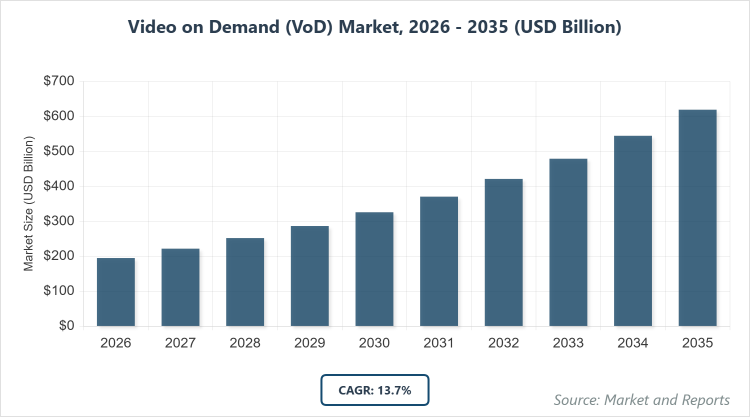
According to MarketnReports, the global Video on Demand (VoD) market size was estimated at USD 194.9 billion in 2025 and is expected to reach USD 703.7 billion by 2035, growing at a CAGR of 13.7% from 2026 to 2035. Video on Demand (VoD) Market is driven by increasing consumer preference for flexible viewing, high-speed internet penetration, and widespread adoption of smart devices.
What are the Key Insights of the Video on Demand (VoD) Market?
- The global Video on Demand (VoD) market was valued at USD 194.9 billion in 2025 and is projected to reach USD 703.7 billion by 2035.
- The market is expected to grow at a CAGR of 13.7% from 2026 to 2035.
- The market is primarily driven by rising demand for personalized on-demand content, proliferation of high-speed internet, and increasing penetration of smartphones and connected devices.
- Subscription Video On Demand (SVOD) dominates the revenue model segment with 57.8% share in 2025 because it provides predictable recurring revenue, ad-free experiences, unlimited access, and fosters strong customer loyalty through seamless multi-device support.
- Smartphones/Tablets dominate the platform segment with 50.0% share in 2025 due to widespread mobile device usage, on-the-go streaming convenience, high-speed mobile networks, and user-friendly apps offering offline downloads.
- Videos/Movies dominate the content type segment with 60.6% share in 2025 as consumers prefer cinematic entertainment across diverse genres, supported by heavy investments in original productions and AI-driven recommendations.
- North America dominates the global market with the largest share due to high streaming adoption rates, advanced infrastructure, strong presence of major content providers, and significant investments in original programming.
What is the Industry Overview of the Video on Demand (VoD) Market?
The Video on Demand (VoD) market refers to digital services that enable consumers to access and view video content such as movies, TV shows, sports, music, and kids’ programming at their convenience, without fixed schedules, through internet-connected devices. This market has evolved as a flexible alternative to traditional linear television and cable systems, allowing users to stream or download content on-demand via subscription, advertising-supported, or pay-per-view models. It encompasses a wide ecosystem including content creators, platform providers, delivery networks, and cloud infrastructure, driven by shifts in consumer behavior toward personalized, anytime-anywhere entertainment. The market reflects the broader transition to over-the-top (OTT) streaming, supported by technological advancements in bandwidth, device compatibility, and data analytics for enhanced user experiences.
What are the Market Dynamics of the Video on Demand (VoD) Market?
Growth Drivers
The VoD market experiences robust growth from surging consumer preference for on-demand and personalized content viewing, eliminating the constraints of traditional broadcasting schedules. High-speed internet expansion, affordable data plans, and widespread adoption of smartphones, tablets, and smart TVs enable seamless streaming across devices. Investments in original exclusive content, AI-powered recommendations, and personalization algorithms enhance user engagement and retention. The shift from cable TV to streaming, accelerated by remote work and leisure time patterns, along with bundling strategies and global market expansion into emerging economies further propels demand.
Restraints
Privacy concerns related to extensive data collection for personalized recommendations and targeted advertising pose significant restraints, as consumers worry about breaches and misuse under regulations like GDPR and CCPA. Compliance requires substantial investments in security measures, which can increase operational costs. Potential loss of trust from data incidents may lead to subscriber churn, fines, and slower adoption rates in privacy-sensitive markets.
Opportunities
Cloud-based VoD platforms offer scalable infrastructure without heavy hardware investments, enabling rapid deployment and cost efficiency. Mobile-optimized features like offline downloads and vertical video formats cater to growing smartphone usage. Emerging markets present untapped potential through localized content, partnerships, and affordable access models. The rise of ad-supported tiers and interactive advertising opens new revenue streams while broadening audience reach. Growth in edutainment, lifestyle, and niche content categories also creates diversification opportunities.
Challenges
Intense competition among global and regional players leads to content saturation, rising licensing costs, and frequent mergers or acquisitions. Balancing ad frequency in AVOD models without alienating users remains difficult. Regulatory compliance across diverse markets adds complexity, while maintaining high-quality, varied content amid escalating consumer expectations demands continuous innovation and investment.
Video on Demand (VoD) Market: Report Scope
| Report Attributes | Report Details |
| Report Name | Video on Demand (VoD) Market |
| Market Size 2025 | USD 194.9 Billion |
| Market Forecast 2035 | USD 703.7 Billion |
| Growth Rate | CAGR of 13.7% |
| Report Pages | 222 |
| Key Companies Covered | Netflix, Amazon, Disney, Comcast, Paramount Global, Warner Bros Discovery, Apple, Google, Roku, and Others |
| Segments Covered | By Revenue Model, By Platform, By Content Type, and By Region |
| Regions Covered | North America, Latin America, Western Europe, Eastern Europe, Asia Pacific, Middle East & Africa |
| Base Year | 2025 |
| Historical Year | 2020 – 2024 |
| Forecast Year | 2026 – 2035 |
| Customization Scope | Avail customized purchase options to meet your exact research needs. |
What is the Market Segmentation in the Video on Demand (VoD) Market?
The Video on Demand (VoD) market is segmented by revenue model, platform, content type, and region.
Based on Revenue Model Segment, Subscription Video On Demand (SVOD) is the most dominant due to its 57.8% share in 2025, providing stable recurring income that supports continuous content investment, ad-free viewing, and multi-device accessibility, driving user loyalty and long-term growth. Advertising Video On Demand (AVOD) is the second most dominant, expanding rapidly as free access attracts price-sensitive users, while personalized ads improve monetization and enable broader market penetration.
Based on Platform Segment, Smartphones/Tablets lead with 50.0% share in 2025, supported by mobile proliferation, high-speed networks, portability, and app features like offline viewing that cater to on-the-go consumption, significantly boosting overall market accessibility. Smart TVs are the second most dominant, gaining traction through larger screens, integrated apps, and home entertainment preferences, helping drive adoption in residential settings.
Based on Content Type Segment, Videos/Movies hold the dominant position with 60.6% share in 2025, fueled by strong consumer demand for cinematic storytelling, extensive genre variety, blockbuster originals, and interactive features that enhance engagement and encourage subscriptions. Sports content is the second most dominant, growing due to live event appeal, fan loyalty, and premium monetization potential, contributing to increased viewership and revenue diversification.
What are the Recent Developments in the Video on Demand (VoD) Market?
- In June 2025, Rakuten Group launched Rakuten Play, a streaming guide in Japan featuring content rankings to improve user discovery and engagement.
- In May 2025, Netflix rolled out its in-house advertising technology platform to enhance ad-supported offerings and personalized ad experiences.
- In April 2025, Comcast and Charter formed a 50/50 joint venture to develop a next-generation streaming platform named Flex, aiming to advance distribution and user interfaces.
What is the Regional Analysis of the Video on Demand (VoD) Market?
- North America to dominate the global market.
North America leads the VoD market due to high internet penetration, early adoption of streaming services, advanced technological infrastructure, and presence of major global players investing heavily in original content and R&D. The United States contributes around 80% of the regional share, supported by strong consumer spending, widespread smart device usage, and competitive landscape driving innovation.
Asia Pacific shows the fastest growth with high CAGRs in countries like China (18.6%) and India (17.3%), driven by massive smartphone penetration, affordable data plans, rapid OTT platform expansion, and demand for localized edutainment and lifestyle content. Emerging middle-class consumers and government support for digital infrastructure further accelerate adoption.
Europe maintains steady growth with strong contributions from Germany (14.4% CAGR) and the United Kingdom (13.2% CAGR), propelled by mature markets, regulatory frameworks promoting content diversity, and increasing shift from traditional TV to streaming services.
Latin America, Middle East, and Africa are emerging with rising internet access, mobile-first consumption, and growing investments in local content production, though infrastructure and affordability challenges persist in some areas.
Who are the Key Market Players in the Video on Demand (VoD) Market?
- Netflix maintains leadership through massive investments in original content, global expansion, advanced personalization algorithms, and hybrid revenue models including ad-supported tiers.
- Amazon leverages Prime bundling, vast content library, and integration with e-commerce to drive subscriber growth and cross-selling opportunities.
- Disney focuses on family-oriented and franchise-based content through Disney+, utilizing iconic IPs and strategic acquisitions to capture diverse audience segments.
- Comcast emphasizes distribution strength, partnerships, and next-gen platforms to enhance content delivery and user experiences.
- Paramount Global prioritizes premium content and bundling strategies to retain subscribers and expand reach.
- Warner Bros Discovery invests in diverse genres and international markets to strengthen its streaming presence.
- Apple differentiates through high-quality originals, privacy focus, and seamless device integration.
- Google utilizes YouTube’s scale and ad technology to dominate AVOD and support broader VoD ecosystems.
- Roku excels in platform distribution and ad-supported models for cord-cutters.
What are the Market Trends in the Video on Demand (VoD) Market?
- Increasing adoption of cloud-based infrastructure for scalable and cost-effective content delivery.
- Surge in mobile streaming with features like offline downloads and vertical formats.
- Growth of ad-supported models (AVOD) with personalized and interactive advertising.
- Rising focus on content personalization through AI and analytics.
- Expansion into emerging markets with localized and niche content.
- Strategic partnerships, bundling, and mergers for market consolidation.
- Shift toward hybrid revenue models combining subscriptions and ads.
What Market Segments and their Subsegments are Covered in the Report?
By Revenue Model
- Subscription Video On Demand (SVOD)
- Advertising Video On Demand (AVOD)
- Transactional Video On Demand (TVOD)
- Others
By Platform
- Smartphones/Tablets
- Smart TVs
- Laptops/PCs
- Others
By Content Type
- Videos/Movies
- Sports
- Kids Content
- Music
- Others
By Region
- North America
- U.S.
- Canada
- Europe
- UK
- Germany
- France
- Rest of Europe
- Asia Pacific
- China
- India
- Japan
- Rest of Asia Pacific
- Latin America
- Brazil
- Mexico
- Rest of Latin America
- Middle East & Africa
- UAE
- South Africa
- Rest of Middle East & Africa
Chapter 1. Preface
1.1 Report Description and Scope1.2 Research Scope1.3 Research Methodology1.3.1 Market Research Type1.3.2 Market Research MethodologyChapter 2. Executive Summary
2.1 Global Video on Demand (VoD) Market, (2026 - 2035) (USD Billion)2.2 Global Video on Demand (VoD) Market: SnapshotChapter 3. Global Video on Demand (VoD) Market - Industry Analysis
3.1 Video on Demand (VoD) Market: Market Dynamics3.2 Market Drivers3.2.1 The VoD market is growing rapidly due to rising demand for personalized on-demand content, widespread high-speed internet and smart device adoption, AI-driven recommendations, exclusive original content, and the global shift from cable TV to streaming platforms.3.3 Market Restraints3.3.1 The VoD market is restrained by data privacy and security concerns, high compliance costs with regulations like GDPR and CCPA, and the risk of subscriber churn and trust loss from data breaches.3.4 Market Opportunities3.4.1 The VoD market offers opportunities through cloud-based scalability, mobile-first features, emerging market expansion with localized content, ad-supported revenue models, and growth in edutainment, lifestyle, and niche content segments.3.5 Market Challenges3.5.1 The VoD market faces challenges from intense competition, content saturation, high licensing costs, AVOD ad balancing, regulatory compliance, and the need for continuous investment to meet rising consumer expectations.3.6 Porter’s Five Forces Analysis3.7 Market Attractiveness Analysis3.7.1 Market Attractiveness Analysis By Revenue Model3.7.2 Market Attractiveness Analysis By Platform3.7.3 Market Attractiveness Analysis By Content TypeChapter 4. Global Video on Demand (VoD) Market- Competitive Landscape
4.1 Company Market Share Analysis4.1.1 Global Video on Demand (VoD) Market: Company Market Share, 20254.2 Strategic Development4.2.1 Acquisitions & mergers4.2.2 New Product launches4.2.3 Agreements, partnerships, collaborations, and joint ventures4.2.4 Research and development and regional expansion4.3 Price Trend AnalysisChapter 5. Global Video on Demand (VoD) Market - Revenue Model Analysis
5.1 Global Video on Demand (VoD) Market Overview: Revenue Model5.1.1 Global Video on Demand (VoD) Market share, By Revenue Model, 2025 and 20355.2 Subscription Video On Demand (SVOD)5.2.1 Global Video on Demand (VoD) Market by Subscription Video On Demand (SVOD), 2026 - 2035 (USD Billion)5.3 Advertising Video On Demand (AVOD)5.3.1 Global Video on Demand (VoD) Market by Advertising Video On Demand (AVOD), 2026 - 2035 (USD Billion)5.4 Transactional Video On Demand (TVOD)5.4.1 Global Video on Demand (VoD) Market by Transactional Video On Demand (TVOD), 2026 - 2035 (USD Billion)5.5 Others5.5.1 Global Video on Demand (VoD) Market by Others, 2026 - 2035 (USD Billion)Chapter 6. Global Video on Demand (VoD) Market - Platform Analysis
6.1 Global Video on Demand (VoD) Market Overview: Platform6.1.1 Global Video on Demand (VoD) Market Share, By Platform, 2025 and 20356.2 Smartphones/Tablets6.2.1 Global Video on Demand (VoD) Market by Smartphones/Tablets, 2026 - 2035 (USD Billion)6.3 Smart TVs6.3.1 Global Video on Demand (VoD) Market by Smart TVs, 2026 - 2035 (USD Billion)6.4 Laptops/PCs6.4.1 Global Video on Demand (VoD) Market by Laptops/PCs, 2026 - 2035 (USD Billion)6.5 Others6.5.1 Global Video on Demand (VoD) Market by Others, 2026 - 2035 (USD Billion)Chapter 7. Global Video on Demand (VoD) Market - Content Type Analysis
7.1 Global Video on Demand (VoD) Market Overview: Content Type7.1.1 Global Video on Demand (VoD) Market Share, By Content Type, 2025 and 20357.2 Videos/Movies7.2.1 Global Video on Demand (VoD) Market by Videos/Movies, 2026 - 2035 (USD Billion)7.3 Sports7.3.1 Global Video on Demand (VoD) Market by Sports, 2026 - 2035 (USD Billion)7.4 Kids Content7.4.1 Global Video on Demand (VoD) Market by Kids Content, 2026 - 2035 (USD Billion)7.5 Music7.5.1 Global Video on Demand (VoD) Market by Music, 2026 - 2035 (USD Billion)7.6 Others7.6.1 Global Video on Demand (VoD) Market by Others, 2026 - 2035 (USD Billion)Chapter 8. Video on Demand (VoD) Market - Regional Analysis
8.1 Global Video on Demand (VoD) Market Regional Overview8.2 Global Video on Demand (VoD) Market Share, by Region, 2025 & 2035 (USD Billion)8.3 North America8.3.1 North America Video on Demand (VoD) Market, 2026 - 2035 (USD Billion)8.3.1.1 North America Video on Demand (VoD) Market, by Country, 2026 - 2035 (USD Billion)8.3.2 North America Video on Demand (VoD) Market, by Revenue Model, 2026 - 20358.3.2.1 North America Video on Demand (VoD) Market, by Revenue Model, 2026 - 2035 (USD Billion)8.3.3 North America Video on Demand (VoD) Market, by Platform, 2026 - 20358.3.3.1 North America Video on Demand (VoD) Market, by Platform, 2026 - 2035 (USD Billion)8.3.4 North America Video on Demand (VoD) Market, by Content Type, 2026 - 20358.3.4.1 North America Video on Demand (VoD) Market, by Content Type, 2026 - 2035 (USD Billion)8.4 Europe8.4.1 Europe Video on Demand (VoD) Market, 2026 - 2035 (USD Billion)8.4.1.1 Europe Video on Demand (VoD) Market, by Country, 2026 - 2035 (USD Billion)8.4.2 Europe Video on Demand (VoD) Market, by Revenue Model, 2026 - 20358.4.2.1 Europe Video on Demand (VoD) Market, by Revenue Model, 2026 - 2035 (USD Billion)8.4.3 Europe Video on Demand (VoD) Market, by Platform, 2026 - 20358.4.3.1 Europe Video on Demand (VoD) Market, by Platform, 2026 - 2035 (USD Billion)8.4.4 Europe Video on Demand (VoD) Market, by Content Type, 2026 - 20358.4.4.1 Europe Video on Demand (VoD) Market, by Content Type, 2026 - 2035 (USD Billion)8.5 Asia Pacific8.5.1 Asia Pacific Video on Demand (VoD) Market, 2026 - 2035 (USD Billion)8.5.1.1 Asia Pacific Video on Demand (VoD) Market, by Country, 2026 - 2035 (USD Billion)8.5.2 Asia Pacific Video on Demand (VoD) Market, by Revenue Model, 2026 - 20358.5.2.1 Asia Pacific Video on Demand (VoD) Market, by Revenue Model, 2026 - 2035 (USD Billion)8.5.3 Asia Pacific Video on Demand (VoD) Market, by Platform, 2026 - 20358.5.3.1 Asia Pacific Video on Demand (VoD) Market, by Platform, 2026 - 2035 (USD Billion)8.5.4 Asia Pacific Video on Demand (VoD) Market, by Content Type, 2026 - 20358.5.4.1 Asia Pacific Video on Demand (VoD) Market, by Content Type, 2026 - 2035 (USD Billion)8.6 Latin America8.6.1 Latin America Video on Demand (VoD) Market, 2026 - 2035 (USD Billion)8.6.1.1 Latin America Video on Demand (VoD) Market, by Country, 2026 - 2035 (USD Billion)8.6.2 Latin America Video on Demand (VoD) Market, by Revenue Model, 2026 - 20358.6.2.1 Latin America Video on Demand (VoD) Market, by Revenue Model, 2026 - 2035 (USD Billion)8.6.3 Latin America Video on Demand (VoD) Market, by Platform, 2026 - 20358.6.3.1 Latin America Video on Demand (VoD) Market, by Platform, 2026 - 2035 (USD Billion)8.6.4 Latin America Video on Demand (VoD) Market, by Content Type, 2026 - 20358.6.4.1 Latin America Video on Demand (VoD) Market, by Content Type, 2026 - 2035 (USD Billion)8.7 The Middle-East and Africa8.7.1 The Middle-East and Africa Video on Demand (VoD) Market, 2026 - 2035 (USD Billion)8.7.1.1 The Middle-East and Africa Video on Demand (VoD) Market, by Country, 2026 - 2035 (USD Billion)8.7.2 The Middle-East and Africa Video on Demand (VoD) Market, by Revenue Model, 2026 - 20358.7.2.1 The Middle-East and Africa Video on Demand (VoD) Market, by Revenue Model, 2026 - 2035 (USD Billion)8.7.3 The Middle-East and Africa Video on Demand (VoD) Market, by Platform, 2026 - 20358.7.3.1 The Middle-East and Africa Video on Demand (VoD) Market, by Platform, 2026 - 2035 (USD Billion)8.7.4 The Middle-East and Africa Video on Demand (VoD) Market, by Content Type, 2026 - 20358.7.4.1 The Middle-East and Africa Video on Demand (VoD) Market, by Content Type, 2026 - 2035 (USD Billion)Chapter 9. Company Profiles
9.1 Netflix9.1.1 Overview9.1.2 Financials9.1.3 Product Portfolio9.1.4 Business Strategy9.1.5 Recent Developments9.2 Amazon9.2.1 Overview9.2.2 Financials9.2.3 Product Portfolio9.2.4 Business Strategy9.2.5 Recent Developments9.3 Disney9.3.1 Overview9.3.2 Financials9.3.3 Product Portfolio9.3.4 Business Strategy9.3.5 Recent Developments9.4 Comcast9.4.1 Overview9.4.2 Financials9.4.3 Product Portfolio9.4.4 Business Strategy9.4.5 Recent Developments9.5 Paramount Global9.5.1 Overview9.5.2 Financials9.5.3 Product Portfolio9.5.4 Business Strategy9.5.5 Recent Developments9.6 Warner Bros Discovery9.6.1 Overview9.6.2 Financials9.6.3 Product Portfolio9.6.4 Business Strategy9.6.5 Recent Developments9.7 Apple9.7.1 Overview9.7.2 Financials9.7.3 Product Portfolio9.7.4 Business Strategy9.7.5 Recent Developments9.8 Google9.8.1 Overview9.8.2 Financials9.8.3 Product Portfolio9.8.4 Business Strategy9.8.5 Recent Developments9.9 Roku9.9.1 Overview9.9.2 Financials9.9.3 Product Portfolio9.9.4 Business Strategy9.9.5 Recent Developments
Frequently Asked Questions
Video on Demand (VoD) refers to services that allow users to access and watch video content anytime without scheduled broadcasts, delivered over the internet via streaming or download on various devices.
Key factors include high-speed internet expansion, smart device proliferation, demand for personalized content, investments in originals, AI recommendations, mobile streaming growth, and emerging market penetration.
The market was USD 194.9 billion in 2025 and is projected to reach USD 703.7 billion by 2035.
The market is expected to grow at a CAGR of 13.7% from 2026 to 2035.
North America will contribute notably due to its dominant share and high adoption rates.
Major players include Netflix, Amazon, Disney, Comcast, Paramount Global, Warner Bros Discovery, Apple, Google, and Roku.
The report provides comprehensive analysis of market size, forecasts, trends, segmentation, drivers, restraints, opportunities, regional insights, competitive landscape, and strategic recommendations.
Stages include content creation and acquisition, platform development, cloud delivery infrastructure, data analytics for personalization, monetization through various models, and end-user distribution.
Preferences are shifting toward personalized, mobile-first, and ad-supported options with demand for localized, niche, and interactive content alongside hybrid revenue models.
Data privacy regulations like GDPR and CCPA require robust compliance, impacting data usage for personalization and advertising, while environmental concerns around data center energy consumption influence sustainable infrastructure adoption.