
Tube Trailers Market Size, Share, and Trends 2026 to 2035
According to MarketReports, the global tube trailers market size was estimated at USD 1.2 billion in 2025 and is expected to reach USD 2.1 billion by 2035, growing at a CAGR of 6.42% from 2026 to 2035. The Tube Trailers Market is primarily driven by the rising demand for compressed natural gas (CNG) and hydrogen transportation as industries shift toward cleaner energy sources and cost-effective alternatives to pipeline infrastructure.
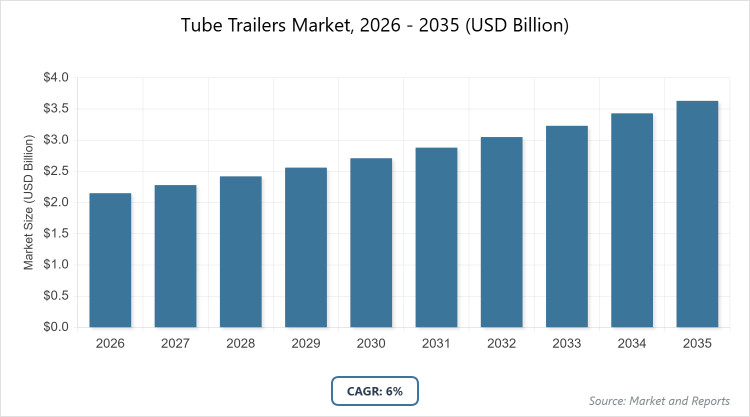
What are the Key Insights into the Tube Trailers Market?
- The global Tube Trailers market is projected to grow from approximately USD 1.2 billion in 2026 to USD 2.1 billion by 2035, reflecting a compound annual growth rate (CAGR) of around 6.42%.
- Among product types, standard tube trailers dominate as the leading subsegment, offering cost-effective solutions for general gas transport.
- In end-use segments, hydrogen holds the dominant position, driven by clean energy demands.
- By application, industrial gases are the most prominent, benefiting from manufacturing expansions.
- Asia Pacific emerges as the dominant region, contributing the largest market share due to rapid industrialization and energy transitions.
What is the Tube Trailers Market?
Industry Overview
The Tube Trailers market involves the design, manufacturing, and distribution of specialized trailers equipped with high-pressure tubes for transporting compressed gases such as hydrogen, CNG, helium, and industrial gases, offering safe, efficient bulk delivery for applications in energy, chemicals, and manufacturing sectors. These trailers, featuring multiple seamless steel or composite cylinders mounted on chassis with safety valves and monitoring systems, provide high-capacity storage and transport without the need for on-site compression, catering to logistics needs in remote or high-demand locations.
Positioned within the broader industrial gas and transportation equipment sector, the market emphasizes innovations in lightweight materials, safety standards, and capacity enhancements to meet regulatory requirements for hazardous materials, while supporting the shift toward clean energy transitions like hydrogen fuel, ultimately facilitating global supply chains for gases amid rising demand for sustainable transport solutions and infrastructure development.
What Drives the Tube Trailers Market?
Growth Drivers
The Tube Trailers market is driven by the expanding hydrogen and CNG sectors amid clean energy transitions, where high-pressure trailers are essential for efficient gas transport in fuel cell vehicles and natural gas distribution, coupled with government incentives for green infrastructure, boosting adoption. Technological advancements in composite materials reduce weight and increase capacity, improving fuel efficiency and safety for long-haul logistics, while rising industrial gas demand in chemicals and manufacturing propels usage. Additionally, urbanization and remote site operations in oil & gas enhance the need for mobile storage, supporting market growth through partnerships and fleet expansions.
Restraints
High initial costs for advanced composite trailers and maintenance of high-pressure systems limit affordability, particularly in emerging markets where budget constraints favor traditional methods. Strict regulatory standards for hazardous gas transport require extensive certifications, delaying deployments and increasing compliance expenses. Moreover, supply chain disruptions for specialized cylinders and competition from pipeline transport in developed regions erode market share.
Opportunities
The surge in hydrogen economy initiatives opens avenues for specialized trailers in fuel transport, driven by net-zero goals and investments in refueling infrastructure. Emerging economies offer untapped potential through industrialization and energy access projects, where localized production can capture demand. Furthermore, innovations in lightweight, high-capacity designs align with sustainability trends, enabling entry into renewable gas segments via collaborations.
Challenges
Navigating diverse global safety regulations for gas transport increases operational complexities, complicating exports amid varying standards. Volatility in raw material prices for steel and composites strains manufacturing costs, while environmental scrutiny over emissions from trailer fleets demands greener alternatives. Additionally, infrastructure gaps in charging or refilling stations hinder widespread adoption.
Tube Trailers Market: Report Scope
| Report Attributes | Report Details |
| Report Name | Tube Trailers Market |
| Market Size 2025 | USD 1.2 Billion |
| Market Forecast 2035 | USD 2.1 Billion |
| Growth Rate | CAGR of 6.42% |
| Report Pages | 210 |
| Key Companies Covered | FIBA Technologies, Inc, Hexagon Purus ASA, Composite Advanced Technologies, LLC, Linde AG, Air Liquide, Air Products and Chemicals Inc, and Calvera |
| Segments Covered | By Product Type, By End-Use, By Application, By Region |
| Regions Covered | North America, Europe, Asia Pacific (APAC), Latin America, The Middle East and Africa (MEA) |
| Base Year | 2025 |
| Historical Year | 2020 – 2024 |
| Forecast Year | 2026 – 2035 |
| Customization Scope | Avail customized purchase options to meet your exact research needs. |
How is the Tube Trailers Market Segmented?
The tube trailers market is segmented by product type, end-use, application, and region.
By product type, including standard, jumbo, super jumbo, and ultra jumbo, with standard emerging as the most dominant due to its balanced capacity, affordability, and versatility for common gas transport like CNG; this dominance drives the market by enabling entry-level adoption and high-volume sales in logistics, while jumbo ranks as the second most dominant, preferred for higher payloads in hydrogen applications, supporting growth through efficiency in bulk delivery.
By end-use, the market divides into hydrogen, CNG, helium, and industrial gases, where hydrogen dominates owing to rising clean energy initiatives and fuel cell transport; its prevalence propels market expansion by aligning with sustainability goals, whereas industrial gases follow as the second dominant, essential for manufacturing supply, contributing via steady demand.
By application, segments include transportation, storage, and others, with transportation leading as it facilitates safe gas delivery to remote sites; this segment fuels dynamics by generating logistics revenue, while storage secures second place, used for on-site reserves, enhancing operational flexibility.
What are the Recent Developments in the Tube Trailers Market?
- In 2024, Hexagon Purus launched a new composite tube trailer for hydrogen transport with increased capacity, targeting European clean energy projects to meet emission standards.
- In 2025, FIBA Technologies expanded its manufacturing facility in the US for high-pressure trailers, aiming to support North American hydrogen infrastructure growth.
- In early 2026, Linde AG partnered with a logistics firm for fleet upgrades, incorporating advanced safety features for industrial gas delivery.
How Does Regional Performance Vary in the Tube Trailers Market?
- Asia Pacific to dominate the market
Asia Pacific dominates the Tube Trailers market, propelled by rapid industrialization and clean energy shifts; China leads with massive hydrogen production and export capabilities, while India contributes through CNG infrastructure. Japan adds tech innovations for high-pressure systems, and Southeast Asia gains from oil & gas demands. South Korea supports through advanced manufacturing, and Vietnam emerges with energy infrastructure projects. The region’s large-scale urbanization and government subsidies for green hydrogen drive demand for high-capacity trailers, while manufacturing strengths lower costs and enable exports.
North America exhibits steady growth through energy independence initiatives; the United States stands out as the dominating country with shale gas transport and hydrogen pilots, Canada supports through natural gas exports, and Mexico emerges via cross-border logistics. The region’s focus on hydrogen corridors and refueling stations boosts trailer adoption, while regulatory support for clean energy accelerates fleet upgrades. Industrial gas demand in manufacturing hubs like Texas and Alberta further sustains market strength.
Europe maintains a mature market, influenced by green directives; Germany emerges as the leading country with hydrogen corridor projects, while France and the UK propel adoption in renewables. Italy focuses on industrial gas supply, and Spain on Mediterranean energy hubs. The EU’s hydrogen strategy and emission targets drive demand for composite trailers, with cross-border infrastructure enhancing transport efficiency. Northern Europe emphasizes sustainable logistics, supported by strong R&D.
Latin America shows emerging growth, driven by resource extraction; Brazil predominates with biofuel transport, Argentina supports through gas fields, and Chile through mining applications. The region’s focus on energy diversification and industrial expansion increases need for mobile gas solutions, while partnerships with global suppliers facilitate technology adoption. Economic recovery supports infrastructure investments.
The Middle East & Africa region represents developing potential, focused on oil & gas; the United Arab Emirates leads via hydrogen ambitions, Saudi Arabia grows through Vision 2030, and South Africa through industrial supply. The region’s oil wealth funds green hydrogen projects, while Africa gains from mining and energy access initiatives. Emerging partnerships with European firms enhance adoption.
Who are the Key Market Players in the Tube Trailers Industry?
- FIBA Technologies, Inc. focuses on high-pressure innovations and US expansions for hydrogen.
- Hexagon Purus ASA invests in composite materials for lightweight trailers in Europe.
- Composite Advanced Technologies, LLC. emphasizes safety features for industrial gases.
- Linde AG pursues partnerships for fleet optimizations in logistics.
- Air Liquide adopts sustainable designs for clean energy transport.
- Air Products and Chemicals, Inc. leverages global networks for CNG applications.
- Calvera optimizes cost-effective models for emerging markets.
What are the Current Market Trends in Tube Trailers?
- Increasing demand for hydrogen tube trailers in clean energy transitions.
- Growth in composite materials for lighter, higher-capacity designs.
- Rise in safety monitoring systems with IoT integrations.
- Adoption of high-pressure tubes for efficient gas storage.
- Expansion of rental services for cost-effective usage.
- Focus on regulatory compliance for hazardous materials.
- Shift toward electric towing vehicles for sustainability.
What Market Segments are Covered in the Report?
By Product Type
- Standard
- Jumbo
- Super Jumbo
- Ultra Jumbo
By End-Use
- Hydrogen
- CNG
- Helium
- Industrial Gases
By Application
- Transportation
- Storage
- Others
By Region
-
- North America
- U.S.
- Canada
- Europe
- UK
- Germany
- France
- Rest of Europe
- Asia Pacific
- China
- India
- Japan
- Rest of Asia Pacific
- Latin America
- Brazil
- Mexico
- Rest of Latin America
- Middle East & Africa
- UAE
- South Africa
- Rest of Middle East & Africa
- North America
Frequently Asked Questions
Tube trailers are specialized trailers with high-pressure tubes for transporting compressed gases like hydrogen or CNG, used in energy and industrial sectors.
Key factors include clean energy transitions, industrial gas demand, technological advancements, and infrastructure investments.
The market is projected to grow from approximately USD 800 million in 2026 to USD 1.8 billion by 2035, driven by hydrogen adoption.
The CAGR is expected to be around 7.5% from 2026 to 2035, indicating steady expansion.
Asia Pacific will contribute notably, holding the largest share due to industrialization.
Major players include FIBA Technologies, Inc, Hexagon Purus ASA, Composite Advanced Technologies, LLC, Linde AG, Air Liquide, Air Products and Chemicals Inc, and Calvera, driving growth through innovations.
The report offers insights into size, trends, segmentation, regions, players, and forecasts for informed strategies.
Stages include raw material sourcing, manufacturing assembly, distribution, and end-use logistics.
Trends are shifting toward lightweight, safe designs, with preferences for sustainable, high-capacity trailers in clean energy.
Regulations on gas transport safety drive compliance; environmental concerns push for low-emission materials, increasing costs but fostering green innovation.