
Trifluoroacetic Acid Market Size, Share and Trends 2026 to 2035
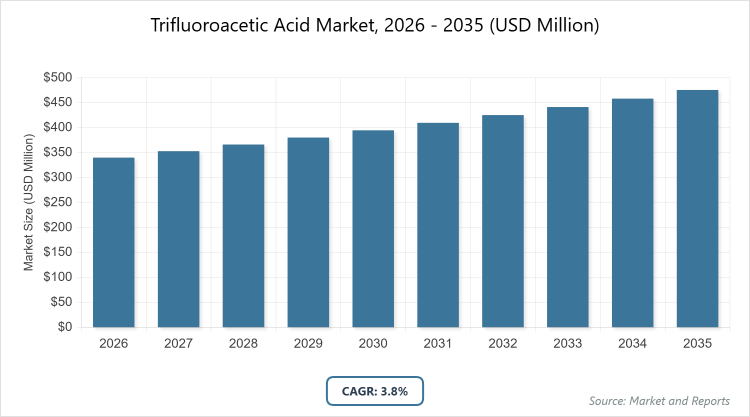
According to MarketnReports, the global Trifluoroacetic Acid market size was estimated at USD 340 million in 2025 and is expected to reach USD 494 million by 2035, growing at a CAGR of 3.8% from 2026 to 2035. Trifluoroacetic Acid Market is driven by rising demand for peptide-based drugs and advanced agrochemicals, where it serves as a critical synthesis intermediate, alongside its widespread use as a mobile phase modifier in high-performance liquid chromatography (HPLC) applications for research and quality control.
What are the Key Insights into the Trifluoroacetic Acid Market?
- Global trifluoroacetic acid market valued at approximately USD 340 million in 2025, projected to reach USD 494 million by 2035.
- Expected CAGR of around 3.8% from 2026 to 2035, driven by pharmaceutical and agrochemical demands.
- Dominant subsegment by type: 99.5% Trifluoroacetic Acid, accounting for the largest share due to balanced purity for industrial use.
- Dominant subsegment by application: Medical Intermediates, holding over 40% market share for peptide synthesis.
- Dominant subsegment by end-use: Pharmaceuticals, contributing around 45% revenue for drug development.
- Dominant region: Asia-Pacific, contributing over 40% of global revenue with China as the leading country.
What is the Trifluoroacetic Acid Industry Overview?
Industry Overview
Trifluoroacetic acid (TFA) is a strong organic acid with the chemical formula CF3COOH, widely recognized for its high acidity, volatility, and solubility in various solvents, making it an essential reagent in organic synthesis, chromatography, and material processing. This market encompasses the production, distribution, and application of TFA in high-purity forms, serving as a key intermediate in pharmaceuticals for peptide synthesis, in agrochemicals for herbicide production, and in chemicals for polymer modifications where its ability to cleave protecting groups and facilitate reactions is crucial.
TFA is typically manufactured through the oxidation of trifluoroacetaldehyde or hydrolysis of trifluoroacetyl chloride, with emphasis on handling its corrosive nature through specialized equipment and safety protocols.The industry involves upstream suppliers of fluorine compounds, manufacturers focusing on distillation for purity levels, and downstream users in labs and industrial scales, prioritizing environmental compliance due to its potential as a greenhouse gas contributor. This market is driven by the demand for fluorinated compounds in advanced materials and life sciences, balancing high-performance applications with sustainable practices like recycling and alternative syntheses in a competitive global landscape.
What are the Market Dynamics in the Trifluoroacetic Acid Sector?
Growth Drivers
The trifluoroacetic acid market is fueled by expanding pharmaceutical applications, particularly in peptide and protein synthesis where TFA acts as a deprotecting agent, driven by the rise in biologics and drug development amid global health challenges requiring precise chemical tools. Increasing agrochemical demand for fluorinated pesticides and herbicides enhances crop yields, supported by population growth and food security needs in emerging economies. Technological advancements in chromatography, using TFA as a mobile phase additive for HPLC, boost adoption in analytical labs and quality control. Regulatory support for green chemistry encourages its use in eco-friendly processes, while industrial growth in electronics for etching and cleaning further propels consumption.
Restraints
High production costs from fluorine sourcing and energy-intensive processes, coupled with volatility in raw material prices like hydrofluoric acid, limit affordability in cost-sensitive markets where alternatives like acetic acid suffice for less demanding applications. Stringent environmental regulations on perfluorinated compounds, classifying TFA as a persistent pollutant, increase compliance burdens and disposal costs. Supply chain disruptions from geopolitical issues affect availability, while health hazards requiring specialized handling deter small-scale users. Competition from substitute acids like formic acid in certain syntheses restrains expansion in non-specialized sectors.
Opportunities
Opportunities arise from innovations in sustainable synthesis, such as bio-based TFA derivatives, aligning with circular economy goals and opening markets in green pharmaceuticals funded by eco-grants. Expansion in emerging applications like battery electrolytes for lithium-ion tech presents growth in renewables, driven by energy transitions. Partnerships for localized production in high-demand regions can mitigate supply risks, while AI-optimized formulations enhance efficiency in agrochem. Government incentives for R&D in fluorochemicals unlock potential in advanced materials for aerospace and semiconductors.
Challenges
Managing environmental impact from TFA’s persistence in water systems poses challenges, necessitating investments in degradation tech amid tightening global regulations. Ensuring supply stability amid fluorine mineral shortages requires diversified sourcing, while quality control for high-purity grades demands advanced analytics. Market fragmentation with varying standards complicates international trade, and counterfeit products undermine safety. Balancing demand with sustainable production remains a hurdle in volatile economic conditions.
Trifluoroacetic Acid Market: Report Scope
| Report Attributes | Report Details |
| Report Name | Trifluoroacetic Acid Market |
| Market Size 2025 | USD 340 million |
| Market Forecast 2035 | USD 494 million |
| Growth Rate | CAGR of 3.8% |
| Report Pages | 235 |
| Key Companies Covered | Solvay, SRF Limited, Halocarbon LLC, Sinochem Group, Shandong Xingfu, and Zhejiang Sanhuan |
| Segments Covered | By Type, Application, End-Use, and Region |
| Regions Covered | North America, Europe, Asia Pacific (APAC), Latin America, The Middle East and Africa (MEA) |
| Base Year | 2025 |
| Historical Year | 2020 – 2024 |
| Forecast Year | 2026 – 2035 |
| Customization Scope | Avail customized purchase options to meet your exact research needs. |
How is the Trifluoroacetic Acid Market Segmented?
The Trifluoroacetic Acid market is segmented by type, application, end-use, and region.
By Type, The 99.5% Trifluoroacetic Acid segment dominates the market, primarily due to its optimal purity level offering cost-effective performance in bulk applications like agrochemical intermediates where high acidity is needed without ultra-purity overheads, supported by manufacturing efficiencies. This dominance drives the market by enabling volume production for widespread use, reducing costs through economies of scale, and meeting regulatory standards for general synthesis, thereby expanding accessibility in emerging industries. The 99.9% Trifluoroacetic Acid segment ranks second, essential for sensitive pharmaceutical processes requiring minimal impurities, helping to propel market growth by commanding premium pricing, fostering R&D in biologics, and supporting high-value drug pipelines.
By Application, Medical Intermediates lead the application segment, as TFA is crucial for deprotection in peptide synthesis, driven by biopharma growth needing reliable reagents for complex molecules. This subsegment drives the market by aligning with healthcare innovations, ensuring high yields in drug manufacturing, and complying with GMP standards, thus increasing demand in R&D labs. Pesticide Intermediates follow as the second dominant, used in fluorinated herbicide production for enhanced efficacy, contributing to market expansion through agricultural modernization, improving crop protection, and tapping into food security initiatives.
By End-Use, Pharmaceuticals dominate the end-use segment, fueled by TFA’s role in synthesis and purification of APIs, supported by rising biologics demand. This leadership accelerates market growth by syncing with health sector investments, promoting high-purity supplies that boost efficiency, and enabling advanced therapies. Agriculture ranks second, employed in agrochem formulations for pest control, helping to drive the market through yield-enhancing products, addressing global farming challenges, and supporting sustainable practices.
What are the Recent Developments in the Trifluoroacetic Acid Market?
- In 2023, Solvay expanded its TFA production facility in Europe with sustainable processes, reducing emissions by 20% to meet regulatory demands, enhancing supply for pharmaceutical clients.
- In 2024, SRF Limited launched a high-purity TFA line for agrochem, partnering with Indian firms for localized supply, boosting adoption in pesticide intermediates.
- In 2025, Halocarbon LLC acquired a U.S. plant for TFA derivatives, integrating green tech for battery applications, opening new revenue in renewables.
- In early 2026, Sinochem Group invested in R&D for bio-based TFA, targeting eco-friendly coatings, aligning with sustainability trends globally.
What is the Regional Analysis of the Trifluoroacetic Acid Market?
Asia-Pacific dominates the trifluoroacetic acid market, propelled by industrial growth in chemicals and agriculture, with China as the dominating country due to its massive manufacturing base, government support for fluorochemicals under Made in China 2025, and leadership in exports through companies like Sinochem. The region’s expansion is fueled by India’s pharma boom and Japan’s precision synthesis; South Korea’s electronics contribute, but China’s dominance stems from its vast domestic demand, low-cost production, and policies addressing environmental concerns, boosting revenue through high-volume agrochem and pharma applications.
North America holds a significant share, characterized by advanced R&D in biologics and regulations favoring high-purity chemicals, with the United States as the dominating country owing to its biopharma hubs, FDA-driven standards, and players like Halocarbon investing in sustainable production. The region benefits from Canada’s resource processing; the U.S. leads with innovations in drug synthesis, enhancing competitiveness, driving market expansion via premium pharmaceutical uses.
Europe exhibits steady growth, focused on green regulations and high-value applications, with Germany as the dominating country due to its chemical industry strength, EU REACH compliance, and firms like Solvay pioneering low-emission TFA. The region is driven by the UK’s agrochem and France’s coatings; Germany’s leadership arises from exports and sustainability investments, fostering market development by addressing climate goals.
The Rest of the World shows emerging potential, with Brazil dominating in Latin America through agrochem exports, while Saudi Arabia leads in the Middle East with oil-derived chemicals. Growth is spurred by Africa’s farming; the region’s progress relies on imports and partnerships, increasing share in developing sectors.
Who are the Key Market Players and Their Strategies in the Trifluoroacetic Acid Industry?
Solvay: Focuses on sustainable production, expanding capacities and R&D for low-emission TFA to lead in Europe.
SRF Limited: Emphasizes agrochem applications, pursuing partnerships for Asian expansions and cost optimizations.
Halocarbon LLC: Prioritizes high-purity grades, investing in acquisitions for U.S. dominance in pharmaceuticals.
Sinochem Group: Concentrates on exports, leveraging government support for bio-based innovations in China.
Shandong Xingfu: Adopts quality advancements, targeting pesticide intermediates through local supply chains.
Zhejiang Sanhuan: Utilizes material efficiencies, focusing on coatings for industrial growth.
What are the Current Market Trends in the Trifluoroacetic Acid Sector?
- Increasing adoption in biopharma for peptide synthesis amid drug development.
- Shift toward sustainable, low-emission production processes.
- Growth in agrochem for fluorinated pesticides in emerging markets.
- Emphasis on high-purity grades for electronics and batteries.
- Rise in regulatory compliance driving green alternatives.
- Focus on R&D for bio-based TFA derivatives.
What Market Segments are Covered in the Report?
By Type
-
- 99.5% Trifluoroacetic Acid
- 99.9% Trifluoroacetic Acid
- Others
By Application
-
- Medical Intermediates
- Pesticide Intermediates
- Others
By End-Use
-
- Pharmaceuticals
- Agriculture
- Chemicals
- Others
By Region
-
- North America
- U.S.
- Canada
- Europe
- UK
- Germany
- France
- Rest of Europe
- Asia Pacific
- China
- India
- Japan
- Rest of Asia Pacific
- Latin America
- Brazil
- Mexico
- Rest of Latin America
- Middle East & Africa
- UAE
- South Africa
- Rest of Middle East & Africa
- North America
Chapter 1. Preface
Chapter 2. Executive Summary
Chapter 3. Global Trifluoroacetic Acid Market - Industry Analysis
Chapter 4. Global Trifluoroacetic Acid Market- Competitive Landscape
Chapter 5. Global Trifluoroacetic Acid Market - Type Analysis
Chapter 6. Global Trifluoroacetic Acid Market - Application Analysis
Chapter 7. Global Trifluoroacetic Acid Market - End-Use Analysis
Chapter 8. Trifluoroacetic Acid Market - Regional Analysis
Chapter 9. Company Profiles
Frequently Asked Questions
Trifluoroacetic acid is a strong organic acid used as a reagent in synthesis, chromatography, and material processing for its high acidity and solubility.
Key factors include pharmaceutical expansions, agrochemical demands, sustainability trends, and innovations in high-purity applications.
The trifluoroacetic acid market is projected to grow from approximately USD 340 million in 2026 to USD 494 million by 2035.
The CAGR for the trifluoroacetic acid market during 2026-2035 is expected to be around 3.8%, driven by industrial growth.
Asia-Pacific will contribute notably, accounting for over 40% of the market value, led by China.
Major players include Solvay, SRF Limited, Halocarbon LLC, Sinochem Group, Shandong Xingfu, and Zhejiang Sanhuan.
The global trifluoroacetic acid market report provides insights into size, segmentation, dynamics, regional analysis, players, trends, and forecasts.
The value chain includes raw material sourcing, manufacturing via oxidation, purification, distribution, and end-use formulation.
Market trends are evolving toward sustainable and high-purity products, with preferences shifting to eco-friendly reagents for pharma and agrochem.
Regulatory factors include emission controls on fluorochemicals, while environmental factors involve pollution mandates, driving green innovations but increasing costs.