
Transformer Oil Market Size and Forecast 2026 to 2035
According to MarketnReports, the global Transformer Oil market size was estimated at USD 3.82 billion in 2025 and is expected to reach USD 10.86 billion by 2035, growing at a CAGR of 12.3% from 2026 to 2035. Transformer Oil Market is driven by the expanding power transmission and distribution infrastructure, rising electricity demand, and need for efficient insulation and cooling of transformers.
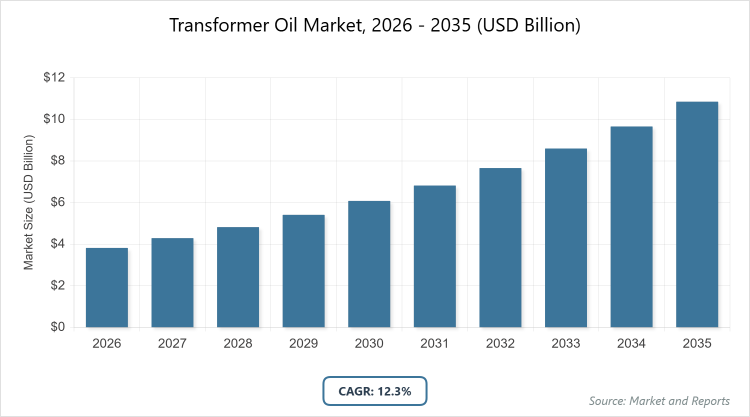
What are the Key Insights?
- Market Value and CAGR: The global transformer oil market is projected to grow from approximately USD 3.82 billion in 2025 to USD 10.86 billion by 2035, at a CAGR of 12.3%.
- Dominated Subsegment in Product Segment: Mineral-based oils dominate with over 75.6% revenue share.
- Dominated Subsegment in Rating Segment: The 100 MVA to 500 MVA rating dominates with over 53.8% revenue share.
- Dominated Subsegment in End-use Segment: The industrial end-use dominates with over 48.8% revenue share.
- Dominated Region: Asia Pacific dominates with over 55.2% revenue share.
What is the Industry Overview?
Transformer oil serves as a dielectric insulating fluid primarily utilized in power and distribution transformers to ensure strong electrical resistance and effective cooling, thereby maintaining optimal performance and safety of these systems. This market encompasses various types of oils designed for electrical insulation and heat dissipation in transformers, switchgears, and other high-voltage equipment, playing a crucial role in the efficient transmission and distribution of electricity across global power grids. The industry is characterized by its integral connection to the expanding power sector, where demand stems from the need for reliable energy infrastructure, particularly in emerging economies undergoing rapid urbanization and industrialization. Innovations focus on enhancing oil properties such as fire resistance, biodegradability, and environmental compatibility, addressing the evolving requirements of modern electric grids that incorporate renewable energy sources and advanced transmission technologies.
What are the Market Dynamics?
Growth Drivers
The transformer oil market is propelled by the steady expansion of the global power sector, coupled with significant advancements in electric grid infrastructure in emerging economies, which necessitate reliable insulating fluids for enhanced transformer efficiency and longevity. Increasing investments in rural electrification initiatives worldwide are boosting the deployment of distribution transformers, thereby heightening demand for high-performance oils that ensure safe and uninterrupted power supply. Rapid industrialization across sectors like chemicals, food processing, steel, and automotive is driving the need for robust electrical systems, where transformer oils play a vital role in maintaining operational stability under high loads. Furthermore, the global population surge is leading to expanded residential areas, increasing the installation of single-phase and three-phase transformers that rely on these oils for insulation and cooling, while ongoing upgrades in power utilities and renewable energy capacity additions in key regions are further accelerating market growth.
Restraints
The market faces constraints from stringent environmental regulations aimed at reducing energy wastage and promoting sustainable practices, which limit the adoption of traditional mineral-based oils due to their non-biodegradable nature and potential for pollution. In developed and developing economies alike, there is a pronounced shift towards green technologies, restraining the growth of conventional products that pose risks during handling and disposal. Political instabilities in major oil-producing nations contribute to volatile crude oil prices, indirectly affecting the cost structure of base oils used in transformer oil production, making it challenging for manufacturers to maintain consistent pricing and profitability.
Opportunities
Opportunities abound with the global surge in transformer installations, particularly favoring bio-based oils that offer eco-friendly attributes such as non-toxicity and rapid biodegradability, positioning them as ideal for applications where environmental safety is paramount. Power utilities are increasingly prioritizing upgrades to enhance the safety and performance of both new and existing transformers, creating avenues for innovative oil formulations that meet higher standards of fire resistance and efficiency. The expansion of commercial and industrial sectors is leading to more substations and high-voltage equipment, opening doors for market players to introduce advanced products tailored to these demanding environments.
Challenges
Challenges include fluctuations in crude oil prices driven by geopolitical tensions in key producing regions, which disrupt supply chains and elevate production costs for mineral-based transformer oils, impacting overall market stability. The presence of entrenched domestic manufacturers in high-growth areas complicates entry for international players, requiring strategic adaptations to local regulations and competitive landscapes. Additionally, the transition to environmentally friendly alternatives demands substantial R&D investments, posing hurdles for smaller entities in keeping pace with evolving consumer and regulatory expectations.
Transformer Oil Market: Report Scope
| Report Attributes | Report Details |
| Report Name | Transformer Oil Market |
| Market Size 2025 | USD 3.82 Billion |
| Market Forecast 2035 | USD 10.86 Billion |
| Growth Rate | CAGR of 12.3% |
| Report Pages | 218 |
| Key Companies Covered |
China Petroleum & Chemical Corporation (Sinopec Lubricant Company), Cargill Inc., Shell Plc., Nynas AB., Ergon, Inc. (Ergon International Inc.), and Engen Petroleum Ltd. |
| Segments Covered | By Product, By Rating, By End-use, and By Region. |
| Regions Covered | North America, Europe, Asia Pacific (APAC), Latin America, The Middle East and Africa (MEA) |
| Base Year | 2025 |
| Historical Year | 2020 – 2024 |
| Forecast Year | 2026 – 2035 |
| Customization Scope | Avail customized purchase options to meet your exact research needs. |
How is the Transformer Oil Market Segmented?
The Transformer Oil market is segmented by product, rating, end-use, and region.
By Product
The most dominant subsegment is mineral-based oils, accounting for over 75.6% revenue share, primarily due to their high compatibility with a wide range of electrical equipment including capacitors, circuit breakers, transformers, switchgears, and boilers, offering cost-effective solutions with excellent thermal transfer and field winding protection properties that ensure reliable performance in high-voltage applications; this dominance drives the market by providing affordable, readily available options that support the vast existing infrastructure of power systems worldwide, facilitating efficient electricity distribution and minimizing operational disruptions.
The second most dominant subsegment is bio-based oils, which are gaining traction for their eco-friendly characteristics derived from vegetable oil feedstocks, being free of halogens, silicone, and petroleum hydrocarbons while exhibiting non-toxicity and biodegradability; this position helps propel market growth by aligning with global sustainability trends, enabling safer disposal and reduced environmental impact, thus attracting investments from utilities focused on green technologies and regulatory compliance.
By Rating
The most dominant subsegment is the 100 MVA to 500 MVA rating, holding over 53.8% revenue share, as it is extensively used in large-scale industrial settings such as refineries, power plants, and manufacturing facilities where it handles high voltages for generation, transmission, and distribution, providing robust insulation and cooling essential for heavy-duty operations; its dominance drives the market by supporting the backbone of industrial power needs, ensuring stability in energy-intensive sectors and contributing to overall grid reliability amid growing industrialization.
The second most dominant subsegment is the <100 MVA rating, recognized as the second-largest with a projected CAGR of 12.0%, typically employed for voltage step-up and step-down in power distribution systems serving smaller networks; this contributes to market expansion by addressing the demands of urban and rural electrification projects, enhancing accessibility to electricity in diverse settings and fostering incremental growth in distribution infrastructure.
By End-use
The most dominant subsegment is the industrial end-use, capturing over 48.8% revenue share, driven by the need for electrical machinery operating at discrete voltages in sectors like power generation, where three-phase distribution transformers rely on these oils for insulation and heat management; its leading position propels the market by underpinning the rapid industrialization that requires dependable power solutions, thereby boosting demand for high-performance oils that minimize downtime and enhance efficiency in manufacturing processes.
The second most dominant subsegment is the residential end-use, anticipated to achieve the highest CAGR of 12.7%, fueled by expanding residential areas utilizing single-phase transformers for homes and three-phase for larger communities; this drives market growth by responding to population increases and urbanization, promoting the adoption of oils that ensure safe and efficient power delivery to households, thus supporting broader energy access initiatives.
What are the Recent Developments?
- In May 2023, Cargill Inc. introduced FR3r natural ester, a fully biodegradable and environmentally friendly transformer insulating fluid made from over 95% rapeseed oil, which enhances the company’s competitive positioning by offering superior sustainability features that appeal to utilities seeking greener alternatives.
What is the Regional Analysis of the Transformer Oil Market?
Asia Pacific to dominate the market
Asia Pacific holds the dominant position with over 55.2% revenue share, driven by surging electricity demand in countries like China and India, where rapid growth in commercial and industrial sectors, along with the proliferation of substations and significant additions to renewable energy capacity, fuel the need for transformer oils; China emerges as the dominating country due to its massive investments in power infrastructure and strong domestic manufacturing base, which not only supports local demand but also influences regional supply chains, while India’s focus on rural electrification and grid modernization further amplifies market expansion, though the presence of robust local players poses entry barriers for foreign entities, overall contributing to the region’s leadership in global market dynamics through sustained industrialization and energy transition efforts.
North America experiences steady growth propelled by advancements in industrial and manufacturing sectors in the U.S. and Canada, with technical upgrades and modernization of existing transformers alongside a declining crude oil market facilitating cost-effective production of mineral-based oils; the U.S. stands as the dominating country, leveraging its extensive power grid infrastructure and regulatory emphasis on energy efficiency to drive demand for high-performance insulating fluids, enabling enhancements in transformer safety and reliability that support the region’s shift towards sustainable energy practices and reduced environmental impact.
Europe’s market is shaped by a strong push towards green technologies and stringent environmental regulations, with key contributions from countries like Germany, France, and the UK, where investments in renewable integration and grid upgrades increase the adoption of bio-based oils; Germany dominates the region through its leadership in industrial innovation and commitment to sustainability, fostering demand for advanced transformer oils that align with EU directives on energy wastage and pollution control, thereby driving market growth via enhanced focus on eco-friendly solutions and efficient power distribution systems.
Latin America’s transformer oil market is influenced by emerging industrialization and power sector expansions in Brazil and Argentina, where increasing electricity access and infrastructure developments boost demand for reliable insulating fluids; Brazil dominates as the leading country, supported by its vast energy resources and initiatives for rural and urban electrification, which heighten the need for transformer oils in distribution networks, contributing to regional growth amid challenges like economic volatility and the transition to sustainable alternatives.
The Middle East & Africa region faces impacts from political instability and crude oil price fluctuations, yet growth is evident in Saudi Arabia, South Africa, and Turkey through oil-rich economies investing in power infrastructure; Saudi Arabia dominates due to its significant oil production capabilities that influence base oil availability for transformer oils, coupled with efforts to diversify energy sources and enhance grid reliability, driving market progress despite regional challenges in supply chain stability and environmental considerations.
Who are the Key Market Players in the Transformer Oil Market?
- China Petroleum & Chemical Corporation (Sinopec Lubricant Company) employs strategies focused on capacity expansions and R&D for eco-friendly products, leveraging its strong domestic presence in Asia to enhance production of mineral-based oils while exploring bio-based alternatives to meet global sustainability demands.
- Cargill Inc. pursues innovation through product launches like the FR3r natural ester, emphasizing geographical expansions and mergers to broaden its consumer base and capitalize on the growing preference for biodegradable insulating fluids.
- Shell Plc. adopts strategies centered on R&D for novel eco-friendly oils and strategic acquisitions to strengthen its market position, focusing on high-performance solutions that address regulatory requirements and enhance transformer efficiency.
- Nynas AB. implements capacity and geographical expansions alongside investments in bio-based oil production, aiming to expand its footprint in emerging markets while prioritizing sustainable practices to drive competitive advantage.
- Ergon, Inc. (Ergon International Inc.) focuses on mergers and acquisitions to enhance its product portfolio, with an emphasis on eco-friendly innovations that cater to industrial and utility applications for sustained growth.
- Engen Petroleum Ltd. utilizes strategic initiatives like R&D and partnerships to develop advanced transformer oils, targeting regional expansions in Africa to meet increasing power sector demands.
What are the Current Market Trends?
- Dominance of mineral-based oils persists due to their broad compatibility and cost-effectiveness in various electrical applications.
- Rising adoption of bio-based oils as sustainable alternatives, driven by environmental concerns and regulatory pressures.
- Increased transformer installations in power utilities and industrial sectors for infrastructure upgrades and renewable integration.
- Shift towards green technologies amid global focus on reducing energy wastage and pollution.
- Growing use of transformer oils in residential and commercial expansions to support urbanization and electrification efforts.
What Market Segments are Covered in the Report?
By Product
-
- Mineral-based Oils
-
-
- Naphthenic Base Oils
-
-
-
- Paraffinic Base Oils
-
-
- Silicone-based Oils
- Bio-based Oils
By Rating
-
- <100 MVA
- 100 MVA to 500 MVA
- 501 MVA to 800 MVA
- >800 MVA
By End-use
-
- Utilities
- Industrial
- Residential
- Commercial
By Region
-
- North America
- U.S.
- Canada
- Europe
- UK
- Germany
- France
- Rest of Europe
- Asia Pacific
- China
- India
- Japan
- Rest of Asia Pacific
- Latin America
- Brazil
- Mexico
- Rest of Latin America
- Middle East & Africa
- UAE
- South Africa
- Rest of Middle East & Africa
- North America
Frequently Asked Questions
Transformer oil is a dielectric insulating fluid used in power and distribution transformers to provide electrical insulation, cooling, and protection against oxidation, ensuring the efficient and safe operation of electrical equipment.
Key factors include advancements in electric grid infrastructure, rising electricity demand from industrialization and urbanization, investments in renewable energy, regulatory shifts towards eco-friendly products, and fluctuations in crude oil prices affecting production costs.
The transformer oil market is projected to grow from USD 3.82 billion in 2025 to USD 10.86 billion by 2035.
The CAGR value is expected to be 12.3% during 2026-2035.
Asia Pacific will contribute notably, driven by high electricity demand and infrastructure growth in countries like China and India.
Major players include China Petroleum & Chemical Corporation (Sinopec Lubricant Company), Cargill Inc., Shell Plc., Nynas AB., Ergon, Inc. (Ergon International Inc.), and Engen Petroleum Ltd.
The report provides comprehensive insights into market size, growth forecasts, segmentation analysis, dynamics including drivers and restraints, regional overviews, competitive landscape, trends, and strategic recommendations.
The value chain includes feedstock sourcing (e.g., crude oil or vegetable oils), refining and production of base oils, formulation and blending into transformer oils, distribution to end-users like utilities and industries, and end-of-life management such as disposal or recycling.
Market trends are shifting towards bio-based and eco-friendly oils, with consumers preferring sustainable, non-toxic options that comply with environmental regulations and enhance transformer performance.
Regulatory factors include stringent EPA guidelines on energy wastage and pollution, promoting biodegradable oils, while environmental concerns over non-biodegradable mineral oils and crude oil volatility impact growth by encouraging shifts to green alternatives.