
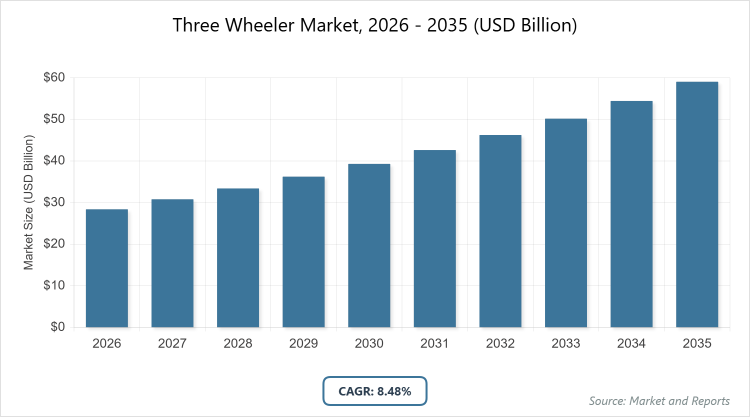
Three Wheeler Market Size, Share and Trends 2026 to 2035
According to MarketnReports, the global Three Wheeler market size was estimated at USD 28.38 billion in 2025 and is expected to reach USD 64.05 billion by 2035, growing at a CAGR of 8.48% from 2026 to 2035. The transformative shift towards electric mobility and enhanced service offerings in urban transportation.
What are the Key Insights into the Three Wheeler Market?
- The global Three Wheeler market was valued at USD 28.38 billion in 2025 and is projected to reach USD 64.05 billion by 2035.
- The market is expected to grow at a CAGR of 8.48% during the forecast period.
- The market is driven by increasing urbanization, demand for affordable transportation, and shift towards electric variants.
- The electric three-wheeler segment dominates the type segment with a 40% share & why it is dominated as it offers eco-friendly and cost-effective alternatives amid rising fuel prices and environmental regulations.
- The passenger transportation segment dominates the application segment with a 60% share & why it is dominated due to high demand in densely populated urban areas for public commuting and ride-sharing services.
- The fleet operators segment dominates the end-user segment with a 35% share & why it is dominated owing to scalability in ride-hailing and delivery services, enabling efficient urban logistics.
- Asia Pacific dominates the global market with a 70% share & why it is dominated thanks to rapid urbanization, large population bases in India and China, and government incentives for electric vehicles.
What is the Three Wheeler?
Industry Overview
The Three Wheeler market comprises compact vehicles with three wheels designed for passenger and cargo transport, offering affordable and maneuverable solutions for urban and rural mobility. Market definition includes motorized tricycles, auto-rickshaws, and e-rickshaws used in short-distance commuting, last-mile delivery, and commercial applications, emphasizing fuel efficiency, low maintenance, and adaptability to congested traffic conditions in developing regions.
What are the Market Dynamics in Three Wheeler?
Growth Drivers
The growth drivers in the three-wheeler market are fueled by rapid urbanization in emerging economies, where congested cities demand agile, low-cost transport options like auto-rickshaws for daily commuting and last-mile connectivity. The transition to electric three-wheelers is accelerated by government subsidies, emission reduction targets, and falling battery costs, making them viable alternatives to traditional fuel-based models. Increasing e-commerce and delivery services require efficient, compact vehicles for urban logistics, boosting demand for cargo variants. Additionally, rising fuel prices and maintenance costs for four-wheelers push consumers towards economical three-wheelers, while infrastructure developments in rural areas expand market reach.
Restraints
Restraints in the three-wheeler market include stringent safety regulations and emission norms that increase compliance costs for manufacturers, potentially slowing adoption in price-sensitive markets. Limited range and charging infrastructure for electric models hinder widespread use, especially in regions with unreliable power supply. Competition from two-wheelers and compact cars offers alternatives with better stability and comfort, diverting potential buyers. Moreover, economic volatility in developing countries affects consumer purchasing power, impacting sales of non-essential vehicles.
Opportunities
Opportunities in the three-wheeler market emerge from the growing emphasis on sustainable transport, with potential for hybrid and solar-powered models to address environmental concerns and attract eco-conscious consumers. Expansion into untapped rural markets through affordable financing and government programs can drive volume growth. Innovations in smart features like GPS tracking and app integration for ride-sharing enhance operational efficiency, opening avenues in the gig economy. Partnerships with e-commerce giants for customized delivery fleets present new revenue streams in logistics.
Challenges
Challenges in the three-wheeler market involve addressing safety perceptions, as three-wheelers are often seen as less stable, requiring design improvements and regulatory advocacy. Infrastructure gaps, such as poor roads and lack of charging stations, limit electric model adoption. Supply chain disruptions for components like batteries affect production timelines and costs. Finally, intense competition among local manufacturers leads to price wars, squeezing margins, and necessitating differentiation through quality and technology.
Three Wheeler Market: Report Scope
| Report Attributes | Report Details |
| Report Name | Three Wheeler Market |
| Market Size 2025 | USD 28.38 Billion |
| Market Forecast 2035 | USD 64.05 Billion |
| Growth Rate | CAGR of 8.48% |
| Report Pages | 220 |
| Key Companies Covered |
Bajaj Auto Limited, Mahindra & Mahindra Limited, TVS Motor Company Limited, Piaggio & C. SpA, Tata Motors Limited, Yamaha Motor Co., Ltd., Hero Electric Vehicles Pvt. Ltd., Eicher Motors Limited, Lohia Auto Industries, Scooters India Limited, and Others |
| Segments Covered | By Type, By Application, By End-User, and By Region |
| Regions Covered | North America, Europe, Asia Pacific (APAC), Latin America, and The Middle East and Africa (MEA) |
| Base Year | 2025 |
| Historical Year | 2020 – 2024 |
| Forecast Year | 2026 – 2035 |
| Customization Scope | Avail customized purchase options to meet your exact research needs. |
How is the Market Segmentation Done in Three Wheeler?
The Three Wheeler market is segmented by type, application, end-user, and region.
Based on the Type Segment, Electric three-wheeler emerges as the most dominant subsegment, holding approximately 40% market share, primarily because of supportive government policies on emissions and subsidies that reduce ownership costs, driving market growth by promoting sustainable urban mobility and reducing dependence on fossil fuels. Passenger carrier follows as the second dominant, with around 30% share, valued for its versatility in public transport, contributing to market expansion through efficient handling of high passenger volumes in congested areas.
Based on the Application Segment, Passenger transportation stands out as the most dominant subsegment, capturing about 60% of the market, due to the essential role in affordable daily commuting in populous regions, which helps drive the market by addressing mobility needs and supporting economic activities. Goods transportation ranks second with roughly 25% share, driven by e-commerce growth requiring quick deliveries, propelling market growth through enhanced logistics efficiency.
Based on the End-User Segment, Fleet operators are the most dominant subsegment, accounting for 35% share, attributed to their use in organized ride-sharing and delivery services, enhancing market drive by scaling operations and integrating technology for better management. Individual users follow with 30% share, fueled by personal mobility needs in urban settings, which advances the market through increased accessibility and affordability.
What are the Recent Developments in Three Wheeler?
- In October 2025, Bajaj Auto launched a new electric three-wheeler model with enhanced battery life, targeting urban delivery fleets in India, with production ramped up to 50,000 units annually.
- In December 2025, Mahindra & Mahindra acquired a stake in a Chinese e-rickshaw startup to expand its electric portfolio, investing USD 100 million for technology transfer.
- In January 2026, TVS Motor Company partnered with Uber to deploy 10,000 three-wheelers in Southeast Asia, focusing on sustainable transport solutions.
- In February 2026, Piaggio introduced a hybrid three-wheeler in Europe, compliant with new emission standards, aiming at the growing tourism sector.
- In March 2026, Tata Motors unveiled autonomous features in its cargo three-wheelers, tested in pilot programs for last-mile logistics.
What is the Regional Analysis of Three Wheeler?
- Asia Pacific to dominate the global market.
Asia Pacific commands the largest share in the three-wheeler market at 70%, propelled by high population density and urbanization in India, which dominates regionally due to government incentives for electric vehicles and extensive use in public transport, with China contributing through manufacturing exports and domestic cargo applications.
North America holds a modest 5% share, driven by niche applications in urban delivery, led by the United States with growing interest in electric models for sustainable logistics, though limited by preference for larger vehicles.
Europe accounts for 10% of the market, with a focus on eco-friendly variants, dominated by Italy through Piaggio’s innovations in passenger and cargo segments for city mobility.
Latin America represents 8% share, spurred by affordable transport needs in Brazil and Mexico, where Brazil leads in adopting CNG three-wheelers for cost-effective operations.
The Middle East and Africa comprise 7% of the market, with India-influenced models in Africa, led by Nigeria and Egypt for rural and urban commuting amid infrastructure challenges.
Who are the Key Market Players in Three Wheeler?
- Bajaj Auto Limited. Bajaj Auto focuses on electric and CNG variants, expanding exports and investing in R&D for battery technology to capture urban markets.
- Mahindra & Mahindra Limited. Mahindra emphasizes sustainable mobility, developing hybrid models and partnering for fleet solutions in logistics.
- TVS Motor Company Limited. TVS pursues global expansions, integrating smart tech in three-wheelers for ride-sharing applications.
- Piaggio & C. S.p.A. Piaggio leverages European design for premium segments, focusing on electric conversions for environmental compliance.
- Tata Motors Limited. Tata Motors invests in autonomous features, targeting cargo efficiency in e-commerce deliveries.
- Yamaha Motor Co., Ltd. Yamaha explores electric prototypes, aiming at Southeast Asian markets with lightweight designs.
- Hero Electric Vehicles Pvt. Ltd. Hero Electric specializes in e-rickshaws, promoting affordable green transport in India.
- Eicher Motors Limited. Eicher develops robust cargo models, focusing on durability for industrial use.
- Lohia Auto Industries. Lohia targets budget segments, offering customizable electric three-wheelers for rural areas.
- Scooters India Limited. Scooters India focuses on government contracts, supplying passenger carriers for public services.
What are the Market Trends in Three Wheeler?
- Rapid adoption of electric three-wheelers due to environmental regulations.
- Integration of smart technologies like GPS and app-based booking.
- Growth in last-mile delivery applications for e-commerce.
- Shift towards hybrid models for better range and efficiency.
- Increasing government subsidies for green vehicles.
- Expansion into rural markets with affordable financing.
- Focus on safety enhancements and ergonomic designs.
- Rise in women-friendly three-wheeler models.
- Collaborations with ride-hailing platforms.
- Development of solar-assisted charging systems.
What Market Segments and their Subsegments are Covered in the Three Wheeler Report?
By Type
- Passenger Carrier
- Load Carrier
- Auto Rickshaw
- E-Rickshaw
- Cargo Three-Wheeler
- Petrol Three-Wheeler
- Diesel Three-Wheeler
- Electric Three-Wheeler
- CNG Three-Wheeler
- LPG Three-Wheeler
- Others
By Application
- Passenger Transportation
- Goods Transportation
- Last-Mile Delivery
- Urban Mobility
- Rural Transportation
- Commercial Logistics
- Tourism
- Waste Management
- Emergency Services
- Industrial Use
- Others
By End-User
- Individual Users
- Fleet Operators
- Logistics Companies
- Government & Municipalities
- Tourism Operators
- Waste Management Firms
- Industrial Sector
- Commercial Transport
- Rental Services
- E-Commerce Platforms
- Others
By Region
- North America
- U.S.
- Canada
- Europe
- UK
- Germany
- France
- Rest of Europe
- Asia Pacific
- China
- India
- Japan
- Rest of Asia Pacific
- Latin America
- Brazil
- Mexico
- Rest of Latin America
- Middle East & Africa
- UAE
- South Africa
- Rest of Middle East & Africa
Chapter 1. Preface
Chapter 2. Executive Summary
Chapter 3. Global Three Wheeler Market - Industry Analysis
Chapter 4. Global Three Wheeler Market- Competitive Landscape
Chapter 5. Global Three Wheeler Market - Type Analysis
Chapter 6. Global Three Wheeler Market - Application Analysis
Chapter 7. Global Three Wheeler Market - End-User Analysis
Chapter 8. Three Wheeler Market - Regional Analysis
Chapter 9. Company Profiles
Three wheelers are compact vehicles with three wheels, used for passenger and cargo transport, offering affordable mobility solutions in urban and rural areas. Key factors include urbanization, shift to electric vehicles, government incentives, and rising demand for last-mile delivery. The market is projected to grow from approximately USD 30.79 billion in 2026 to USD 64.05 billion by 2035. The CAGR is expected to be 8.48% during the forecast period. Asia Pacific will contribute notably, holding around 70% of the global market value due to high demand in India and China. Major players include Bajaj Auto Limited, Mahindra & Mahindra Limited, TVS Motor Company Limited, Piaggio & C. SpA, Tata Motors Limited, Yamaha Motor Co., Ltd., Hero Electric Vehicles Pvt. Ltd., Eicher Motors Limited, Lohia Auto Industries, and Scooters India Limited. The report provides comprehensive analysis including market size, forecasts, segmentation, dynamics, regional insights, key players, trends, and FAQs. The value chain includes raw material sourcing, component manufacturing, vehicle assembly, distribution, sales, and after-sales service. Trends are shifting towards electric and smart-integrated models, with consumers preferring eco-friendly, cost-effective options for urban use. Regulatory factors include emission norms and safety standards, while environmental factors involve incentives for electric vehicles to reduce pollution.Frequently Asked Questions