
Thermal Energy Storage Market Size, Share and Trends 2026 to 2035
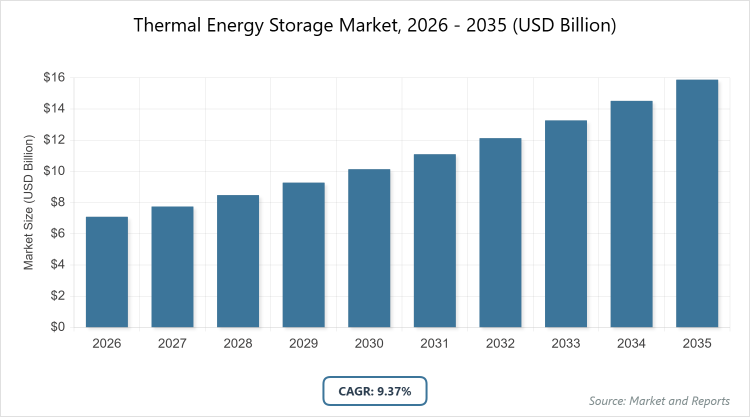
According to MarketnReports, the global Thermal Energy Storage market size was estimated at USD 7.09 billion in 2025 and is expected to reach USD 17.36 billion by 2035, growing at a CAGR of 9.37% from 2026 to 2035. Increasing integration of renewable energy sources and demand for energy efficiency.
What are the Key Insights into the thermal energy storage market?
- The global Thermal Energy Storage market was valued at USD 7.09 billion in 2025 and is projected to reach USD 17.36 billion by 2035.
- The market is expected to grow at a CAGR of 9.37% during the forecast period.
- The market is driven by the rising adoption of renewable energy and the need for efficient energy management.
- In the technology segment, sensible heat storage dominates with 45% share due to its cost-effectiveness and simplicity in large-scale applications like district heating.
- In the storage material segment, molten salts dominate with 40% share as they enable high-temperature storage for concentrated solar power plants.
- In the application segment, power generation dominates with 36% share owing to integration with renewables for a stable energy supply.
- In the end-user segment, utilities dominate with 40% share because of their role in grid balancing and renewable integration.
- Asia Pacific dominates the regional market with 46% share because of rapid industrialization, renewable energy investments, and supportive policies in China and India.
What is the Thermal Energy Storage Market?
Industry Overview
The thermal energy storage market involves technologies and systems that capture and store thermal energy for later use, enabling efficient management of energy supply and demand by storing excess heat or cold from sources like solar, industrial processes, or electricity during off-peak periods and releasing it when needed. These systems, categorized into sensible, latent, and thermochemical storage, utilize materials such as water, molten salts, or phase change materials to maintain energy in forms like heated fluids or chemical bonds, supporting applications in power generation, heating, cooling, and industrial processes while reducing reliance on fossil fuels and enhancing grid stability. Market definition includes all equipment, materials, and services for storing thermal energy, focusing on sustainability through renewable integration, cost reduction in energy consumption, and compliance with environmental regulations to mitigate climate change impacts in a transitioning energy landscape.
What are the Market Dynamics Shaping the Thermal Energy Storage Market?
Growth Drivers
The growth drivers in the thermal energy storage market are anchored in the global shift toward renewable energy sources, where TES systems enable the storage of intermittent solar and wind power for a consistent supply, reducing curtailment and enhancing grid reliability amid rising electrification demands. Government incentives and policies promoting energy efficiency and carbon reduction, such as subsidies for CSP plants and district heating projects, accelerate adoption by lowering upfront costs and encouraging investments in sustainable infrastructure. Technological advancements in materials like advanced PCMs and molten salts improve storage capacity and thermal stability, making TES more viable for industrial applications and urban energy management.
Additionally, increasing energy prices and the need for peak shaving drive commercial and utility sectors to deploy TES for cost savings, fostering market expansion through optimized energy use and reduced fossil fuel dependence.
Restraints
Restraints in the thermal energy storage market include high initial capital costs for system installation and materials, such as specialized tanks and heat exchangers, which deter adoption in cost-sensitive regions and smaller-scale projects despite long-term savings. Limited technological maturity for certain methods like thermochemical storage leads to lower efficiencies and higher operational complexities, restricting widespread implementation. Infrastructure challenges, including the need for compatible grid systems and space requirements for large-scale storage, pose barriers in urban or retrofitting scenarios. Moreover, fluctuating raw material prices for salts and PCMs, coupled with supply chain dependencies, increase project uncertainties and costs, hindering market penetration in developing economies.
Opportunities
Opportunities in the thermal energy storage market arise from innovations in hybrid systems integrating TES with renewables and AI for predictive energy management, enhancing efficiency in smart grids and enabling new applications like vehicle-to-grid storage. Expanding district heating and cooling networks in urbanizing areas offer potential for large-scale TES deployments, supported by green building initiatives. The rise of industrial waste heat recovery using TES can reduce energy consumption in manufacturing, attracting investments through carbon credits. Furthermore, emerging markets with high solar potential, like those in Africa and Latin America, present avenues for affordable, localized solutions using abundant materials, driving growth through international funding and technology transfers.
Challenges
Challenges in the thermal energy storage market involve achieving high energy density and long-term stability in storage materials, as degradation over cycles can reduce system lifespan and efficiency, requiring ongoing R&D to optimize formulations. Regulatory inconsistencies across regions complicate standardization and certification, delaying project approvals and increasing compliance costs. Integrating TES with existing energy infrastructures demands significant retrofitting, posing technical and financial hurdles. Additionally, public awareness and acceptance of TES benefits remain low, necessitating education campaigns to overcome skepticism and promote adoption amid competing energy storage technologies like batteries.
Thermal Energy Storage Market: Report Scope
| Report Attributes | Report Details |
| Report Name | Thermal Energy Storage Market |
| Market Size 2025 | USD 7.09 Billion |
| Market Forecast 2035 | USD 17.36 Billion |
| Growth Rate | CAGR of 9.37% |
| Report Pages | 220 |
| Key Companies Covered |
Abengoa Solar, Burns & McDonnell, SolarReserve, BrightSource Energy, Calmac, MAN Energy Solutions, and Others |
| Segments Covered | By Technology, By Storage Material, By Application, By End-User, and By Region |
| Regions Covered | North America, Europe, Asia Pacific (APAC), Latin America, and The Middle East and Africa (MEA) |
| Base Year | 2025 |
| Historical Year | 2020 – 2024 |
| Forecast Year | 2026 – 2035 |
| Customization Scope | Avail customized purchase options to meet your exact research needs. |
How is the Market Segmentation Structured in Thermal Energy Storage Market?
The Thermal Energy Storage market is segmented by technology, storage material, application, end-user, and region.
Based on the Technology Segment, sensible heat storage is the most dominant subsegment, followed by latent heat storage as the second most dominant. Sensible heat storage dominates due to its straightforward design using low-cost materials like water or rocks for large-scale energy shifting in district systems, driving the market by enabling cost-effective renewable integration and peak load management that supports global decarbonization efforts; latent heat storage follows with its high energy density from PCMs, propelling growth through compact solutions for space-constrained applications like building cooling.
Based on the Storage Material Segment, molten salts are the most dominant subsegment, followed by phase change materials (PCM) as the second most dominant. Molten salts lead because of their high-temperature capabilities and thermal stability in CSP plants, accelerating market expansion by facilitating round-the-clock renewable power generation; phase change materials gain prominence for their efficient heat absorption in compact forms, driving the market via versatile use in HVAC and industrial processes.
Based on Application Segment, power generation is the most dominant subsegment, followed by district heating & cooling as the second most dominant. Power generation dominates owing to TES’s role in stabilizing intermittent renewables, fueling market growth through enhanced grid reliability and energy security; district heating & cooling thrives on urban energy efficiency needs, propelling the market via centralized systems that reduce emissions.
Based on End-User Segment, utilities is the most dominant subsegment, followed by commercial & industrial as the second most dominant. Utilities dominate due to their scale in grid management and renewable integration, enhancing market penetration for large TES projects; commercial & industrial rise with energy cost-saving demands, driving adoption in factories and buildings.
What are the Recent Developments in the Thermal Energy Storage Market?
- In May 2025, Zeo Energy acquired Heliogen to integrate solar thermal with storage for continuous low-carbon energy.
- In March 2025, Kemira expanded strength chemical agents in Thailand for pulp and paper, indirectly supporting TES in industrial heat.
- In January 2025, Nouryon launched low-carbon hydrogen peroxide for pulp bleaching, aiding sustainable TES applications.
How does Regional Analysis Impact the Thermal Energy Storage Market?
- Asia Pacific to dominate the global market.
Asia Pacific leads the thermal energy storage market, driven by rapid urbanization, renewable energy targets, and government subsidies for clean technologies; China dominates as the key country, with massive CSP installations and industrial heat storage initiatives supporting its carbon neutrality goals.
North America exhibits strong growth in the thermal energy storage market, fueled by federal incentives and grid modernization; the United States is the dominant country, leveraging DOE funding for advanced TES in renewables and utilities.
Europe demonstrates substantial expansion in the thermal energy storage market, supported by EU Green Deal and energy transition policies; Germany emerges as the dominating country, with district heating networks and R&D in latent storage.
Latin America shows emerging potential in the thermal energy storage market, aided by solar resources; Chile stands out as the dominating country, focusing on molten salt TES for CSP in the Atacama Desert.
The Middle East and Africa represent nascent growth in the thermal energy storage market, propelled by solar projects; the UAE dominates, with Masdar’s investments in TES for sustainable energy hubs.
Who are the Key Market Players in the thermal energy storage market?
- Abengoa Solar focuses on molten salt TES for CSP, expanding through international projects for renewable integration.
- Burns & McDonnell employs engineering expertise for custom TES designs, prioritizing efficiency in utility applications.
- SolarReserve pursues advanced tower-based CSP with TES, emphasizing cost reduction through innovation.
- BrightSource Energy leverages heliostat technology with molten salt storage for high-temperature power generation.
- Calmac adopts ice-based TES for cooling, targeting commercial buildings for peak demand management.
- MAN Energy Solutions concentrates on thermochemical storage, focusing on industrial heat recovery.
What are the Market Trends in the thermal energy storage market?
- Increasing integration with renewables for a 24/7 power supply.
- Advancements in phase change materials for compact storage.
- Growth in district heating and cooling systems.
- Shift toward low-carbon molten salts for sustainability.
- Adoption of AI for optimized energy dispatch.
- Expansion in waste heat recovery applications.
- Rise in hybrid TES-battery systems.
What Market Segments and their Subsegments are Covered in the Thermal Energy Storage Report?
By Technology
- Sensible Heat Storage
- Latent Heat Storage
- Thermochemical Storage
- Molten Salt Technology
- Electric Thermal Storage Heaters
- Solar Energy Storage
- Ice-based Technology
- Miscibility Gap Alloy Technology
- Others
By Storage Material
- Water
- Molten Salts
- Phase Change Materials (PCM)
- Others
By Application
- Power Generation
- District Heating & Cooling
- Process Heating & Cooling
- Ice Storage Air-Conditioning
- Others
By End-User
- Utilities
- Commercial & Industrial
- Residential
- Others
By Region
- North America
- U.S.
- Canada
- Europe
- UK
- Germany
- France
- Rest of Europe
- Asia Pacific
- China
- India
- Japan
- Rest of Asia Pacific
- Latin America
- Brazil
- Mexico
- Rest of Latin America
- Middle East & Africa
- UAE
- South Africa
- Rest of Middle East & Africa
Frequently Asked Questions
Thermal energy storage refers to systems that store excess thermal energy for later use, using materials like water or salts to manage supply and demand in heating, cooling, and power applications.
Key factors include renewable energy integration, energy efficiency mandates, technological advancements in materials, and government incentives for sustainable infrastructure.
The thermal energy storage market is projected to grow from USD 7.09 billion in 2025 to USD 17.36 billion by 2035.
The market is expected to grow at a CAGR of 9.37% from 2026 to 2035.
Asia Pacific will contribute notably, holding around 46% market share due to industrialization and renewable investments.
Major players include Abengoa Solar, Burns & McDonnell, SolarReserve, BrightSource Energy, Calmac, and MAN Energy Solutions, driving growth through innovative TES technologies.
The report provides comprehensive analysis including market size, trends, segmentation, regional insights, key players, and forecasts from 2026 to 2035.
Stages include material sourcing, system design and manufacturing, installation, operation and maintenance, and end-of-life recycling.
Trends evolve toward hybrid systems and AI optimization, with preferences for sustainable, cost-effective solutions in renewables.
Factors include carbon reduction policies, renewable mandates, and incentives for energy storage to combat climate change.