
Textile Chemicals Market Size, Share and Trends 2026 to 2035
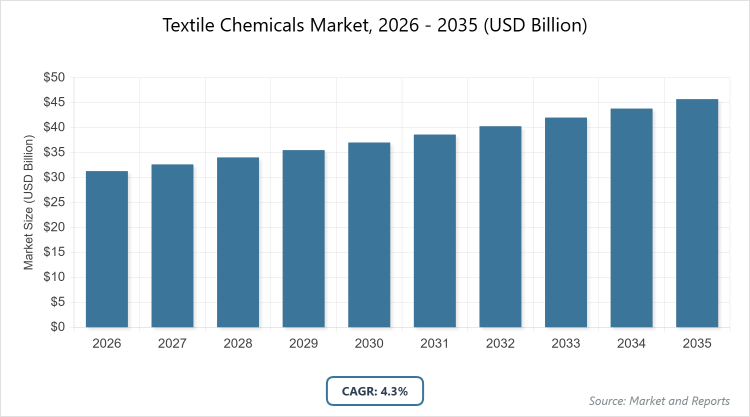
The global Textile Chemicals Market size was estimated at USD 31.3 Billion in 2025 and is expected to reach USD 45.7 Billion by 2035, growing at a CAGR of 4.3% from 2026 to 2035.The Textile Chemicals Market is primarily driven by the increasing demand for apparel and technical textiles, alongside a growing shift toward sustainable, eco-friendly, and high-performance chemical solutions.
Key Insights
- The global textile chemicals market is projected to grow from approximately USD 31.3 billion in 2026 to USD 45.7 billion by 2035.
- The market is expected to register a CAGR of 4.3% during the forecast period from 2026 to 2035.
- In product type segmentation, colorants and auxiliaries dominate as the leading subsegment.
- In application segmentation, apparel holds the dominant position.
- Asia Pacific emerges as the dominated region in the global market.
Industry Overview
The textile chemicals market encompasses a wide array of specialized substances used throughout the textile manufacturing process to enhance the properties, appearance, and functionality of fabrics and fibers. These chemicals include dyes, pigments, auxiliaries, finishing agents, and surfactants that are applied at various stages such as pretreatment, dyeing, printing, and finishing to improve qualities like color fastness, water repellency, flame retardancy, and softness. This market serves the global textile industry, which produces apparel, home furnishings, technical textiles, and industrial materials, by addressing needs for durability, aesthetics, and performance while adapting to evolving demands for sustainability and innovation in fabric production.
What are the Market Dynamics?
Growth Drivers
The growth of the textile chemicals market is primarily driven by the expanding global textile industry, fueled by rising consumer demand for fashionable apparel, home furnishings, and technical textiles in sectors like automotive and healthcare. Increasing urbanization and disposable incomes in emerging economies boost clothing and interior textile consumption, while advancements in chemical formulations enable enhanced fabric properties such as antimicrobial and wrinkle-resistant features. Additionally, the shift toward sustainable and eco-friendly chemicals, including bio-based alternatives, aligns with environmental regulations and consumer preferences for green products, further propelling market expansion through innovation and product differentiation.
Restraints
The textile chemicals market faces restraints from stringent environmental regulations and concerns over the toxicity of certain chemicals, which increase compliance costs and limit the use of traditional substances like azo dyes and heavy metals. Volatility in raw material prices, particularly petroleum-based inputs, impacts production costs and profit margins for manufacturers. Moreover, the rise of alternative materials and processes, such as digital printing that reduces chemical usage, poses a challenge to conventional chemical demand, while supply chain disruptions from geopolitical tensions and trade barriers hinder market stability and accessibility in key regions.
Opportunities
Opportunities in the textile chemicals market arise from the growing emphasis on sustainable and bio-based chemicals, opening avenues for innovation in green formulations that meet regulatory standards and appeal to eco-conscious consumers. The expansion of technical textiles in industries like aerospace, medical, and construction creates demand for specialized high-performance chemicals offering advanced functionalities such as UV protection and conductivity. Emerging markets in Asia and Africa present untapped potential due to industrialization and rising textile exports, while partnerships between chemical suppliers and textile manufacturers can drive R&D for customized solutions, enhancing market penetration and value-added offerings.
Challenges
Challenges in the textile chemicals market include the need to balance performance with environmental safety, as developing non-toxic alternatives often requires significant R&D investment without immediate cost recovery. Intense competition from low-cost producers in developing regions pressures pricing and margins for established players, while counterfeit and substandard chemicals undermine market trust and quality standards. Adapting to rapid technological changes, such as automation in textile processing, demands continuous skill upgrades and infrastructure investments, and global economic uncertainties can fluctuate demand, making long-term planning difficult for stakeholders.
Textile Chemicals Market: Report Scope
| Report Attributes | Report Details |
| Report Name | Textile Chemicals Market |
| Market Size 2025 | USD 31.3 Billion |
| Market Forecast 2035 | USD 45.7 Billion |
| Growth Rate | CAGR of 4.3% |
| Report Pages | 210 |
| Key Companies Covered |
BASF SE, Huntsman Corporation, The Dow Chemical Company, Archroma, and Wacker Chemie AG. |
| Segments Covered | By Product Type, By Application, By Region |
| Regions Covered | Asia Pacific, North America, Europe, Latin America, The Middle East and Africa |
| Base Year | 2025 |
| Historical Year | 2020 – 2024 |
| Forecast Year | 2026 – 2035 |
| Customization Scope | Avail customized purchase options to meet your exact research needs. |
What is the Market Segmentation?
How is the Textile Chemicals Market Segmented by Product Type?
The textile chemicals market is segmented by product type into categories such as coating and sizing agents, colorants and auxiliaries, finishing agents, surfactants, and others. The most dominant segment is colorants and auxiliaries, which commands a significant share due to their essential role in imparting vibrant colors, improving dye fixation, and enhancing fabric printability, driving the market by meeting the high demand for aesthetically appealing textiles in fashion and home decor industries where visual appeal directly influences consumer purchases and brand differentiation. The second most dominant segment is finishing agents, which contribute substantially by providing value-added properties like softness, wrinkle resistance, and water repellency, helping to drive the market through increased adoption in premium textiles and technical applications that require durability and functionality to satisfy evolving end-user needs for high-performance fabrics.
How is the Textile Chemicals Market Segmented by Application?
Market segmentation by application includes apparel, home furnishing, technical textiles, industrial textiles, and others. Apparel stands out as the most dominant segment, capturing the largest share owing to the massive global demand for clothing driven by population growth, fashion trends, and e-commerce expansion, which propels the market by necessitating chemicals that ensure color vibrancy, comfort, and longevity in everyday wear items. Home furnishing follows as the second most dominant, fueled by rising residential construction and interior design interests, aiding market growth through the application of chemicals that enhance stain resistance, flame retardancy, and aesthetic qualities in products like curtains and upholstery, thereby supporting consumer preferences for durable and stylish home environments.
How is the Textile Chemicals Market Segmented by Region?
Regional segmentation divides the market into Asia Pacific, North America, Europe, Latin America, and Middle East & Africa. Asia Pacific is the most dominant region, primarily due to its robust textile manufacturing base and export-oriented economies, driving the overall market by leveraging low-cost production and high-volume output to supply global demands for affordable textiles. North America ranks as the second most dominant, supported by advanced technological integrations and a focus on sustainable innovations, which help propel the market through high-value applications in technical textiles and compliance with stringent environmental standards that encourage premium chemical solutions.
Recent Developments
- In 2024, major players like Archroma introduced a new line of bio-based dyes aimed at reducing environmental impact, marking a shift toward sustainability that aligns with global regulations and consumer demands for eco-friendly textiles, potentially reshaping supply chains by encouraging wider adoption of green chemistry.
- In 2025, Huntsman Corporation acquired a smaller specialty chemicals firm to expand its portfolio in high-performance finishing agents, strengthening its market position through enhanced R&D capabilities and broader distribution networks in emerging markets.
- In early 2026, new EU regulations on chemical restrictions in textiles came into effect, prompting industry-wide adaptations such as reformulating products to eliminate banned substances, which could increase costs but also spur innovation in safer alternatives.
What is the Regional Analysis?
What is the Status of the Asia Pacific Region in the Textile Chemicals Market?
The Asia Pacific region dominates the textile chemicals market, accounting for over 57% share, driven by extensive textile production hubs that benefit from abundant raw materials, skilled labor, and government incentives for exports. China stands as the dominating country, with its massive manufacturing capacity and integrated supply chains enabling cost-effective production of chemicals for dyes and auxiliaries, while India follows closely with growing investments in sustainable technologies; the region’s rapid urbanization and rising middle-class consumption further amplify demand for apparel and home textiles, positioning it as a key growth engine through innovations in eco-friendly formulations and expansions in technical textiles for automotive and medical applications.
What is the Status of the North America Region in the Textile Chemicals Market?
North America holds a significant position in the textile chemicals market, characterized by advanced R&D and a focus on high-value, specialized chemicals that cater to technical and industrial textiles. The United States is the dominating country, leveraging strong intellectual property in nanotechnology and bio-based chemicals to drive innovations in antimicrobial and flame-retardant agents, supported by robust regulatory frameworks that promote sustainability; Canada contributes through its emphasis on eco-friendly practices, and the region’s emphasis on reshoring manufacturing amid supply chain disruptions enhances local production, fostering growth in premium segments like sportswear and protective gear.
What is the Status of the Europe Region in the Textile Chemicals Market?
Europe represents a mature market in textile chemicals, emphasizing sustainability and compliance with strict environmental directives like REACH, which influence product development toward low-impact solutions. Germany dominates as the leading country, with its engineering prowess in developing advanced finishing and surfactant chemicals for high-end fashion and automotive textiles, while Italy excels in luxury apparel applications; the region’s push for circular economy models encourages recycling and bio-based innovations, driving market evolution through collaborations between chemical firms and textile brands to meet consumer demands for ethical and durable products.
What is the Status of the Latin America Region in the Textile Chemicals Market?
Latin America is an emerging player in the textile chemicals market, benefiting from natural resources and growing textile exports to North America and Europe. Brazil is the dominating country, with its vibrant apparel and home furnishing sectors utilizing chemicals for colorants and sizing agents, supported by agricultural byproducts for bio-based alternatives; Mexico contributes through nearshoring advantages and trade agreements like USMCA, enhancing chemical demand in automotive textiles, while the region’s focus on sustainable agriculture inputs positions it for growth in eco-friendly chemicals amid increasing foreign investments.
What is the Status of the Middle East & Africa Region in the Textile Chemicals Market?
The Middle East & Africa region shows potential in the textile chemicals market, driven by investments in diversification beyond oil and rising domestic consumption. Turkey dominates in the Middle East with its strategic location bridging Europe and Asia, excelling in apparel chemicals through efficient production and exports, while South Africa leads in Africa with advancements in technical textiles for mining and agriculture; the region’s challenges with infrastructure are offset by opportunities in sustainable chemicals, supported by international aid and partnerships that aim to build local manufacturing capabilities.
Key Market Players and Strategies
BASF SE focuses on sustainability through its development of bio-based and low-VOC chemicals, investing heavily in R&D to create innovative solutions like water-saving dyeing processes, while forming strategic alliances with textile mills to co-develop customized products that reduce environmental footprints. Huntsman Corporation emphasizes mergers and acquisitions to expand its specialty chemicals portfolio, alongside a strategy of geographic expansion into Asia Pacific markets, prioritizing high-performance textiles with advanced auxiliaries to capture shares in technical applications. The Dow Chemical Company adopts a innovation-driven approach by leveraging digital technologies for precise chemical formulations, coupled with sustainability initiatives like recycling programs, to strengthen its position in finishing agents and surfactants globally. Archroma pursues a differentiation strategy via eco-friendly colorants and auxiliaries, collaborating with brands on zero-discharge manufacturing, and expanding through acquisitions to enhance its presence in emerging markets. Wacker Chemie AG concentrates on silicone-based chemicals for enhanced fabric properties, with a strategy centered on R&D for smart textiles and partnerships in Europe and North America to drive adoption in high-tech sectors.
Market Trends
- Increasing adoption of sustainable and bio-based chemicals to comply with environmental regulations and meet consumer preferences for green textiles.
- Growth in digital textile printing technologies that reduce water and chemical usage while enabling customization.
- Expansion of technical textiles in healthcare and automotive sectors, demanding specialized chemicals for functionality like antimicrobial properties.
- Rise of nanotechnology in textiles for advanced features such as self-cleaning and UV protection.
- Shift toward circular economy practices, including chemical recycling and waste reduction in manufacturing processes.
Market Segments Covered in the Report
By Product Type
- Coating and Sizing Agents
- Colorants and Auxiliaries
- Finishing Agents
- Surfactants
- Others
By Application
- Apparel
- Home Furnishing
- Technical Textiles
- Industrial Textiles
- Others
By Region
-
- North America
- U.S.
- Canada
- Europe
- UK
- Germany
- France
- Rest of Europe
- Asia Pacific
- China
- India
- Japan
- Rest of Asia Pacific
- Latin America
- Brazil
- Mexico
- Rest of Latin America
- UAE
- South Africa
- Rest of Middle East & AfricaMiddle East & Africa
- North America
Chapter 1. Preface
Chapter 2. Executive Summary
Chapter 3. Global Textile Chemicals Market - Industry Analysis
Chapter 4. Global Textile Chemicals Market- Competitive Landscape
Chapter 5. Global Textile Chemicals Market - Product Type Analysis
Chapter 6. Global Textile Chemicals Market - Application Analysis
Chapter 7. Textile Chemicals Market - Regional Analysis
Chapter 8. Company Profiles
Frequently Asked Questions
The textile chemicals market refers to the industry involved in producing and supplying chemicals used in textile processing, including dyes, auxiliaries, and finishing agents to enhance fabric properties.
Key factors include rising demand for sustainable chemicals, expansion in technical textiles, regulatory pressures for eco-friendly products, and growth in emerging economies' textile production.
The market is projected to grow from approximately USD 31.3 billion in 2026 to USD 45.7 billion by 2035.
The CAGR is expected to be 4.3% during 2026-2035.
Asia Pacific will contribute notably, driven by its dominant textile manufacturing base in countries like China and India.
Major players include BASF SE, Huntsman Corporation, The Dow Chemical Company, Archroma, and Wacker Chemie AG.
The report provides comprehensive insights into market size, trends, segmentation, regional analysis, key players, and future forecasts.
The value chain includes raw material sourcing, chemical manufacturing, distribution to textile processors, application in fabric production, and end-use in consumer products.
Trends are shifting toward sustainability, with consumers preferring eco-friendly and functional textiles, leading to increased demand for bio-based and high-performance chemicals.
Stringent regulations on toxic chemicals, such as EU REACH and upcoming bans, are pushing the market toward greener alternatives, impacting growth through higher compliance costs but fostering innovation.