
Text Analytics Market Size, Share and Trends 2026 to 2035
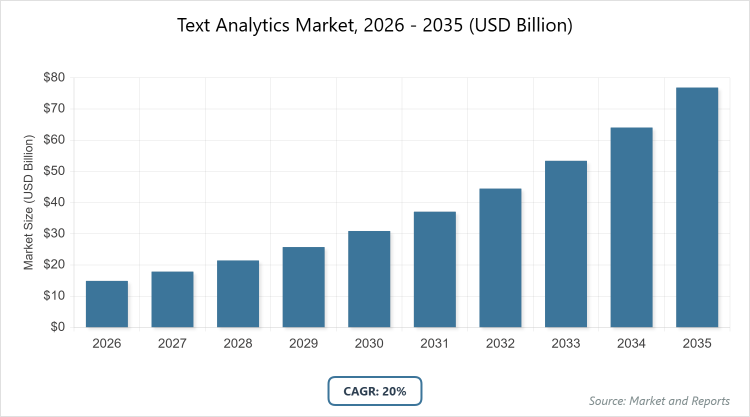
According to MarketnReports, the global Text Analytics market size was estimated at USD 14.9 billion in 2025 and is expected to reach USD 92.4 billion by 2035, growing at a CAGR of 20% from 2026 to 2035. Text Analytics Market is driven by the increasing adoption of AI and NLP for extracting insights from unstructured data.
What is Text Analytics? An Industry Overview
Text analytics is a technology-driven process that applies natural language processing (NLP), machine learning, and statistical methods to extract meaningful insights from unstructured text data, such as emails, social media, customer reviews, and documents, enabling organizations to uncover patterns, sentiments, and trends for informed decision-making. The market definition includes software and services that facilitate sentiment analysis, entity recognition, topic modeling, and text summarization, supporting applications across industries like customer service, marketing, and risk management to transform vast amounts of textual information into actionable intelligence, enhancing operational efficiency and strategic planning.
What are the Key Insights of Text Analytics Market?
- The global Text Analytics market was valued at USD 14.9 billion in 2025 and is projected to reach USD 92.4 billion by 2035.
- The global Text Analytics market is expected to grow at a CAGR of 20% during the forecast period 2026-2035.
- The Text Analytics market is driven by rising data volumes from social media and the need for real-time customer insights.
- The software subsegment dominates the component segment with a 63% share due to its core role in enabling advanced NLP algorithms.
- The cloud subsegment dominates the deployment mode segment with a 69% share owing to its scalability and cost-efficiency for enterprises.
- The sentiment analysis subsegment dominates the application segment with a 30% share because of its widespread use in customer experience management.
- The BFSI subsegment dominates the vertical segment with a 25% share attributed to regulatory compliance and fraud detection needs.
- North America dominates the global Text Analytics market with a 40% share due to high technology adoption and presence of key vendors like IBM and Microsoft.
What are the Market Dynamics of Text Analytics?
Growth Drivers
The text analytics market is propelled by the exponential increase in unstructured data from sources like social media, emails, and customer feedback, necessitating advanced tools to derive actionable insights for business intelligence. The integration of AI and machine learning enhances accuracy in sentiment analysis and predictive modeling, enabling real-time decision-making that boosts customer satisfaction and operational efficiency. Government regulations mandating data privacy and compliance, such as GDPR, further drive adoption, as organizations leverage text analytics to monitor risks and ensure adherence, fostering innovation in sectors like finance and healthcare.
Restraints
High implementation costs for advanced text analytics solutions, including software licensing and skilled personnel training, limit adoption among small and medium enterprises lacking resources. Data privacy concerns and ethical issues surrounding AI bias in text processing deter widespread use, as inaccuracies can lead to misguided insights. Additionally, the lack of standardized data formats and interoperability between systems complicates integration, slowing market penetration in fragmented industries.
Opportunities
The rise of generative AI and large language models presents opportunities for enhanced text summarization and content generation, allowing businesses to automate reporting and personalize marketing. Emerging markets in Asia-Pacific offer growth potential through digital transformation initiatives, where affordable cloud-based solutions can address language diversity and regional needs. Partnerships between tech firms and vertical-specific providers can unlock new applications, such as in e-commerce for personalized recommendations, expanding market reach.
Challenges
Ensuring data quality and handling multilingual text remain challenges, as variations in language and slang can reduce analysis accuracy, requiring ongoing algorithm refinements. The rapid evolution of AI regulations demands adaptable solutions, posing compliance risks for vendors. Moreover, competition from open-source tools pressures proprietary providers to innovate continuously while maintaining profitability.
Text Analytics Market: Report Scope
| Report Attributes | Report Details |
| Report Name | Text Analytics Market |
| Market Size 2025 | USD 14.9 Billion |
| Market Forecast 2035 | USD 92.4 Billion |
| Growth Rate | CAGR of 20% |
| Report Pages | 220 |
| Key Companies Covered |
IBM, Microsoft, Oracle, SAS Institute, SAP, Google, and Others |
| Segments Covered | By Component, By Deployment Mode, By Application, By Vertical, and By Region |
| Regions Covered | North America, Europe, Asia Pacific (APAC), Latin America, and The Middle East and Africa (MEA) |
| Base Year | 2025 |
| Historical Year | 2020 – 2024 |
| Forecast Year | 2026 – 2035 |
| Customization Scope | Avail customized purchase options to meet your exact research needs. |
The Text Analytics market is segmented by component, deployment mode, application, vertical, and region.
Based on Component Segment: The software segment is the most dominant, holding a 63% market share, as it forms the backbone of NLP and machine learning capabilities essential for processing vast text data, driven by its flexibility in customization. This dominance drives market growth by enabling scalable insights across industries. The services segment is the second most dominant with a 37% share, providing implementation and consulting support, which propels the market through expert deployment and optimization.
Based on Deployment Mode Segment: The cloud segment is the most dominant, capturing a 69% share, due to its ease of access, lower costs, and ability to handle large datasets remotely. Its dominance accelerates market growth by facilitating real-time analytics for global enterprises. The on-premise segment ranks second with a 31% share, preferred for data-sensitive applications, driving the market with secure, controlled environments.
Based on Application Segment: The sentiment analysis segment is the most dominant, with a 30% share, attributed to its critical role in gauging customer opinions from social media and reviews. This leads market growth by enhancing brand management and product development. The document categorization segment is second with a 25% share, aiding in organizing unstructured data, propelling growth through efficiency in knowledge management.
Based on Vertical Segment: The BFSI segment is the most dominant, holding a 25% share, as it requires robust text analytics for fraud detection and compliance monitoring. This dominance fosters market expansion by addressing regulatory demands. The retail segment is second with a 20% share, using analytics for customer feedback, driving growth via personalized marketing.
What are the Recent Developments in Text Analytics Market?
- In 2025, IBM enhanced its Watson platform with advanced multilingual NLP capabilities, improving sentiment analysis accuracy for global enterprises.
- Microsoft integrated generative AI into Azure Text Analytics, enabling automated summarization for customer service applications.
- SAS launched a new fraud detection module using text analytics, targeting BFSI to reduce losses by identifying suspicious patterns in communications.
- OpenText acquired a startup specializing in real-time social media monitoring, expanding its portfolio for media and entertainment clients.
- Google Cloud updated its NLP API with better entity recognition, supporting healthcare for extracting insights from medical records.
What is the Regional Analysis of Text Analytics Market?
- North America to dominate the global market
North America leads the Text Analytics market with a 40% share, driven by technological innovation and high data generation. The United States dominates, with tech hubs like Silicon Valley hosting companies such as IBM and Microsoft, supported by investments in AI research and regulatory frameworks like CCPA.
Europe holds a prominent position in the Text Analytics market, fueled by data privacy laws and digital initiatives. Germany is the dominant country, leveraging manufacturing data for predictive maintenance, aligned with Industry 4.0 and GDPR compliance.
Asia-Pacific is the fastest-growing region for Text Analytics, propelled by digital transformation. China dominates, with e-commerce giants like Alibaba using text analytics for customer insights, backed by national AI strategies.
Latin America is emerging in the Text Analytics market, focusing on e-commerce and finance. Brazil leads, adopting solutions for sentiment analysis in retail, supported by economic digitalization.
The Middle East and Africa show potential in Text Analytics, driven by smart city projects. The UAE is a key player, implementing analytics in Dubai for public services, attracting global investments.
Who are the Key Market Players and Strategies in Text Analytics?
IBM focuses on AI-driven NLP enhancements, partnering for enterprise integrations to improve analytics accuracy.
Microsoft emphasizes cloud-based solutions, investing in generative AI for automated text processing.
Oracle prioritizes data integration, collaborating on compliance tools for regulated industries.
SAS Institute specializes in fraud detection, expanding through acquisitions for advanced modeling.
SAP pursues ERP integrations, forming alliances for real-time business intelligence.
Google develops multilingual APIs, targeting global markets with scalable cloud services.
What are the Market Trends in Text Analytics?
- Integration of generative AI for automated content generation and summarization.
- Rise of multilingual NLP to handle diverse global data sources.
- Focus on real-time analytics for immediate customer feedback.
- Adoption of ethical AI to address bias in text processing.
- Growth in hybrid deployment for flexibility and security.
- Emphasis on sentiment analysis for enhanced customer experience.
What are the Market Segments and their Subsegment Covered in the Text Analytics Report?
By Component
-
- Software
- Services
- Consulting
- Implementation
- Managed Services
- Training
- License
- Maintenance
- Integration
- Automation Tools
- Others
By Deployment Mode
-
- Cloud
- On-Premise
- Hybrid
- SaaS
- Others
By Application
-
- Sentiment Analysis
- Document Categorization
- Topic Detection
- Entity Recognition
- Text Summarization
- Fraud Detection
- Customer Experience Management
- Predictive Analytics
- Social Media Monitoring
- Risk Management
- Others
By Vertical
-
- BFSI
- Retail
- Healthcare
- IT & Telecom
- Media & Entertainment
- Government
- Manufacturing
- Energy & Utilities
- Transportation
- Education
- Others
By Region
-
- North America
- U.S.
- Canada
- Europe
- UK
- Germany
- France
- Rest of Europe
- Asia Pacific
- China
- India
- Japan
- Rest of Asia Pacific
- Latin America
- Brazil
- Mexico
- Rest of Latin America
- Middle East & Africa
- UAE
- South Africa
- Rest of Middle East & Africa
- North America
Chapter 1. Preface
Chapter 2. Executive Summary
Chapter 3. Global Text Analytics Market - Industry Analysis
Chapter 4. Global Text Analytics Market- Competitive Landscape
Chapter 5. Global Text Analytics Market - Component Analysis
Chapter 6. Global Text Analytics Market - Deployment Mode Analysis
Chapter 7. Global Text Analytics Market - Application Analysis
Chapter 8. Global Text Analytics Market - Vertical Analysis
Chapter 9. Text Analytics Market - Regional Analysis
Chapter 10. Company Profiles
Frequently Asked Questions
Text Analytics is the process of deriving insights from unstructured text using NLP and AI to analyze patterns and sentiments.
Key factors include AI advancements, data explosion, and demand for real-time insights.
The market is projected to grow from USD 17.9 billion in 2026 to USD 92.4 billion by 2035.
The market is expected to grow at a CAGR of 20% during 2026-2035.
North America will contribute notably, holding a 40% share due to technological leadership.
Major players include IBM, Microsoft, Oracle, SAS Institute, SAP, and Google.
The report provides market size, trends, segmentation, regional insights, key players, and forecasts.
Stages include data collection, software development, deployment, analysis, and insight generation.
Trends focus on AI integration and real-time processing, with preferences for cloud-based, ethical solutions.
Data privacy regulations like GDPR drive compliant tools, while sustainability influences energy-efficient AI.