
Telecom API Market Size, Share and Trends 2026 to 2035
According to MarketnReports, the global telecom API market size was estimated at USD 305.85 billion in 2025 and is expected to reach USD 1,741.39 billion by 2035, growing at a CAGR of 21.3% from 2026 to 2035. Telecom API Market is driven by the increasing demand from enterprises to seamlessly integrate communication functionalities, such as messaging and voice, directly into their applications, alongside the shift of telecom operators towards monetizing their network infrastructure through Communication Platform as a Service (CPaaS) partnerships.
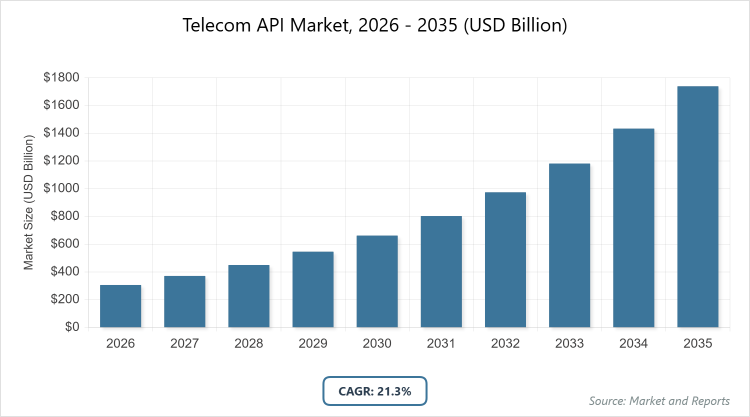
What are the Key Insights into the Telecom API Market?
- Global telecom API market valued at approximately USD 305.85 billion in 2025, projected to reach USD 1,741.39 billion by 2034.
- Expected CAGR of around 21.3% from 2026 to 2035, driven by 5G adoption and digital transformation.
- Dominant subsegment by type: Messaging API, accounting for the largest share due to widespread use in notifications.
- Dominant subsegment by user type: Enterprise developers, holding over 60% market share for business integrations.
- Dominant subsegment by deployment: Cloud-based, contributing around 70% revenue for scalability.
- Dominant region: Asia-Pacific, contributing over 31% of global revenue with China as the leading country.
What is the Telecom API Industry Overview?
Industry Overview
Telecom APIs, or Application Programming Interfaces in the telecommunications sector, are standardized software intermediaries that enable seamless integration between telecom networks and third-party applications, allowing developers to access core functionalities such as messaging, voice calls, location services, and payment processing without building infrastructure from scratch. These APIs facilitate the creation of innovative services like SMS notifications, VoIP communications, IoT connectivity, and real-time data analytics, serving as a bridge between telecom operators’ legacy systems and modern digital ecosystems including cloud platforms, mobile apps, and enterprise software.
The market encompasses the development, deployment, and monetization of these APIs by telecom providers, platform vendors, and aggregators, targeting industries like e-commerce, healthcare, finance, and logistics where reliable, scalable communication is essential. Telecom APIs typically include protocols for authentication, data exchange, and error handling, promoting openness in the industry through standards like GSMA’s Open Gateway initiative, which encourages collaboration to unlock network capabilities for enhanced user experiences.
This market is pivotal in the digital transformation era, enabling operators to generate new revenue streams beyond traditional voice and data services while addressing demands for security, low latency, and global interoperability in an increasingly connected world.
What are the Market Dynamics in the Telecom API Sector?
Growth Drivers
The telecom API market is propelled by the rapid adoption of 5G networks and IoT devices, which require robust APIs for real-time data exchange and connectivity management, driven by surging demand in smart cities, autonomous vehicles, and industrial automation. Increasing digital transformation across enterprises necessitates seamless integration of communication services into applications, with APIs enabling features like omnichannel customer engagement and secure payments, supported by the rise of CPaaS (Communications Platform as a Service) models.
Regulatory pushes for open networks, such as the EU’s digital single market initiatives, encourage operators to expose APIs, fostering innovation and partnerships with tech giants. Additionally, the explosion of mobile apps and e-commerce platforms amplifies the need for messaging and location APIs, enhancing user personalization and operational efficiency in a mobile-first world.
Restraints
High development and integration costs for secure, compliant APIs pose barriers, particularly for smaller operators in emerging markets where legacy systems require extensive upgrades to support modern standards, limiting scalability. Data privacy concerns and stringent regulations like GDPR restrict API exposure, as breaches can lead to hefty fines and erode trust, slowing adoption in sensitive sectors. Fragmented standards across regions and operators hinder interoperability, complicating developer ecosystems and increasing time-to-market for new services. Moreover, competition from over-the-top (OTT) players like WhatsApp and Zoom, which bypass traditional telecom APIs, diverts revenue streams and pressures margins.
Opportunities
Opportunities arise from the integration of AI and machine learning into APIs for predictive analytics and automated customer service, opening niches in personalized marketing and fraud detection, appealing to enterprises seeking competitive edges. The expansion of edge computing with 5G creates demand for low-latency APIs in AR/VR and gaming, enabling new monetization models through premium services. Collaborations via open API ecosystems, such as GSMA’s Camara project, allow operators to aggregate capabilities globally, tapping into underserved markets in Africa and Latin America. Government incentives for digital infrastructure in developing regions further unlock potential for API-driven telemedicine and financial inclusion services.
Challenges
Ensuring API security against cyber threats remains a core challenge, as exposed network functions are vulnerable to attacks, requiring continuous investments in encryption and monitoring amid evolving hacker tactics. Balancing openness with revenue protection is tricky, as free or low-cost APIs can cannibalize core services, demanding sophisticated pricing strategies. Rapid technological shifts, like the transition to 6G, necessitate frequent updates to API frameworks, straining resources for operators with diverse portfolios. Additionally, developer adoption hinges on comprehensive documentation and support, where deficiencies can lead to low utilization and market fragmentation.
Telecom API Market: Report Scope
| Report Attributes | Report Details |
| Report Name | Telecom API Market |
| Market Size 2025 | USD 305.85 billion |
| Market Forecast 2035 | USD 1,741.39 billion |
| Growth Rate | CAGR of 21.3% |
| Report Pages | 235 |
| Key Companies Covered | Twilio, Vonage (Ericsson), Sinch, AT&T, Verizon, Orange, and Telefónica |
| Segments Covered | By Type, User Type, Deployment, and Region |
| Regions Covered | North America, Europe, Asia Pacific (APAC), Latin America, The Middle East and Africa (MEA) |
| Base Year | 2025 |
| Historical Year | 2020 – 2024 |
| Forecast Year | 2026 – 2035 |
| Customization Scope | Avail customized purchase options to meet your exact research needs. |
How is the Telecom API Market Segmented?
The telecom API market is segmented by type, user type, deployment, and region.
By Type, The messaging API segment dominates the telecom API market, primarily because of its essential role in enabling SMS, MMS, and RCS for real-time notifications, marketing campaigns, and customer engagement across industries like retail and banking, supported by high mobile penetration and regulatory mandates for secure communication. This dominance drives the market by facilitating cost-effective, scalable solutions that boost user retention and revenue through premium features like rich media messaging, thereby encouraging operator investments in CPaaS platforms and expanding digital services globally.
The IVR/voice API segment ranks second, utilized for interactive voice response systems in call centers and virtual assistants due to its efficiency in handling high-volume queries, helping to propel market growth by integrating with AI for personalized interactions, reducing operational costs, and supporting omnichannel strategies in healthcare and finance.
By User Type, Enterprise developers lead the user type segment, as they leverage APIs to embed communication features into custom applications for internal efficiency and customer-facing services, driven by the need for seamless integration in CRM and ERP systems. This subsegment drives the market by commanding premium pricing for advanced functionalities, fostering long-term contracts, and stimulating innovation in tailored solutions that enhance business agility and competitiveness.
Partner developers follow as the second dominant, collaborating with operators for co-created services like app ecosystems, contributing to market expansion through revenue-sharing models, broadening API accessibility, and accelerating adoption in startups and niche verticals.
By Deployment, Cloud-based deployment dominates the deployment segment, favored for its flexibility, scalability, and lower upfront costs, allowing rapid provisioning and global access ideal for dynamic applications in e-commerce and IoT. This leadership accelerates market growth by aligning with digital migration trends, enabling pay-as-you-go models that attract SMEs, and supporting multi-cloud integrations for resilience.
Hybrid deployment ranks second, combining on-premise security with cloud efficiency for regulated industries like finance, helping to drive the market through balanced solutions that address data sovereignty concerns, facilitating gradual transitions, and enhancing trust in API adoption.
What are the Recent Developments in the Telecom API Market?
- In July 2025, Twilio launched a new global developer portal expanding its telecom API catalogue with advanced location and identity services, aiming to simplify integration for enterprises and boost adoption in emerging markets through enhanced documentation and tools.
- In March 2025, Vonage (Ericsson) acquired a CPaaS startup to integrate AI-driven analytics into its voice APIs, enhancing real-time insights for customer service applications and strengthening its position in North America and Europe.
- In September 2024, Sinch partnered with a major Asian operator to deploy RCS APIs for e-commerce, enabling rich messaging features that improved engagement rates and opened new revenue streams in mobile commerce.
- In November 2024, AT&T expanded its Open Gateway initiative with new edge APIs for 5G, targeting IoT developers and fostering collaborations to accelerate low-latency applications in industrial sectors.
What is the Regional Analysis of the Telecom API Market?
- Asia-Pacific to dominate the market
Asia-Pacific dominates the global telecom API market, driven by massive mobile subscriber bases, rapid 5G rollout, and booming digital economies, with China as the dominating country due to its extensive infrastructure investments, government policies like Digital Silk Road promoting API openness, and leadership in IoT and e-commerce integrations that generate high demand for messaging and location services.
The region’s growth is fueled by India’s fintech surge and Southeast Asia’s app economy, supported by low-cost data plans; Japan’s advanced tech ecosystem contributes, but China’s dominance stems from its operator giants like China Mobile exposing APIs at scale, exporting models to neighbors, and addressing urbanization needs, boosting revenue through volume-driven adoption and innovation hubs.
North America holds a substantial share in the telecom API market, characterized by mature CPaaS adoption and regulatory support for innovation, with the United States as the dominating country owing to its tech hubs, stringent data privacy laws like CCPA, and major players driving enterprise integrations in cloud and AI. The region benefits from Canada’s growing fintech sector and cross-border collaborations; the U.S. leads through investments in 5G APIs for AR/VR, enhancing developer ecosystems and compliance, propelling market expansion via premium services and partnerships with hyperscalers like AWS.
Europe exhibits steady growth in the telecom API market, focused on GDPR compliance and sustainable digital infrastructure, with Germany as the dominating country due to its industrial strength, EU-wide initiatives like GAIA-X for federated APIs, and leadership in automotive IoT integrations. The region is propelled by the UK’s fintech innovations and France’s smart city projects; Germany’s dominance arises from its export-focused economy and R&D in secure voice APIs, fostering market development by addressing privacy concerns and enabling cross-EU interoperability.
The Rest of the World, including Latin America, Middle East, and Africa, shows emerging potential, with Brazil dominating in Latin America through e-commerce growth and 5G trials, while Saudi Arabia leads in the Middle East with Vision 2030 digital investments. Growth is driven by Africa’s mobile money surge in Kenya; the region’s progress relies on international partnerships for API platforms, gradually increasing share through affordable messaging solutions in underserved areas.
Who are the Key Market Players and Their Strategies in the Telecom API Industry?
Twilio: Focuses on CPaaS innovation, expanding through acquisitions and AI integrations to offer scalable messaging and voice APIs, targeting enterprises for global reach.
Vonage (Ericsson): Emphasizes 5G-enabled APIs, leveraging parent company synergies for network exposure and partnerships to penetrate IoT markets.
Sinch: Prioritizes RCS and omnichannel solutions, pursuing mergers for geographic expansion and developer tools to enhance engagement APIs.
AT&T: Adopts open gateway strategies, investing in edge computing APIs for low-latency services and collaborations with developers for enterprise adoption.
Verizon: Concentrates on secure identity APIs, focusing on regulatory compliance and 5G integrations to serve finance and healthcare sectors.
Orange: Employs ecosystem partnerships, developing location and IoT APIs for African markets while emphasizing sustainability in operations.
Telefónica: Utilizes open innovation platforms, targeting Latin America with payment APIs and joint ventures for digital transformation.
What are the Current Market Trends in the Telecom API Sector?
- Increasing adoption of AI-enhanced APIs for predictive customer interactions and fraud detection.
- Shift toward open network APIs via initiatives like GSMA Camara for standardized global access.
- Growth in 5G-specific APIs enabling edge computing and low-latency applications in AR/VR.
- Emphasis on privacy-focused designs complying with regulations like GDPR and CCPA.
- Rise of CPaaS models integrating messaging, voice, and video for omnichannel experiences.
- Expansion in IoT APIs for device management amid smart city and industrial deployments.
What Market Segments are Covered in the Report?
By Type
-
- Messaging API
- IVR/Voice API
- Payment API
- Location API
- Others
By User Type
-
- Enterprise Developers
- Partner Developers
- Internal Telecom Developers
By Deployment
-
- Cloud-based
- Hybrid
- On-premise
By Region
-
- North America
- U.S.
- Canada
- Europe
- UK
- Germany
- France
- Rest of Europe
- Asia Pacific
- China
- India
- Japan
- Rest of Asia Pacific
- Latin America
- Brazil
- Mexico
- Rest of Latin America
- Middle East & Africa
- UAE
- South Africa
- Rest of Middle East & Africa
- North America
Chapter 1. Preface
Chapter 2. Executive Summary
Chapter 3. Global Telecom API Market - Industry Analysis
Chapter 4. Global Telecom API Market- Competitive Landscape
Chapter 5. Global Telecom API Market - Type Analysis
Chapter 6. Global Telecom API Market - User Type Analysis
Chapter 7. Global Telecom API Market - Deployment Analysis
Chapter 8. Telecom API Market - Regional Analysis
Chapter 9. Company Profiles
Frequently Asked Questions
Telecom APIs are software interfaces that allow developers to access and integrate telecommunications services like messaging, voice, and location into applications, enabling seamless communication functionalities.
Key factors include 5G and IoT proliferation, enterprise digital transformation, regulatory support for open APIs, and AI integrations for enhanced services.
The telecom API market is projected to grow from approximately USD 305.85 billion in 2026 to USD 1,741.39 billion by 2035, reflecting robust expansion.
The CAGR for the telecom API market during 2026-2035 is expected to be around 21.3%, driven by technological advancements.
Asia-Pacific will contribute notably, accounting for over 31% of the market value, led by rapid digital adoption in China.
Major players include Twilio, Vonage (Ericsson), Sinch, AT&T, Verizon, Orange, and Telefónica, through innovations and partnerships.
The global telecom API market report provides insights into size, segmentation, dynamics, regional analysis, players, trends, and forecasts for strategic decisions.
The value chain includes API development by operators, platform aggregation, developer integration, service deployment, and monetization through usage fees.
Market trends are evolving toward AI and 5G integrations, with preferences shifting to secure, scalable CPaaS solutions for omnichannel communications.
Regulatory factors include data privacy laws like GDPR, while environmental factors involve sustainable network practices, driving secure and efficient API designs but increasing compliance costs.