
T-Strap Heels Market Size, Share and Trends 2026 to 2035
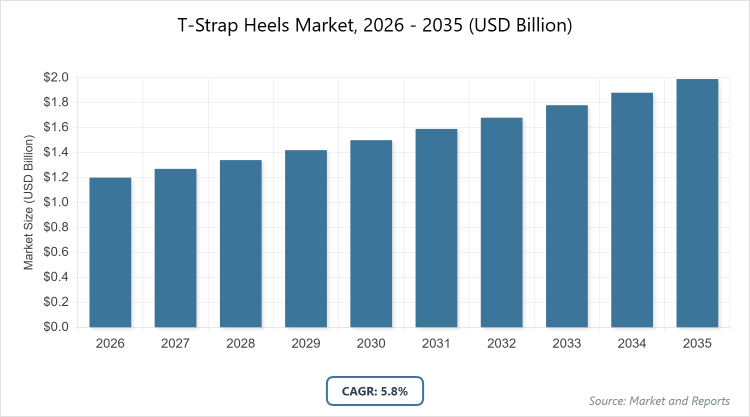
According to MarketnReports, the global T-Strap Heels market size was estimated at USD 1.2 billion in 2025 and is expected to reach USD 2.1 billion by 2035, growing at a CAGR of 5.8% from 2026 to 2035. The T-Strap Heels Market is driven by the revival of vintage and retro fashion trends, emphasizing elegant, structured footwear.
What are the Key Insights into the T-Strap Heels Market?
- The global T-strap heels market was valued at USD 1.2 billion in 2025 and is projected to reach USD 2.1 billion by 2035.
- The market is expected to grow at a CAGR of 5.8% during the forecast period from 2026 to 2035.
- The T-strap heels market is driven by the resurgence of Art Deco-inspired fashion and demand for stable, stylish heels.
- The leather segment dominates the material category with a 50% share due to its premium quality, durability, and classic appeal, allowing for intricate designs that attract high-end consumers.
- The women segment dominates the end-user category with a 85% share as T-strap designs offer feminine elegance and support, enhanced by vintage trend revivals on social platforms.
- Europe dominates the regional market with a 35% share owing to its fashion history, luxury brands, and cultural affinity for retro styles in urban settings.
What is the Industry Overview of the T-Strap Heels Market?
T-strap heels are characterized by a distinctive T-shaped strap that runs vertically down the center of the foot and connects to a horizontal ankle strap, providing both style and stability, often evoking vintage glamour from the 1920s and 1930s while adapted for modern wear. This market includes heels with varying heights and materials, appealing to consumers seeking sophisticated options for formal, casual, or party occasions that blend nostalgia with contemporary comfort. The market definition covers T-strap heels manufactured from diverse materials, sold through multiple channels, and targeted at various end-users, focusing on advancements in ergonomics, sustainability, and design versatility within the broader high-heeled footwear sector.
What are the Market Dynamics in the T-Strap Heels Market?
Growth Drivers
The T-strap heels market is propelled by the revival of vintage aesthetics, influenced by media and runway shows featuring 1920s flapper styles, where consumers value the heels’ secure fit for dancing and extended wear. Rising interest in sustainable luxury, with eco-leather and recycled straps, draws environmentally conscious buyers, while e-commerce expansions enable global access to customized options. Celebrity endorsements and social media trends amplify desirability, particularly among millennials seeking versatile pieces for events. Additionally, innovations in heel cushioning enhance comfort, broadening appeal beyond formal occasions to everyday fashion, driving overall market momentum.
Restraints
Restraints in the T-strap heels market stem from high manufacturing costs for detailed strap work and premium materials, which elevate prices and limit penetration in emerging economies. Competition from comfortable alternatives like block heels or flats diverts consumers amid health concerns over prolonged heel wear. Seasonal demand fluctuations, peaking during party seasons, restrict consistent sales, while global trade disruptions affect material imports. Counterfeit products in online spaces erode trust in authentic brands, further constraining growth in price-sensitive segments.
Opportunities
Opportunities in the T-strap heels market include adopting smart materials, such as adjustable straps with memory foam for personalized fit, targeting active professionals. Expansion into Asia-Pacific via affordable synthetics capitalizes on urbanization and fashion growth. Brands can develop vegan lines to meet sustainability demands, while AR virtual try-ons boost online conversions. Collaborations with vintage-inspired influencers create exclusive collections, enhancing premium pricing and loyalty among Gen Z through social campaigns.
Challenges
Challenges in the T-strap heels market involve ensuring strap durability across sizes, as wear and tear can lead to high returns. Rapid fashion cycles demand constant redesigns, straining resources for niche players. Environmental regulations on tanning processes increase costs, while IP issues with replicated vintage designs dilute uniqueness. Economic pressures reduce luxury spending, and adapting to diverse foot anatomies requires inclusive R&D amid global variations.
T-Strap Heels Market: Report Scope
| Report Attributes | Report Details |
| Report Name | T-Strap Heels Market |
| Market Size 2025 | USD 1.2 Billion |
| Market Forecast 2035 | USD 2.1 Billion |
| Growth Rate | CAGR of 5.8% |
| Report Pages | 220 |
| Key Companies Covered | Manolo Blahnik, Jimmy Choo, Stuart Weitzman, Zara, Gucci, Prada, Christian Louboutin, and Others |
| Segments Covered | By Type, By Material, By Distribution Channel, By End-User, and By Region |
| Regions Covered | North America, Europe, Asia Pacific (APAC), Latin America, and The Middle East and Africa (MEA) |
| Base Year | 2025 |
| Historical Year | 2020 – 2024 |
| Forecast Year | 2026 – 2035 |
| Customization Scope | Avail customized purchase options to meet your exact research needs. |
What is the Market Segmentation of the T-Strap Heels Market?
The T-Strap Heels market is segmented by type, material, distribution channel, end-user, and region.
By Type: The mid heel segment dominates with a significant share, followed by the high heel as the second most dominant. Mid heel’s popularity derives from its balance of elevation and comfort, ideal for all-day wear in professional settings; this dominance drives the market by appealing to practical fashionistas, increasing adoption through versatile styling, and boosting volume in retail channels.
By Distribution Channel: The online segment dominates with a major share, followed by offline as the second most dominant. Online prevails with ease of comparison and global shipping via sites like Zappos; this advances the market through virtual fittings, enhancing accessibility and impulse purchases among digital shoppers.
By End-User: The women segment dominates with an overwhelming share, followed by professionals as the second most dominant. Women’s lead comes from targeted retro marketing and the heels’ flattering silhouette; it fuels expansion via event-driven sales, promoting loyalty and higher margins.
What are the Recent Developments in the T-Strap Heels Market?
- Manolo Blahnik released a vintage-inspired T-strap collection in early 2025, featuring crystal embellishments, which heightened luxury demand and saw rapid sell-outs in boutiques.
- Jimmy Choo updated its T-strap line in mid-2025 with sustainable leather, aligning with eco-trends and boosting e-commerce through celebrity features.
- Stuart Weitzman collaborated with influencers for a limited T-strap series in 2025, incorporating metallic straps, expanding youth appeal and online traffic.
- Zara introduced affordable synthetic T-straps in its fall 2025 drop, targeting fast fashion and resulting in increased store visits.
What is the Regional Analysis of T-Strap Heels Market?
- Europe is to dominate the global market.
Europe commands the T-strap heels market with approximately 35% share, anchored in its rich fashion legacy, appreciation for vintage designs, and high demand for elegant footwear in social scenes. Italy dominates as the key country, driven by artisans in Milan crafting luxury leather options for brands like Gucci, fueling exports; France adds with Paris’s runway influences, while the UK supports through London’s e-commerce. The region’s CAGR of 6.0% to 2035 is bolstered by sustainability norms and cultural events.
North America holds a strong stance with about 30% share, driven by retro trend adoption and high spending on accessories. The United States leads, with New York and Los Angeles propelling sales via Nordstrom and celebrity culture; Canada contributes in Toronto with eco-variants. Projected CAGR of 5.6% through 2035 gains from digital strategies, offsetting variability with premiums.
Asia-Pacific exhibits rapid expansion with around 25% share, set for a CAGR of 6.3% from 2026 to 2035, via urbanization and Western influences. China dominates, with synthetic options on Alibaba in Shanghai, backed by manufacturing; India follows in Mumbai with e-commerce. Growth leverages collaborations and bio-materials, addressing counterfeits.
Latin America shows potential with a roughly 5% share, marked by fashion vibrancy and brand introductions. Brazil leads in São Paulo with colorful designs on Mercado Libre, suited to climates; Mexico bridges with imports. CAGR of 5.4% to 2035 benefits from digital and recycled initiatives, navigating economics.
The Middle East and Africa (MEA) provide emerging avenues with about 5% share, from luxury aspirations and retail growth. The United Arab Emirates dominates in Dubai’s malls with premium imports; Saudi Arabia accelerates in Riyadh. CAGR of 5.2% through 2035 thrives on tourism and eco-shifts, despite constraints.
Who are the Key Market Players in the T-Strap Heels Market?
- Manolo Blahnik focuses on crystal-embellished T-straps, using artisanal techniques for luxury positioning via exclusive drops.
- Jimmy Choo prioritizes sustainable T-strap innovations, leveraging celebrity ties to expand premium share.
- Stuart Weitzman employs influencer collaborations for metallic T-straps, targeting youth for trend growth.
- Zara delivers fast-fashion T-shirts, utilizing supply chains for mass accessibility.
- Gucci integrates vintage T-straps with logos, focusing on the runway for elite markets.
- Prada adopts minimalist T-strap approaches, emphasizing quality for urban expansion.
- Christian Louboutin pursues bold T-strap designs, using red soles for differentiation in premiums.
What are the Market Trends in the T-Strap Heels Market?
- Revival of 1920s flapper styles with T-strap embellishments for vintage glamour.
- Shift to eco-leather and recycled straps for sustainable appeal.
- Rise in metallic and jewel tones for party versatility.
- Integration of cushioned insoles for all-day comfort.
- Growth in customizable strap lengths via apps.
- Adoption of block T-straps for stability in trends.
- Focus on hybrid formal-casual designs for professionals.
What Market Segments and Subsegments are Covered in the T-Strap Heels Report?
By Type
-
- Low Heel
- Mid Heel
- High Heel
- Block Heel
- Others
By Material
-
- Leather
- Synthetic
- Suede
- Fabric
- Others
By Distribution Channel
-
- Online
- Offline
- Others
By End-User
-
- Women
- Teens
- Professionals
- Others
By Region
-
- North America
- U.S.
- Canada
- Europe
- UK
- Germany
- France
- Rest of Europe
- Asia Pacific
- China
- India
- Japan
- Rest of Asia Pacific
- Latin America
- Brazil
- Mexico
- Rest of Latin America
- Middle East & Africa
- UAE
- South Africa
- Rest of Middle East & Africa
- North America
Chapter 1. Preface
Chapter 2. Executive Summary
Chapter 3. Global T-Strap Heels Market - Industry Analysis
Chapter 4. Global T-Strap Heels Market- Competitive Landscape
Chapter 5. Global T-Strap Heels Market - Type Analysis
Chapter 6. Global T-Strap Heels Market - Material Analysis
Chapter 7. Global T-Strap Heels Market - Distribution Channel Analysis
Chapter 8. Global T-Strap Heels Market - End-User Analysis
Chapter 9. T-Strap Heels Market - Regional Analysis
Chapter 10. Company Profiles
Frequently Asked Questions
T-strap heels feature a central vertical strap connecting to an ankle strap, offering style and support in vintage-inspired designs.
Key factors include vintage revivals, sustainable materials, e-commerce, and celebrity influences.
The market is projected to grow from USD 1.2 billion in 2025 to USD 2.1 billion by 2035.
The CAGR is expected to be 5.8% from 2026 to 2035.
Europe will contribute notably, with around 35% share due to fashion legacy.
Major players include Manolo Blahnik, Jimmy Choo, Stuart Weitzman, Zara, Gucci, Prada, and Christian Louboutin.
The report delivers comprehensive insights on size, trends, segments, regions, players, and forecasts from 2026 to 2035.
Stages encompass material sourcing, design/manufacturing, distribution, marketing, and end-user consumption with support.
Trends evolve toward sustainability and versatility, with preferences for comfortable, retro designs via social media.
Eco-regulations encourage sustainable practices, positively influencing growth through innovative materials.