
Synchronizer Ring Market Size, Share, and Trends 2026 to 2035
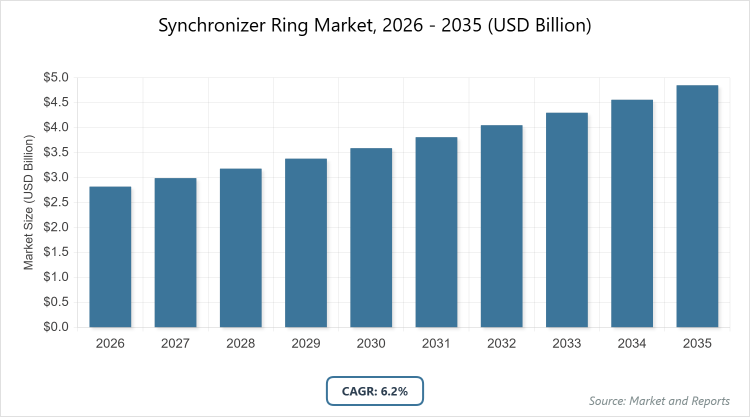
According to MarketReports, the global synchronizer ring market size was estimated at USD 2.82 billion in 2025 and is expected to reach USD 4.85 billion by 2035, growing at a CAGR of 6.2% from 2026 to 2035. The Synchronizer Ring Market is primarily driven by the increasing global production of passenger and commercial vehicles, particularly in emerging economies where manual and automated transmissions (AMT) remain the preferred choice due to their cost-efficiency and mechanical simplicity.
What are the key insights into the Synchronizer Ring Market?
- The global synchronizer ring market is projected to grow from USD 2.82 billion in 2026 to USD 4.85 billion in 2035.
- The market is anticipated to register a CAGR of 6.2% during the forecast period from 2026 to 2035.
- Steel synchronizer rings dominate the material segment due to their superior durability and resistance to wear.
- Passenger vehicles lead the application segment, driven by high production volumes and consumer demand for affordable manual transmission cars.
- Asia-Pacific dominates regionally, accounting for the largest market share owing to robust automotive manufacturing and sales.
What is the Synchronizer Ring Market?
Industry Overview
The synchronizer ring market encompasses the production, distribution, and application of specialized components integral to automotive transmission systems, primarily in manual and certain automatic gearboxes. These rings, also known as blocking rings, facilitate seamless gear shifting by equalizing the rotational speeds of gears, thereby preventing grinding and ensuring smooth transitions during vehicle operation.
Predominantly used in passenger and commercial vehicles, the market involves a value chain from raw material sourcing, such as metals like brass and steel, to manufacturing through precision engineering techniques, and extends to integration by original equipment manufacturers (OEMs) and aftermarket suppliers. This industry supports the broader automotive sector by enhancing driving efficiency, reducing wear on transmission parts, and contributing to overall vehicle performance and safety, with evolving demands driven by technological advancements in transmission designs and the shift toward more durable and lightweight materials.
What Drives the Synchronizer Ring Market?
Growth Drivers
The synchronizer ring market is propelled by the rising global demand for vehicles with manual transmissions, particularly in emerging economies where cost-effective and fuel-efficient options remain popular among consumers; this is further amplified by increasing automotive production, urbanization, and higher disposable incomes leading to greater vehicle ownership, alongside the growing aftermarket for replacement parts due to aging vehicle fleets and maintenance needs, as well as innovations in transmission technologies like dual-clutch systems that require advanced synchronizer components to improve performance and efficiency.
Restraints
Market growth faces hurdles from the accelerating shift toward automatic and continuously variable transmissions (CVTs), which reduce the necessity for traditional synchronizer rings, compounded by the rapid adoption of electric vehicles (EVs) that often eliminate multi-gear transmissions altogether; additionally, supply chain disruptions, fluctuating raw material prices for metals like steel and brass, and stringent regulatory standards on emissions and vehicle efficiency impose higher production costs and compliance challenges on manufacturers, limiting expansion in price-sensitive regions.
Opportunities
Emerging prospects lie in the integration of synchronizer rings into hybrid and electric vehicle transmissions, where multi-speed systems are being developed for high-performance EVs to optimize energy efficiency; furthermore, advancements in material science, such as the use of carbon-fiber composites and high-strength alloys, open avenues for lighter, more durable products that align with sustainability goals, while expanding automotive markets in Asia-Pacific and Latin America offer potential for partnerships with local OEMs and increased aftermarket penetration through digital sales channels.
Challenges
The industry grapples with adapting to the electrification trend, where traditional components like synchronizer rings must evolve or risk obsolescence in fully electric drivetrains; moreover, volatile global trade relations affecting raw material availability, coupled with the need for continuous R&D investment to meet evolving emission regulations and consumer preferences for automated driving, pose significant operational and financial strains on smaller players in a competitive landscape dominated by large conglomerates.
Synchronizer Ring Market: Report Scope
| Report Attributes | Report Details |
| Report Name | Synchronizer Ring Market |
| Market Size 2025 | USD 2.82 Billion |
| Market Forecast 2035 | USD 4.85 Billion |
| Growth Rate | CAGR of 6.2% |
| Report Pages | 220 |
| Key Companies Covered | ZF Friedrichshafen AG, BorgWarner Inc, Aisin Seiki Co., Ltd, Schaeffler Group, and NSK Ltd |
| Segments Covered | By Material, By Application, By Region |
| Regions Covered | North America, Europe, Asia Pacific (APAC), Latin America, The Middle East and Africa (MEA) |
| Base Year | 2025 |
| Historical Year | 2020 – 2024 |
| Forecast Year | 2026 – 2035 |
| Customization Scope | Avail customized purchase options to meet your exact research needs. |
How is the Synchronizer Ring Market Segmentation?
The synchronizer ring market is segmented by material, application, and region.
By material, In the material segmentation, steel synchronizer rings emerge as the most dominant subsegment, capturing over 50% of the market share, primarily because of their exceptional strength, longevity, and ability to withstand high-stress conditions in heavy-duty applications, which drives market growth by reducing replacement frequency and enhancing transmission reliability in both passenger and commercial vehicles, thereby lowering overall maintenance costs for end-users and supporting the industry’s push toward more efficient automotive systems. The second most dominant is brass synchronizer rings, holding around 30% share, valued for their excellent thermal conductivity and cost-effectiveness in standard passenger car transmissions, which contributes to market expansion by enabling smoother gear shifts in budget-friendly vehicles popular in emerging markets, thus broadening accessibility and sustaining demand amid rising vehicle ownership.
By application, Within the application segmentation, passenger vehicles stand out as the most dominant, comprising approximately 70% of the market, attributed to the massive global production of personal cars, especially those with manual transmissions in cost-conscious regions, which propels the overall market by increasing the volume of synchronizer ring integrations and fostering innovations in lightweight designs that improve fuel efficiency and driving comfort. Commercial vehicles rank as the second most dominant, with about 30% share, fueled by the expanding logistics sector requiring durable transmission components for trucks and buses under varying loads, thereby driving market growth through heightened demand for robust rings that ensure operational reliability and minimize downtime in fleet operations.
What Recent Changes Have Occurred in the Synchronizer Ring Market?
- In March 2023, ZF Friedrichshafen AG introduced a new series of synchronizer rings optimized for electric vehicle applications, incorporating advanced materials to support multi-speed transmissions in high-performance EVs, marking a strategic pivot toward electrification and enhancing compatibility with hybrid systems.
- In January 2024, Aisin Seiki Co., Ltd. announced the expansion of its manufacturing plant in Mexico, aimed at boosting production capacity for synchronizer rings to meet rising demand in the North American aftermarket, reflecting efforts to strengthen supply chains amid global disruptions.
- In July 2025, BorgWarner Inc. formed a partnership with a prominent electric vehicle producer to supply specialized synchronizer rings for next-generation models, emphasizing lightweight composites to improve energy efficiency and align with sustainability trends in the automotive sector.
How Does the Synchronizer Ring Market Vary by Region?
- Asia-Pacific to dominate the market
Asia-Pacific dominates the global synchronizer ring market with the largest share of approximately 45%, driven by massive automotive production and a strong preference for manual transmission vehicles in emerging economies. China emerges as the leading country, accounting for over 30% of global output due to its position as the world’s top vehicle manufacturer with annual production exceeding 25 million units. Rapid urbanization, rising middle-class incomes, and government support for local manufacturing in India and Southeast Asia further accelerate demand and aftermarket growth. Local suppliers benefit from cost advantages and supply chain integration with major OEMs. This region’s sustained manual transmission popularity ensures its dominant position through 2035.
North America holds a significant market share of around 30%, characterized by a mature automotive sector, high vehicle ownership, and robust demand for replacement parts in aging fleets. The United States dominates the region, supported by over 280 million registered vehicles and a focus on performance transmissions in passenger cars and light trucks. Growth is bolstered by increasing adoption of multi-speed systems in hybrids and niche manual preferences. Major manufacturers and stringent quality standards drive innovation in durable materials. Aftermarket channels thrive due to extensive road networks and consumer emphasis on maintenance.
Europe accounts for about 20% of the market, exhibiting steady growth with a CAGR higher than the global average, fueled by premium vehicle production and regulatory push for efficient transmissions. Germany leads as the dominant country, home to key players like ZF and Schaeffler, emphasizing exports and advanced engineering in dual-clutch systems. High ownership rates in France and the UK, combined with EU sustainability initiatives, promote lightweight and eco-friendly synchronizer designs. Hybrid vehicle expansion sustains demand amid transitioning to electrification. R&D investments ensure technological leadership in the region.
Latin America represents around 8% of the global share, showing moderate growth supported by economic recovery and expanding automotive assembly operations. Brazil dominates as the primary country, producing several million vehicles annually with a focus on affordable manual transmission models for domestic and regional markets. Rising commercial vehicle needs in logistics boost durable component demand. Government incentives for local production enhance market accessibility. Aftermarket sales grow with increasing vehicle parc and urbanization trends.
The Middle East & Africa holds approximately 7% share, emerging through infrastructure projects and growing fleet requirements in commercial sectors. South Africa leads as the dominant country, with established assembly plants catering to heavy-duty trucks and mining applications needing reliable transmissions. The UAE contributes via luxury vehicle imports and performance parts demand. Oil economies support vehicle ownership expansion and aftermarket services. Focus on sustainable mobility gradually influences component preferences.
Who Leads the Synchronizer Ring Market and How?
- ZF Friedrichshafen AG employs strategies focused on innovation in electrification, investing heavily in R&D for synchronizer rings compatible with EV and hybrid transmissions, alongside strategic partnerships with OEMs to expand market reach and enhance product durability through advanced materials.
- BorgWarner Inc. prioritizes acquisitions and collaborations with electric vehicle manufacturers to integrate lightweight synchronizer solutions, emphasizing sustainability by adopting eco-friendly manufacturing processes to reduce emissions and meet regulatory standards.
- Aisin Seiki Co., Ltd. pursues global expansion through facility upgrades and localized production in key markets like North America, leveraging cost efficiencies and supply chain optimizations to cater to the growing aftermarket demand for reliable transmission components.
- Schaeffler Group concentrates on technological advancements in precision engineering, developing high-strength alloy rings to improve performance in commercial vehicles, while forming alliances with European automakers to drive innovation in fuel-efficient systems.
- NSK Ltd. adopts a strategy of material diversification, incorporating carbon composites for lighter rings, combined with digitalization in supply chains to enhance distribution efficiency and target emerging markets in the Asia-Pacific.
What are the Current Market Trends in the Synchronizer Ring Market?
- Advancements in lightweight materials like carbon-fiber composites and high-strength alloys to enhance durability and fuel efficiency in response to emission regulations.
- Increasing integration of synchronizer rings in hybrid and electric vehicle transmissions to support multi-speed systems for better performance.
- Shift toward sustainable manufacturing practices, including recycling and eco-friendly processes, to align with global environmental standards.
- Growth in the aftermarket segment is driven by aging vehicle fleets and rising consumer awareness of maintenance for manual transmissions.
- Adoption of digital sales channels and e-commerce for replacement parts streamlines access in emerging regions.
What Categories are Explored in the Synchronizer Ring Market Report?
By Material
- Steel Synchronizer Rings
- Brass Synchronizer Rings
- Copper Base Alloy Rings
By Application
- Passenger Vehicles
- Commercial Vehicles
By Region
-
- North America
- U.S.
- Canada
- Europe
- UK
- Germany
- France
- Rest of Europe
- Asia Pacific
- China
- India
- Japan
- Rest of Asia Pacific
- Latin America
- Brazil
- Mexico
- Rest of Latin America
- Middle East & Africa
- UAE
- South Africa
- Rest of Middle East & Africa
- North America
Frequently Asked Questions
Synchronizer rings are essential automotive components used in transmission systems to facilitate smooth gear shifts by matching the speeds of engaging gears, preventing grinding and extending the lifespan of the gearbox.
Key factors include rising demand for manual transmission vehicles in emerging markets, advancements in material technologies for durability, integration in hybrid EVs, but tempered by shifts to automatic transmissions and supply chain volatilities.
The market is expected to grow from USD 2.82 billion in 2026 to USD 4.85 billion by 2035.
The CAGR is projected at 6.2% over the forecast period.
Asia-Pacific will contribute the most, driven by high vehicle production and sales in countries like China and India.
Major players include ZF Friedrichshafen AG, BorgWarner Inc, Aisin Seiki Co., Ltd, Schaeffler Group, and NSK Ltd
The report provides comprehensive insights into market size, growth drivers, segmentation, regional analysis, key players, trends, and forecasts to aid strategic decision-making.
The value chain includes raw material procurement (metals like steel and brass), manufacturing through forging and machining, assembly by OEMs, distribution via suppliers, and end-use in vehicles with aftermarket support.
Trends are shifting toward lightweight, sustainable materials and EV-compatible designs, while consumers prefer durable components for fuel efficiency and smooth performance in manual vehicles.
Stringent emission regulations like the EU's Green Deal and global sustainability mandates are pushing for eco-friendly materials and innovations, while supply chain regulations impact raw material costs and availability.