
Sustainable Palm Oil Market Size, Share and Trends 2026 to 2035
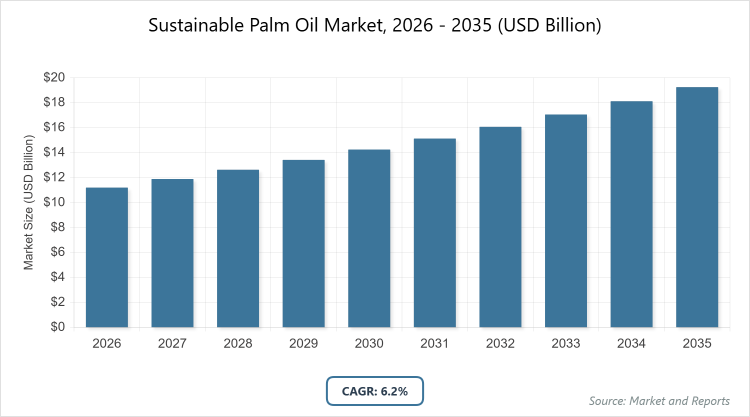
According to MarketnReports, the global Sustainable Palm Oil market size was estimated at USD 11.2 billion in 2025 and is expected to reach USD 20.5 billion by 2035, growing at a CAGR of 6.2% from 2026 to 2035. Rising consumer demand for ethically sourced products and stringent environmental regulations.
What are the Key Insights into the Sustainable Palm Oil Market?
- The global sustainable palm oil market size was valued at USD 11.2 billion in 2025 and is projected to reach USD 20.5 billion by 2035.
- The sustainable palm oil market is expected to grow at a CAGR of 6.2% during the forecast period from 2026 to 2035.
- The sustainable palm oil market is driven by increasing corporate commitments to sustainability, regulatory pressures for eco-friendly sourcing, and growing consumer preference for certified products.
- In the type segment, crude palm oil dominates with a 50% share due to its versatility as a base material for refining and widespread use in food and biofuel applications, supported by easier certification processes.
- In the application segment, food & beverage dominates with a 60% share owing to high demand for sustainable ingredients in processed foods, driven by consumer awareness and brand commitments to ethical sourcing.
- In the end-user segment, food industry dominates with a 55% share because it requires large volumes of certified oil for compliance with global standards and to meet retailer sustainability demands.
- Asia Pacific dominates the global sustainable palm oil market with a 60% share, attributed to major production hubs in Indonesia and Malaysia, coupled with strong export demands and government-backed certification initiatives.
What is the Sustainable Palm Oil?
Industry Overview
Sustainable palm oil refers to palm oil produced in ways that minimize environmental impact, protect biodiversity, and ensure fair labor practices, often certified by organizations like the Roundtable on Sustainable Palm Oil (RSPO). This market encompasses the cultivation, processing, and distribution of palm oil that adheres to sustainability standards, including traceability from plantation to end product, excluding conventional palm oil without certification. The market definition involves the global sector focused on eco-friendly palm oil variants used across industries, promoting deforestation-free practices and community benefits to address criticisms of traditional palm oil production. It supports a shift toward responsible sourcing, balancing economic viability with ecological preservation in major producing regions.
What are the Market Dynamics in Sustainable Palm Oil?
Growth Drivers
The sustainable palm oil market is experiencing robust growth driven by heightened global awareness of environmental issues and corporate pledges to reduce deforestation linked to palm oil production. Consumer preferences are shifting toward ethically sourced products, prompting major food and cosmetic brands to adopt RSPO-certified oil, which enhances brand reputation and meets retailer sustainability requirements. Regulatory frameworks in Europe and North America, such as the EU Deforestation Regulation, mandate traceable and sustainable sourcing, compelling suppliers to invest in certification and transparent supply chains.
Technological advancements in plantation management, like precision agriculture and blockchain for traceability, improve yield efficiency while ensuring compliance, further boosting market adoption. Additionally, the expanding biofuel sector seeks sustainable feedstocks to align with green energy goals, creating new demand avenues in emerging economies.
Restraints
High certification costs and complex supply chain requirements act as significant restraints in the sustainable palm oil market, particularly for smallholder farmers who struggle with compliance expenses and documentation. Limited infrastructure in producing regions hinders widespread adoption of sustainable practices, leading to supply shortages and price premiums that deter cost-sensitive buyers. Consumer skepticism about certification effectiveness, amid greenwashing concerns, undermines trust and slows market penetration in price-driven segments. Volatility in palm oil prices due to weather impacts and geopolitical factors affects investment in sustainable initiatives. Moreover, competing vegetable oils like soy or sunflower, perceived as more sustainable alternatives, pose substitution risks in applications where palm oil’s unique properties are not essential.
Opportunities
Opportunities in the sustainable palm oil market are emerging from the rise of bio-based products and circular economy models, where certified oil serves as a key ingredient in eco-friendly cosmetics, lubricants, and bioplastics. Partnerships between NGOs, governments, and corporations to support smallholder certification programs can expand supply bases in Africa and Latin America, tapping into untapped production potential. Digital innovations, such as satellite monitoring for zero-deforestation compliance, offer tools for enhanced traceability, attracting investment from impact funds focused on ESG criteria. Growing demand in Asia’s expanding middle class for sustainable consumer goods provides market entry points for premium certified products. Furthermore, policy incentives for sustainable biofuels in transportation sectors open avenues for diversified applications beyond traditional uses.
Challenges
Challenges persist in the sustainable palm oil market due to enforcement gaps in certification standards, where illegal logging and land conversion undermine credibility and supply integrity. Smallholders, representing a large portion of production, face barriers in accessing markets and financing for sustainable upgrades, leading to uneven adoption rates. Market fragmentation with multiple certification schemes confuses buyers and dilutes impact, complicating global harmonization efforts. Climate change effects, such as erratic weather patterns, threaten yields in key regions, exacerbating supply vulnerabilities. Additionally, balancing economic development in producing countries with environmental protection requires nuanced policy approaches to avoid trade barriers or boycotts that could disrupt global supply chains.
Sustainable Palm Oil Market: Report Scope
| Report Attributes | Report Details |
| Report Name | Sustainable Palm Oil Market |
| Market Size 2025 | USD 11.2 Billion |
| Market Forecast 2035 | USD 20.5 Billion |
| Growth Rate | CAGR of 6.2% |
| Report Pages | 220 |
| Key Companies Covered |
Wilmar International Limited, Sime Darby Plantation Berhad, Golden Agri-Resources Ltd, IOI Corporation Berhad, Cargill, Incorporated, Kuala Lumpur Kepong Berhad, Musim Mas Holdings, United Plantations Berhad, SIPEF NV, AAK AB, and Others |
| Segments Covered | By Type, By Application, By End-User, and By Region |
| Regions Covered | North America, Europe, Asia Pacific (APAC), Latin America, and The Middle East and Africa (MEA) |
| Base Year | 2025 |
| Historical Year | 2020 – 2024 |
| Forecast Year | 2026 – 2035 |
| Customization Scope | Avail customized purchase options to meet your exact research needs. |
How is the Sustainable Palm Oil Market Segmentation Analyzed?
The Sustainable Palm Oil market is segmented by type, application, end-user, and region.
Based on Type Segment, crude palm oil emerges as the most dominant subsegment, followed by palm kernel oil as the second most dominant. Crude palm oil leads due to its primary role in downstream refining for various applications and easier integration into sustainable supply chains through mass balance certification; this dominance drives the market by enabling scalable production that meets global demand for versatile, cost-effective, sustainable oils while supporting traceability initiatives.
Based on Application Segment, food & beverage stands out as the most dominant subsegment, with cosmetics & personal care as the second most dominant. Food & beverage dominates because it accounts for the bulk of palm oil consumption in processed goods, where sustainability certifications are increasingly mandated by retailers; this drives market growth through high-volume commitments from major brands, fostering broader adoption and investment in certified plantations.
Based on the end-user segment, the food industry is the most dominant subsegment, with the cosmetic industry as the second most dominant. The food industry leads as it utilizes large quantities for manufacturing, driven by consumer and regulatory pressure for ethical sourcing; its dominance propels the market by encouraging supply chain transformations that enhance overall sustainability standards and market accessibility.
What are the Recent Developments in Sustainable Palm Oil?
- In January 2026, Wilmar International announced a partnership with smallholder farmers in Indonesia to expand RSPO-certified plantations, aiming to increase sustainable output by 20% through training and technology support.
- In March 2026, Sime Darby Plantation launched a blockchain-based traceability platform for its sustainable palm oil supply chain, enhancing transparency and compliance with EU regulations.
- In April 2026, Cargill committed to sourcing 100% sustainable palm oil for its European operations by 2027, investing in verification systems to meet growing demand.
- In September 2025, IOI Corporation expanded its sustainable palm oil production in Malaysia with new zero-deforestation commitments, targeting a 15% increase in certified volumes.
- In November 2025, Unilever unveiled plans to achieve full traceability in its sustainable palm oil supply, collaborating with RSPO to strengthen certification processes.
How Does Regional Analysis Shape the Sustainable Palm Oil Market?
- Asia Pacific to dominate the global market.
Asia Pacific holds the leading position in the sustainable palm oil market, driven by extensive production capacities and government initiatives promoting certification, with Indonesia as the dominating country where vast plantations and export-oriented policies fuel sustainable practices. Indonesia’s dominance is bolstered by its role as the world’s largest producer, implementing national standards like ISPO alongside RSPO to address global demands, while Malaysia follows closely with advanced refining infrastructure and commitments to no-deforestation pledges.
Europe maintains a strong influence in the sustainable palm oil market through stringent regulations and consumer-driven demand for certified products, with Germany as the dominating country leveraging its manufacturing base for food and cosmetics that require traceable sourcing. The region’s focus on the EU Deforestation Regulation pushes importers toward sustainable options, supporting innovation in supply chain verification across member states.
North America shows steady growth in the sustainable palm oil market, emphasized by corporate sustainability goals and biofuel applications, dominated by the United States, where major brands commit to RSPO-certified oil amid rising eco-conscious consumption. The area’s emphasis on transparent labeling and partnerships with producers enhances market integration, particularly in food processing and personal care sectors.
Latin America is emerging in the sustainable palm oil market with expanding plantations and certification efforts, led by Colombia, where favorable climates and government support drive sustainable exports to Europe. The region’s biodiversity focus encourages zero-deforestation models, positioning it as a growing alternative supplier.
The Middle East and Africa region exhibits potential in the sustainable palm oil market, focusing on local consumption and emerging production, with South Africa as the dominating country, utilizing imports for food industries while pushing for regional certification standards. The area’s development is aided by international collaborations to build sustainable practices amid arid challenges.
Who are the Key Market Players in Sustainable Palm Oil?
- Wilmar International Limited emphasizes supply chain traceability and smallholder inclusion through programs like PROSPEK, investing in digital tools for certification compliance.
- Sime Darby Plantation Berhad focuses on zero-deforestation commitments and partnerships for seed innovation, enhancing yield sustainability in core operations.
- Golden Agri-Resources Ltd pursues vertical integration and RSPO adherence, expanding certified plantations via community engagements.
- IOI Corporation Berhad adopts strategic expansions and technology-driven monitoring to ensure no-deforestation sourcing.
- Cargill, Incorporated, leverages global networks for sustainable sourcing, committing to full traceability by 2025.
- Kuala Lumpur Kepong Berhad invests in R&D for high-yield varieties and certification, supporting smallholder training.
- Musim Mas Holdings prioritizes integrated refining with sustainability, focusing on biofuel applications.
- United Plantations Berhad emphasizes organic practices and carbon reduction strategies in plantations.
- SIPEF NV targets European markets with certified oil, enhancing traceability systems.
- AAK AB develops specialty fats from sustainable palm, partnering for customized solutions.
What are the Market Trends in Sustainable Palm Oil?
- Rising adoption of blockchain for supply chain traceability to ensure certification integrity.
- Increasing corporate commitments to 100% sustainable sourcing by major brands.
- Growth in smallholder certification programs to expand supply bases.
- Expansion of national sustainability standards like ISPO and MSPO.
- Demand for premium certified oils in cosmetics and biofuels.
- Integration of satellite monitoring for zero-deforestation compliance.
- Shift toward segregated and identity-preserved supply models.
- Focus on biodiversity conservation in plantation management.
What Market Segments and Subsegments are Covered in the Sustainable Palm Oil Report?
By Type
- Crude Palm Oil
- Palm Kernel Oil
- Fractional Palm Oil
- Red Palm Oil
- White Palm Oil
- Refined Palm Oil
- Organic Palm Oil
- RSPO Certified Palm Oil
- Identity Preserved Palm Oil
- Segregated Palm Oil
- Others
By Application
- Food & Beverage
- Cosmetics & Personal Care
- Biofuel
- Pharmaceuticals
- Animal Feed
- Surfactants
- Lubricants
- Oleochemicals
- Bakery Products
- Confectionery
- Others
By End-User
- Food Industry
- Cosmetic Industry
- Energy Sector
- Pharmaceutical Companies
- Animal Feed Manufacturers
- Household Consumers
- Industrial Users
- Retailers
- Chemical Manufacturers
- Bioenergy Producers
- Others
By Region
- North America
- U.S.
- Canada
- Europe
- UK
- Germany
- France
- Rest of Europe
- Asia Pacific
- China
- India
- Japan
- Rest of Asia Pacific
- Latin America
- Brazil
- Mexico
- Rest of Latin America
- Middle East & Africa
- UAE
- South Africa
- Rest of Middle East & Africa
Frequently Asked Questions
Sustainable palm oil is palm oil produced through environmentally responsible practices that minimize deforestation, protect biodiversity, and ensure fair labor, often certified by standards like RSPO.
Key factors include regulatory mandates for deforestation-free products, corporate sustainability pledges, consumer demand for ethical sourcing, and advancements in traceability technologies.
The market is projected to grow from over USD 11.2 billion in 2025 to USD 20.5 billion by 2035.
The CAGR is expected to be 6.2% from 2026 to 2035.
Asia Pacific will contribute notably, as the primary production and export hub with strong certification initiatives.
Major players include Wilmar International Limited, Sime Darby Plantation Berhad, Golden Agri-Resources Ltd, IOI Corporation Berhad, and Cargill, Incorporated.
The report offers detailed insights on market size, trends, segmentation, regional analysis, key players, and growth forecasts.
Stages include plantation cultivation, harvesting, milling, refining, certification, distribution, and end-use application.
Trends focus on traceability and certification, with consumers preferring eco-labeled products and brands committing to sustainability.
Factors include EU deforestation regulations, national certification mandates, and biodiversity protection policies pushing for sustainable practices.