
Sustainability in Chemicals Market Size, Share and Trends 2026 to 2035
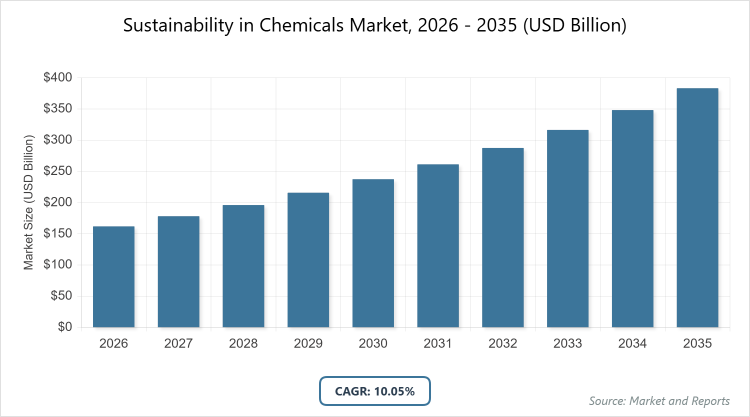
According to MarketnReports, the global Sustainability in Chemicals Market size was estimated at USD 161.87 billion in 2025 and is expected to reach USD 421.66 billion by 2035, growing at a CAGR of 10.05% from 2026 to 2035. Sustainability in Chemicals Market is driven by increasing regulatory pressures and rising consumer demand for eco-friendly products.
What are the Key Insights of the Sustainability in Chemicals Market?
- The global Sustainability in Chemicals Market was valued at USD 161.87 billion in 2025 and is projected to reach USD 421.66 billion by 2035.
- The Sustainability in Chemicals Market is anticipated to grow at a CAGR of 10.05% during the forecast period from 2026 to 2035.
- The Sustainability in Chemicals Market is driven by stringent environmental regulations and growing adoption of green chemistry practices across industries.
- In the product type segment, bio-alcohols dominate with a 35% share due to their versatile applications in biofuels and solvents, enabling reduced reliance on fossil fuels.
- In the application segment, construction dominates with a 27% share because of the increasing use of sustainable materials in building practices to meet green certification standards.
- In the end-user segment, manufacturing industries dominate with a 32% share owing to the integration of eco-friendly chemicals in production processes to enhance sustainability and efficiency.
- Asia Pacific dominates the Sustainability in Chemicals Market with a 45% share attributed to rapid industrialization, supportive government policies, and high demand from emerging economies like China and India.
What is the Sustainability in Chemicals Market Industry Overview?
The Sustainability in Chemicals Market involves the development, production, and distribution of chemical products and processes that minimize environmental impact, promote resource efficiency, and support circular economy principles. This market encompasses bio-based, recycled, and low-emission chemicals designed to replace traditional petroleum-derived alternatives, serving diverse industries while addressing global sustainability challenges. Market definition pertains to the sector focused on green chemistry innovations, including renewable feedstocks, biodegradable materials, and energy-efficient manufacturing techniques, which aim to reduce carbon footprints, conserve resources, and comply with stringent environmental regulations without compromising performance or economic viability.
What are the Market Dynamics of the Sustainability in Chemicals Market?
Growth Drivers
The Sustainability in Chemicals Market is fueled by escalating global awareness of climate change and the push for carbon-neutral initiatives, prompting industries to adopt bio-based and recyclable chemicals. Advancements in biotechnology and green synthesis methods have lowered production costs, making sustainable alternatives more accessible and competitive. Moreover, corporate commitments to ESG criteria and consumer preferences for environmentally responsible products are accelerating demand, while government incentives for renewable resources further bolster market expansion across sectors like packaging and automotive.
Restraints
Fluctuations in the availability and pricing of bio-based feedstocks, such as agricultural residues, pose challenges to consistent supply chains and scalability. High initial investment requirements for transitioning to sustainable production facilities deter smaller enterprises from entering the market. Additionally, technical limitations in achieving equivalent performance to conventional chemicals in certain applications, combined with complex certification processes, slow down widespread adoption and hinder overall growth.
Opportunities
The integration of circular economy models offers avenues for innovation in chemical recycling and upcycling technologies, creating new revenue streams from waste materials. Expanding markets in developing regions provide untapped potential for sustainable chemical solutions tailored to local needs, such as water treatment and agriculture. Furthermore, collaborations between academia, industry, and governments can drive R&D in novel green chemistries, positioning companies to capitalize on emerging trends like bio-refineries and low-carbon processes.
Challenges
Ensuring consistent quality and scalability of sustainable chemicals amid varying raw material sources remains a hurdles, impacting reliability in high-stakes applications. Regulatory inconsistencies across regions complicate global trade and compliance efforts for multinational firms. Additionally, competition from established fossil-based products, which often benefit from economies of scale, requires ongoing education and advocacy to shift market perceptions and behaviors toward sustainability.
Sustainability in Chemicals Market: Report Scope
| Report Attributes | Report Details |
| Report Name | Sustainability in Chemicals Market |
| Market Size 2025 | USD 161.87 Billion |
| Market Forecast 2035 | USD 421.66 Billion |
| Growth Rate | CAGR of 10.05% |
| Report Pages | 220 |
| Key Companies Covered |
BASF SE, Dow Inc., Braskem SA, Arkema Group, Novozymes A/S, Eastman Chemical Company, and Others. |
| Segments Covered | By Product Type, By Application, By End-User, and By Region. |
| Regions Covered | North America, Europe, Asia Pacific (APAC), Latin America, and The Middle East and Africa (MEA) |
| Base Year | 2025 |
| Historical Year | 2020 - 2024 |
| Forecast Year | 2026 - 2035 |
| Customization Scope | Avail customized purchase options to meet your exact research needs. |
What is the Market Segmentation of the Sustainability in Chemicals Market?
The Sustainability in Chemicals Market is segmented by product type, application, end-user, and region.
By Product Type Segment. Bio-alcohols emerge as the most dominant subsegment, followed by bio-polymers as the second most dominant. Bio-alcohols lead due to their broad utility in producing biofuels, solvents, and intermediates with lower emissions, driving the market by facilitating the transition to renewable energy sources and reducing dependence on petroleum, thereby enhancing environmental compliance and energy security. Bio-polymers rank second, prized for their biodegradability and use in packaging and textiles, contributing to market growth by addressing plastic pollution concerns and supporting circular economy initiatives through innovative, plant-derived materials.
By Application Segment. Construction stands out as the most dominant subsegment, with packaging as the second most dominant. Construction's dominance arises from the essential incorporation of green adhesives, coatings, and insulators to achieve sustainable building standards, propelling the market by enabling energy-efficient structures and meeting regulatory demands for reduced environmental impact. Packaging follows, utilizing sustainable chemicals for recyclable and compostable materials, which advances the market by catering to consumer demands for eco-friendly products and minimizing waste in supply chains.
By End-User Segment. Manufacturing industries is the most dominant subsegment, while automotive & transportation ranks as the second most dominant. Manufacturing industries lead because they extensively employ sustainable chemicals to optimize processes, reduce emissions, and improve product lifecycle sustainability, fueling market growth through enhanced operational efficiencies and alignment with global ESG goals. Automotive & transportation comes second, incorporating lightweight bio-materials and low-emission coatings to support electric vehicle advancements, which drives the market by promoting fuel efficiency and complying with stringent emission regulations.
What are the Recent Developments in the Sustainability in Chemicals Market?
- BASF expanded its bio-based chemicals portfolio with a new production facility for sustainable surfactants, targeting the personal care industry to reduce carbon footprints and meet rising demand for green ingredients.
- Dow Inc. announced a collaboration with a biotech firm to develop advanced bio-polymers from agricultural waste, enhancing material properties for packaging applications and advancing circular economy goals.
- Braskem invested in a large-scale bio-ethanol plant in Brazil, aiming to increase output of renewable polyethylene and support global efforts in reducing plastic pollution.
- Arkema acquired a startup specializing in green solvents, integrating innovative technologies to offer low-VOC alternatives for industrial coatings and adhesives.
- Novozymes launched enzyme-based solutions for efficient biofuel production, optimizing processes to lower energy consumption and emissions in the energy sector.
What is the Regional Analysis of the Sustainability in Chemicals Market?
Asia Pacific to dominate the global market.
Asia Pacific commands the largest share in the Sustainability in Chemicals Market, propelled by robust economic expansion and proactive sustainability policies. China, as the dominating country, excels with massive investments in bio-refineries and green manufacturing, driven by national initiatives for carbon neutrality and a vast consumer base demanding eco-friendly products.
Europe maintains a strong position through stringent environmental regulations and innovation in green technologies. Germany dominates this region with its leadership in chemical engineering and R&D, focusing on bio-based materials and circular processes to achieve EU sustainability targets.
North America benefits from technological advancements and corporate sustainability commitments. The United States leads as the dominating country, leveraging shale resources for bio-feedstocks and federal incentives for clean energy, fostering growth in sustainable chemicals across industries.
Latin America grows through abundant natural resources and bio-economy focus. Brazil dominates, capitalizing on its biofuel expertise and agricultural residues to produce renewable chemicals, supporting regional exports and environmental conservation efforts.
The Middle East and Africa leverage oil diversification strategies and emerging green initiatives. Saudi Arabia stands out as the dominating country, investing in sustainable petrochemicals and partnerships for bio-based innovations to transition toward a greener economy.
What are the Key Market Players and Strategies in the Sustainability in Chemicals Market?
BASF SE. BASF SE adopts strategies centered on innovation in bio-based products and partnerships for sustainable supply chains, committing to carbon neutrality by 2050 through investments in renewable feedstocks and green processes.
Dow Inc. Dow Inc. focuses on circular economy advancements and R&D in low-carbon technologies, pursuing acquisitions to expand its sustainable materials portfolio while emphasizing resource efficiency.
Braskem SA. Braskem SA leverages its expertise in bio-polyethylene, expanding production capacities from sugarcane and collaborating on global sustainability projects to meet eco-friendly packaging demands.
Arkema Group. Arkema Group prioritizes green chemistry innovations, developing bio-sourced resins and solvents while investing in recycling technologies to enhance product sustainability.
Novozymes A/S. Novozymes A/S employs enzyme-based solutions for industrial processes, partnering with biotech firms to optimize biofuel and detergent production for reduced environmental impact.
Eastman Chemical Company. Eastman Chemical Company integrates molecular recycling and bio-based intermediates, strategizing to replace fossil-derived products with sustainable alternatives in textiles and plastics.
What are the Market Trends in the Sustainability in Chemicals Market?
- Accelerating adoption of bio-based feedstocks to replace petroleum derivatives and reduce greenhouse gas emissions.
- Growing emphasis on circular economy practices, including chemical recycling and upcycling of waste materials.
- Increasing integration of digital technologies for process optimization and supply chain transparency in sustainable production.
- Rising demand for green solvents and biocatalysts in pharmaceuticals and personal care for safer, eco-friendly formulations.
- Expansion of regulatory frameworks promoting low-carbon chemicals and incentives for sustainability investments.
- Heightened focus on collaborative R&D among industry players to innovate affordable green chemistry solutions.
What are the Market Segments and their Subsegments Covered in the Report?
By Product Type- Bio-Alcohols
- Bio-Organic Acids
- Bio-Ketones
- Bio-Polymers
- Bio-Surfactants
- Green Solvents
- Biocatalysts
- Bio-Based Polymers
- Renewable Feedstocks
- Eco-Friendly Additives
- Others
- Industrial & Chemicals
- Pharmaceuticals
- Construction
- Packaging
- Automotive
- Agriculture
- Personal Care
- Food & Beverages
- Textiles
- Electronics
- Others
- Manufacturing Industries
- Healthcare & Pharmaceuticals
- Consumer Goods
- Automotive & Transportation
- Building & Construction
- Agriculture & Food Processing
- Electrical & Electronics
- Packaging Industry
- Energy Sector
- Textile Industry
- Others
By Region
- North America
- U.S.
- Canada
- Europe
- UK
- Germany
- France
- Rest of Europe
- Asia Pacific
- China
- India
- Japan
- Rest of Asia Pacific
- Latin America
- Brazil
- Mexico
- Rest of Latin America
- Middle East & Africa
- UAE
- South Africa
- Rest of Middle East & Africa
Frequently Asked Questions
The Sustainability in Chemicals Market encompasses the production and use of eco-friendly chemicals derived from renewable sources, focusing on reducing environmental impact across various industries.
Key factors include stringent regulations, technological advancements in green chemistry, and shifting consumer preferences toward sustainable products.
The market is projected to grow from USD 161.87 billion in 2026 to USD 421.66 billion by 2035.
The CAGR is expected to be 10.05% during this period.
Asia Pacific will contribute significantly, driven by industrialization and policy support in China and India.
Major players include BASF SE, Dow Inc., Braskem SA, Arkema Group, Novozymes A/S, and Eastman Chemical Company.
The report offers in-depth analysis of market size, trends, segments, regional dynamics, and competitive strategies.
Stages include raw material sourcing from renewables, green manufacturing, distribution, application in end-products, and recycling or biodegradation.
Trends are moving toward bio-based innovations, with consumers favoring products that minimize environmental harm and support circularity.
Factors include carbon taxes, bans on harmful chemicals, and incentives for renewable materials, pushing industry-wide sustainability adoption.