
Suspension Spring Market Size, Share and Trends 2026 to 2035
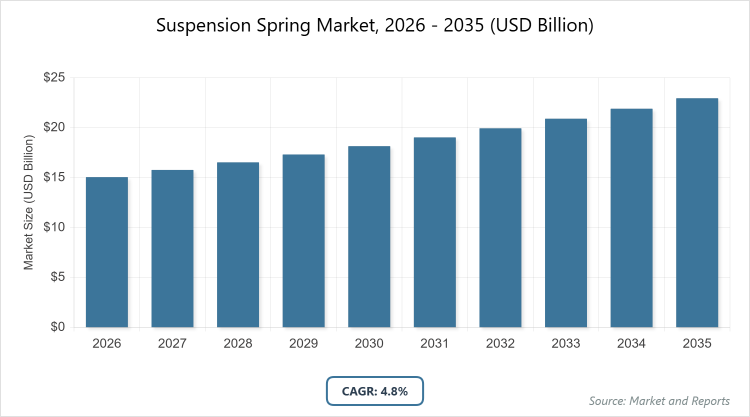
According to MarketnReports, the global suspension spring market size was estimated at USD 15.05 billion in 2026 and is expected to reach USD 24.0 billion by 2035, growing at a CAGR of 4.8% from 2026 to 2035. Suspension Spring Market is driven by increasing global automotive production volumes and rising consumer demands for enhanced ride quality and comfort, coupled with the necessity for specialized, lightweight, yet robust springs designed to support the heavier weight of growing electric vehicle fleets.
What are the Key Insights into the Suspension Spring Market?
- Global suspension spring market valued at approximately USD 15.05 billion in 2026, projected to reach USD 24.0 billion by 2035.
- Expected CAGR of around 4.8% from 2026 to 2035, driven by automotive growth and EV adoption.
- Dominant subsegment by type: Coil Springs, accounting for the largest share due to versatility in passenger vehicles.
- Dominant subsegment by application: Passenger Vehicles, holding over 45% market share for comfort-focused designs.
- Dominant subsegment by distribution channel: OEM, contributing around 60% revenue for integrated systems.
- Dominant region: Asia-Pacific, contributing over 38% of global revenue with China as the leading country.
What is the Suspension Spring Industry Overview?
Industry Overview
Suspension springs are critical components in vehicle and machinery suspension systems, designed to absorb shocks, maintain tire contact with the road, and provide stability by compressing and expanding to manage load and vibrations, typically made from materials like steel or composites in forms such as coil, leaf, or air springs. These springs are essential in automotive, industrial, and transportation sectors for enhancing ride comfort, handling, and durability, with applications spanning passenger cars, commercial vehicles, railways, and heavy machinery where they integrate with shock absorbers and struts for optimal performance.
The market involves raw material suppliers for high-tensile alloys, manufacturers employing coiling, heat treatment, and coating processes to meet strength and corrosion resistance standards, and distributors catering to OEMs and aftermarket needs. Suspension springs are categorized by type, material, and functionality, emphasizing lightweight designs for fuel efficiency and adaptability to electric vehicles’ torque requirements. This industry is driven by automotive production growth, infrastructure development, and innovations in smart suspensions, balancing traditional mechanical reliability with advanced sensor integrations for active control, amid regulatory pushes for safety and emissions in a globally competitive environment focused on sustainability and customization.
What are the Market Dynamics in the Suspension Spring Sector?
Growth Drivers
The suspension spring market is propelled by the booming automotive industry, particularly the rise in electric and hybrid vehicles requiring advanced lightweight springs for better energy efficiency and handling, supported by global electrification trends and government incentives for green mobility. Increasing demand for enhanced ride comfort in passenger and commercial vehicles drives adoption of innovative designs like air and composite springs, aligning with consumer preferences for premium features amid urbanization.
Infrastructure developments in emerging economies boost usage in heavy machinery and railways, while technological advancements in materials like high-strength alloys reduce weight and improve durability, attracting investments from OEMs. Rising aftermarket sales for vehicle upgrades and maintenance further fuel growth, as aging fleets in developed regions necessitate replacements.
Restraints
High manufacturing costs for advanced materials like composites and air springs, coupled with volatility in steel prices, limit adoption in budget-sensitive segments where traditional leaf springs suffice, exacerbated by supply chain disruptions from geopolitical tensions. Stringent environmental regulations on emissions and waste in production processes increase compliance expenses, particularly in Europe where alternatives like passive systems gain traction. Technical challenges in integrating smart features with existing vehicles hinder penetration, while economic slowdowns reduce vehicle production. Competition from alternative suspension technologies like active systems in luxury segments restrains expansion in entry-level markets.
Opportunities
Opportunities emerge from the EV transition, with demand for specialized springs optimized for battery weight and torque, supported by R&D grants for lightweight innovations in emerging markets. Expansion into industrial applications like construction equipment amid global infrastructure booms offers growth, while partnerships for customizable aftermarket solutions tap aging vehicle fleets. Adoption of sustainable practices using recycled materials aligns with green regulations, opening premium niches. Digital twins and 3D printing for rapid prototyping enable faster market entry, fostering collaborations with OEMs for next-gen vehicles.
Challenges
Achieving weight reduction without compromising strength poses technical challenges, requiring continuous R&D amid material shortages. Navigating diverse regulatory standards across regions increases administrative burdens, while counterfeit products erode trust in quality. Supply dependencies on steel imports expose vulnerabilities to trade policies, and talent shortages for advanced manufacturing demand training investments. Balancing performance with cost in competitive bids remains a hurdle amid fluctuating demand from automotive cycles.
Suspension Spring Market: Report Scope
| Report Attributes | Report Details |
| Report Name | Suspension Spring Market |
| Market Size 2026 | USD 15.05 billion |
| Market Forecast 2035 | USD 24.0 billion |
| Growth Rate | CAGR of 4.8% |
| Report Pages | 240 |
| Key Companies Covered | NHK Spring Co. Ltd., Mubea Group, Rassini, Sogefi S.p.A., MW Industries Inc., Tenneco Inc., and Hendrickson International Corporation |
| Segments Covered | By Type, Application, Distribution Channel, and Region |
| Regions Covered | North America, Europe, Asia Pacific (APAC), Latin America, The Middle East and Africa (MEA) |
| Base Year | 2025 |
| Historical Year | 2020 – 2024 |
| Forecast Year | 2026 – 2035 |
| Customization Scope | Avail customized purchase options to meet your exact research needs. |
How is the Suspension Spring Market Segmented?
The Suspension Spring Market is segmented by type, inner liner, application, distribution channel, and region.
By Type, The Coil Springs segment dominates the suspension spring market, primarily because of their compact design, superior ride comfort, and widespread use in passenger vehicles where they provide better handling and weight distribution, supported by automotive OEM preferences for cost-effective, lightweight options in modern chassis. This dominance drives the market by enabling high-volume production for global auto manufacturers, reducing vehicle weight for fuel efficiency, and integrating with advanced systems like adaptive suspensions, thereby expanding adoption in EVs and hybrids.
The Leaf Springs segment ranks second, favored for their durability and load-bearing capacity in commercial vehicles and trucks where simplicity and strength are essential, helping to propel market growth by catering to heavy-duty sectors, supporting infrastructure projects, and offering economical solutions in emerging economies.
By Application, Passenger Vehicles lead the application segment, as suspension springs enhance comfort and stability in cars and SUVs, driven by rising consumer demand for smooth rides amid urbanization. This subsegment drives the market by aligning with automotive sales growth, promoting innovations in lightweight designs for EVs, and complying with safety norms, thus increasing demand worldwide. Commercial Vehicles follow as the second dominant, essential for load management in trucks and buses where springs ensure durability under heavy use, contributing to market expansion through logistics expansions, improving fleet efficiency, and tapping into e-commerce transport needs.
By Distribution Channel, OEM dominates the distribution channel segment, as manufacturers integrate customized springs directly into vehicle assembly for optimal performance, supported by long-term contracts with auto makers. This leadership accelerates market growth by syncing with production volumes, fostering R&D collaborations for advanced materials, and ensuring quality standards in new vehicles. Aftermarket ranks second, providing replacements and upgrades for existing fleets, helping to drive the market through consumer maintenance trends, enabling part availability via e-commerce, and supporting vehicle longevity in mature markets.
What are the Recent Developments in the Suspension Spring Market?
- In August 2023, ZF Friedrichshafen AG acquired TRW Automotive to expand its suspension spring offerings, focusing on lightweight solutions for EVs, enhancing its global portfolio and market share in Asia-Pacific.
- In June 2023, KYB Corporation invested USD 100 million in expanding production capacity for air suspension springs, targeting the growing commercial vehicle segment and improving supply for North American OEMs.
- In September 2023, Tenneco Inc. developed new lightweight suspension springs using aluminum and carbon fiber, aimed at reducing emissions and fuel consumption, boosting adoption in European luxury vehicles.
- In 2024, NHK Spring Co. Ltd. partnered with a Chinese EV manufacturer to supply coil springs for electric models, incorporating smart sensors for adaptive performance, strengthening its presence in Asia.
What is the Regional Analysis of the Suspension Spring Market?
- Asia-Pacific to dominate the market
Asia-Pacific dominates the suspension spring market, driven by rapid automotive production, infrastructure investments, and EV adoption, with China as the dominating country due to its massive vehicle manufacturing base, government policies like Made in China 2025 promoting local components, and leadership in exports through companies like Zhejiang Shuanghuan Driveline Co. Ltd. The region’s growth is supported by India’s two-wheeler boom and Japan’s advanced tech; South Korea’s electronics integrations contribute, but China’s dominance stems from its vast domestic demand, low-cost labor, and supply chain efficiencies, boosting revenue through high-volume applications in passenger and commercial vehicles amid urbanization.
North America holds a substantial share, characterized by premium vehicle demand and regulatory focus on safety, with the United States as the dominating country owing to its truck and SUV market, NHTSA standards, and major players like Hendrickson investing in air suspensions for heavy-duty segments. The region benefits from Canada’s mining equipment; the U.S. leads with innovations in lightweight materials for fuel efficiency, driving market expansion via aftermarket upgrades and EV integrations.
Europe exhibits steady growth, focused on sustainability and high-performance vehicles, with Germany as the dominating country due to its automotive heritage, EU emission regulations, and firms like Thyssenkrupp AG developing composite springs for luxury cars. The region is propelled by the UK’s commercial fleets and France’s rail applications; Germany’s leadership arises from exports and green tech, fostering market development by addressing climate goals.
The Rest of the World shows emerging potential, with Brazil dominating in Latin America through truck manufacturing, while UAE leads in the Middle East with luxury vehicle imports. Growth is spurred by Africa’s infrastructure; the region’s progress relies on foreign investments, increasing share in heavy-duty sectors.
Who are the Key Market Players and Their Strategies in the Suspension Spring Industry?
NHK Spring Co. Ltd.: Focuses on lightweight innovations, expanding through EV partnerships and R&D for adaptive systems.
Mubea Group: Emphasizes sustainable materials, investing in carbon fiber springs and European expansions for premium vehicles.
Rassini: Prioritizes heavy-duty applications, pursuing acquisitions for North American dominance in commercial segments.
Sogefi S.p.A.: Concentrates on air suspensions, leveraging OEM contracts for fuel-efficient designs.
MW Industries Inc.: Adopts customization strategies, targeting aftermarket with diverse material options.
Tenneco Inc.: Utilizes advanced alloys, focusing on emissions reduction through global collaborations.
Hendrickson International Corporation: Employs truck-focused innovations, investing in air systems for logistics.
What are the Current Market Trends in the Suspension Spring Sector?
- Adoption of lightweight materials like composites for EV efficiency and reduced emissions.
- Integration of smart sensors for real-time adjustments in adaptive suspensions.
- Growth in air springs for adjustable comfort in commercial and luxury vehicles.
- Emphasis on sustainable manufacturing with recycled steels and eco-friendly processes.
- Rise in aftermarket demand for upgrades in aging fleets.
- Expansion in EV-specific designs to handle battery weight and torque.
What Market Segments are Covered in the Report?
By Type
-
- Coil Springs
- Leaf Springs
- Air Springs
- Others
By Application
-
- Passenger Vehicles
- Commercial Vehicles
- Others
By Distribution Channel
-
- OEM
- Aftermarket
By Region
-
- North America
- U.S.
- Canada
- Europe
- UK
- Germany
- France
- Rest of Europe
- Asia Pacific
- China
- India
- Japan
- Rest of Asia Pacific
- Latin America
- Brazil
- Mexico
- Rest of Latin America
- Middle East & Africa
- UAE
- South Africa
- Rest of Middle East & Africa
- North America
Frequently Asked Questions
Suspension springs are mechanical components that absorb shocks and maintain vehicle stability by compressing under load, essential in automotive and industrial systems for ride comfort and handling.
Key factors include EV adoption, lightweight material innovations, infrastructure developments, and sustainability regulations.
The suspension spring market is projected to grow from approximately USD 15.05 billion in 2026 to USD 24.0 billion by 2035.
The CAGR for the suspension spring market during 2026-2035 is expected to be around 4.8%, driven by automotive demands.
Asia-Pacific will contribute notably, accounting for over 38% of the market value, led by manufacturing in China.
Major players include NHK Spring Co. Ltd., Mubea Group, Rassini, Sogefi S.p.A., MW Industries Inc., Tenneco Inc., and Hendrickson International Corporation, through innovations.
The global suspension spring market report provides insights into size, segmentation, dynamics, regional analysis, players, trends, and forecasts.
The value chain includes raw material sourcing, manufacturing coiling/forming, heat treatment, coating, assembly, and distribution to OEMs/aftermarket.
Market trends are evolving toward lightweight and smart suspensions, with preferences shifting to durable, eco-friendly components for EVs and comfort.
Regulatory factors include emission standards for vehicles, while environmental factors involve sustainable material mandates, driving innovations but increasing costs.