
Subscription and Billing Management Market Size, Share and Trends 2026 to 2035
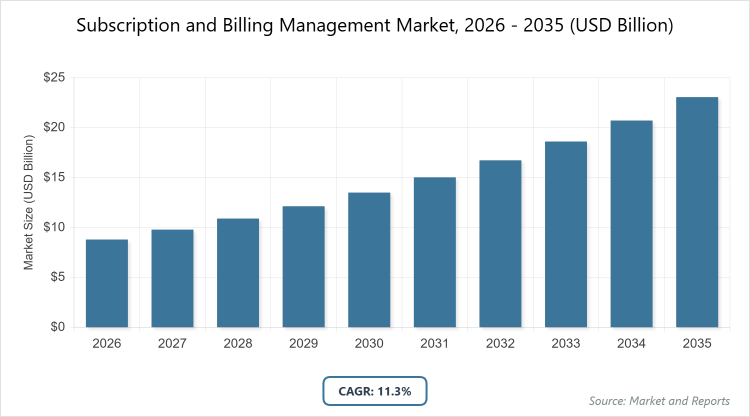
According to MarketnReports, the global Subscription and Billing Management market size was estimated at USD 8.8 billion in 2025 and is expected to reach USD 25.7 billion by 2035, growing at a CAGR of 11.3% from 2026 to 2035. Subscription and Billing Management Market is driven by the increasing adoption of subscription-based business models across various industries.
What are the Key Insights into the Subscription and Billing Management Market?
- The global Subscription and Billing Management market was valued at USD 8.8 billion in 2025 and is projected to reach USD 25.7 billion by 2035.
- The market is anticipated to grow at a CAGR of 11.3% from 2026 to 2035.
- The market is driven by the increasing adoption of subscription-based business models across various industries.
- In the component segment, software dominates with a 65% share due to its essential role in automating recurring billing, invoicing, and subscription management processes.
- In the deployment type segment, cloud-based solutions hold the largest share of 40% because of their flexibility, scalability, and cost-effectiveness in supporting remote operations.
- In the enterprise size segment, large enterprises dominate as they require robust systems for handling complex billing strategies and high transaction volumes.
- In the industry vertical segment, IT leads due to the high prevalence of SaaS and cloud-based services necessitating advanced billing solutions.
- North America dominates the market with over 30.9% share, attributed to the presence of major technology companies, early adoption of subscription models, and significant investments in cloud infrastructure.
What is the Industry Overview of the Subscription and Billing Management Market?
The subscription and billing management market refers to the ecosystem of software solutions and services designed to handle recurring revenue models, automating processes such as invoicing, payment collection, subscription lifecycle management, and customer relationship tracking. This market caters to businesses transitioning from traditional one-time sales to ongoing subscription services, enabling them to manage customer subscriptions efficiently, reduce churn, and optimize revenue streams through data-driven insights. It encompasses tools that integrate with various payment gateways, CRM systems, and analytics platforms to provide seamless experiences across industries like software, media, and e-commerce, ultimately fostering customer loyalty and operational efficiency.
What are the Market Dynamics in the Subscription and Billing Management Market?
Growth Drivers
The growth of the subscription and billing management market is propelled by the widespread shift toward subscription-based business models in sectors such as software-as-a-service (SaaS), streaming media, and e-commerce, which demand automated and scalable billing systems to handle recurring payments and personalized customer experiences. Additionally, the integration of advanced technologies like artificial intelligence (AI) and machine learning for predictive analytics, fraud detection, and dynamic pricing further accelerates market expansion by enhancing operational efficiency and reducing revenue leakage. The rise in digital transformation initiatives, coupled with increasing consumer preferences for flexible payment options and seamless transactions, also contributes significantly to the demand for sophisticated billing solutions that ensure compliance with global regulations and support multi-currency operations.
Restraints
Despite its growth potential, the subscription and billing management market faces restraints from the complexity of integrating these systems with legacy infrastructure, which can lead to high implementation costs and extended deployment times for organizations. Data privacy concerns and the need to comply with stringent regulations such as GDPR and varying tax laws across regions pose additional challenges, potentially deterring smaller enterprises from adopting advanced solutions due to the risk of non-compliance penalties. Moreover, the market is hindered by the lack of standardization in billing practices, which can result in errors, disputes, and customer dissatisfaction if not managed properly.
Opportunities
Opportunities in the subscription and billing management market abound with the expansion of emerging markets in Asia-Pacific and Latin America, where rising internet penetration and smartphone adoption are fueling the growth of digital services like OTT platforms and online gaming, creating demand for localized billing solutions. The advent of blockchain technology for secure and transparent transactions, along with the increasing focus on sustainability through paperless billing, opens new avenues for innovation and market penetration. Furthermore, partnerships between billing providers and fintech companies can enable enhanced payment ecosystems, particularly in underserved regions, driving broader adoption and revenue diversification.
Challenges
Challenges in the subscription and billing management market include managing high volumes of transactions in real-time while ensuring accuracy and security, especially for large enterprises with diverse customer bases and multiple subscription tiers. Evolving regulatory landscapes, such as changes in tax policies and data protection laws, require continuous updates to billing systems, which can strain resources and increase operational complexity. Additionally, competition from open-source alternatives and the need to address customer churn through personalized experiences present ongoing hurdles that demand agile and innovative responses from market players.
Subscription and Billing Management Market: Report Scope
| Report Attributes | Report Details |
| Report Name | Subscription and Billing Management Market |
| Market Size 2025 | USD 8.8 Billion |
| Market Forecast 2035 | USD 25.7 Billion |
| Growth Rate | CAGR of 11.3% |
| Report Pages | 226 |
| Key Companies Covered | SAP SE, Salesforce Inc., Oracle Corporation, Chargebee, Zuora, Aria Systems Inc., Recurly, Zoho Corporation, and Others |
| Segments Covered | By Component, By Deployment Type, By Enterprise Size, By Industry Vertical, and By Region |
| Regions Covered | North America, Europe, Asia Pacific (APAC), Latin America, and The Middle East and Africa (MEA) |
| Base Year | 2025 |
| Historical Year | 2020 – 2024 |
| Forecast Year | 2026 – 2035 |
| Customization Scope | Avail customized purchase options to meet your exact research needs. |
What is the Market Segmentation in the Subscription and Billing Management Market?
The Subscription and Billing Management market is segmented by component, deployment type, enterprise size, industry vertical, and region.
Based on the component segment, software emerges as the most dominant subsegment, followed by services as the second most dominant. Software dominates because it provides the core platforms for automating billing processes, offering features like real-time analytics, integration with payment systems, and scalability, which directly drive market growth by enabling businesses to streamline operations and reduce manual errors; services, while secondary, support implementation and maintenance, helping to customize solutions and ensure long-term efficiency, thus contributing to overall market expansion through enhanced adoption rates.
Based on the deployment type segment, cloud-based solutions are the most dominant, with on-premises as the second most dominant. Cloud-based deployment leads due to its flexibility, lower upfront costs, and ability to support remote access and rapid scalability, which drives the market by facilitating digital transformation and accommodating the growing trend of hybrid work environments; on-premises, though less prevalent, appeals to organizations requiring high data control and customization, aiding market growth by addressing security concerns in regulated industries.
Based on the enterprise size segment, large enterprises hold the dominant position, followed by small and medium-sized enterprises (SMEs). Large enterprises dominate as they manage complex billing needs for vast customer bases and multiple revenue streams, driving the market through investments in advanced systems that optimize revenue and compliance; SMEs, as the second dominant, benefit from affordable cloud solutions that level the playing field, contributing to market growth by expanding access to subscription models in smaller operations.
Based on the industry vertical segment, IT is the most dominant, with media and entertainment as the second most dominant. The IT sector leads owing to the proliferation of SaaS and cloud services that rely on recurring billing for sustained revenue, propelling market growth through innovations in software delivery and customer retention strategies; media and entertainment follows, driven by the surge in OTT platforms and content subscriptions, which boosts the market by necessitating efficient management of user subscriptions and personalized content delivery.
What are the Recent Developments in the Subscription and Billing Management Market?
- In June 2024, Aria Systems unveiled Aria Billing Studio for ServiceNow, a solution that enhances billing capabilities with real-time features, allowing businesses to streamline operations and improve customer satisfaction through integrated workflows.
- In April 2024, Recurly announced plans for new dashboards equipped with benchmarks, enabling merchants to gain competitive insights and optimize their subscription strategies based on industry data.
- In March 2024, Younium secured €2.76 million in funding to expand its B2B subscription management solutions across Europe and North America, focusing on scaling operations and enhancing platform features.
- In May 2024, Vodafone Idea launched prepaid plans bundled with Netflix subscriptions, targeting increased user engagement in the streaming market through integrated billing for entertainment services.
- In June 2024, Vodafone Idea and Airtel introduced streaming bundles including Netflix and Disney+ Hotstar, aiming to capitalize on the growing demand for OTT content with seamless subscription management.
What is the Regional Analysis of the Subscription and Billing Management Market?
- North America to dominate the global market.
North America leads the subscription and billing management market, driven by a robust ecosystem of technology innovators and early adopters of subscription models, with significant investments in cloud infrastructure enhancing scalability and efficiency. The region’s dominance is bolstered by high consumer spending on digital services, stringent regulatory frameworks that necessitate compliant billing systems, and the presence of key players fostering innovation. The dominating country, United States, contributes substantially through its massive e-commerce sector and widespread SaaS adoption, where companies leverage advanced analytics for personalized billing, further propelling regional growth.
Asia-Pacific is experiencing rapid expansion in the subscription and billing management market, fueled by surging internet penetration, smartphone proliferation, and digital transformation across emerging economies. This region benefits from increasing e-commerce activities, subscription-based gaming, and OTT services, which demand efficient billing solutions to handle diverse payment methods and currencies. The dominating country, India, stands out with its high mobile data consumption and government initiatives promoting digital payments, enabling providers to tap into a vast consumer base and drive market growth through localized and affordable subscription models.
Europe maintains a strong position in the subscription and billing management market, emphasizing compliance with regulations like GDPR and VAT, which require precise and secure billing systems. The region’s focus on sustainability and automation in industries such as SaaS and media supports steady growth, with integrations of AI for enhanced customer experiences. The dominating country, Germany, excels due to its industrial strength and adoption of cloud solutions in manufacturing and services, contributing to market advancement by prioritizing data privacy and efficient revenue management.
Latin America is emerging as a promising market for subscription and billing management, driven by expanding mobile connectivity and the rise of digital services in e-commerce and streaming. Challenges like economic variability are offset by opportunities in fintech integrations and subscription bundles, promoting financial inclusion. The dominating country, Brazil, leads with its large population and increasing mobile subscriptions, where providers focus on automated platforms to manage high transaction volumes and support the growing demand for online entertainment and utilities.
Middle East and Africa shows potential in the subscription and billing management market, supported by digital adoption in telecommunications and e-commerce amid improving infrastructure. The region addresses challenges in payment diversity through localized solutions, with a focus on mobile-first strategies. The dominating country, Saudi Arabia, drives progress through its Vision 2030 initiatives, emphasizing digital transformation and high mobile penetration, which facilitates the implementation of subscription models in sectors like retail and media.
Who are the Key Market Players in the Subscription and Billing Management Market?
SAP SE employs strategies focused on cloud-based platforms and integrations with enterprise resource planning systems, enabling seamless billing automation and compliance management, which strengthens its market position by catering to large enterprises seeking scalable solutions.
Salesforce Inc. leverages its CRM expertise to offer comprehensive subscription management tools, emphasizing AI-driven personalization and analytics to reduce churn and enhance customer loyalty, driving growth through strategic partnerships and continuous innovation.
Oracle Corporation adopts a multi-cloud approach with advanced billing software that supports complex revenue models, focusing on data security and regulatory compliance to appeal to global industries, thereby expanding its footprint via acquisitions and technology enhancements.
Chargebee specializes in subscription billing automation with features for dynamic pricing and multi-currency support, targeting SaaS companies to streamline operations and boost revenue, utilizing agile development and customer-centric updates for competitive advantage.
Zuora provides end-to-end subscription management platforms, concentrating on monetization strategies and predictive insights to help businesses adapt to evolving models, reinforced by collaborations and a focus on emerging markets for sustained expansion.
Aria Systems Inc. offers flexible billing solutions integrated with ServiceNow and other ecosystems, prioritizing real-time processing and customization to meet enterprise needs, advancing through product launches and emphasis on operational efficiency.
Recurly develops merchant-focused dashboards and benchmarks for subscription optimization, aiming at e-commerce and digital services to provide actionable insights, supported by funding and feature expansions to capture market share.
Zoho Corporation delivers cost-effective, integrated billing tools within its suite of business applications, targeting SMEs with user-friendly interfaces and automation, promoting growth via accessibility and continuous platform improvements.
What are the Market Trends in the Subscription and Billing Management Market?
- Increasing integration of AI and machine learning for predictive billing analytics and fraud detection.
- Shift toward cloud-based deployments for enhanced scalability and remote accessibility.
- Growing emphasis on personalized subscription experiences to reduce customer churn.
- Expansion of subscription models in media and entertainment through OTT platforms and bundles.
- Adoption of blockchain for secure and transparent transaction management.
- Focus on regulatory compliance and data privacy in billing processes.
- Rise in multi-currency and localized payment options for global markets.
- Incorporation of sustainability features like paperless invoicing.
- Partnerships between billing providers and fintech for innovative payment ecosystems.
- Emphasis on data-driven insights for revenue optimization and customer retention.
What Market Segments and Their Subsegments are Covered in the Subscription and Billing Management Report?
By Component
- Software
- Services
By Deployment Type
- Cloud
- On-Premises
By Enterprise Size
- Large Enterprises
- Small and Medium-sized Enterprises
By Industry Vertical
- IT
- Media and Entertainment
- BFSI
- Retail
- Healthcare
- Others
By Region
- North America
- U.S.
- Canada
- Europe
- UK
- Germany
- France
- Rest of Europe
- Asia Pacific
- China
- India
- Japan
- Rest of Asia Pacific
- Latin America
- Brazil
- Mexico
- Rest of Latin America
- Middle East & Africa
- UAE
- South Africa
- Rest of Middle East & Africa
Frequently Asked Questions
Subscription and billing management involves software and services that automate the processes of managing recurring subscriptions, invoicing, payments, and customer relationships for businesses operating on subscription-based revenue models.
Key factors include the adoption of subscription models, digital transformation, AI integration, regulatory compliance needs, and expansion in emerging markets.
The market is projected to grow from an estimated value post-2025 to USD 25.7 billion by 2035.
The CAGR is expected to be 11.3%.
North America will contribute notably, holding the largest share due to technological advancements and key players.
Major players include SAP SE, Salesforce Inc., Oracle Corporation, Chargebee, Zuora, Aria Systems Inc., Recurly, and Zoho Corporation.
The report provides in-depth analysis of market size, trends, segments, regional insights, key players, and forecasts.
Stages include software development, service provision, deployment integration, end-user adoption, and ongoing analytics and optimization.
Trends are shifting toward AI-driven personalization, cloud solutions, and sustainable practices, with consumers preferring seamless, flexible payment options.
Regulatory factors like GDPR, tax laws, and data privacy standards, along with environmental pushes for paperless billing, influence growth by necessitating compliant and eco-friendly solutions.