
Steam Turbine MRO Market Size, Share and Trends 2026 to 2035
According to MarketnReports, the global Steam Turbine MRO market size was estimated at USD 22.9 billion in 2025 and is expected to reach USD 38.83 billion by 2035, growing at a CAGR of 5.4% from 2026 to 2035. Increasing global electricity demand and aging turbine infrastructure.
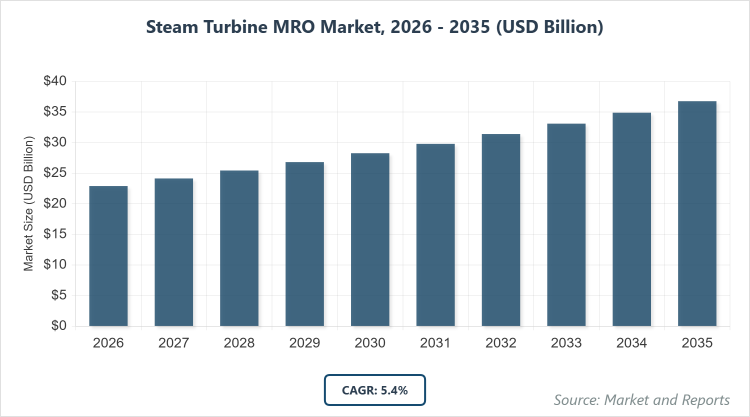
What are the Key Insights into Steam Turbine MRO Market?
- The global Steam Turbine MRO market was valued at USD 22.9 billion in 2025 and is projected to reach USD 38.83 billion by 2035.
- The market is expected to grow at a CAGR of 5.4% during the forecast period from 2026 to 2035.
- The market is driven by rising electricity demand, aging infrastructure, and advancements in predictive maintenance technologies.
- The maintenance subsegment dominates the service type segment with a 53.9% share due to its focus on preventive measures that reduce unplanned outages and extend turbine life; the coal subsegment leads the plant fuel segment with a 60.1% share owing to the extensive installed base of coal-fired plants requiring frequent servicing; the 300-600 MW subsegment holds a 50.5% share in the capacity segment as it represents the most common size for utility-scale turbines balancing efficiency and cost; the power generation subsegment commands a 67.3% share in the end-user segment because of its heavy reliance on steam turbines for baseload power.
- Asia-Pacific dominates with a 49.6% share due to rapid industrialization, high energy demand, and large-scale thermal power installations in countries like China and India.
What is the Steam Turbine MRO Market?
Industry Overview
The Steam Turbine MRO market encompasses the maintenance, repair, and overhaul services essential for ensuring the operational efficiency, reliability, and longevity of steam turbines used in power generation and industrial applications. Market definition includes all activities related to servicing steam turbines, such as routine inspections, component replacements, performance upgrades, and major overhauls, aimed at minimizing downtime and optimizing energy output in sectors reliant on thermal power. This market plays a critical role in supporting global energy infrastructure by addressing wear and tear from continuous operation, enabling turbines to meet stringent performance and environmental standards without the need for full replacements.
What are the Market Dynamics in Steam Turbine MRO?
Growth Drivers
Rising global electricity demand, particularly in emerging economies, is a primary growth driver for the Steam Turbine MRO market, as it necessitates the continuous operation and upkeep of existing power generation assets to avoid disruptions in supply. Aging turbine fleets worldwide, many installed decades ago, require regular maintenance and upgrades to maintain efficiency and comply with modern emission standards, further propelling market expansion. Technological advancements, such as digital monitoring and predictive analytics, enable more efficient MRO practices, reducing costs and downtime while enhancing turbine performance.
Restraints
High costs associated with MRO services, including specialized labor and parts, act as a significant restraint, particularly for smaller operators or in regions with budget constraints, limiting market accessibility. The accelerated retirement of coal-fired plants in developed regions due to environmental regulations shifts focus away from traditional steam turbines, constraining growth in those areas. Additionally, the increasing shift toward renewable energy sources reduces the long-term demand for steam turbine-based power, impacting the overall MRO market potential.
Opportunities
The integration of digital technologies like IoT, AI, and data analytics presents opportunities for innovative MRO solutions, allowing for condition-based maintenance that optimizes operations and extends asset life. Retrofitting and upgrading existing turbines for better efficiency and lower emissions open new avenues in markets transitioning to cleaner energy. Expanding industrial applications in oil & gas and manufacturing sectors, especially in developing regions, create additional demand for specialized MRO services.
Challenges
The transition to renewable energy poses a challenge by diminishing the role of steam turbines in new installations, potentially leading to a shrinking installed base over time. Skilled labor shortages in specialized turbine maintenance hinder timely service delivery and increase operational risks. Stringent regulatory and environmental standards require continuous adaptation, adding complexity and costs to MRO processes.
Steam Turbine MRO Market: Report Scope
| Report Attributes | Report Details |
| Report Name | Steam Turbine MRO Market |
| Market Size 2025 | USD 22.9 Billion |
| Market Forecast 2035 | USD 38.83 Billion |
| Growth Rate | CAGR of 5.4% |
| Report Pages | 220 |
| Key Companies Covered |
GE Vernova, Siemens Energy, Mitsubishi Power, Shanghai Electric, Dongfang Electric, Harbin Electric, Bharat Heavy Electricals Limited, Toshiba Energy Systems & Solutions Corporation, Sulzer Ltd, Elliott Group, and Others |
| Segments Covered | By Service Type, By Plant Fuel, By Capacity, By End-User, and By Region |
| Regions Covered | North America, Europe, Asia Pacific (APAC), Latin America, and The Middle East and Africa (MEA) |
| Base Year | 2025 |
| Historical Year | 2020 – 2024 |
| Forecast Year | 2026 – 2035 |
| Customization Scope | Avail customized purchase options to meet your exact research needs. |
How is the Market Segmentation of Steam Turbine MRO?
The Steam Turbine MRO market is segmented by service type, plant fuel, capacity, end-user, and region.
Based on Service Type Segment, the maintenance subsegment is the most dominant with a 53.9% share, driven by its preventive nature that minimizes costly breakdowns and ensures consistent turbine performance, thereby supporting overall market growth through reduced operational risks; the repair subsegment is the second most dominant, addressing immediate failures and contributing to market expansion by enabling quick restorations that sustain power output.
Based on Plant Fuel Segment, the coal subsegment is the most dominant with a 60.1% share, owing to the vast global fleet of coal-fired plants that demand frequent MRO to handle high-temperature operations and ash-related wear, driving market growth via sustained servicing needs; the natural gas subsegment is the second most dominant, benefiting from the efficiency of combined-cycle plants that require specialized maintenance to optimize fuel usage and reduce emissions.
Based on Capacity Segment, the 300 to 600 MW subsegment is the most dominant with a 50.5% share, as it encompasses the majority of utility-scale turbines where economies of scale make MRO investments highly effective in boosting efficiency and longevity, propelling market growth; the above 600 MW subsegment is the second most dominant, focusing on large supercritical units that drive demand for advanced overhauls to handle higher pressures and temperatures.
Based on End-User Segment, the power generation subsegment is the most dominant with a 67.3% share, due to its critical reliance on steam turbines for baseload electricity, where reliable MRO ensures grid stability and cost-effective operations, fueling market advancement; the oil and gas subsegment is the second most dominant, utilizing turbines in processing and refining, where MRO enhances safety and productivity.
What are the Recent Developments inthe Steam Turbine MRO Market?
- In January 2026, Bechtel and Westinghouse Electric Company selected Arabelle Solutions to supply three half-speed Arabelle steam turbines and generator sets for Poland’s first nuclear power project, enhancing turbine efficiency and supporting the country’s energy transition.
- In December 2025, Rotating Machinery Services, Inc. acquired the steam turbine and centrifugal compressor business from EthosEnergy, rooted in the TurboCare brand, to expand its service capabilities and strengthen its market position in turbine MRO.
- In January 2025, Mitsubishi Heavy Industries Compressor International Corporation (MCO-I) introduced Phased Array Ultrasonic Testing (PAUT) for steam turbine maintenance, revolutionizing inspection accuracy and reducing downtime.
- In January 2024, Mechanical Dynamics and Analysis (MD&A) completed new bucket and cover installations on a steam turbine in Saudi Arabia, along with diaphragm repairs, improving operational reliability in the region.
How is the Regional Analysis of the Steam Turbine MRO Market?
- Asia-Pacific to dominate the global market.
Asia-Pacific leads the Steam Turbine MRO market with a 49.6% share, driven by rapid industrialization and massive energy infrastructure investments in dominating countries like China and India, where extensive coal and gas-fired plants require ongoing maintenance to meet surging electricity demands.
North America holds a significant position with a 22% share, supported by nuclear life-extension programs and combined-cycle gas turbine fleets in the United States, the dominant country, emphasizing predictive maintenance to enhance efficiency amid coal plant retirements.
Europe accounts for an 18% share, propelled by nuclear upgrades in France, the leading country, and combined-cycle expansions in Germany to integrate renewables, focusing on sustainable MRO practices to comply with strict environmental regulations.
The Middle East and Africa represent a growing segment with a projected 6.2% CAGR, led by large-scale projects in Saudi Arabia and the UAE, dominant countries, where MRO services support new combined-cycle plants and oil & gas operations for energy diversification.
South America holds a 6% share, with Brazil as the key country driving growth through hydro-thermal hybrid upgrades and cogeneration in Argentina, addressing regional energy needs with cost-effective turbine overhauls.
Who are the Key Market Players in Steam Turbine MRO?
- GE Vernova focuses on integrating advanced digital solutions like predictive analytics and long-term service agreements to enhance turbine efficiency and reduce downtime, strengthening its position through technological innovation and global service networks.
- Siemens Energy emphasizes sustainable upgrades and modular overhaul strategies, partnering with regional providers to expand its aftermarket presence and offer customized MRO solutions for diverse plant fuels.
- Mitsubishi Power invests in advanced inspection technologies such as PAUT and life-extension programs, targeting high-growth regions like Asia-Pacific with comprehensive maintenance contracts to optimize performance.
- Shanghai Electric leverages cost advantages and preferential procurement in China, dominating the domestic market with integrated MRO services for coal and nuclear turbines, while expanding internationally through strategic alliances.
- Dongfang Electric specializes in large-scale overhauls for supercritical units, focusing on localization of parts and services to capture a significant share in Asia’s aging infrastructure.
- Harbin Electric prioritizes efficiency retrofits and digital monitoring, collaborating with OEMs to provide end-to-end MRO for utility-scale turbines in high-demand markets.
- Bharat Heavy Electricals Limited commands the Indian market with government-backed refurbishment projects, offering affordable maintenance and repair services tailored to coal-fired plants.
- Toshiba Energy Systems & Solutions Corporation adopts condition-based maintenance and AI-driven diagnostics to extend turbine life, targeting nuclear and industrial applications globally.
- Sulzer Ltd provides independent service solutions with a focus on rapid repairs and upgrades, differentiating through flexibility and expertise in multi-vendor environments.
- Elliott Group concentrates on centrifugal and steam turbine integrations, employing acquisition strategies to broaden its MRO portfolio and enhance service delivery in the oil & gas sectors.
What are the Market Trends in Steam Turbine MRO?
- Adoption of digital technologies such as IoT, AI, and data analytics for predictive and condition-based maintenance to minimize downtime and improve efficiency.
- Increasing focus on sustainability through green materials, retrofitting for lower emissions, and life-extension programs for existing turbines.
- Growth in robotic inspections and modular overhaul methods to enhance safety and reduce outage durations.
- Rising demand for remote diagnostics and digital twins to optimize MRO in remote or high-risk environments.
- Shift toward long-term service agreements (LTSAs) linking performance guarantees with advanced analytics.
What Market Segments and Subsegments are Covered in the Steam Turbine MRO Report?
By Service Type
- Maintenance
- Repair
- Overhaul
By Plant Fuel
- Coal
- Natural Gas
- Nuclear
- Biomass/Waste-to-Energy
By Capacity
- Below 300 MW
- 300 To 600 MW
- Above 600 MW
By End-User
- Power Generation
- Oil and Gas
- Industrial
By Region
-
- North America
- U.S.
- Canada
- Europe
- UK
- Germany
- France
- Rest of Europe
- Asia Pacific
- China
- India
- Japan
- Rest of Asia Pacific
- Latin America
- Brazil
- Mexico
- Rest of Latin America
- Middle East & Africa
- UAE
- South Africa
- Rest of Middle East & Africa
- North America
Frequently Asked Questions
Steam turbine MRO refers to maintenance, repair, and overhaul services for steam turbines, ensuring their efficiency, reliability, and extended operational life in power and industrial applications.
Key factors include rising electricity demand, aging infrastructure, technological advancements in predictive maintenance, and the need for efficiency upgrades amid environmental regulations.
The market is projected to grow from USD 24.07 billion in 2026 to USD 38.83 billion by 2035.
The CAGR is expected to be 5.4% from 2026 to 2035.
Asia-Pacific will contribute notably, holding around 49.6% of the market share due to high energy demand and infrastructure growth.
Major players include GE Vernova, Siemens Energy, Mitsubishi Power, Shanghai Electric, and Dongfang Electric.
The report provides comprehensive analysis including market size, trends, segmentation, regional insights, key players, and forecasts from 2026 to 2035.
Stages include assessment and planning, parts procurement, on-site maintenance/repair, overhaul execution, testing/commissioning, and performance monitoring.
Trends are shifting toward digital and sustainable solutions, with preferences for predictive maintenance, retrofits, and long-term service agreements to enhance efficiency and reduce costs.
Stringent emission standards and renewable energy policies drive demand for upgrades and life extensions, while coal plant retirements in some regions constrain traditional MRO growth.